The Mercedes-Benz EQC: Electric Intelligence

15.

May 2019

Oslo

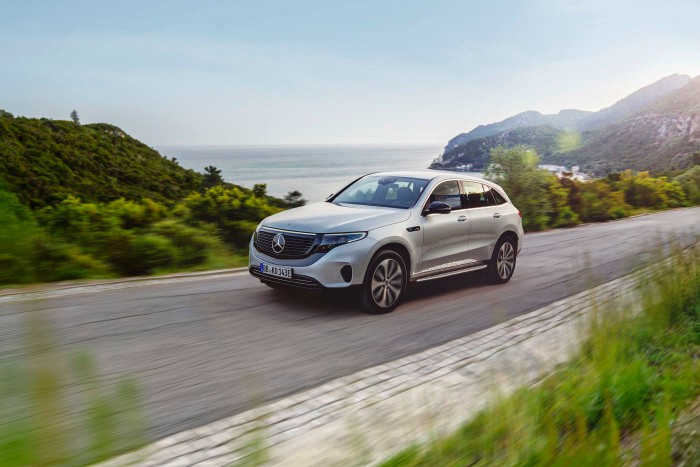
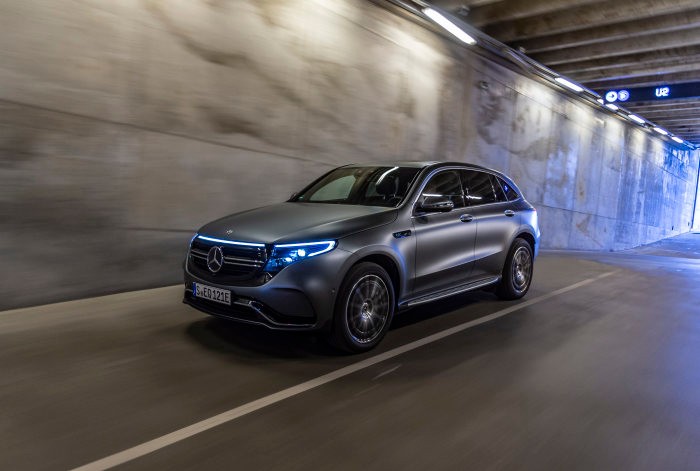
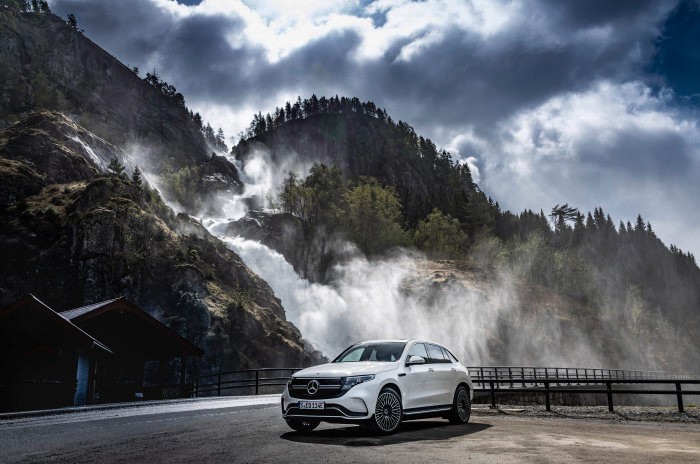
EQC (electricity consumption combined: 20.8 – 19.7 kWh/100 km; CO2 emissions combined: 0 g/km)* ; *Electric energy consumption and range have been determined on the basis of Regulation (EC) No. 692/2008. Electric energy consumption and range depend on the vehicle configuration.Oslo. The new Mercedes-Benz EQC (combined power consumption: 20.8 – 19.7 kWh/100 km; combined CO2 emissions: 0 g/km)[1] is the first Mercedes-Benz under the product and technology brand EQ. At the press driving presentation in Oslo, the European “capital of e-mobility”, the EQC is dynamically demonstrating its all-round qualities for the first time. It systematically embodies the principle of “human-centred innovation”, and makes e-mobility simple, reliable and convenient for the customer. The EQC combines the know-how from more than 130 years of automobile engineering with the mobility requirements of the future, and stands for Electric Intelligence.
“The Mercedes-Benz EQC is not just a vehicle with electric drive, it combines hallmark attributes of the brand such as quality, safety and comfort. Its progressive design, unique driving comfort and an operating range absolutely suitable for day-to-day needs emphasise that the EQC is the Mercedes among electric vehicles. This is also shown by its services – from optimised navigation to charging management. It all comes under the heading “Electric Intelligence” – a mobility package that goes well beyond the vehicle itself,” says Britta Seeger, member of the Board of Management of Daimler AG responsible for Mercedes-Benz Cars Sales.
Optimum planning before a journey
Individual services relating to e-mobility have been around for a while. The EQC takes a new, comprehensive approach: the intelligent networking of services and functions considerably simplifies use of the vehicle. With its intelligently coordinated drive system, battery management, charging management, recuperation strategies, digital services and the infotainment system MBUX, the EQC is a new departure in e-mobility.
The experience already begins before the journey. EQC drivers can plan their destinations from the home or office, enter a departure time and bring the interior to the desired temperature. They receive an intelligently planned route including necessary charging stops and an arrival time. On request they can receive a push notification when the charging process starts and ends. This creates transparency and helps drivers to plan upcoming journeys to best effect. Programming is possible directly via MBUX – Mercedes-Benz User Experience or via the Mercedes me App.
Intelligent navigation – more than just from A to B
The vehicle's electric intelligence is also shown in for the EQC optimised navigation. It uses numerous factors to plan a route automatically – including loading stops if necessary. It takes into account e.g. the current charge status of the battery, the weather, the topography and traffic flow, and available charging stations. The route calculation is always based on a fast and convenient route with few charging stops and short charging times – therefore quick-charging stations are given preference. Customers do not necessarily have to charge the vehicle fully, but can charge it to suit the total journey time. The route planning also responds dynamically to changes. It can take place both offboard and onboard, i.e. externally (via the Mercedes me App) and within the vehicle. The journey can therefore be conveniently planned at home before departure, or while already en route if required. The voice control specific to the Mercedes-Benz EQC makes operating the EQC easier – thanks to natural language recognition. It is activated by the key words “Hey Mercedes”. This is because the LINGUATRONIC of MBUX recognises and understands many questions and commands relating to electric car specific control aspects. A few examples: “Show me the energy flow”, “What charging settings have been made?”, “Charge the vehicle to 85 percent” or “Where is the nearest charging station?”.
Via Mercedes me Charge the customer receives access to the world's largest charging net with over 300,000 charging points and over different operators of public charging stations in Europe alone (municipalities, carparks, motorways, shopping centres, etc.). Thanks to EQC-optimised navigation, Mercedes-Benz customers can find these stations easily and can gain convenient access to the charging stations via the Mercedes me Charge card, the Mercedes me App or directly from the car. No separate contracts are necessary for this: apart from authentification, customers benefit from an integrated payment function with simple billing. The customer chooses the preferred payment method only once. Every charging procedure is debited automatically. The individual charging processes are clearly listed in a monthly invoice.
Mercedes me Charge also allows access to the quick-charging stations of the pan-European network IONITY. Especially over long distances, the short charging times make for a pleasant journey. By 2020 IONITY will construct and operate around 400 quick-charging stations along the main traffic arteries in Europe. IONITY was founded in November 2017 as a joint venture by BMW Group, Daimler AG, Ford Motor Company and the Volkswagen group with Audi and Porsche.
Tailor-made drive system for efficiency and dynamics
To exploit the advantages of locally emission-free electric drive to the full, the developers of the first Mercedes-Benz vehicle under the new product and technology brand EQ decided on a completely newly developed drive system with intelligent control. Both the electric powertrains (eATS) and the battery were tailor-made for the Mercedes-Benz EQC. Tractive power is provided by an asynchronous motor at each axle. The asynchronous motors generate an output of 300 kW and a maximum combined torque of 760 Nm. The electric motor, a fixed-ratio transmission with a differential, the cooling system and the power electronics form a highly integrated, very compact unit.
The compact electric powertrains (eATS) at the front and rear axles give the EQC the driving characteristics of an all-wheel drive. Intelligent control allows dynamic torque distribution between the two driven axles over a wide operating range, creating the conditions for high driving dynamics. Torque shifting allows the torque to be distributed dynamically between the front and rear axles, ensuring that there is always a satisfying balance between power and efficiency.
To reduce power consumption and increase dynamism, the electric drivetrains are configured differently: the front electric motor is configured for best possible efficiency in the low to medium load range, while the rear one determines dynamism.
The battery: powerful energy pack from in-house production
The centrepiece of the Mercedes-Benz EQC is the lithium-ion battery arranged in the vehicle floor. With an energy content of 80 kWh (NEDC)[2], it employs a sophisticated operating strategy to supply the vehicle with power, enabling an electric range of 445 – 471 km (NEDC)2.
The latest-generation lithium-ion battery consists of 384 cells and is located in the vehicle floor, between the two axles. The battery system is modular in design, consisting of two modules with 48 cells each and four with 72 cells each. The powerful high-voltage battery has a maximum voltage of 405 V and a nominal capacity of 230 Ah.
The entire battery system is liquid-cooled. At low temperatures a battery heater ensures outstanding performance and efficiency, especially while charging. The battery is an integral part of the crash concept for the vehicle as a whole. Its low, central location also has a positive effect on the handling characteristics of the EQC. The battery is produced in Germany, by the wholly-owned Daimler subsidiary Deutsche ACCUMOTIVE in Kamenz/Saxony.
Intelligent recuperation and assistants for good progress
To ensure that the technical operating range is used to the maximum, the Mercedes-Benz EQC also charges its batteries when on the move. On the overrun or when braking, the mechanical rotation is converted into electrical energy and used to charge the high-voltage battery (recuperation). During this process, both electric motors are used as generators. This achieves the maximum recuperative deceleration.
The driver has a major influence on recuperation. He/she is also able to influence the recuperation level using so-called paddles behind the steering wheel. The paddle on the left increases the level of recuperation, the paddle on the right reduces it. The following stages are available:
D Auto (recuperation via ECO Assist to suit the situation) D + (coasting) D (low recuperation) D – (medium recuperation) D – – (high recuperation) This makes one-pedal driving possible, because in most situations the recuperative deceleration is enough not to require operation of the brake pedal. The ECO Assist assistance system is a particularly intelligent tool that helps drivers to achieve maximum efficiency. Following the maxim of “predictive driving for economy”, navigation data, traffic sign recognition and information from the intelligent safety assistants (radar and stereo camera) are networked. The ECO Assist assistance system comprehensively supports drivers in implementing this effective efficiency strategy: by prompting the driver when it is appropriate to come off the accelerator, e.g. because the vehicle is approaching a speed limit, and by functions such as coasting and specific control of recuperation.
In combination with EQC-optimised navigation, active range monitoring ensures that the driver reaches the destination even if a charging stop is missed. The driver receives additional support in the Max Range driving mode, which was specially developed for the Mercedes-Benz EQC. In this mode the driver is encouraged to keep to the speed limit by a haptic accelerator pressure point, so that the next charging point or the destination is reached.
ECO Assist takes the following traffic situations and information into account in its driving recommendations and efficiency strategy: route profile (bends, junctions, roundabouts, gradients), speed limits and the distance from vehicles travelling ahead.The power consumption and range of electric vehicles greatly depend on the driving style. The EQC supports its driver with driving modes that have different characteristics.[3] In the more economical driving modes, the haptic accelerator pedal that prompts the driver to conserve power plays an important role.
Strategic driving for longer range
The power consumption and range of electric vehicles greatly depend on the driving style. The EQC supports its driver with driving modes that have different characteristics.[1] In the more economical driving modes, the haptic accelerator pedal that prompts the driver to conserve power plays an important role.
The following programs are available:
COMFORT: Default setting; accelerator pedal characteristic supports a comfortable driving style, but also automatically becomes more dynamic depending on the driving style. ECO: Driving program focused on high efficiency and low consumption. MAX RANGE: Intelligent driving program that can help the driver achieve the maximum possible range. SPORT: Driving program focused on the best response for the highest driving performance. INDIVIDUAL: There is also an individual driving program which allows the various parameters to be adjusted separately. Efficient charge management
Whether at home via a wallbox, while shopping, at work or particularly fast on the motorway: there are various ways to supply electric vehicles with power. Intelligently networked charging solutions focussed on the mobility and convenience needs of customers are an integral part of the new product and technology brand EQ.
As standard the EQC is equipped with a water-cooled onboard charger (OBC) with a capacity of 7.4 kW, making it suitable for AC charging at home or at public charging stations. The charging time required for a full charge depends on the available infrastructure and the country-specific vehicle equipment.
It is faster still with DC charging – which is standard for the EQC – for example via CCS (Combined Charging Systems) in Europe and the USA, CHAdeMO in Japan or GB/T in China. This usually public quick-charging system expands the existing technical standard for AC charging of electric vehicles with the capacity for DC fast charging. Depending on the SoC (state of charge) the EQC can be charged with a maximum output of up to 110 kW at an appropriate charging station. In around 40 minutes, the battery can be charged from 10 – 80 percent SoC.[4]
The EQC can be charged at a domestic power socket, but with the Mercedes-Benz Wallbox Home, all battery-electric vehicles and plug-in hybrids by Mercedes-Benz can be charged much faster than from a domestic socket. The Mercedes-Benz Wallbox Home is a charging station that allows fast, safe and convenient recharging at home.
In cooperation with a country-specific charger installation partner, Mercedes-Benz also offers easy and rapid installation of the Mercedes-Benz Wallbox and professional advice on all aspects of e-mobility.
Long-term worry-free vehicle usage
Also available for the Mercedes-Benz EQC are optional, customer-friendly e-mobility services, which ensure long-term worry-free vehicle usage. These include the optional service packages “Maintenance Service”, “Pick-up & Delivery Service” and “Vehicle Warranty Extension”, as well as the “Wearing Parts Package”, which are already available on vehicle purchase.[5]
The “Maintenance Service” comprises all required maintenance work for a period of up to six years or a mileage of 150,000 kilometres. Special attention is paid to checking safety-relevant parts and checking the functionality of electrical components. Use of Mercedes-Benz GenuineParts and special tools ensures a smooth and reliable driving experience.
In combination with the “Maintenance Service”, the “Pick-up & Delivery Service” makes planning workshop visits as convenient as possible. The Mercedes-Benz EQC will be collected for maintenance work over a period of six years (or up to six times) and will also be returned upon the customer's request. This service is available from the customer's home, from the office or from any other place within a defined radius around an authorised Mercedes-Benz workshop.
The service package “Vehicle Warranty Extension” protects the vehicle owner against unexpected repair costs beyond the standard Mercedes-Benz new car warranty[6] up to a vehicle age of six years. The extension of the vehicle warranty is the optimal addition to the standard EQC battery certificate for the high-voltage battery, which is valid for eight years or 160,000 kilometres. It guarantees a properly functioning high-voltage battery and also covers significant capacity loss.
The “Wearing Parts Package” includes replacement of important wearing parts such as brake linings, brake discs or wiper blades for a period of up to six years. This supports high value retention for the Mercedes-Benz EQC, and a high level of cost certainty.
All of the service packages are bound to the vehicle for a period of six years and are transferred to subsequent owners in case the vehicle is sold. This additionally contributes to the vehicle's value retention.
In time for the Mercedes-Benz EQC launch there will be a “Holiday Mobility Package” available for customers in Germany[7]. Through access to a Mercedes-Benz rental vehicle with a traditional combustion engine, the customer will be able to travel further distances on holiday in areas that do not yet have sufficient charging infrastructure.
With the Holiday Mobility Package the customer receives a specific “mobility budget” for the premium rental service Mercedes-Benz Rent. This will give access to the full range of Mercedes-Benz products, from a convertible for a summer weekend break, through to the V-Class for a family holiday. The mobility package will be simple to redeem at Mercedes-Benz EQ partners, tailored according to individual needs and with the customary Mercedes-Benz Rent premium service. EQC customers will benefit from a price advantage of around 10% compared to regular Mercedes-Benz rental fees.
Technical data
CO2 emissions
0 g/km
Power consumption (NEDC)
20.8 – 19.7 kWh/100 km)[8]
Range (NEDC)
445 – 471 km8
Charging time at a Wallbox or at public charging stations (AC charging)
11 hrs.[9]
Charging time at a quick-charging station (DC charging)
approx. 40 min.[10]
Drive system
2 asynchronous motors, all-wheel drive
Output
300 kW (408 hp)
Peak torque
760 Nm
Top speed
180 km/h (governed)
Acceleration 0-100 km/h
5.1 s
Battery
Lithium-ion
Battery energy content (NEDC)
80 kWh8
Battery weight
652 kg
Length/width (incl. mirrors)/height
4,761/1,884 (2,096) /1,623 mm
Track width (FA/RA)
1,625/1,615 mm
Wheelbase
2,873 mm
Luggage compartment (depending on equipment fitted)
approx. 500 l
Kerb weight (EC)/perm. gross vehicle weight/payload (EC)
2,495/2,940/445 kg
Perm. trailer load for 12% uphill gradient
1,800 kg
[1] Power consumption and range have been determined on the basis of Regulation (EC) No. 692/2008. Power consumption and range depend on the vehicle configuration.
[2] Power consumption and range have been determined on the basis of Regulation (EC) No. 692/2008. Power consumption and range depend on the vehicle configuration.
[3] This package applies to Germany and the European markets, and may vary in other countries.
[4] The charging times are for 10-80% full charge when using a DC rapid charging station with supply voltage 400 V, current at least 300A.
[5] This package applies to Germany and the European markets, and may vary in other countries.
[6] The exact conditions of the “vehicle guarantee extension” are to be found in the respective general terms and conditions for each country when purchasing the vehicle.
[7] In other European countries, country-specific mobility solutions are being planned for EQC customers. These will be announced at a later date.
[8] Power consumption and range have been determined on the basis of Regulation (EC) No. 692/2008. Power consumption and range depend on the vehicle configuration.
[9] The charging times are for 10-100% full charge when using a Wallbox or public charging station (AC connection with at least 7.4 kW, 16A per phase)
[10] The charging times are for 10-80% full charge when using a DC rapid charging station with supply voltage 400 V, current at least 300A.

Press Contact

Koert Groeneveld

Head of International Product & Technology Communications

koert.groeneveld@daimler.com

Tel: +49 711 17-92311

Fax: +49 711 17-94365

Wolfgang Würth

Manager Communications EQ

wolfgang.wuerth@daimler.com

Tel: +49 711 17-46508

Fax: +49 711 17-79016071

Press Contact Overview

Media

Download

Pictures (38)

Videos (4)

Documents (5)

Media Contact (2)

Filter

Show thumbnails
Show list
Slideshow

Zoom

Preview

Details

Do you really want to delete the data record?

Please wait a moment …

Please wait a moment …

Please wait a moment …

Please wait a moment …

19C0331_014

19C0331_037

19C0331_060

19C0331_062

19C0331_069

19C0338_001

19C0338_003

19C0338_006

19C0338_103

19C0338_107

19C0338_114

19C0332_001

19C0332_007

19C0332_021

19C0332_033

19C0333_004

19C0333_009

19C0333_012

19C0333_024

19C0333_043

19C0333_091

19C0333_093

19C0333_106

19C0334_006

19C0334_007

19C0334_012

19C0334_013

19C0334_019

19C0334_032

19C0334_038

19C0334_057

19C0334_061

19C0334_069

19C0334_087

19C0334_095

19C0334_099

19C0338_007

19C0333_010

Loading
“Ambition2039”: Our path to sustainable mobility

Over the next 20 years, Mercedes-Benz Cars aims to have a carbon-neutral new passenger car fleet and aims to have plug-in hybrids or all-electric vehicles to make up more than 50% of its car sales by 2030. Focus on the customer: The electric offensive offers customers attractive products and access to convenient, user-friendly services. Important… Continue reading “Ambition2039”: Our path to sustainable mobility

09. Apr 2019 Mercedes-Benz sells more than 560,000 vehicles worldwide in Q1 2019

April 09, 2019 – Mercedes-Benz sells more than 560,000 vehicles worldwide in Q1 2019 Mercedes-Benz delivered 227,644 vehicles worldwide in March (-4.1%). In China, the strongest-selling quarter of all time was achieved with sales of 174,343 Mercedes-Benz cars (+2.6%). In March, the global sales of the new A-Class set a new record for the first… Continue reading 09. Apr 2019
Mercedes-Benz sells more than 560,000 vehicles worldwide in Q1 2019

01. May 2019 Mercedes-Benz USA reports April sales of 22,949 vehicles

May 01, 2019 – Mercedes-Benz USA reports April sales of 22,949 vehicles Atlanta, USA – Mercedes-Benz USA (MBUSA) today reported April sales of 22,949 Mercedes-Benz models. Mercedes-Benz Vans reported April sales of 2,682 units and smart reported 85, bringing MBUSA to a grand total of 25,716 vehicles for the month. On a year-to-date basis, MBUSA… Continue reading 01. May 2019
Mercedes-Benz USA reports April sales of 22,949 vehicles

Mercedes-Benz Vans: Mercedes-Benz Concept EQV: first fully electric trip in the Mediterranean city of Barcelona

09.

May 2019

Stuttgart/Barcelona

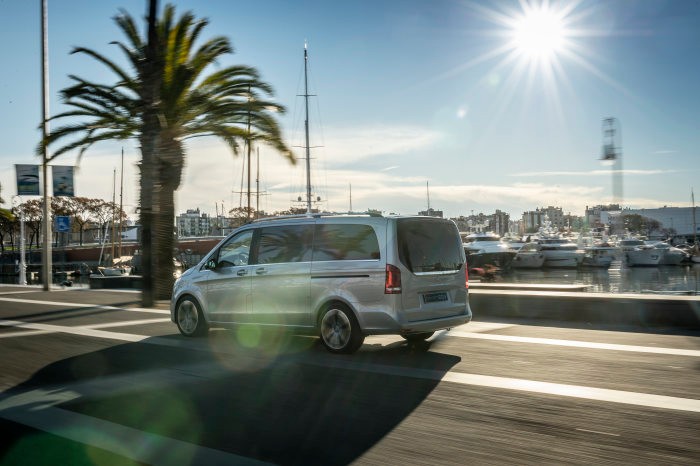
Stuttgart/Barcelona. Shortly after the world premiere at the Geneva Motor Show, the Concept EQV completed its first urban journey. In the port of Barcelona, the concept vehicle showed that the electric future for premium MPVs is just around the corner.
At the Geneva Motor Show at the beginning of March, the world's first fully electric premium MPV was presented to the public: with the Concept EQV, Mercedes-Benz showed what the locally emission-free future can look like in this segment.
Now the Concept EQV has completed its first public drive and presented itself in the port of Barcelona in front of a fitting backdrop. The vehicle is aimed equally at families, sports enthusiasts or quality shuttle services. With its progressive exterior, the Concept EQV caused a stir with passers-by in the fashion and design city. In particular, the EQ-typical radiator grille with its continuous LED strip left a lasting impression.
Its inner values are equally impressive
In addition to its attractive design, the Concept EQV stands in particular for practical, everyday and locally emission-free electromobility. The technical highlights include a range of up to 400 kilometres and an integrated rapid charging function. This means that sufficient energy for approx. 100 kilometres can be charged in about 15 minutes. What's more, the vehicle offers the greatest possible level of comfort in its interior and maximum functionality, for example thanks to the diverse range of possible seating configurations.
The Concept EQV is driven via the front axle by a compact electric powertrain with an output of 150 kW. And with a top speed of 160 km/h, it ensures superior driving pleasure out of town, too. Energy is supplied by a lithium-ion battery with a capacity of 100 kWh. This is installed in the underbody of the vehicle, providing the full space in the interior for passengers.
Very soon, Mercedes-Benz Vans will be taking the next step: a series model is planned on the basis of the Concept EQV which will be presented to the public at this year's IAA in Frankfurt am Main.

Press Contact

Oliver Fenzl

Spokesperson Van Technology Communications – eDrive@Vans

oliver.fenzl@daimler.com

Tel: +49 (0)711 17-4 54 64

Fax: +49 (0)711 17-52030

Press Contact Overview

Media

Download

Pictures (20)

Videos (1)

Documents (1)

Media Contact (1)

Filter

Show thumbnails
Show list
Slideshow

Zoom

Preview

Details

Do you really want to delete the data record?

Please wait a moment …

Please wait a moment …

Please wait a moment …

Please wait a moment …

19C0295_003

19C0295_004

19C0295_005

19C0295_006

19C0295_008

19C0295_009

19C0295_013

19C0295_014

19C0295_016

19C0295_018

19C0295_020

19C0295_022

19C0295_023

19C0295_029

19C0295_030

19C0295_031

19C0295_032

19C0295_033

19C0295_035

19C0295_036

Loading

Mercedes-Benz sells about 182,000 vehicles worldwide in April

10.

May 2019

Stuttgart

EQC Edition 1886 (combined electric energy consumption: 20.8 – 19.7 kWh/100 km; combined CO2 emissions: 0 g/km)*. *Electric energy consumption and range have been determined on the basis of Regulation (EC) No. 692/2008. Electric energy consumption and range depend on the vehicle configuration. Mercedes-Benz sold 181,936 automobiles worldwide last month (-5.5%). In the first four months of the year, 742,809 cars with the three-pointed star were handed over to customers (-5.6%). Sales in China increased to a new high of 232,050 units for the period of January to April (+2.2%). Positive sales momentum from the ongoing success of the new A-Class: More than 49,000 compact cars were delivered worldwide in April (+6.0%). Global sales of smart increased by 14.3% to 11,573 units in April. The Mercedes-Benz EQC (combined power consumption: 20.8 – 19.7 kWh/100 km; combined CO2 emissions: 0 g/km)* can be ordered since May 6. Stuttgart. Mercedes-Benz delivered 181,936 cars in April (-5.5%) and a total of 742,809 in the first four months of the year (-5.6%). The ongoing sales success of the new A-Class resulted in worldwide growth for the compact cars in April (+6.0%). A contribution to this sales success came from the new A-Class Saloon, a further model complementing the compact-car entry into the world of premium saloon cars from Mercedes-Benz. Unit sales of SUVs were still dampened in April by the model changes. Mercedes-Benz Cars expects especially for the new SUV models increasing vehicle availability in the coming months and therefore additional growth opportunities in a highly competitive market environment. Since the beginning of the year, Mercedes-Benz has maintained its market leadership in the premium segment in Germany, UK, France, Switzerland, Sweden, Portugal, Poland, Denmark, Czech Republic, Australia and Canada.
“With the EQC sales launch on May 6, we have reached another milestone along the way to a new era at Mercedes-Benz: The EQC is the pioneer of our future Mercedes-Benz EQ vehicle portfolio,” said Britta Seeger, Member of the Board of Management of Daimler AG responsible for Mercedes-Benz Cars Marketing and Sales. “We are delighted not only with the first fully electric SUV from Mercedes-Benz, but also with strong demand for our new premium SUVs: The new model year of the GLC and GLC Coupé, and also the new GLS, have been available for order since April, and together with the GLE and our new compact cars will provide further momentum in the course of the year.”
Mercedes-Benz unit sales by region and market
In Europe, 71,263 cars with the three-pointed star were delivered last month (-4.8%). In Germany, the region’s core market, sales of 24,970 units in April were slightly below the high prior-year level (-1.3%). In the major markets of France and Russia, unit sales increased in both April and the first four months of the year. In France, Mercedes-Benz actually achieved a new record for January to April (+2.8%).
In the Asia-Pacific region, Mercedes-Benz sold 79,125 vehicles (-1.4%). In China, the region’s core market, sales continued to grow and reached a new high of 232,050 units in the first four months of the year (+2.2%). Unit sales were at a new record level also in April, with deliveries of 57,707 vehicles (+0.8%). In Singapore and Vietnam, unit sales increased at double-digit rates in the first four months and also reached new record levels.
A total of 111,668 units were sold in the NAFTA region from January to April (-11.7%). In the region’s core market, the USA, Mercedes-Benz sold a total of 22,949 vehicles with the star last month (-15.7%). Sales in the USA in the first four months totalled 94,120 units (-10.9%).
Mercedes-Benz unit sales by model
Following sales growth in March, worldwide unit sales of the compact cars increased also in April: More than 49,000 units sold represents an increase of 6.0% for the A- and B-Class, CLA, CLA Shooting Brake and GLA. Worldwide unit sales of the new A-Class continued to grow by a strong double-digit rate in April (+45.3%). The B-Class achieved sales growth in the first four months of the year in the major markets UK and Spain.
With sales of more than 138,000 units in April, the C-Class Saloon and Estate reached the high prior-year level (-0.8%). Sales of the long-wheelbase version of the C-Class Saloon were higher than ever before in the past four months (+10.9%). Sales of the C-Class Estate in the period of January to April increased in markets including Germany, Japan and Belgium.
With deliveries of about 60,000 units of the GLA, GLC, GLC Coupé, GLE, GLE Coupé, GLS and G-Class models, sales of SUVs in April were below the high prior-year level due to model changes (-12.7%). The new G-Class was popular among customers around the world, with strong double-digit growth rates to highs in both April and the past four months.
smart
In April, 11,573 customers worldwide were delighted to receive their new two-door or four-door urban microcars from the smart brand – an increase of 14.3%. The two-door and four-door smart models were especially popular in Europe last month. Unit sales in this region increased by 25.8%, partially driven by double-digit growth rates in Germany, Italy, France, Switzerland, Belgium and Austria. Unit sales by smart in Germany reached a new record in the past four months (+16.2%).
Overview of Mercedes-Benz Cars unit sales
April 2019
Change in %
Year to April 2019
Change in %
Mercedes-Benz
181,936
-5.5
742,809
-5.6
smart
11,573
+14.3
38,621
-5.5
Mercedes-Benz Cars
193,509
-4.5
781,430
-5.6
Mercedes-Benz unit sales in the regions/markets
Europe
71,263
-4.8
295,941
-5.4
– thereof Germany
24,970
-1.3
95,512
-4.1
Asia-Pacific
79,125
-1.4
319,121
-3.1
– thereof China
57,707
+0.8
232,050
+2.2
NAFTA
27,557
-16.9
111,668
-11.7
– thereof USA
22,949
-15.7
94,120
-10.9

Press Contact

Katja Liesenfeld

Manager Global Business Communications
Sales & After Sales Mercedes-Benz Cars

katja.liesenfeld@daimler.com

Tel: +49 711 17-32972

Fax: +49 711 17-790-24594

Christopher R. Springer

Global Business Communications
Sales & After Sales Mercedes-Benz Cars

christopher_renz.springer@daimler.com

Tel: +49 711 17-33806

Fax: +49 711 17-7902-3252

Sofia Stauber

Head of Global Business Communications
Mercedes-Benz Cars

sofia.stauber@daimler.com

Tel: +49 711 17-40598

Fax: +49 711 17790-91184

Press Contact Overview

Media

Download

Pictures (3)

Documents (2)

Media Contact (3)

Filter

Show thumbnails
Show list
Slideshow

Zoom

Preview

Details

Do you really want to delete the data record?

Please wait a moment …

Please wait a moment …

Please wait a moment …

Please wait a moment …

18C1072_004

19C0258_072

18C0291_007

Loading

The new Mercedes-Benz EQC: The Mercedes-Benz among electric vehicles

08.

May 2019

Stuttgart

Press Contact (2)

Wolfgang Würth

Manager Communications EQ

wolfgang.wuerth@daimler.com

Tel: +49 711 17-46508

Fax: +49 711 17-79016071

Koert Groeneveld

Head of International Product & Technology Communications

koert.groeneveld@daimler.com

Tel: +49 711 17-92311

Fax: +49 711 17-94365

EQC (electricity consumption combined: 20.8 – 19.7 kWh/100 km; CO2 emissions combined: 0 g/km)* ; *Electric energy consumption and range have been determined on the basis of Regulation (EC) No. 692/2008. Electric energy consumption and range depend on the vehicle configuration.

Download

Filter

Do you really want to delete the data record?

Please wait a moment …

Please wait a moment …

Please wait a moment …

Please wait a moment …

The Mercedes-Benz among electric vehicles

Stuttgart, May 8, 2019

End-to-end mobility from the inventor of the automobile

Stuttgart, May 8, 2019

Progressive Luxury: Pioneer of a new electro-look

Stuttgart, May 8, 2019

Dynamic performance meets efficiency

Stuttgart, May 8, 2019

Pleasantly climatised interior from the start

Stuttgart, May 8, 2019

Unique user experience with EQC specific functions

Stuttgart, May 8, 2019

LINGUATRONIC voice control: “Hey Mercedes”

Stuttgart, May 8, 2019

Relaxed travel from start to finish

Stuttgart, May 8, 2019

High stress-relieving comfort and better support in hazardous situations

Stuttgart, May 8, 2019

Mitigating the consequences of accidents with modern technology and the EQC specific safety concept

Stuttgart, May 8, 2019

Endurance tests around the globe: on the road to series production

Stuttgart, May 8, 2019

Electrified Mercedes hits the road

Stuttgart, May 8, 2019

Worldwide electric initiative: Mercedes-Benz is putting the first EQ model into series production

Stuttgart, May 8, 2019

Loading

Mercedes-Benz Vans starts campaign for the new V-Class: Make Your Move

08.

May 2019

Stuttgart

Mercedes-Benz starts the innovative marketing communication campaign “Make Your Move” to accompany the market launch of the new V-Class. Five protagonists provide an insight into their lives and tell us about a life-changing decision. What is special about the campaign? For the first time ever Mercedes-Benz Vans has dispensed with a written screenplay and is relying on authentic stories from real life that are relevant to its target groups. Initially, the campaign will be shown for the most part on social media channels and will be followed by TV advertisements. The films can be seen now online.

Marion Friese, Head of Marketing at Mercedes-Benz Vans: For the first time, with “Make Your Move” we are taking a new approach to campaign communication because the V-Class is a versatile vehicle for very different target groups: we have families and sports fans who need a lot of space as well as those running a business who use their V-Class both for work and privately. With this campaign, Mercedes-Benz would like to show the customer target group that the flexible V-Class is an excellent companion for any situation in life and provides freedom and independence.”
“Make Your Move” – Five real-life stories
Nothing is more authentic than reality. That is why, for this campaign, Mercedes-Benz looked all over the world for people to tell their own story of decision, change and movement:
a family man looking for work-life balance, an outdoor couple with the thrill of adventure on the one hand and everyday commitments on the other, an employee about to make the leap into self-employment with a focus on recreation, a woman with a new calling on a new continent, two friends realising their dream Every V-Class customer target group will identify with one of the five stories: the life of every individual is flexible and can change, and the new V-Class is just as versatile. The films can be seen online. The Lukas Lindemann Rosinski Agency is responsible for the idea, concept and realisation of the campaign.
The campaign – in three steps to the product
The communication campaign is primarily designed for social media channels and takes the different customer target groups to the product in three steps: first, the emotional story teaser arouses the viewer's interest. The target group is then provided with specific product information using canvas and carousel formats which can be clicked to appear in full-screen mode or allow several photos, videos or links to be shown in one display. In the third step, interested parties are guided to the Mercedes-Benz website. The focus of the campaign is on the initial marketing communication in social media, later the content will be used for other advertising formats such as TV advertisements.
Marco Polo: same campaign, different story
This communication concept will also be adopted for the compact Marco Polo camper van. The campaign will be launched at the same time, but with its own authentic story. It will portray Nick Fouquet, a well-known milliner who specialises in exclusive, individually made hats.
The new V-Class
Five years ago, the Mercedes-Benz V-Class set standards in the MPV segment with its design, value appeal, comfort as well as safety and assistance systems. The facelift builds upon these core values and thus enhances the attractiveness of the biggest member of the Stuttgart-based passenger car family. The compact Marco Polo and Marco Polo HORIZON camper and leisure vans also benefit from the innovations implemented in the V-Class. Focal points of the facelift include a restyled and striking front-end design and the introduction of the OM 654 four-cylinder diesel engine generation – with the V 300 d being the new top-power variant with 176 kW (239 hp) (combined fuel consumption 6.1-5.9 l/100 km, combined CO2 emissions 161-155 g/km)[1]. The new engine generation is even more efficient and clean and offers further improved noise and vibration characteristics. In addition the new V-Class comes with the 9G-TRONIC automatic transmission for the first time as well as several safety and assistance systems meeting the latest technological level, among them Active Brake Assist. The new V-Class can be ordered in Europe since March 2019.
[1] The stated figures were determined in accordance with the prescribed measuring method. These are the “NEDC CO2 figures” according to Art. 2 No. 1 Implementing Regulation (EU) 2017/1153. The fuel consumption figures were calculated based on these figures. Further information on the vehicles on offer, including the WLTP values, can be found for each country at www.mercedes-benz.com

Press Contact

Diana Boch

Spokesperson V-Class and Travel Vans

diana.boch@daimler.com

Tel: +49 (0)711 17-52406

Fax: +49 (0)711 17-52030

Ingeborg Gärtner

Spokesperson Private Vans (V-/X-Class and Travel Vans)

ingeborg.gaertner@daimler.com

Tel: +49 (0)711 17-49784

Fax: +49 (0)711 17-52030

Press Contact Overview

Media

Download

Pictures (1)

Documents (1)

Media Contact (2)

Filter

Show thumbnails
Show list
Slideshow

Zoom

Preview

Details

Do you really want to delete the data record?

Please wait a moment …

Please wait a moment …

Please wait a moment …

Please wait a moment …

18C0903_310

Loading

Daimler Financial Services: Future topic “Mobility”

08.

May 2019

Stuttgart

Jörg Lamparter, Head of Mobility Services, to become Daimler Financial Services AG Board Member for “Digital and Mobility Solutions”, effective June 1, 2019 Benedikt Schell, currently Chief Experience Officer (CXO) on the Board of Management for Daimler Financial Services AG, moving to the position of Chairman of Mercedes-Benz Bank AG in Germany Klaus Entenmann, Chairman of Daimler Financial Services AG: “In Jörg Lamparter, we are gaining a recognized expert in digital mobility services as a new Member of the Board of Management. Within Daimler Financial Services AG, which will change its name to Daimler Mobility AG this summer, he will systematically merge the growing fields of digitization and mobility.” Stuttgart, Germany – Daimler Financial Services AG is strategically realigning key areas of its business by establishing a new division on the Board of Management. Effective June1, 2019, Jörg Lamparter is poised to become a new Member of the Daimler Fina..

Mercedes-Benz Museum: Visitor Information.

Bonuscard + Kultur, Museumspass, StuttCard Card holder will receive free admission. Breuninger Card Breuninger Card holders will receive, when you buy two tickets, a discount of 50% (equivalent to two tickets for the price of one). And 10% discount on our shop items (excluded from the action are all items with fixed book prices, discounted… Continue reading Mercedes-Benz Museum: Visitor Information.