A new addition to the family: new four-door coupé from Mercedes-AMG

06.

March 2018

Affalterbach

Press Contact for this Press Release (2)

Birgit Zaiser

Manager Communications Mercedes-AMG

birgit.zaiser@daimler.com

Tel: +49 7144 302-581

Fax: –

Koert Groeneveld

Head of International Product & Technology Communications

koert.groeneveld@daimler.com

Tel: +49 711 17-92311

Fax: +49 711 17-94365

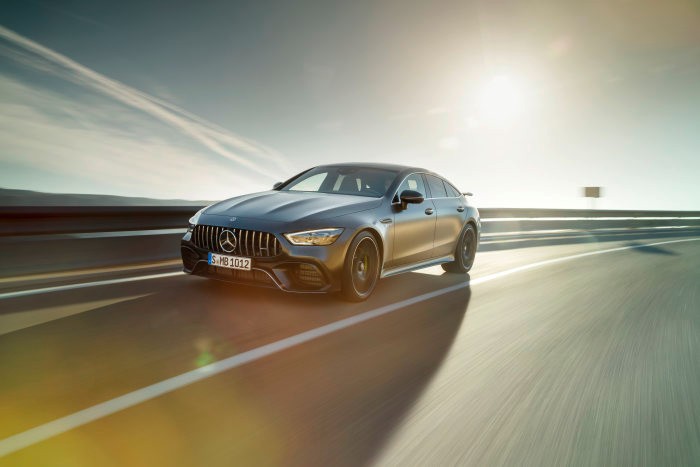
Fuel consumption combined: 11.2-9.1l/100 km; CO2 emissions combined: 256-209 g/km* (provisional data)Affalterbach. More space, more power, more goose pimples – the new Mercedes-AMG GT 4-Door model delivers driving experiences in new dimensions and extends the AMG model family. The new coupé is the first four-door sports car from Affalterbach and draws directly on the legendary SLS and AMG GT models of success. As another vehicle developed autonomously by Mercedes-AMG it combines unique design, high comfort and outstanding sports car engineering with an athletic, four-door fastback layout. It thus offers more space and more potential uses. Systematic expansion of the AMG GT family with the 4-door Coupé opens up the sports car segment to those looking for a vehicle for day-to-day use, but unwilling to go without the unparalleled performance of Mercedes-AMG.
Longitudinal and lateral dynamics at the highest level, and a striking silhouette with classic proportions put the Mercedes-AMG GT 4‑Door Coupé in the portfolio of its two-door brother at first glance. The expressive design with the low bonnet, dominant front and muscular body language emphasises the sporty genes of the four-door coupé, which sets new standards as the youngest model in the AMG family: As the first four-door AMG GT model it combines high everyday comfort with diverse individualisation options and the latest sports car engineering.
“The new AMG GT 4-Door Coupé blends the impressive racetrack dynamism of our two-door sports car with maximum suitability for everyday use. It has a unique way of embodying our brand core, “Driving Performance” and with its systematic configuration it will attract new customers for Mercedes-AMG”, commented Tobias Moers, CEO of Mercedes-AMG GmbH.
The new AMG GT 4-Door Coupé delivers special driving experiences on all levels and with a top speed of up to 315 km/h and its driving dynamics it cuts an effortlessly superior figure wherever it goes. Powerful, up-to-date 6-cylinder in-line and V8 engines with outputs ranging from 320 kW (435 hp) to 470 kW (639 hp) allow completely new driving experiences and combine impressive performance with modern efficiency.
The interior of the first four-door AMG GT model is characterised by elegant coolness and also the latest features: innovative control panels can be intuitively operated and configured as required. The blend of high individualisation and sports car technology, placing yet more focus on the requirements of discerning customers, is also clear from the wealth of equipment packages and individual options. The latest coup from Affalterbach also lives up to the Mercedes-AMG brand pledge with regard to its high driving dynamics and sets the benchmark in its segment on the racetrack too.
Clear at first sight: the AMG GT family membership
Clearly recognisable as a member of the AMG GT family, the new AMG GT 4-Door Coupé follows the design philosophy of Sensual Purity. It takes the striking proportions with convex surfaces and a muscular body and develops them to exciting effect for a four-door variant of an AMG GT Coupé.
The front view with a long bonnet and two powerdomes leaves no doubt that this is the youngest member of the AMG GT family. The 4-door coupé follows the design tradition of the successful AMG GT models: the powerful body exudes dynamism and motivation. Sensuous shapes with convex surfaces lend the four-door GT timeless elegance, whilst the flowing silhouette with the lowered greenhouse flags up its sporting credentials. As in the AMG GT R radiator shutters, the Airpanel in front of the centre cooling air inlet improves the car's aerodynamic efficiency. Slim MULTIBEAM LED headlamps, the AMG-specific radiator protection grille, the Shark Nose and the front apron with its enhanced Jet Wing (with a flowing A-Wing on the six-cylinder model) also lend the youngest model from Affalterbach the hallmark presence of the AMG GT family.
With frameless side windows and a flat windscreen inclined far to the rear, features of the classic coupé architecture are also cited. With the additional seat row in the rear the characteristic lines of the AMG GT models are not compromised. The tailored upper contours and broad shoulders point to the athletic, sporty orientation of the car, which is additionally emphasised by very pronounced rear wheel arches.
The rear view of the new 4-door coupé picks up on familiar features of the AMG GT design idiom: extremely slim LED tail lights define the hallmark boot sill line, the rear aerofoil extendable in several stages not only underscores the family affiliation; it is also an important element of the active aerodynamics.
The two eight-cylinder models can be identified through the three horizontal louvres in the side front air intakes, the Jet Wing with its trim element in Silver Shadow, the distinctive diffuser on the tail end and the two-pipe exhaust system with trapezoidal tailpipe trims. The six-cylinder variant, meanwhile, has one louvre in each of the air inlet grilles, round twin tailpipe trims and a somewhat less pronounced rear diffuser.
“The new AMG GT 4-Door Coupé is the ultimate four-door sports car and the ideal ambassador for Performance Luxury”, said Gorden Wagener, Chief Design Officer Daimler AG. “It embodies a symbiosis of emotion and intelligence with breathtaking proportions and a puristic, surface-oriented design with sensuous shapes. It is both hot and cool at the same time.”
Visual emphasis on demand: the exterior packages
The new AMG GT 4-Door Coupé offers an extensive portfolio of exterior equipment packages, which can be used to add different highlights in terms of design. The Night Package comprises high-gloss black trim, whilst, for example, the Chrome package emphasises the luxurious character of the car with trim and an insert in high-gloss chrome. Two Carbon-Fibre Packages offer different versions of carbon-fibre trim, whilst the optional Aerodynamics package gives the car an even sportier look and is a new feature in this segment. It includes additional functional features in high-gloss black, the Jet‑Wing in Silver Shadow in the front apron and the fixed rear aerofoil and also naturally reduces lift at higher speeds. With the V8 style package the six-cylinder model can also be equipped with design features from the eight-cylinder versions.
Top sporting performance: V8 biturbo engines with up to 470 kW (639 hp)
The exciting AMG 4.0-litre V8 biturbo engine is already used in numerous AMG models. Its output has been enhanced yet further for the new Mercedes‑AMG GT 63 S 4MATIC+ (fuel consumption combined 11.2 l/100 km, CO2 emissions combined 256 g/km)* and ensures superior performance on a par with a sports car. It delivers 470 kW (639 hp) and a maximum torque of 900 Nm, which is available over a wide engine speed range from 2500 to 4500 rpm. The top engine of the new four-door AMG GT thus exudes effortless superiority in every engine speed range. Acceleration from 0 to 100 km/h in 3.2 seconds clearly illustrates this, as does the maximum speed of 315 km/h.
In the Mercedes-AMG GT 63 4MATIC+ (fuel consumption combined 11.0 l/100 km, CO2 emissions combined 252 g/km) the V8 unit provides 430 kW (585 hp) and 800 Nm maximum torque. The sprint from standstill to 100 km/h lasts just 3.4 seconds, and the top speed is 310 km/h.
The AMG 4.0-litre V8 engine works with the proven biturbocharging, where the two exhaust-gas turbochargers are arranged not on the exterior, but between the cylinder banks. The advantages of the “hot inner V” are in the compact engine design and the immediate response of the exhaust-gas turbochargers.
In the AMG GT 63 S variant the eight-cylinder has active engine mounts. They solve the conflicting goals of achieving as soft a connection as possible to the powertrain for high comfort and as rigid a connection as possible for optimum driving dynamics, by steplessly and quickly adapting their rigidity to the respective driving conditions. As an option the AMG GT 63 can be equipped with active engine mounts as part of the Dynamic Plus package.
* The stated figures (provisional data) were determined in accordance with the prescribed measuring method. These are the NEDC CO2 figures according to Art. 2 No. 1 Implementing Regulation (EU) 2017/1153. The fuel consumption figures were calculated based on these figures.
Direct response: the two twin-scroll exhaust-gas turbochargers
Two twin-scroll exhaust-gas turbochargers combined with another innovative technology ensure even more output and better response. For the first time Mercedes-AMG is combining the advantages of twin-scroll technology in the V8 engine with turbine wheels mounted in anti-friction bearings. Through the mounting in anti-friction bearings, friction is reduced to an absolute minimum inside the exhaust-gas turbocharger. The twin-scroll technology also ensures that the exhaust gas flow is optimally utilised. Put together these both improved the immediate response of the four-litre eight-cylinder from AMG, which was already the benchmark. Through the optimised cylinder charge the output and the maximum torque was raised further. Spray-guided direct petrol injection with piezo injectors, the all-aluminium crankcase, the four-valve-per-cylinder design with camshaft adjustment, air-water charge air cooling, alternator management, the ECO start/stop function and the gliding mode have all been retained.
Improved efficiency: the intelligent AMG Cylinder Management
For maximum efficiency, Mercedes-AMG has also equipped the V8 engines with the AMG Cylinder Management cylinder deactivation system. In the partial-load range, cylinders two, three, five and eight are deactivated, which crucially reduces the fuel consumption.
When the driver has selected the “Comfort” drive program, the cylinder deactivation system is available in the wide engine speed range from 1000 to 3250 rpm. A special display on the instrument cluster states whether the cylinder deactivation system is in use and whether the engine is presently operating in the four- or eight-cylinder mode. The transition between these two operating states is immediate, fast and torque-neutral, so the occupants do not have to relinquish any comfort.
Powerful and versatile: six-cylinder engine with innovative hybrid function
Alongside the two V8 engines the new four-door sports car is also available as the Mercedes-AMG GT 53 4MATIC+ (fuel consumption combined 9.1 l/100 km, CO2 emissions combined 209 g/km) with the innovative AMG six-cylinder inline engine. The 320 kW (435 hp) 3.0-litre unit is characterised by high performance, supported by a boost effect with an output of up to 16 kW (22 hp) and 250 newton metres of torque. The EQ Boost starter-alternator combines a starter motor and alternator in a powerful electric motor and is between the engine and transmission. This intelligent combination, along with efficient charging with the electric additional compressor (eZV) and exhaust air turbocharger helps ensure the hallmark AMG performance and driving dynamics but also cuts consumption and emissions at the same time. The four-door AMG GT 53 accelerates from zero to 100 km/h in just 4.5 seconds, and achieves a top speed of 285 km/h.
More energy for yet more innovations: the new 48-volt on-board power supply
The EQ Boost starter-alternator in the new AMG GT 53 also generates the power for the 48 V on-board electrical system. This in turn uses a DC/DC converter to supply the conventional 12 V network for the lights, cockpit, infotainment displays and control units. Through the 48 V battery the battery capacity of the entire car is increased, which means that more electrical energy can be made available for new functions. The 48 V on-board electrical system thus also paves the way for the progressive expansion of infotainment and assistance systems.
Emotive gearshifting experience: the AMG SPEEDSHIFT transmission
The AMG SPEEDSHIFT MCT 9G 9-speed transmission is specially tuned to the requirements of the eight-cylinder variants of the new four-door AMG GT. A wet clutch is used here. This reduces weight and inertia and optimises the response. The extensively tailored software enables extremely short shift times and fast multiple downshifts and delivers an especially emotive gearshifting experience thanks to the double-clutching function. There is also a RACE START function, ensuring optimum acceleration.
The six-cylinder inline engine is coupled with the AMG SPEEDSHIFT TCT 9G transmission. In conjunction with the torque converter the transmission is tuned to the special requirements of this engine. On the other hand, the extremely fast and emotive gearshifting characteristic of an AMG model is also possible depending on the drive program.
In total: the high driving dynamics of the AMG GT
In order to meet the high demands of impressive driving dynamics, Mercedes-AMG engages all the components this takes. With its sophisticated design the bodyshell of the Mercedes-AMG GT 63/53 plays an equally crucial role as the ingenious control strategy of the all-wheel drive system. And it is only in the optimum interplay together with the active aerodynamics, the rear axle steering and the ESP® that the complicated suspension tuning unleashes its full potential. Through the complex networking of all the systems and components the developers in Affalterbach were able to bestow on the car the high level of driving dynamics expected of it as a member of the AMG GT‑family.
Structure made in Affalterbach: the rigid AMG bodyshell
One aim during development of the new four-door AMG GT was to anchor the genes of a sports car in the bodyshell. In order to do this, analysis and simulation methods from racing were used in order to reinforce the structure where necessary for maximum performance. The very rigid front section prevents unwanted distortions about the longitudinal and transverse axle, which ensures precise steering and better feedback for the driver.
In the area of the centre and tail end of the vehicle new reinforcement concepts were used in conjunction with state-of-the-art CRP plastics. This, together with further individual measures plus close networking with Chassis Development right from the outset, ensured that the four-door AMG GT was given an optimum basis for high lateral dynamics potential.
Dynamism made in Affalterbach: the AMG chassis engineering
The outstanding agility and racetrack-ready driving dynamics of the four-door AMG GT are also down to the special AMG suspension. On the six-cylinder model a suspension with steel springs and adjustable damping is used as standard. The suspension on the eight-cylinder variants is based on the fully load-bearing multi chamber air suspension AMG RIDE CONTROL+. A rigid integral carrier bears the front axle, engine, transmission and steering gear.
In conjunction with the wide track width and the configuration for large tyre dimensions, wheel location and spring elements which are independent of one another facilitate high lateral acceleration, whilst the low unsprung masses promote the agile driving feel yet further.
The rear axle differential also has a new specially reinforced mount to improve the NVH (noise, vibration, harshness) characteristics. As on the AMG GT R, an anti-roll bar made of tubular material reduces the overall weight of the rear axle.
Intelligent all-wheel drive: AMG Performance 4MATIC+
All AMG GT 4-Door Coupé models are equipped with the AMG Performance 4MATIC+ all-wheel drive. An electro-mechanically controlled clutch connects the permanently driven rear axle variably to the front axle. The best possible torque split is continuously computed according to the driving conditions and driver's input. The transition from rear-wheel to all-wheel drive and vice versa is seamless, as the intelligent control is integrated into the overall vehicle system architecture. Alongside traction and lateral dynamics, the all-wheel drive also improves the longitudinal dynamics for even more powerful acceleration.
It is still possible to drift thanks to fully variable torque distribution. The Drift Mode is suitable for this; in the S version of the four-door AMG GT it is standard, and in the other models it is available as an option. This can be activated in the “RACE” drive program using the shift paddles, provided that ESP® is deactivated and the transmission is in manual mode. When activating the Drift Mode the four-door sports car thus turns into a model with purely rear-wheel drive.
Optimum traction: rear-axle limited-slip differential
To improve traction and dynamism the AMG GT 63 S has an electronically controlled locking differential at the rear axle as standard. The slip is thus suppressed at the inner wheel on bends, ensuring optimum grip. The driver is therefore able to accelerate out of corners earlier and with more power thanks to the improved traction. The vehicle remains more stable when braking from high speed, while the limited-slip differential also improves traction when accelerating from rest. The electronic locking differential is part of the Dynamic Plus package and in this combination it is also optionally available for all further variants of the four-door AMG GT.
Enhanced agility and precision: the active rear-wheel steering
The AMG GT 4-Door Coupé responds even more sensitively to steering commands thanks to the active rear axle steering which comes as standard in the V8 models and is optional in the six-cylinder versions. The system facilitates an even better combination of agility and stability and thus reinforces the dynamism and the handling safety of the new AMG GT four-door model.
Up to a speed of 100 km/h, the rear wheels point in the opposite direction to the front wheels via two electric actuator motors. As a result, the car turns into corners with significantly higher agility. Under everyday driving conditions, the driver also benefits from a smaller turning circle.
At speeds higher than 100 km/h, the system turns the rear wheels in the same direction as the front wheels. That noticeably improves driving stability. At the same time, the lateral force on the rear wheels builds up considerably faster on changes of direction, thus improving the response to the steering. The driver can also rely on extreme rear-axle grip and high stability when changing direction quickly, without the usual tendency for the rear end to break out.
Direct and immediate: AMG speed-sensitive sports steering
The electromechanical speed-sensitive power steering has a variable ratio. It impresses with its precise feedback thanks to the AMG-specific rack-and-pinion steering with a variable ratio. Power assistance also varies between the three stages “Comfort”, “Sport” and “Sport+”. The corresponding characteristic is automatically activated depending on the selected AMG DYNAMIC SELECT transmission mode or can be personalised as required in “Individual” mode.
Good control and fade-resistant: the AMG high-performance braking systems
In line with the high output values and their associated performance the eight-cylinder models have a large-dimensioned brake system consisting of compound discs with 6-piston fixed callipers at the front and single-piston floating brake callipers at the rear. The S variant is characterised by yellow brake callipers, whilst the base variant of the eight-cylinder sports red brake callipers.
The six-cylinder model is also equipped with internally ventilated and perforated compound brake discs with brake callipers painted silver ..
Mercedes-Benz has set a new unit-sales record every month for the past five years

06.

March 2018

Stuttgart

Press Contact for this Press Release (3)

Katja Liesenfeld

Manager Global Business Communications
Sales & After Sales Mercedes-Benz Cars

katja.liesenfeld@daimler.com

Tel: +49 711 17-32972

Fax: +49 711 17-790-24594

Nora Sterzinger

Global Business Communications
Sales & After Sales Mercedes-Benz Cars

nora.sterzinger@daimler.com

Tel: +49 711 17-33806

Fax: +49 711 17-24847

Sofia Stauber

Head of Global Business Communications
Mercedes-Benz Cars

sofia.stauber@daimler.com

Tel: +49 711 17-40598

Fax: +49 711 17790-91184

In February, Mercedes-Benz achieved its 60th consecutive record month with sales of 163,580 vehicles (+6.3%). More vehicles were sold than ever before in a February in the sales regions Europe, Asia-Pacific and NAFTA. The SUVs and E-Class continued along their successful paths with new sales records. The electric smart models are being sold as of now under the EQ brand. Stuttgart – For five years now, unit sales by Mercedes-Benz have known only one direction month by month; upwards. This February completed the five years: It was the 60th consecutive month in which Mercedes-Benz delivered more vehicles worldwide than in the prior-year month. A total of 163,580 cars were handed over to customers and worldwide growth amounted to 6.3%. The Stuttgart-based company with the three-pointed star was particularly successful in Switzerland, Australia, the USA, Canada and Brazil, where Mercedes-Benz maintained its position as the premium brand with the most new registrations in February.
“We achieved the 60th consecutive sales record in February with more than 163,500 Mercedes-Benz vehicles sold. This success spurs us on to continue not only convincing our customers with our products – we want to thrill them. At the Geneva Motor Show, one of the models amazing our customers will be the newly developed four-door Mercedes-AMG GT Coupé,” said Britta Seeger, Member of the Board of Management of Daimler AG responsible for Mercedes-Benz Cars Marketing & Sales. “In Geneva, we will also present the electric smart models that now belong to the EQ brand and show how much fun urban electric mobility can be. Customers can look forward to optimized charging time and a new electric-mobility app. And Mercedes-Benz offers another new product with its new ‘Mercedes me Flexperience’ mobility service, through which customers can use our cars with a kind of subscription,” continued Seeger.
Mercedes-Benz unit sales by region and market
In the Europe region, more vehicles were sold last month than ever before in a February. A total of 63,593 customers took delivery of their new car with the star (+1.8%). In Germany, unit sales amounted to 21,543 Mercedes-Benz models in February (-2.8%). In Spain, Belgium, Switzerland, Portugal and Poland, new records were set both in February and in the first two months of the year.
Unit sales by Mercedes-Benz in the Asia-Pacific region in February rose by 12.9% to the new high of 65,691 vehicles sold. The company with the star posted a sales record in China with 43,036 vehicles sold (+18.6%), as well as in the markets South Korea (+8.5%), India (+25.7%) and Malaysia (+32.1%).
Mercedes-Benz delivered more vehicles than ever before in a February also in the NAFTA region, with a total of 29,934 units sold (+2.4%). This success is based on record unit sales in February not only in the USA, but also in Canada and Mexico. In the USA, 24,760 customers took delivery of their new Mercedes-Benz (+1.0%). Unit sales increased in Canada by 5.2% and in Mexico by 22.1%.
Mercedes-Benz unit sales by model
The E-Class Saloon and Estate continued along their successful path. Last month, 25,781 of those models were sold, more than ever before in a February (+9.1%). The high number of deliveries is mainly due to strong demand for the two models in their biggest market China.
Unit sales of the new S-Class Saloon in February surpassed the number for the prior-year month by 28.8%. A total of 6,010 customers took delivery of their new luxury saloon. Most of those models went to customers in China and the USA. Although the Mercedes-Maybach S-Class Saloon is approaching the model change, it posted a new sales record last month.
The SUVs from Mercedes-Benz set a new sales record of 59,807 units sold in February, surpassing the previous high of the prior-year month by 13.9%. The GLC achieved particularly strong growth with its sales increasing by 36.8%. As well as the GLC, more units were sold than ever before in a February also of the GLA, the GLC Coupé and the G-Class.
smart
This February, 8,360 customers decided in favour of an urban microcar from the smart brand, and 17,589 smart fortwo and smart forfour models were sold in the first two months of the year. Unit sales of both models increased especially sharply in Germany, with an increase of 37.8% last month. Demand for the electric versions of the smart models was particularly strong in the domestic market.
News from sales and service
The battery-electric versions of the smart models are being sold as of now under the EQ product and technology brand. At the Geneva Motor Show the special models smart EQ fortwo coupé edition nightsky (combined power consumption: 13.0 – 12.9 kWh/100 km; combined CO2 emissions: 0 g/km), smart EQ fortwo cabrio edition nightsky (combined power consumption: 13.1 – 13.0 kWh/100 km; combined CO2 emissions: 0 g/km) and smart EQ forfour edition nightsky (combined power consumption: 13.2 – 13.1 kWh/100 km; combined CO2 emissions: 0 g/km) will be presented. These models will be on the roads as of spring 2018. Customers can look forward to optimized charging technology and a new electric-mobility app. The first Mercedes-Benz model under the EQ brand, the EQC, will be presented to the public for the first time this year and produced at the Mercedes-Benz plant in Bremen as of 2019. By 2022, Mercedes-Benz Cars plans to have more than ten fully electric vehicles on the market. The EQ brand will offer a comprehensive electric-mobility ecosystem of products, services and technologies. The product portfolio ranges from electric vehicles to wall boxes and charging services, as well as home-energy storage.
More information at https://www.daimler.com/innovation/case/electric/eq-brand.html.
Mercedes-Benz customers will soon be greeted by a completely new brand presence in the showrooms. It is already possible to see the new world of experience at the sales centres in Hung Hom in Hong Kong and Flensburg in Germany. A fascinating brand experience is created through the combination of innovative advisory processes, new job profiles like product expert, and the extensive application of digitization in customer advice, sales and service. The new brand presence focuses on the merger of the analogue and digital worlds. The point of sale becomes a point of experience for the Mercedes-Benz Cars brand family.
More information at http://media.daimler.com/marsMediaSite/ko/en/33526633.
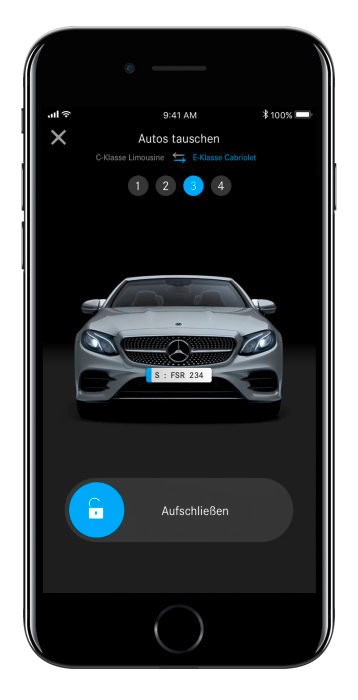
Mercedes-Benz offers another innovation with “Mercedes me Flexperience”. Who hasn’t dreamt of having access to one’s “own” Mercedes-Benz car pool? This dream will soon become reality – with “Mercedes me Flexperience”. The car “subscription” facilitates an individual mobility experience with up to twelve different cars each year, all for a fixed monthly instalment. The entire rental process is fully digitized – even the car swap takes place at the touch of a button. This digitization of the entire rental process sets new standards in the market. Using an app, the customer can also select the car’s engine, colour and interior equipment. Pilot tests are beginning with two of the biggest car dealer groups within the German Mercedes-Benz Cars Sales network, BERESA and LUEG.
Overview of sales by Mercedes-Benz Cars
February 2018
Change in %
Jan. – Feb. 2018
Change in %
Mercedes-Benz
163,580
+6.3
356,994
+7.4
smart
8,360
-9.8
17,589
-7.0
Mercedes-Benz Cars
171,940
+5.4
374,583
+6.6
Mercedes-Benz unit sales in the region/market
Europe
63,593
+1.8
128,879
+3.9
– thereof Germany
21,543
-2.8
43,450
+8.1
Asia-Pacific
65,691
+12.9
160,130
+13.8
– thereof China
43,036
+18.6
111,461
+17.2
NAFTA
29,934
+2.4
59,386
+0.3
– thereof USA
24,760
+1.0
50,067
0.0

Download

Filter

Show thumbnails
Show list
Slideshow

Zoom

Preview

Details

Do you really want to delete the data record?

Please wait a moment …

Please wait a moment …

Please wait a moment …

Please wait a moment …

17C922_03

18C0058_16

18C0191_10

Loading

Flexible change of vehicle with Mercedes me Flexperience: A Mercedes-Benz for every occasion

06.

March 2018

Stuttgart

Press Contact for this Press Release (1)

Mona Moll

Business Innovation & Fashion Communications

mona.moll@daimler.com

Tel: +49 711 17 93799

Fax: +49 711 17-91437

Stuttgart. With Mercedes me Flexperience Mercedes-Benz and Daimler Financial Services are taking another step on the road to becoming an integrated mobility provider. Aside from purchasing, financing and leasing a vehicle, in future customers and interested parties will have the choice of selecting and driving up to twelve new vehicles for a year at a fixed monthly rental rate. The rate includes insurance, maintenance, repair and tyres, and includes 36,000 kilometres a year. The centrepiece of this mobility offer is the Mercedes me Flexperience app, with which the customer can process the entire handling of the vehicle around the clock. This ranges from selecting his or her “dream vehicle” to collecting and returning the vehicle. The entire rental process will thus be digitalised. Based on Mercedes-Benz Rent, the rental offer from Mercedes-Benz Bank, the Mercedes me Flexperience is another mobility offering which was developed and implemented by the incubator Lab1886, Daimler AG's and Daimler Financial Services’

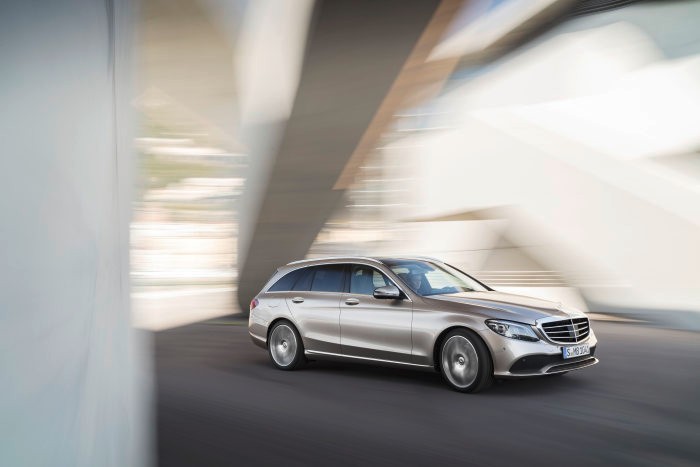
The new Mercedes-Benz C-Class Saloon and the new Estate

06.

March 2018

Stuttgart

Press Contact for this Press Release (2)

Steffen Schierholz

Manager Communications C-Class, E-Class, CLS

steffen.schierholz@daimler.com

Tel: +49 711 17-75852

Fax: +49 711 17-98646

Koert Groeneveld

Head of International Product & Technology Communications

koert.groeneveld@daimler.com

Tel: +49 711 17-92311

Fax: +49 711 17-94365

Fuel consumption combined: 9.4 – 4.6 l/100 km; Combined CO2 emissions: 214 – 123 g/km*Stuttgart. The most successful model series from Mercedes-Benz is entering its fifth year in production with extensive modifications. The design of the exterior and interior benefits from a stylish makeover. The electronic architecture is completely new. The customer benefits from a user experience with an optionally fully digital instrument display and multimedia systems with tailor-made information and music. The assistance systems are now at the level of the S‑Class. The new C-Class will have its world premiere at the Geneva International Motor Show (6 to 18 March) and deliveries to sales partners will begin in June.

The C-Class in its current generation was Mercedes-Benz's top-selling model in its fourth year on sale. More than 415,000 units of the Saloon and Estate were sold worldwide in 2017. The C‑C lass is produced at four plants on four continents. These are the lead plant in Bremen (Germany) plus East London (South Africa), Tuscaloosa (USA) and Beijing (China). The Beijing plant also produces the long version of the C‑Class Saloon, which is built and sold exclusively in China. China was the biggest market for the C‑C lass in 2017.
Power and efficiency: Completely new range of engines
The C-Class Saloon and Estate will enter the market with completely new engines. The following models are e.g. available on market launch in July, with further engine variants to follow:
C 200
C 200 4MATIC
C 220 d
C 43 4MATIC
Transmission
9G-TRONIC
9G-TRONIC
9G-TRONIC
AMG SPEEDSHIFT TCT 9G
Cylinders/arrangement
4/in-line
4/in-line
4/in-line
6/V
Displacement (cc)
1497
1497
1951
2996
Output (kW/hp) Combustion engine
135/184
135/184
143/194
287/390
at rpm
5800-6100
5800-6100
3800
6100
Output of electric motor (kW) Recuperation Boost
12 10
12 10


Max. torque Combustion engine (Nm)
280
280
400
520
at rpm
3.000-4.000
3.000-4.000
1.600-2.800
2.500-5.000
Max. torque Electric motor (Nm)
160
160


Fuel consumption, NEDC 2.0 (l/100 km)
6,0 (6,2)[1]
6,5 (6,7)1
4,4 (4,6)1
9,1 (9,4)*
Combined CO2 emissions (g/km), NEDC 2.0
136 (142)1
148 (153)1
117 (123)1
209 (214)*
Acceleration
0-100 km/h (s)
7,7 (7,9)
8.1
6,9 (7,0)
4,7 (4,8)
Top speed (km/h)
239 (235)
234
240 (233)
250**
Figures in brackets: Estate; *provisional figures, **electronically limited
Electrification continues: C 200 with EQ Boost
A new generation of four-cylinder petrol engines is being launched in the new C-Class. At the same time these models are equipped with an additional 48 volt onboard network with a belt-driven starter/alternator (EQ Boost). The new petrol model will be launched as the C 200 and C 200 4MATIC with a displacement of 1.5 litres, with a 2.0-litre variant to follow later.
The combination of a 48 volt onboard network and EQ Boost creates the conditions for additional functions that help to reduce fuel consumption even further, while improving agility and comfort characteristics. When accelerating, EQ Boost can assist the 135 kW (184 hp) engine with an additional 10 kW (14 hp), bridging the brief moment until the turbocharger has built up its full charge pressure. This boosting is also used to reach the engine's ideal rpm as quickly as possible during gearshifts. The shift time of the automatic transmission is shortened as a result. During deceleration, the starter/alternator recuperates kinetic energy and charges the battery. The water pump is electrically driven and actuated by a characteristic map. This optimally adapts the cooling output to the current need.
Other advantages include gliding mode with the engine switched off, and the recuperative brake with intelligent engine stop when the vehicle is coasting: recuperation only begins with overrun cut-off when braking. When the speed falls below a certain minimum level, the powertrain is decoupled and the engine is switched off. This has the advantage of maximum fuel savings through recuperation together with comfortable vehicle response. The start/stop system operates particularly comfortably thanks to the belt-driven starter/alternator, as the engine restarts almost silently, with low vibrations and very rapidly.
The exhaust gas turbocharger uses a twin-scroll system. Thanks to its dual-flow configuration (the exhaust ducts fed by two cylinders each are separate from each other and only come together directly before the turbine), the torque characteristics have been improved while keeping the exhaust back pressure low. The charge pressure is electronically controlled, which makes it possible to set the optimum charge pressure more rapidly and precisely compared to purely pneumatic control.
CAMTRONIC variable valve timing is also on board. This allows two-stage adjustment of the valve lift on the intake side. In the partial load range this allows a smaller valve lift so that less air is fed to the combustion chamber, thereby avoiding high gas cycle losses. In higher load ranges the system switches to the higher valve lift to achieve the engine's full power delivery. The well-proven BlueDIRECT combustion process and an improved combustion chamber help to ensure low exhaust emissions. In-engine measures to reduce friction round off the efficiency strategy of the new four-cylinder power unit. These include the Mercedes-Benz patented CONICSHAPE® process, known in-house as conical honing: When form-honing the cylinder walls, the cylinder wall is opened out slightly towards the bottom, so as to reduce friction at the piston skirt for lower wear and fuel consumption. Alongside the diesel engines, all the petrol engines are also equipped with a particulate filter in Europe.
Future outlook: Plug-in diesel hybrid in the C-Class
For the first time, Mercedes-Benz is uniting an externally chargeable hybrid system with a diesel engine. At the same time, the combination of the new four-cylinder OM 654 diesel engine and the latest-generation 9G-TRONIC 9-speed hybrid transmission is a special technological highlight. 90 kW of electrical output, an additional electrical torque of 440 Nm and an intended electric range of around 50 km (NEDC) will enhance the experience of locally emission-free mobility.
The planned plug-in diesel hybrid is based on the third generation of the plug‑in hybrids that had their debut at the 2017 IAA in the S-Class S 560 e (combined fuel consumption 2.1 l/100 km, combined CO2 emissions 49 g/km, combined electrical consumption 15.5 kWh/100 km[2]). This has a new lithium-ion battery with a capacity of 13.5 kWh. The new onboard charger increases the charging capacity from 3.6 kW to 7.2 kW, which means that the battery is fully recharged at a wallbox after approx. two hours. This should be possible within seven hours even at a domestic power socket.
The third-generation hybrid technology will support the driver with further improved, intelligent drive management. Through the extended use of data from the navigation system and information from the camera and the radar sensor, the third hybrid generation looks ahead and adapts itself to the speed and route profile. Events such as negotiating towns on the way to the destination are taken into account when planning the available electrical energy, and during recuperation and thermal conditioning of the drive components.
Apart from a serene driving experience, the hybrid technology will ensure extra comfort. This is because in addition to the drive compoinents, the high-voltage onboard electrical system also supplies the electric refrigerant compressor and the high-voltage heater booster. Both will allow pre-entry climate control of the interior not only in summer but also in winter.
State-of-the-art diesel: C 220 d
The new C 220 d shares the four-cylinder diesel engine with the planned plug‑in diesel hybrid. This ultra-modern engine family opens up new dimensions in efficiency. It is the first passenger car diesel engine to use the stepped-bowl combustion process – named after the shape of the combustion bowl in the piston. The innovations also include the combination of an aluminium engine block and steel pistons, as well as the further-improved NANOSLIDE® coating of the cylinder walls.
Despite having a lower displacement than its predecessor, reduced to just under two litres, and weighing around 16 percent less, the new diesel powerplant in the C 220 d has an output of 143 kW (194 hp), precisely 18 kW more than the previous engine, and delivers an NEDC combined consumption of 4.4 (Estate: 4.6) litres per 100 kilometres. This is equivalent to CO2 emissions of 117 (123) grams per kilometre. Alongside optimised airflow on the intake and exhaust sides and the use of fourth-generation common-rail injection with pressures up to 2050 bar, the fuel saving is due to a reduction in internal friction by around 25 percent. On top of this, the engine is also more compact than its predecessor. All components relevant for efficient emissions reduction are installed directly on the engine. Thanks to the near-engine configuration, exhaust aftertreatment has low thermal losses and optimal operating conditions.
Mercedes-AMG: More performance for the C 43
The biturbo engine of the Mercedes-AMG C 43 excels with a powerful output together with low consumption and emissions. Installed close to the engine, the two turbochargers are especially spontaneous in their response.
For the new C-Class, the AMG development engineers have increased the output of the 3.0-litre V6 engine by 17 kW (23 hp) to 287 kW (390 hp). The peak torque of 520 Nm is available from 2500 to 5000 rpm. This package allows impressive performance figures: the new C 43 4MATIC Saloon accelerates from a standstill to 100 km/h in 4.7 seconds, and the Estate in 4.8 seconds. The top speed is electronically limited to 250 km/h.
The engine is combined with the AMG SPEEDSHIFT TCT 9G transmission, which the Mercedes-AMG developers have specially configured for a dynamic driving experience. This has a model-specific software application to achieve very short shift times.
4MATIC all-wheel drive: traction even in difficult road conditions
On market launch the C 200 is available with 4MATIC permanent all-wheel drive for improved traction and driving stability, especially in adverse road conditions. The 4MATIC has an active all-wheel torque distribution of 45 % to the front and 55 % to the rear. As ever, the combination of the ESP® driving dynamics control system with the 4ETS electronic traction system makes regular differential locks superfluous. This saves weight and noticeably improves handling safety as well as ride comfort.
The all-wheel drive is standard equipment for the Mercedes-AMG C 43, and features rear-biased torque distribution with a front/rear axle split of 31 to 69 percent.
The exterior: headlamps with new interior design
The new-look C-Class combines emotionality with intelligence. The vehicle's appearance is defined in particular by its front and the design of the headlamps and tail lights.
With the model facelift, the AMG line features the diamond radiator grille as standard. The front bumpers have been redesigned for all lines. These new designs render the EXCLUSIVE exterior even more expressive and lend the AVANTGARDE exterior a yet more dynamic character. The front bumper features either a silver trim strip (standard), a chrome-plated trim strip (in combination with AVANTGARDE exterior) or a three-part chrome trim strip (EXCLUSIVE exterior). In conjunction with AMG Exterior, the vehicle sports an AMG front apron with a new geometry and at the rear the insert in diffuser-look comes in a new design. The rear bumper of these models has a new lower section; geometry, trim and tailpipe trim vary according to the selected equipment and engine variant.
The design of the front and rear lamps is defined by clear-lined contours. Exquisitely crafted details add highlights and underscore the modern character. The C-Class comes with halogen headlamps incorporating LED daytime running lamps as standard. LED High Performance headlamps featuring a particularly purist interior design are optionally available. For the first time in this model series, MULTIBEAM LED headlamps with ULTRA RANGE high beam are additionally available (see below for details).
The colour spectrum has been broadened by the addition of Mojave silver metallic and emerald green metallic for Saloon and Estate.
Interior design: exquisite fine-tuning
The sporty interior exudes class, featuring flowing forms in a new interpretation of modern luxury.
The centre console is characterised by an elegant flowing trim element – optionally with new materials: open-pore brown walnut or open-pore anthracite oak. The 3D real wood veneer in the centre console combines a hand-crafted character with a modern feel. Newly available interior colours include magma grey/black, plus saddle brown for the AMG Line interior. A change of colour also applies to the option of seat belts in a special colour, which now come in magma grey instead of crystal grey.
The KEYLESS-GO starting function is standard. The start/stop button comes in a new turbine-look design. The vehicle key also features a new design. Customers have a choice between three variants here: black with high-gloss chrome surround, white with chrome surround or high-gloss white with matt chrome surround.
The Multicontour Seat package is new. With this package, the side bolsters and lumbar support can be individually adjusted by means of an electrically driven pneumatic pump. A massage effect in the lumbar area is provided by air chambers which are inflated and deflated in a pulsing or wave-like motion when the function is activated. The seat's pneumatic functions are operated via the multimedia system.
The display concept: fully digital instrument display available as an option
The C-Class has a new display concept which includes an optional, fully-digital instrument cluster with the three visually distinguishable styles “Classic”, “Sport” and “Progressive”.
The screen options at a glance:
Instrument cluster: The basic model features a classic two-tube instrument cluster. Between the tubes there is a 5.5-inch colour display (resolution: 383 x 600 pixels). The display style here is “Classic”.
The fully digital instrument display is available as an option. The screen has a 12.3-inch diagonal and offers high resolution of 1920 x 720 pixels. The cutting-edge screen design offers the three very different display styles “Classic”, “Sport” and “Progressive”. The styles can be switched quickly according to personal tastes or to suit the selected interior. Alongside certain menu items such as trip data or consumption figures, the driver can now additionally view the navigation display data or the ECO display in the instrument cluster. The latter supports the driver in adopting a fuel-efficient driving style.
Central display: The multimedia screen above the centre console is also available in two sizes. In combination with Audio 20 it has a 7-inch screen diagonal and a resolution of 960 x 540 pixels. Here too, the display style is “Classic”.
In combination with Audio 20, a high-resolution central display in 16:9 format is available for the first time, with a 10.25-inch screen diagonal and a resolution of 1920 x 720 pixels (standard in conjunction with COMAND and optional with Audio 20). As with the instrument cluster, a choice of three display styles is also available here. The state-of-the-art mode of presentation enables the displayed information to be grasped intuitively, with clear and informative graphics accompanying the text information under the Vehicle menu item, for example.
The C-Class has touch-sensitive controls in the steering wheel. They respond to swiping motions like the screen of a smartphone. They enable the driver to control the functions of the instrument cluster and of the entire infotainment system without having to take their hands off the steering wheel. The operation of DISTRONIC and cruise control with controls directly on the steering wheel is another new feature.
The infotainment system can additionally be operated via the touchpad with controller (new: haptic feedback) in the centre console or by means of LINGUATRONIC voice control. Vehicle functions such as the seat heating can now also be voice controlled. The optional head-up display is now adjustable over an even wider range.
Intelligent Drive: State-of-the-art active safety
The new C-Class features the latest Mercedes-Benz driving assistance systems offering the driver cooperative support, and therefore provides a higher level of active safety than its predecessor. The C-Class is able to drive semi-autonomously in certain situations. To do this it keeps a close eye on the traffic situation: improved camera and radar systems allow it to see up to 500 m ahead. The vehicle's surroundings are scanned by radar across a distance of up to 250 m to the front, 40 m to the sides and 80 m to the rear, while with the camera a range of up to 500 m is possible to the front, including 90 m in 3D.
The C-Class also uses map and navigation data for assistance functions. For example, Active Distance Control DISTRONIC as part of the Driving Assistance Package is able to give the driver map-based support in numerous situations, and predictively adjust the speed e.g. when approaching bends, junctions or roundabouts. Other new developments include intuitively understandable Active Lane Change Assist and Active Emergency Stop Assist as new functions of Active Steering Assist.
The new C-Class comes with extended Active Brake Assist as standard. Depending on the situation, this can help to mitigate the consequences of rear-end collisions with slow-moving, stopping or stationary vehicles ahead, and even with crossing pedestrians and cyclists, or prevent them altogether.
MULTIBEAM LED headlamps: Optimum visibility in all conditions
The optionally available MULTIBEAM LED headlamps are new to the C-Class. Each headlamp incorporates 84 individually controllable LEDs. These allow extremely quick and precise, electronically controlled adjustment of the headlamps to suit the current traffic situation.
New functions in comparison to the previously available LED Intelligent Light System are junction light, roundabout light, city light and bad-weather light.
In high-beam mode, Adaptive Highbeam Assist Plus enables continuous long-range illumination of the road ahead without dazzling oncoming traffic. When no other road user is detected, the road ahead is straight and the vehicle speed is above 40 km/h, ULTRA RANGE high beam is switched on automatically. This produces the maximum light intensity permitted by law, which results in the brightness of the main beam headlamps only falling below the reference value of 1 lux after a distance of more than 650 metres. When there are oncoming vehicles or vehicles ahead, the LEDs of the main beam modules are partially switched off, masking out a U-shaped area of the light beam. The other areas of the road continue to be illuminated with the high beam (partial high beam). The ULTRA RANGE high beams are only always active if high beam mode has been manually switched on.
ENERGIZING comfort control: for enhanced well-being
ENERGIZING comfort control (optional) links various comfort systems in the vehicle. It systematically uses the functions of the climate control system (including fragrancing) and the seats (heater, ventil..

EQ Power: launch of preproduction of plug-in diesel hybrid

05.

March 2018

Stuttgart/Geneva

Press Contact for this Press Release (3)

Madeleine Herdlitschka

Communications Future Powertrain & e-Mobility

madeleine.herdlitschka@daimler.com

Tel: +49 711 17-76409

Fax: +49 711 17-79016702

Steffen Schierholz

Manager Communications C-Class, E-Class, CLS

steffen.schierholz@daimler.com

Tel: +49 711 17-75852

Fax: +49 711 17-98646

Koert Groeneveld

Head of International Product & Technology Communications

koert.groeneveld@daimler.com

Tel: +49 711 17-92311

Fax: +49 711 17-94365

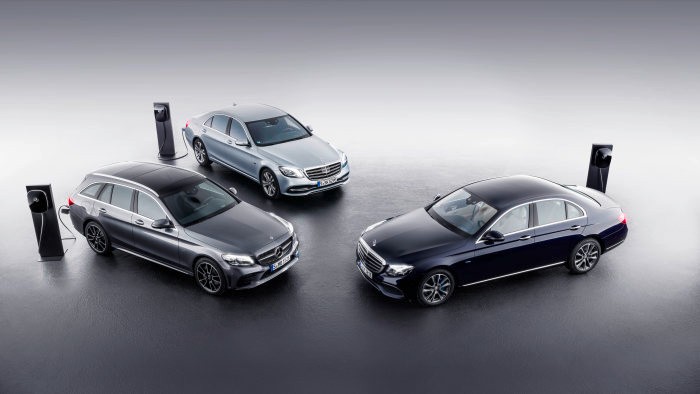
Stuttgart/Geneva. The Geneva Motor Show will see the debut of two new Mercedes-Benz preproduction models that combine state-of-the-art diesel technology with the 9G-TRONIC 9-speed hybrid transmission. Like the S 560 e (combined fuel consumption 2.1 l/100 km, combined CO2 emissions 49 g/km)[1], the C- and E-Class plug-in diesel hybrids will in future use third-generation hybrid technology. Delivery of the first models is scheduled for late summer 2018. At the moment, the company is making systematic preparations for series production of the new plug-in hybrids, with its engineers taking the last important steps on the way to the start of production. Also new: an intelligent, connected variant of the Mercedes‑Benz wallbox will make for easier charging while offering a series of additional functions via a new app.

Plug-in hybrids represent a key technology on the road to a locally emission-free future for the motor vehicle. They offer customers the benefits of two worlds: in town, they run in all-electric mode, while on long journeys they profit from the range of the combustion engine. Mercedes-Benz will for the first time combine the state-of-the-art four-cylinder diesel with the third-generation hybrid drive. The result: even higher efficiency, remarkable ride comfort and dynamic performance as well as an impressive range.
As the strengths of plug-in hybrids come to the fore, especially in larger vehicles and on mixed route profiles, Mercedes-Benz is now opting for this powertrain concept from the C-Class upwards. A key advantage in the strategic hybrid initiative is offered by Mercedes-Benz's intelligent, modular hybrid concept: designed to be scalable, it can be transferred to a large number of rear-wheel drive model series and body styles as well as left- and right-hand drive variants. Hybridisation makes the combustion engine more efficient while delivering a more dynamic performance and greater driving pleasure.
Soon to launch: plug-in diesel hybrid in C- and E-Class
One of the highlights with regard to technology and efficiency promises to be the new plug-in hybrid diesel in the Mercedes-Benz C- and E-Class. Mercedes‑Benz will for the first time pair its state-of-the-art diesel engine with an externally chargeable hybrid system. The combination of the new OM 654 four-cylinder diesel engine with the latest-generation 9G-TRONIC 9-speed hybrid transmission promises to enhance the experience of locally emission-free mobility while at the same time offering emotively appealing driving pleasure. The projected key points are 90 kW electric output, an additional electric torque of 440 Nm and an electric range of around 50 km in the NEDC.
This is made possible in the third hybrid generation also by the new lithium-ion battery, which can store 13.5 kWh of energy. The new on-board charger doubles the charging rate from 3.6 kW to 7.2 kW. A discharged battery can thus be fully recharged in two hours at a wallbox, for example in the convenience of one's own home. This is possible within around seven hours even at a conventional domestic power socket.
The third-generation hybrid technology supports the driver with further improved, intelligent drive management. Through the extended use of data from the navigation system and information from the camera and the radar sensor, third-generation hybrid vehicles can look ahead, well beyond the driver's field of vision, and adjust to the specific speed/route profile. Events such as negotiating towns on the way to the destination are taken into account when planning the available electrical energy, and during recuperation and thermal conditioning of the drive components.
In addition to a superlative driving experience with a total torque of 700 Nm, available from as low as 1400 rpm, the new plug-in diesel hybrids will offer added comfort. The high-voltage on-board electrical system supplies not only the powertrain components, but also the electric refrigerant compressor and the high-voltage heater booster. Both allow pre-entry climate control of the interior not only in summer but also in winter.
Flagship of the third hybrid generation: the S 560 e
Also the S 560 e (combined fuel consumption 2.1 l/100 km, combined CO2 emissions 49 g/km) has an all-electric range of around 50 kilometres in the NEDC. This is the model in which the new power electronics, considerably more efficient than the previous generation, made their debut. The hybrid drive in the S 560 e combines the 270 kW (367 hp) of the V6 petrol engine with an electric output of 90 kW.
State-of-the-art diesel: OM 654
The new plug-in diesel hybrids in the C- and E-Class will share the new OM 654 four-cylinder diesel engine. This ultra-modern engine family opens up new dimensions in efficiency. It is the first passenger car diesel engine to use the stepped-bowl combustion process – named after the shape of the combustion bowl in the piston. The innovations also include the combination of an aluminium engine block and steel pistons, as well as the further-improved NANOSLIDE® coating of the cylinder walls. The internal friction has been reduced by around 25 percent. The new engine also benefits from the use of fourth-generation common-rail injection with pressures of up to 2050 bar.
On top of this, the engine is also more compact than its predecessor. All components relevant for efficient emissions reduction are installed directly on the engine. Thanks to the near-engine configuration, exhaust aftertreatment has a low heat loss and excellent operating conditions.
Intelligent operating strategy with ECO Assist
The new hybrids provide the driver with comprehensive assistance in terms of predictive driving and fuel-saving: the driver is prompted when appropriate to come off the accelerator, e.g. because the S-Class is approaching a speed limit, and assisted by innovative functions such as coasting and energy recovery. For this purpose, navigation data, traffic sign recognition and information from the intelligent safety assistants (radar and stereo camera) are linked and processed.
ECO Assist takes the following traffic situations and information into account in its driving recommendations and efficiency strategy:
Route profile (bends, junctions, roundabouts, gradients) Speed limits Distance from vehicles ahead. ECO Assist continuously generates coasting simulations in the background: depending on the state of charge of the battery and the traffic situation, it computes whether the vehicle should ideally be allowed to coast with the lowest possible driving resistance with the driver's foot off the pedals, or whether it should be decelerated so that the battery can be efficiently charged (energy recovery).
The haptic accelerator helps the driver to achieve an economical and comfortable driving style. A variable pressure point in the pedal, for example, tells the driver that the maximum electric power is being delivered. If the driver continues to press the pedal beyond the pressure point, the combustion engine kicks in. A perceptible resistance in the haptic accelerator advises the driver to take their foot off the accelerator. If the driver follows this recommendation, the combustion engine is switched off and decoupled from the powertrain.
Within the limits of the system, ECO Assist controls the overrun mode according to the situation as soon as the driver takes their foot off the accelerator. The driver is also given a visual prompt to do this: by a “foot off accelerator” symbol in the central display (or, if installed, in the head-up display). At the same time, a diagram gives the driver the reason for the recommendation (e.g. “Junction ahead” or “Gradient ahead”).
To increase the driver's motivation to follow the recommendations of ECO Assist, the on-board computer records how many kilometres/for how much time during a journey the car was driven with the engine off, and shows this in the central display. The reward not only takes the form of reduced fuel consumption, but also an increased electric range.
Performance to suit the driver's wishes: four hybrid modes
Depending on the driver's wishes, four operating modes can be preselected. They are:
HYBRID: Default setting; all functions, such as electric driving, boost and energy recovery, are available and used according to the driving situation and route profile E-MODE: Electric driving, for example in the city centre. The accelerator signals the pressure point at which the combustion engine is started E-SAVE: The charged battery is held in reserve to allow driving in all‑electric mode later CHARGE: The battery is charged while driving. Third-generation hybrid drive: more powerful, more compact
The third-generation hybrid transmission is based on the 9G-TRONIC automatic transmission. The torque converter, clutch and electric motor are housed in the innovative hybrid drive unit. The compact design was achieved by integrating and connecting the separating clutch, torsional vibration damper and torque converter lockup clutch within the rotor of the electric motor. The torque converter with its powerful and highly efficient hydraulic circuit offers the customary smoothness when pulling away in hybrid mode.
Developed together with Bosch as part of the EM-motive joint venture, the electric motor was specially designed for the 9G-TRONIC plug-in hybrid transmission. The equally new power electronics have allowed further increases in output and torque compared with the second generation. The electric performance of 90 kW and 440 Nm contributes to an effortlessly superior driving feel. The top speed in e-mode has been raised from 130 km/h to 140 km/h.
A key factor in the increase of the electric range to around 50 kilometres is the nominal capacity of the new lithium-ion battery, which has grown to 13.5 kWh, while the size of the battery has remained the same. The evolution of the cell chemistry from lithium-iron-phosphate (LiFePo) to lithium-nickel-manganese-cobalt (Li-NMC) made it possible for the cell capacity to be increased from 22 to 37 Ah. The highly efficient battery system comes from the Daimler subsidiary Deutsche ACCUMOTIVE. The power electronics are housed in the engine compartment.
History: first hybrid on the market as early as 2009
The cornerstone of Mercedes-Benz's first hybrid generation, the S 400 Hybrid came out in 2009 as a P1 system (electric motor installed directly on the combustion engine) with an electric output of 20 kW. The strengths of the independent hybrid system lay in the efficiency gain from the recovery of braking energy as well as in the enhanced agility thanks to the electric boost, while the hybrid components added little extra weight. The second hybrid generation came in the form of a P2 configuration (electric motor at the transmission input with clutch in between). In the S-Class, an electric output of 20 kW was combined with a petrol engine in the S 400 h and a diesel engine in the S 300 h.
The first plug-in hybrid system from Mercedes-Benz came out in 2014 in the form of the S 500 Plug-In Hybrid. The available installation space was used to house a capacity of 8.7 kWh for an electric range of 33 km in the NEDC. The output of the electric drive was increased to 85 kW/ 340 Nm, which, in combination with the 245 kW six-cylinder petrol engine, made for a performance on a par with that of an eight-cylinder machine.
Plug-in hybrid without combustion engine: GLC F-CELL
The new GLC F-CELL unveiled at the IAA in September 2017 as a preproduction model is also a plug-in hybrid, for, in a world first, innovative fuel cell/battery technologies have been combined. With up to 4.4 kg of hydrogen on board, this GLC produces sufficient energy for a range of up to 437 km in the NEDC (measured in the presence of TÜV). GLC F-CELL drivers will also benefit from an additional range of up to 49 km in the NEDC thanks to the large lithium-ion battery.
New wallbox from Mercedes-Benz: home charging the easy, compact and intelligent way
The new-generation Mercedes-Benz wallbox makes the charging of plug-in hybrids and electric vehicles even more convenient for the customer: with up to 22 kW, the home charging station is more powerful than ever and makes it possible for the first time, among other things, to control various functions from a smartphone. These include charging control, user management and consumption overview.
The new-generation home charging station from Mercedes-Benz also comes in an even more elegant housing design with cable management. It will be available for European customers from summer 2018 – more than 40 other markets will later follow. Customers can choose between three versions: the basic Wallbox Home, the internet-capable Wallbox Advanced and the Wallbox Twin for charging two vehicles at the same time.
The attractiveness of electric vehicles is closely linked to the availability of suitable charging options. Whether at home using a wallbox, while shopping, at work or super-fast on the motorway: the options for supplying electric vehicles with energy are highly varied: the majority of charging will take place at home. With a wallbox, this is not just convenient, but also considerably faster than from a domestic wall socket, because the wallbox allows charging with up to 22 kW. The new third-generation plug-in hybrids from Mercedes-Benz, for example, can take a charging rate of 7.2 kW. This means that such a vehicle can be charged up to four times faster with a wallbox than when charging from a domestic wall socket.
Intelligent charging management by RFID
The intelligent Advanced and Twin wallboxes are internet-capable, with a built-in electricity meter and allow access control by RFID (Radio Frequency Identification). This makes it possible to manage several vehicles of different users, which is especially attractive for fleets – as well as for office communities or apartment buildings. Thanks to intelligent sharing of the charging power by local load management with up to 14 additional wallboxes, there is no need – even if several wallboxes are installed – for expensive upgrading of the existing house connection. The special thing about the Wallbox Twin: it allows two vehicles (each with 11 kW) to be charged simultaneously from the same wallbox. The Home and Advanced wallboxes will be available from summer 2018, with the Twin variant coming out slightly later in the year.
Everything at a glance: the new Wallbox Web App
The new Wallbox Web App makes it possible for charging control, user management, charging statistics and cost-optimised charging to be adjusted very simply from a smartphone. Also optionally available in Europe is a local billing service for company cars as well as Wallbox Sharing with the partners ABL and has.to.be.
[1] The stated values are the “measured NEDC CO2 values” in conformance with Art. 2 No. 2 Implementing Regulation (EU) 2017/1153, which were determined in accordance with Annex XII of Regulation (EC) No. 692/2008. The fuel consumption figures were calculated based on these figures.

Download

Filter

Show thumbnails
Show list
Slideshow

Zoom

Preview

Details

Do you really want to delete the data record?

Please wait a moment …

Please wait a moment …

Please wait a moment …

Please wait a moment …

18C0194_05

18C0194_01

18C0194_02

Loading

Market entry: ViaVan launches app-based on-demand ridesharing service in Amsterdam

05.

March 2018

Stuttgart

Press Contact for this Press Release (1)

Thomas Christian Rosenthal

Product Communications adVANce and Future Transportation

thomas_christian.rosenthal@daimler.com

Tel: +49 711 1740286

Fax: +49 711 1779029941

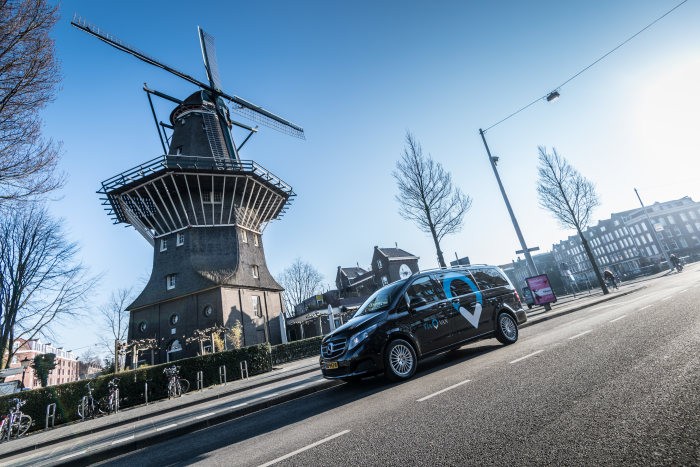
ViaVan, the joint venture between Mercedes-Benz Vans and Via, is launching its service in Amsterdam. The Dutch capital is thus the first city in Europe where this cost-effective and sustainable alternative form of mobility is available with immediate effect. Thanks to innovative technology which enables journeys to be pooled, passengers with similar or the same destinations travel together without any lengthy detours and delays. In September of last year Mercedes-Benz Vans and Via, a start-up company based in New York, founded the joint venture ViaVan with the following aim: to bring ridesharing to Europe and to establish it here as a complement to existing mobility offers. Other cities are to follow suit, including Berlin and London, where the service will also be launched depending on final approvals.
Further information on this topic is available on the ViaVan website: www.ViaVan.com/amsterdamlaunch

Download

Filter

Show thumbnails
Show list
Slideshow

Zoom

Preview

Details

Do you really want to delete the data record?

Please wait a moment …

Please wait a moment …

Please wait a moment …

Please wait a moment …

18C0207_01

18C0207_02

18C0207_03

18C0207_04

18C0207_05

18C0207_06

18C0207_07

18C0207_08

18C0207_09

Loading

The new Mercedes-AMG C 43 4MATIC Saloon and Estate: Enhanced performance and a design update

05.

March 2018

Affalterbach

Press Contact for this Press Release (2)

Birgit Zaiser

Manager Communications Mercedes-AMG

birgit.zaiser@daimler.com

Tel: +49 7144 302-581

Fax: –

Koert Groeneveld

Head of International Product & Technology Communications

koert.groeneveld@daimler.com

Tel: +49 711 17-92311

Fax: +49 711 17-94365

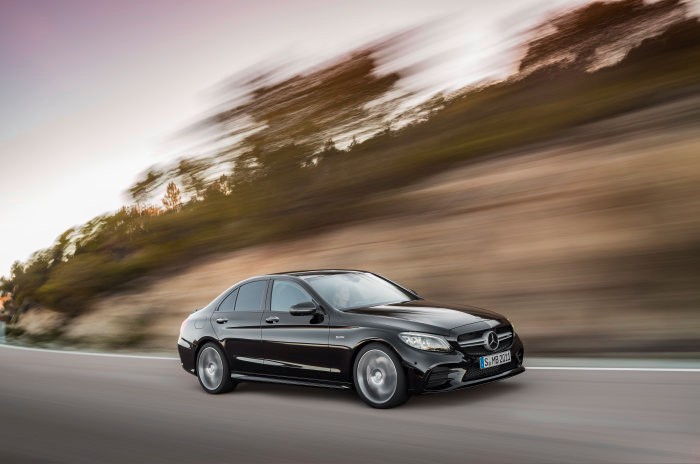
Fuel consumption combined: 9.4-9.1 l/100 km; combined CO2 emissions: 214-209 g/km* (provisional data)Affalterbach. With four body variants, three output levels and two drive types, the C-Class is the most versatile and most successful model series from Mercedes-AMG. Extensive measures now make the entry-level models, the C 43 4MATIC Saloon (combined fuel consumption: 9.1 l/100 km; combined CO2 emissions: 209 g/km[1]) and Estate (combined fuel consumption: 9.4 l/100 km; combined CO2 emissions: 214 g/km1) even more attractive. The AMG radiator grille in a twin-louvre design, the powerfully sculpted front apron and the new rear apron with round twin tailpipe trim elements visibly enhance the new C 43 models and give them an even more distinct positioning. The interior benefits from an optional fully digital cockpit with unmistakable AMG displays and the new generation of AMG steering wheels. The 3.0-litre V6 biturbo engine now delivers 287 kW (390 hp). Together with the AMG SPEEDSHIFT TCT 9G transmission and rear-biased AMG Performance 4MATIC all-wheel drive, the engine combines agile driving dynamics with comfort on long journeys.
“As the most successful model series for Mercedes-AMG, the C-Class family in all its facets has made a major contribution to our corporate success. One major component in this success story was the implementation of the 43-series models, which have thrilled our customers worldwide since the market launch in 2015. The high demand and positive feedback have encouraged us to sharpen up not only the appearance of the facelift, but also its performance, efficiency and dynamism in true AMG style,” says Tobias Moers, Chairman of Mercedes-AMG GmbH.
For this the AMG development engineers have increased the output of the 3.0‑litre V6 engine by 17 kW (23 hp) to 287 kW (390 hp). The peak torque of 520 Nm is available from 2500 to 5000 rpm. This package guarantees impressive performance figures: the new C 43 4MATIC Saloon accelerates from a standstill to 100 km/h in 4.7 seconds, and the Estate in 4.8 seconds. The top speed is electronically limited to 250 km/h.
Sporty and distinctive: the exterior design
The exterior of the C 43 4MATIC is considerably more expressive, even more strongly identifying the new model as a member of the family. New distinguishing features include the AMG radiator grille with twin louvre in matt iridium silver and the powerfully sculpted front apron with additional flics. The side air curtains in the front apron help with optimum guidance of the front airstream. The attachment on the cross fins plus the trim element on the front splitter are finished in silver chrome.
The rear view also conveys a sporty impression with two round twin tailpipe trim elements in high-gloss chrome. The rear apron with side air curtain look and the significantly more expressive diffuser improve air flow characteristics at the rear. The spoiler lip on the boot lid is painted in the vehicle colour.
The optional AMG styling package creates highlights, which are even sportier: a more expressive front splitter, the standard-fit spoiler lip, broader side skirt inserts and flics in the rear bumper are finished in high-gloss black.
Enhanced aerodynamic efficiency: the new AMG aero wheels
When viewed from the side, eye-catching features include the sporty side skirts plus new, aerodynamically optimised AMG light-alloy wheels. Their specifically designed outer aero rings and spoke geometry, which has been optimised in the wind tunnel help to improve air flow around the wheels and thus increase aerodynamic efficiency. As part of this, the developers aimed for the optimum combination of aerodynamics, weight and brake cooling, together with maximum performance and reduced fuel consumption.
There is a choice of two aerodynamically optimised rim designs for the C 43 4MATIC: the standard specification includes the AMG wheel with five twin spokes painted in tremolite grey with a high-sheen finish, in size 7.5 J x 18 ET with 225/45 R 18 tyres at the front, and 8.5 J x 18 ET with 245/40 R 18 tyres at the rear.
As an option there is another design with five twin spokes, painted in tantalite grey, high-gloss black or matt black with a high-sheen finish, in size 7.5 J x 19 ET with 225/40 R 19 tyres at the front, and 8.5 J x 19 ET with 255/35 R 19 tyres at the rear.
Sporty look with model-specific details: the interior design
The interior reinforces the dynamic calibre of the new C 43 4MATIC with numerous individual details. Sporty materials such as leather, DINAMICA microfibre and aluminium in a high-quality finish continue the theme of the expressive exterior in the interior.
The optional AMG Performance seats provide optimum lateral support when adopting a dynamic driving style thanks to the special design of the seat side bolsters of the seat cushion and backrest. As an option the seat side bolsters can be adjusted perfectly by means of built-in air cushions. The Performance seats with integrated head restraints emphasise the sporty character of the cockpit. For the first time in the C 43 4MATIC, the Performance seats can not only be heated, but now also climatised in three levels in conjunction with leather upholstery.
The upholstery in ARTICO man-made leather / DINAMICA microfibre in black with red topstitching equally underscores the dynamic driving character of the C 43 4MATIC. Matching the seat design, the door centre panels and dashboard are finished in ARTICO man-made leather with red topstitching. Aluminium sports pedals with black studs, trim elements in black piano lacquer with light longitudinal-grain aluminium, the black roof liner and the red seat belts create further sporty highlights.
Comprehensive individualisation options
As an option there is a comprehensive choice of individualisation options. New features include trim elements in anthracite open-pore oak wood, open-pore walnut plus the combination of longitudinal-grain aluminium for the doors and black open-pore ash wood for the centre console. On top of this there is the familiar AMG trim in carbon fibre / light longitudinal-grain aluminium and matt silver fibreglass. In terms of upholstery, as an option there is leather in black, black with red topstitching, cranberry red / black and also as a new highlight saddle brown / black.
A fine combination available from the designo range comes with diamond quilting in saddle brown / black and platinum white pearl / black, which can likewise be combined with the AMG Performance seats.
Interior with innovative display concept and operating system
Whether with touchpad and Controller, Touch Control buttons on the steering wheel or via voice entry: the operating system of the C 43 4MATIC is just as versatile as it is flexible. All options are aimed at enabling the control tasks to be carried out as conveniently, quickly and appropriately to the situation as possible in this sporty environment.
Just as flexible is the display of the optional, fully digital instrument cluster with 31.2 cm (12.3-inch) screen diagonal, which brings the vehicle functions directly to life with the three AMG-specific display styles of “Classic”, “Sport” or “Supersport”.
A host of additional AMG information
Via the specific AMG menu, the driver is able to call up a host of additional information to make the driving experience even sportier:
Warm-up: engine and transmission oil temperature plus charge pressure as Boost display Setup: current status of systems such as the drive system, suspension, exhaust system, ESP®, transmission G-Force: display of current g-forces in a coordinate system and ability to save maximum values Race Timer: manual stopwatch for lap times and colour display of fastest and slowest laps, plus average speed and distance Engine Data: engine torque / rated output in a bar chart plus charge pressure as Boost display In addition, there is a digital display of the current speed and the currently engaged gear. The manual transmission mode is marked with a yellow “M”.
The visualisations in the central media display likewise enable further vehicle functions to be experienced even better, e.g. with animated presentation of the driving assistance, vehicle and communication systems. A media display measuring 17.8 cm (7 inches) with a resolution of 960 x 540 pixels comes as standard on board. Another alternative is the 26.0 cm (10.25-inch) media display with a resolution of 1920 x 720 pixels. This is included as standard in conjunction with COMAND Online, or optional for the Audio 20 GPS system.
New generation of AMG steering wheels
Extremely sporty design, a grippy shape with a heavily contoured rim and intuitive operation are the key attributes of the new AMG steering wheel in nappa leather, which comes as standard equipment. It has a flattened bottom section and is perforated in the grip area. The galvanised steering wheel gearshift paddles support a sporty driving style with manual gear shifting. As an option it is also available in nappa leather / DINAMICA microfibre and in nappa leather with trim in black piano lacquer.
The built-in Touch Control buttons are a new feature. These can be used to control the functions of the instrument cluster (left) and the multimedia system (right) by means of horizontal and vertical swiping movements of the finger. As in the S-Class, the settings for Active Distance Assist DISTRONIC and cruise control are made in the left control panels. The control panels on the right are used to activate the voice control and telephone, and to regulate the sound volume, music selection and other functions of the multimedia system.
Well-proven and powerful: the AMG 3.0-litre V6 biturbo engine
The V6 biturbo engine boasts a high power output combined with low fuel consumption and emissions. The high power output is in part courtesy of separate, larger turbochargers (max. charge pressure 1.1 bar). Installed close to the engine, the two turbochargers are especially spontaneous in their response. The AMG power unit can be identified by the engine cover with red aluminium insert and AMG lettering.
AMG SPEEDSHIFT TCT 9G transmission with shorter shift times
The C 43 4MATIC makes use of the AMG SPEEDSHIFT TCT 9G transmission, which the Mercedes-AMG developers have tuned specifically for a dynamic driving experience. This has a model-specific software application to achieve very short shift times.
The multiple downshift function allows more spontaneous bursts of speed, while the double-declutching function in “Sport” and “Sport+” drive programs makes for an even more emotional driving experience. Defined ignition adjustments also provide faster gear shifts in the other modes. In all modes moving off occurs in first gear in order to always guarantee a dynamic driving experience.
“Manual” mode can be selected using a separate button in the centre console. The gear changes are based on the selected drive program, and the driver can now change gear using the paddles on the steering wheel. Moreover, the transmission stays in the selected gear and does not automatically shift up when the engine speed reaches the limit.
Characteristics at the touch of a finger: AMG DYNAMIC SELECT
With the proven DYNAMIC SELECT drive programs “Comfort”, “Sport”, “Sport+” and “Individual”, the characteristics of the C 43 4MATIC+ can be customised at the tap of a finger. The available range extends from efficient and comfortable to very sporty. This modifies key parameters, such as the response of the engine, transmission, suspension and steering. Independently of the DYNAMIC SELECT drive programs, the driver has the option of pressing the “M” button to switch directly to manual mode, in which gearshifts are executed exclusively using the shift paddles on the steering wheel. The suspension set-ups can also be selected specifically on demand.
The fifth mode “Slippery” is new, and is identified by means of the snowflake symbol. The moderate and even power delivery is specially programmed for slippery or snow-covered road conditions.
Rear-biased and agile: AMG Performance 4MATIC all-wheel drive
The standard-specification AMG Performance 4MATIC four-wheel drive features rear-biased torque distribution with a front/rear axle split of 31 to 69 percent. This configuration provides for enhanced driving dynamics and higher lateral acceleration on the road as well as improved traction when accelerating. The single-stage transfer case of the four-wheel drive system is flange-mounted to the transmission as a separate system.
This configuration makes it easier to modify the torque split for each particular model, allowing even more individual characteristics for the respective model series. Its compact design means that it does not entail any space restrictions for passengers or luggage.
With adaptive adjustable damping: AMG RIDE CONTROL suspension
With its adjustable, electronically controlled damping system, the AMG RIDE CONTROL steel suspension of the C 43 4MATIC provides both sporty driving dynamics and brand-typical comfort on long journeys. The basis for this is formed by the 4-link front axle and independent multilink rear suspension. The AMG-specific kinematics and elastokinematics with newly developed components result in very high camber stability when cornering at speed. The axial brake connection on the front axle supports the agile and precise handling.
The adaptive adjustable damping comes as standard. This fully automatic, electronically controlled system adjusts the damping at each wheel to the current requirements. This improves driving safety and ride comfort. The damping is adjusted individually for each wheel, and depends on the driving style, the road surface and the selected suspension setting. The ideal operating point can be selected at all times on the basis of a broad scope of information relating to acceleration or vehicle speed, for example. Via a switch on the centre console, the driver can select between three different sets of damper characteristics, namely “Comfort”, “Sport” and “Sport+”, and thus individually influence the driving experience — from highly comfortable to sportily taut.
Direct and with clear feedback: the AMG speed-sensitive steering
The electromechanical speed-sensitive power steering has a variable ratio. It impresses with its precise, authentic feedback. The steering servo assistance is reduced at high speeds, and continuously increases at lower speeds. This means that comparatively little steering force is required at low speeds, and that the best possible control over the vehicle is maintained at high speeds. The steering servo assistance depends on the selected suspension setting. In “Sport” mode, more feedback is conveyed about the driving conditions.
Data logger for use on the racetrack: AMG TRACK PACE
As the virtual race engineer for recording data when driving on closed-off racetracks, AMG TRACK PACE provides a significantly extended and even more precise scope of functions. TRACK PACE can be ordered as an option for the COMAND Online infotainment system.
When this function is activated, a wealth of vehicle-specific data (e.g. speed, acceleration) are recorded ten times per second while driving. On top of this there are displays of lap and sector times and also the respective difference for a reference time. Because specific display elements light up in green or red, the driver is able to see at a glance, without reading numbers, whether he/she is currently faster or slower than the best time.
After fast laps on the racetrack, driving skills can be analysed and improved on the basis of the data. In addition, acceleration and deceleration values (e.g. 0-100 km/h, ¼ mile, 100-0 km/h) can be measured and saved. Thanks to a new developed algorithm which determines the vehicle position as precisely as possible, TRACK PACE even detects when the circuit is departed from or shortened. Alongside GPS data, the sensors available in the vehicle (acceleration, gyroscope, steering angle, wheel speeds) are used. The data are displayed on the multimedia display, in the instrument cluster and on the head-up display. Known racetracks, for example the Nürburgring, are already stored.
Furthermore, it is also possible to record your own circuits. The map display can be switched from 2D to 3D and updated online. A suitable iPhone app can also be connected via WLAN. Customers can use it to share their experiences and data from the racetrack with other AMG drivers via Facebook, YouTube or the AMG Private Lounge.
Wellness on long-distance journeys: ENERGIZING comfort control
The optional ENERGIZING comfort control is also available for the new C 43 4MATIC. It networks together the various comfort systems in the vehicle and uses specific functions of the air conditioning and seats (heating, ventilation) plus lighting and music moods. Depending on the mood or requirement of the driver, it generates a special wellness set-up to enhance well-being and performance.
Technical data at a glance
Mercedes-AMG C 43 4MATIC Saloon
Mercedes-AMG C 43 4MATIC
Estate
Engine
3.0-litre V6 with two turbochargers
Displacement
2996 cc
2996 cc
Output
287 kW (390 hp) at 6100 rpm
Peak torque
520 Nm at 2500-5000 rpm
Drive system
AMG Performance 4MATIC all-wheel drive with rear-biased torque distribution
Transmission
AMG SPEEDSHIFT TCT 9G
Fuel consumption, combined
9.3-9.1 l/100 km*
9.6-9.4 l/100 km*
Combined CO2 emissions
213-209 g/km*
220-214 g/km*
Efficiency class
F
F
Acceleration 0-100 km/h
4.7 s
4.8 s
Top speed
250 km/h**
250 km/h**
* The stated figures (provisional data) were determined in accordance with the prescribed measuring method. These are the “NEDC CO2 figures” according to Art. 2 No. 1 Implementing Regulation (EU) 2017/1153. The fuel consumption figures were calculated based on these figures. ** electronically limited
[1]The stated figures (provisional data) were determined in accordance with the prescribed measuring method. These are the “NEDC CO2 figures” according to Art. 2 No. 1 Implementing Regulation (EU) 2017/1153. The fuel consumption figures were calculated based on these figures.

Download

Filter

Show thumbnails
Show list
Slideshow

Zoom

Preview

Details

Do you really want to delete the data record?

Please wait a moment …

Please wait a moment …

Please wait a moment …

Please wait a moment …

17C900_127

17C900_125

17C900_129

17C900_131

17C900_128

17C900_137

17C900_132

17C900_141

17C900_020

17C900_030

17C900_035

17C900_144

17C900_052

17C900_027

17C900_048

17C900_059

17C900_033

17C900_062

17C900_112

17C900_100

17C900_110

17C900_101

17C900_120

17C900_092

17C900_119

17C900_123

17C900_116

17C900_097

Loading

First examples will be in dealer showrooms in May: The new A-Class can be ordered now

05.

March 2018

Stuttgart

Press Contact for this Press Release (2)

Markus Nast

Manager Communications Compact Cars

markus.nast@daimler.com

Tel: +49 711 17-96357

Fax: +49 711 17-79055289

Koert Groeneveld

Head of International Product & Technology Communications

koert.groeneveld@daimler.com

Tel: +49 711 17-92311

Fax: +49 711 17-94365

Combined fuel consumption 6,2 – 4,1 l/100 km, combined CO2 emissions 141 – 108 g/km*Stuttgart. Prices for the new A‑Class start at 30,231.95 euros[1] for the A 200 with 120 kW (163 hp) and a manual transmission (combined fuel consumption 5.8 l/100 km, combined CO2 emissions 133 g/km[2]). Allowing for equipment, it therefore remains at the level of its predecessor. The market launch begins in May.
Prices for the new Mercedes-Benz A-Class:
A 200
A 200
A 250
A 180 d
Transmission
6-speed manual transmission
7G-DCT
7G-DCT
7G-DCT
Displacement (cc)
1332
1332
1991
1461
Power output (kW/hp)
120/163
120/163
165/224
85/116
at rpm
5500
5500
5500
4000
Peak torque (Nm)
250
250
350
260
at rpm
1620
1620
1800
1750-2500
Combined fuel consumption (l/100 km)2
6.3-5.8
5.6-5.2
6.5-6.2
4.5-4.1
Combined CO2 emissions (g/km)2
144-133
128-120
149-141
118-108
Acceleration
0-100 km/h (s)
8.2
8.0
6.2
10.5
Top speed (km/h)
225
225
250
202
Price from (euros)1
30,231.95
32,326.35
36,461.60
31,398.15
Edition 1: Exclusive special model on market launch
The A-Class will be available as an “Edition 1” model at an additional price of 7021 euros for around one year after the market launch. Both on the exterior and in the interior, the exclusive special model has numerous colour highlights in Edition green. In addition, equipment features such as LED High Performance headlamps, sport seats and ambience lighting are standard equipment. The Edition 1 is available with all engine variants.
Safety: MULTIBEAM LED, driving assistance systems, PRE-SAFE®
Another example of the technology transfer from the luxury to the compact class are the optionally available MULTIBEAM LED headlamps (1487.50 euros). These allow extremely quick and precise, electronically controlled adjustment of the headlamps to suit the current traffic situation. 18 individually actuated LEDs are housed in each headlamp. The daylight-like light colour of the LEDs is easy on the eyes and has a positive effect on concentration. As a further option, LED High Performance headlamps (987.70 euros) offer a wider light distribution compared to the standard halogen headlamps, a daylight-like light colour and lower energy consumption.
The new A-Class is equipped with the latest driving assistance systems, which give the driver cooperative support. This means that it has the highest level of active safety in its segment, with functions adopted from the S‑Class. For the first time, the A-Class is able to drive semi-autonomously in certain driving situations. Active Distance Assist DISTRONIC and Active Steering Assist now support the driver even more conveniently in keeping a safe distance and steering, and the vehicle speed is now also automatically adjusted on bends, at road junctions and on roundabouts.
The Driving Assistance package (1796.90 euros, expected to be available from fourth quarter of 2018) includes the following systems: Active Distance Control DISTRONIC with route-based speed adjustment; Active Steering Assist with Active Lane Change Assist and Active Emergency Stop Assist; Active Speed Limit Assist; Active Brake Assist with cross-traffic function; Evasive Steering Assist; Active Blind Spot Assist; PRE-SAFE® PLUS. PRE-SAFE® PLUS can recognise an imminent rear-end collision. If the danger of a collision persists, the system can lock the brakes of the stationary vehicle before a rear-end collision to prevent it from being shunted forward by the impact. This can minimise the risk of injury by reducing the forward jolt caused by the impact.
Further PRE-SAFE® functions are included in the Driving Assistance package, but are also separately available in the PRE-SAFE® system (392.20 euros). The PRE‑SAFE® system makes use of the time before an impending accident. Numerous measures can reduce the loads acting on the occupants. These also include the innovative PRE-SAFE® Sound system. This prepares the human hearing for the expected noise of an impact when there is a risk of a collision. When the danger of a collision is detected, the system causes the onboard sound system to emit a short rushing sound, which can activate a tiny muscle in the human ear. This contracts as a reflex when loud noises occur, thus protecting the hearing.
The optional head-up display (1178.10 euros) is a new feature in the A-Class. Important information is projected into the windscreen, reducing distraction from the traffic situation. There is also less eye fatigue for the driver, as the eyes do not constantly have to refocus between close-up and long-distance vision.
MBUX – Mercedes-Benz User Experience: In conversation with the car
The new A-Class is the first Mercedes-Benz model to feature the completely new multimedia system MBUX – Mercedes-Benz User Experience, which also ushers in a new era in Mercedes me connectivity. A unique feature of this system is its ability to learn thanks to artificial intelligence. MBUX is optionally individualisable, and adapts to suit the user. As a further option it features intelligent voice control, which is activated by the key phrase “Hey Mercedes”.
The MBUX functions are modular in structure, so that the precise needs of different customers and markets can be met. As standard this has two 7-inch displays for the instrument cluster and media display with touchscreen, a multifunction sport steering wheel with touch control buttons on the left and right, a USB interface (Type C), a Bluetooth® connection for telephony and audio sources.
Basic Navigation package (1356.60 euros): extended MBUX functions (including intelligent voice control with “Hey Mercedes”), navigation, pre-installation for Live Traffic Information and touchpad. Premium Navigation package (3016.65 euros): 10.25-inch instrument cluster, 10.25-inch media display, extended MBUX functions, navigation, pre-installation for Live Traffic Information, pre-installation for digital radio, touchpad and Traffic Sign Assist. MBUX Augmented Reality for Navigation (297.50 euros) is a completely new function where the map display is enhanced with augmented reality. A video image of the surroundings taken with the aid of the front camera is augmented with helpful navigation information, for example, arrows or house numbers are automatically superimposed directly onto the touchscreen of the media display.
New and improved Mercedes me connect services are being launched with the new infotainment generation MBUX. The Mercedes me App collection can be placed as an icon on the screen in a user-friendly way, and can be freely sorted on the homepage like all other main applications.
The individual Mercedes me Connect services are grouped into equipment packages. Those available for the new A-Class are the Connectivity package for Navigation (119 euros[3]), which includes Live Traffic incl. Car-to-X communication, map updates in the dealership or over-the-air and the extended navigation services such as carpark information, filling station prices) and the Connectivity package for Navigation and Comfort (261.80 euros with additional in-car office function and pre-installation for the Concierge service).
Mercedes me is now extending its services to include private car sharing: the Mercedes me Car Sharing App allows A‑Class drivers to share their vehicle with a specified group of users. Friends, family members or colleagues can then easily book the A-Class for a fixed period of time.
The authorised user opens the vehicle using the App and by means of the Mercedes me communication module installed in the vehicle. The A-Class is started with a key which is left in the vehicle, temporary use of which is likewise enabled over the air by Mercedes me. When returning the vehicle, the driver leaves the key in the vehicle and locks it using the App, thereby bringing the sharing period to an end. The key in the vehicle can be used only during the sharing period.
Comfort: ambience lighting, seat climate control, multicontour seat
64 colours are possible with the ambience lighting (315.35 euros, in combination with the Style, Progressive or AMG line). The different colours are composed into ten colour worlds to allow an avant-garde lighting display with spectacular colour changes. If required, the colour worlds adapt to suit the different styles of the Widescreen display.
At the same time, comfort features from higher vehicle segments make an appearance: For the first time in this model series, and apart from seat heating for the driver and front passenger (345.10 euros), seat climate control (1059.10 euros) and the Multicontour Seat package (702.10 euros, expected from second quarter of 2018) with a massage function are available for the front seats.
Services: Attractive offers by Mercedes-Benz Bank AG
Mercedes-Benz Bank offers attractive leasing and financing packages for private customers. For the A 200, for example (price: 34,289.25 euros) the leasing instalment is a monthly 299 euros[4].
With the market launch of the new A-Class, customers taking out the telematics-based car insurance “InScore” will receive a discount of up to 30 percent on their insurance premium. They can directly influence the amount of their insurance premium with a “driver score” that is made up of the driving style, driving time and route. Drivers can view their “driver score” at any time in the “Mercedes me” customer portal, and if necessary adapt their driving behaviour. The new, fully integrated telematics car insurance is available for all telematics-capable Mercedes-Benz vehicles.
All Mercedes-Benz vehicles feature extensive security and anti-theft systems. Secure access to systems, data security, data privacy and anti-theft protection are important elements of our research and development activities. These and other measures serve to protect personal data against unauthorised access or illegal processing and disclosure. The measures are part of our information security management system, and are continually adapted to technical and organisational developments.
The data relevant for calculation of the telematic premium are sent to the scorer service provider of Daimler Financial Services in pseudonymised form. An average score for driving behaviour is then calculated. As the next step, the insurer determines the amount of the premium on the basis of this average score. The individual data covering driving style, driving time and route are not passed on to the insurer.
The new A-Class also assists networking within fleets, and with “connect business”, which is provided by Mercedes-Benz Connectivity Services GmbH, it helps to save costs. The digital services include an automated vehicle log, vehicle status monitoring and intelligent lease monitoring features.
The service protects the personal privacy of users, as they can switch to private-use mode at any time. Whereas no positional data are transferred in private mode, the fleet manager has a high level of transparency with business journeys.
[1] All prices shown in this press information: MSRP for Germany including 19% VAT
[2] The stated figures were determined in accordance with the prescribed measuring method. These are “NEFZ CO2 figures acc. to the Art. 2 No. 1 Implementing Regulation (EU) 2017/1153. The fuel consumption figures were calculated based on these figures.
[3] Use of these services requires registration in the Mercedes me Portal and consent to the terms of use for the Mercedes me connect services. In addition the vehicle must be linked to the user account. After activation, the services can be used free of charge for the specified validity period, and can afterwards be renewed for a fee. Activation is only possible within two years of first registration.
[4] Calculation example for a period of 36 months and a total mileage of 30,000 kilometres with a leasing downpayment of 2190 euros

Download

Filter

Show thumbnails
Show list
Slideshow

Zoom

Preview

Details

Do you really want to delete the data record?

Please wait a moment …

Please wait a moment …

Please wait a moment …

Please wait a moment …

17C832_01

Loading

New power from Detroit for Daimler-trucks in North America

Stuttgart/Redford, Michigan – In February, Daimler Trucks North America (DTNA) subsidiary Detroit Diesel Corporation increased their engine-portfolio. The Detroit DD8 is built in the Detroit components plant and powers medium-duty trucks. Depending on output, the six-cylinder engine with 7.7 liter displacement releases between 260 and 350 hp. By introducing the DD8, Daimler is ahead of… Continue reading New power from Detroit for Daimler-trucks in North America

The new Mercedes-Benz CLS: Third generation of the original

02.

March 2018

Stuttgart/Barcelona

Press Contact for this Press Release (3)

Birgit Zaiser

Manager Communications Mercedes-AMG

birgit.zaiser@daimler.com

Tel: +49 7144 302-581

Fax: –

Koert Groeneveld

Head of International Product & Technology Communications

koert.groeneveld@daimler.com

Tel: +49 711 17-92311

Fax: +49 711 17-94365

Steffen Schierholz

Manager Communications C-Class, E-Class, CLS

steffen.schierholz@daimler.com

Tel: +49 711 17-75852

Fax: +49 711 17-98646

Fuel consumption combined: 8.7 – 5.6 l/100 km; combined CO2 emissions: 200 – 148 g/km*

Download

Filter

Do you really want to delete the data record?

Please wait a moment …

Please wait a moment …

Please wait a moment …

Please wait a moment …

The new Mercedes-Benz CLS: Highlights: Key facts

Stuttgart/Barcelona, Mar 2, 2018

Short version: The new Mercedes-Benz CLS: Third generation of the original

Stuttgart/Barcelona, Mar 2, 2018

The new Mercedes-Benz CLS: Interesting facts: Did you know that…

Stuttgart/Barcelona, Mar 2, 2018

The new Mercedes-Benz CLS: Special Edition 1 model: Particularly exclusive launch model

Stuttgart/Barcelona, Mar 2, 2018

The new Mercedes-Benz CLS: Design: Following the traces of its predecessors

Stuttgart/Barcelona, Mar 2, 2018

The new Mercedes-Benz CLS under the microscope: MULTIBEAM LED headlamps: Outstanding light in any situation

Stuttgart/Barcelona, Mar 2, 2018

The new Mercedes-Benz CLS: Aerodynamics: Numerous detailed improvements

Stuttgart/Barcelona, Mar 2, 2018

The new Mercedes-Benz CLS: Drive system: Completely new range of engines

Stuttgart/Barcelona, Mar 2, 2018

The new Mercedes-Benz CLS on the test bench: New test cycle: The first Mercedes model certified according to WLTP/RDE

Stuttgart/Barcelona, Mar 2, 2018

The new Mercedes-Benz CLS: Driving assistance systems: Automated driving functions and exemplary safety

Stuttgart/Barcelona, Mar 2, 2018

The new Mercedes-Benz CLS: Infotainment system: Extensive entertainment and information programme

Stuttgart/Barcelona, Mar 2, 2018

The new Mercedes-Benz CLS: Body and passive safety: On the safe side

Stuttgart/Barcelona, Mar 2, 2018

The new Mercedes-Benz CLS: Suspension: A choice of three variants

Stuttgart/Barcelona, Mar 2, 2018

The new Mercedes-AMG CLS 53 4MATIC+: Sporty design combined with performance and efficiency

Stuttgart/Barcelona, Mar 2, 2018

Combined fuel consumption 8.7 l/100 km, combined CO2 emissions 200 g/km*

The new Mercedes-Benz CLS: Technical data

Stuttgart/Barcelona, Mar 2, 2018

The new Mercedes-Benz CLS: ENERGIZING comfort control: Wellness while driving

Stuttgart/Barcelona, Feb 26, 2018

Loading