Via Far Outpaces Uber, Lyft in NYC Utilization

Published June 21, 2019 6:01 pm, Via NYC
Via Far Outpaces Uber, Lyft in NYC Utilization
A new study by the city’s Taxi & Limousine Commissions reveals Via has a substantially higher utilization rate than its competition, cutting down on ‘cruising’

Newly proposed ride-hailing regulations in New York City reveal that Via is outpacing the competition yet again, this time showing that Via has a dramatically higher utilization rate than its competitors.

That’s according to a new study by the city’s Taxi & Limousine Commission on how to improve efficiency and manage for-hire vehicle growth in NYC. The city announced it will soon require for-hire vehicles in Manhattan be empty no more than 36 percent of the time by February 2020, and 31 percent by August 2020. But according to the TLC, Via is already at only 13 percent, while every other company is at least 42 percent.

According to the report, Via “has a substantially higher utilization in the Manhattan core (87%) than do Uber, Lyft, or Juno (54-58% in the Manhattan core). Of the other three high-volume FHV companies, Uber has the highest utilization and Juno the lowest, but the difference is small.”

Taking home the top spot for utilization is nothing new for Via, either. In 2018, the TLC reported that Via had the highest utilization rate of any for-hire vehicle service in New York City. Since launching in 2013, 95 percent of the company’s rides in NYC have been booked as shared. To date, Via’s shared rides eliminated 30 million driver miles on New York streets.

That’s compared to self-reported data from Uber and Lyft, which saw only 20 percent and 35 percent booked as shared, respectively.

The city’s latest report on utilization, however, comes just months after it mandated widespread driver wage increases, where it became clear that Via already paid its drivers far above the new minimum wage restrictions. And not by coincidence, Via’s higher driver pay and vehicle utilization are linked.

The TLC’s new report outlines how Uber, Lyft and Juno’s low utilization rates “cause drivers to spend over 40% of total work time empty and cruising for passengers. Combined with decreasing per-trip pay, this underutilization led to significant declines in driver income.”

Much like NYC’s updated minimum wage requirements, Via is already far exceeding the city’s new proposed “cruising” requirement. New York officials are now demanding that Uber, Lyft and Juno play catch-up.

Between Via’s exceptional utilization rate and high driver wages, the company continues to prove that it’s possible to run a highly efficient transportation service that both treats drivers fairly and reduces traffic congestion.

Read more

AEye Team Profile: Vivek Thotla

On June 26th, AEye Staff Engineer, Vivek Thotla, will be speaking on a panel called “Should We Take CV To The Edge?” at IoT Forum on Computer Vision @ Sensors Expo.
Vivek is a staff engineer at AEye, where he leads product verification and validation, and is responsible for LiDAR simulation and data strategy in producing automotive grade products. Previously, he was a Component Owner / Functional Delivery Owner for point cloud algorithms at Continental, where he was responsible for planning, requirements, design and development of embedded platform-based algorithms for a Hi-Res 3D Flash LiDAR, in addition to enforcing ADAS process stages to meet ASPICE levels and functional safety. He has also held engineering roles at Tribis, AmpliSine Labs, Missouri S&T and Enigma Portal. Vivek holds an MBA in Information Technology Project Management and a PhD and Masters in Electrical, Electronics and Communications Engineering.

We sat down with Vivek to learn more about the advantages of integrating computer vision at the sensor, building automotive grade LiDAR products, and why he decided to move to the Bay Area.

Q: How much of an autonomous vehicle’s computer vision should be done at the sensor, as opposed to a central processor?
The amount of data produced today by a perception system is enormous. And incorporating all the data from the different kinds of sensors used (like radar, camera, and LiDAR) makes it very difficult and expensive to process and store. In a typical perception system, roughly 80% of the data produced by the sensors is thrown out.

However, intelligent sensors – like what we develop at AEye – are software definable. Meaning, you can adjust its settings to get high resolution data from an object and get sparse data in the background, cutting down the overall amount of data processed by more than 80%. This makes computer vision algorithms at the central processor faster and efficient because once you preprocess data, latency becomes less of an issue. Currently, AV companies are spending a tremendous amount of money storing useless data. Preprocessing saves both time and money.

Q: What is the largest challenge in producing automotive grade LiDAR products?
Industry wide, the greatest challenge is maintaining the quality, reliability, and consistency needed on all components and software that go into a LiDAR sensor of over 100,000 samples or more and over the sensor’s lifetime. Another major challenge for bringing LiDAR products to the automotive market is designing the sensor to fit in different regions of the car. There are a lot of constraints based on where the sensor is placed on the vehicle and certain issues that arise from each placement. For example, a sensor placed behind a windshield might need a completely different design than a sensor that’s placed in the front bumper.

There are many interesting LiDAR architectures out there that work really well at smaller samples and in the lab. But the moment the product needs to scale and deal with all the quality and environmental requirements of being an automotive grade product, they fail. AEye is mitigating these challenges by partnering directly with Tier 1’s who know the process of making large-scale, automotive grade products. In my own experience, I’ve found that once a Tier 1 partners with you, they are extremely supportive because they believe in you, and that proves you are capable of achieving it.

In addition to our partners who help us push the sensor to automotive grade, we have a great functional safety team here at AEye. I came to AEye from a Tier 1, so I know what goes into developing an automotive grade sensor, and the AEye team is made up of people from all over the automotive industry that have great, diverse insight into how to bring a product to market.

Q: You moved to the Bay Area from Santa Barbara. What was it about Silicon Valley that drew you here?
It has always been my dream to come to Silicon Valley – you hear about it so much as the epicenter of technology and innovation. And it’s true: Silicon Valley is at the heart of the autonomous driving industry. All the innovative and novel work happening today in the LiDAR industry is happening here and I did not want to miss my chance to help develop the tools for true autonomy.

Connect with AEye at Sensors Expo! Learn more here.

AEye Team Profile: Vivek Thotla — VentureBeat Says iDAR Is “Built for Speed”AEye Team Profile: Dr. Allan SteinhardtAEye Adds VP of AI and Software to Executive TeamAEye Advisory Board Profile: Scott PfotenhauerThe Future of Autonomous Vehicles: Part II – Blind Technology without Compassion Is RuthlessAEye Advisory Board Profile: Adrian KaehlerAEye Team Profile: Indu VijayanAEye Expands Business Development and Customer Success Team to Support Growing Network of Global Partners and CustomersAEye Sets New Benchmark for LiDAR Range

Ford to Deliver Exciting Ford GT Supercar News at Goodwood Festival of Speed

About Ford Motor Company Ford Motor Company is a global company based in Dearborn, Michigan. The company designs, manufactures, markets and services a full line of Ford cars, trucks, SUVs, electrified vehicles and Lincoln luxury vehicles, provides financial services through Ford Motor Credit Company and is pursuing leadership positions in electrification, autonomous vehicles and mobility solutions.… Continue reading Ford to Deliver Exciting Ford GT Supercar News at Goodwood Festival of Speed

Jeffrey Jones

Jeff Jones is the Vice President of Ford’s North American City Solutions. He leads Ford’s global efforts to partner with municipalities to identify key urban mobility needs that will inform development of new mobility services while also working to create, pilot and implement new mobility solutions in cities worldwide. Previously, Jones was an Executive Director… Continue reading Jeffrey Jones

20 Jun 2019 UK consortium to drive new era of electric powertrain developm…

Ground-breaking concepts aim to provide the most cost-effective, lightweight, compact and efficient electric powertrain on the market Ambitious ACeDrive project positions the UK as global leader in electric powertrain research and development Match-funding awarded by the APC to help deliver mass-production ready technology Project led by GKN Automotive in partnership with Drive System Design and… Continue reading 20 Jun 2019 UK consortium to drive new era of electric powertrain developm…

Sophisticated and Sporty: The All-New Kia Seltos

News

All

SUBSCRIBE TO RSS FEED

XML

Seltos brings sophistication and assertiveness to the compact SUV marketForward-looking interior characterized by high-quality materialsPowered by efficient Smartstream petrol and diesel enginesOne of the most high-tech cars in its class with a range of in-car featuresSeltos will be manufactured in Andhra Pradesh, India, and Gwangju, KoreaOn sale in global markets during the second half of 2019 The new Kia Seltos brings sophistication, assertiveness and cutting-edge technology and safety features to the global compact SUV segment. Kia revealed the Seltos for the first time globally today at a special event in Delhi, India. The Seltos is characterized by distinctive design details, lending the compact SUV an air of understated sportiness. It combines forward-looking technical features, class-leading space and a suite of world-class safety features, and is powered by a choice of highly-efficient Smartstream petrol and diesel engines. Mr. Han-Woo..

GROUPE RENAULT AND NISSAN SIGN EXCLUSIVE ALLIANCE DEAL WITH WAYMO TO EXPLORE DRIVERLESS MOBILITY SERVICES

 Groupe Renault and Nissan to become the first automotive manufacturers to explore driverless mobility services with Waymo in France and Japan Exclusive agreement to initially focus on driverless mobility services for people and goods in France and Japan   Groupe Renault, Nissan Motor Co., and Waymo, leaders in their respective fields, have entered into an… Continue reading GROUPE RENAULT AND NISSAN SIGN EXCLUSIVE ALLIANCE DEAL WITH WAYMO TO EXPLORE DRIVERLESS MOBILITY SERVICES

Via and Busways Launch Microtransit Service Connecting The Ponds and Schofields Residents to Public Transit

Published June 12, 2019 4:16 pm, Via NYC
Via and Busways Launch Microtransit Service Connecting The Ponds and Schofields Residents to Public Transit
The Cooee Busways app brings on-demand, dynamic transportation to suburbs surrounding two new Sydney Metro stations.

June 12, 2019 (New South Wales, Australia) — Via, the world’s leading provider and developer of on-demand public mobility solutions, today announced a new microtransit deployment in partnership with Transport for New South Wales (TfNSW) and Busways, a leading Australian public transit provider. Called Cooee Busways, the new on-demand shared transit network brings first- and last- mile rides for residents in The Ponds and Schofields, connecting more residents to the Sydney Metro public transportation system.

Cooee Busways is now Via’s fourth microtransit deployment in New South Wales, Australia, joining services in Newcastle, Northern Beaches and Macquarie Park.

“Via’s technology is redefining mobility across the globe, and we are thrilled to partner with Busways and TfNSW to provide residents with a convenient, affordable, and congestion-reducing transportation alternative,” said Daniel Ramot, co-founder and CEO of Via. “Via’s powerful passenger matching and vehicle routing algorithm is the solution to solving the first-and-last mile challenge, seamlessly integrating into the existing public transit infrastructure to connect residents to transit hubs in their communities.”

Using the Cooee Busways app, riders will be able to hail a shuttle directly from their smartphone. Via’s advanced algorithms will enable multiple riders to seamlessly share the vehicle. The powerful technology will direct passengers to a nearby virtual bus stop within a short walking distance for pick up and drop off, allowing for quick and efficient shared trips without lengthy detours, or inconvenient fixed routes and schedules.

Cooee Busways operates Monday to Friday from 5 a.m. until 9 p.m., connecting commuters with Schofields Train Station and the new Sydney Metro stations at Tallawong and Rouse Hill. With the opening of Sydney Metro Northwest, Via’s timely deployment provides an affordable, convenient, and reliable transportation option for those commuting through these new major transit hubs.

“Integrated public transport options will alleviate commuter’s frustration with congestion on western Sydney roads when they’re just trying to get to work and back home each day,” Busways Managing Director, Byron Rowe, said. “The Ponds and Schofields are growing areas and the Cooee Busways on-demand service provides a crucial first and last mile link to the train and metro.”

Commuters can use the service by downloading the Cooee Busways smartphone app powered by Via, available on iOS and Android. Users can book rides between Schofields Train Station, Tallawong Metro station, or Rouse Hill Metro station, and anywhere within the service zone highlighted within the app.

Via is a leading provider and developer of on-demand public mobility solutions, working with cities and transportation agencies around the world to connect more people to transit. Cooee Busways is among numerous other deployments powered by Via around the globe that make it easier for commuters who do not own a car, prefer not to drive and park, or live within a long distance of a transit hub.

Via has been tapped by cities and transportation players around the world to help re-engineer public transit from a regulated system of rigid routes and schedules to a fully dynamic, on-demand network. Via now has more than 70 launched and pending deployments in more than 15 countries. To learn more about Via, visit www.platform.ridewithvia.com.

About Via
Via is re-engineering public transit, from a regulated system of rigid routes and schedules to a fully dynamic, on-demand network. Via’s mobile app connects multiple passengers who are headed the same way, allowing riders to seamlessly share a premium vehicle. First launched in New York City in September 2013, the Via platform operates in the United States and in Europe through its joint venture with Mercedes-Benz Vans, ViaVan. Via’s technology is also deployed worldwide through dozens of partner projects with public transportation agencies, private transit operators, taxi fleets, private companies, and universities, seamlessly integrating with public transit infrastructure to power cutting-edge on-demand mobility. For more information, visit www.platform.ridewithvia.com.

Read more

Now Available: XL and Lux Scheduled Rides

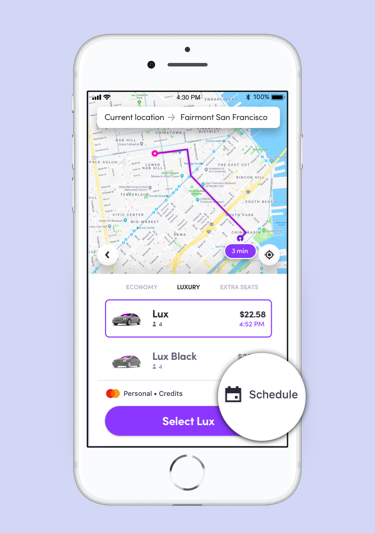
Did you know you can now schedule a Lux or XL ride up to a week in advance? Whether you’re catching an early-morning flight or have a business meeting across town, you’ll have one less thing to worry about. Now you can schedule XL and Lux rides for those times when you need extra space… Continue reading Now Available: XL and Lux Scheduled Rides

Joseph R. Hinrichs

Joe Hinrichs is president, Automotive, effective May 1, 2019, reporting to Jim Hackett, Ford president and CEO. In this role, Hinrichs leads Ford’s drive to strengthen its Automotive operations and deliver a sustainable global EBIT margin of 8 percent. Hinrichs has responsibility for Ford’s global business units – North America, South America, Europe, China and… Continue reading Joseph R. Hinrichs