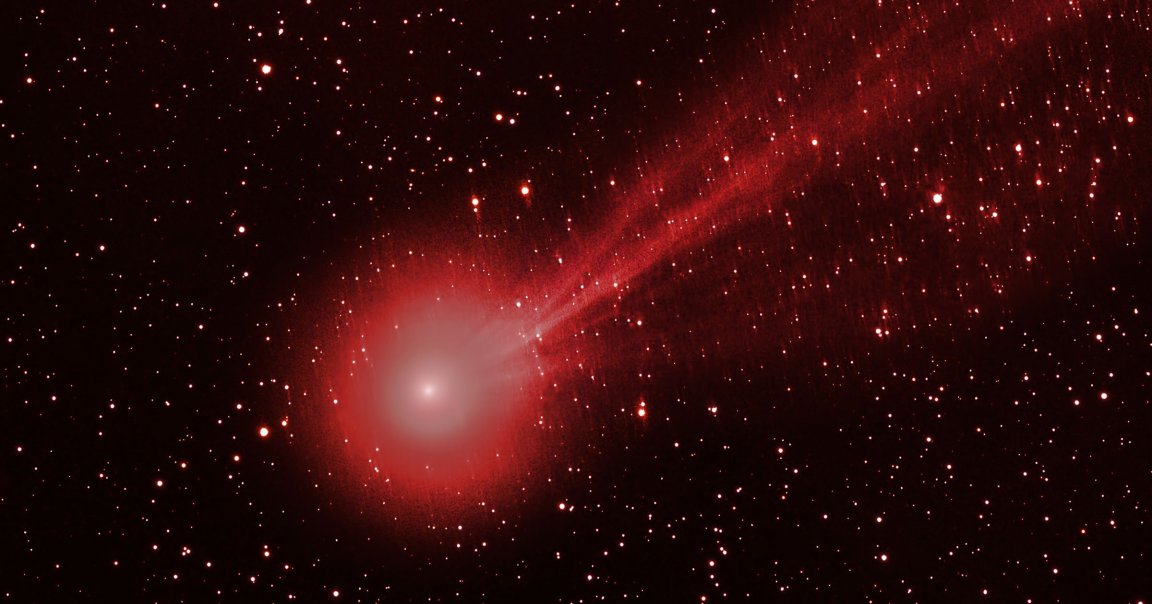
The mysterious interstellar object 3I/ATLAS is just weeks away from reaching its closest point to Earth: it’s expected to pass within just 170 million miles of our home planet on December 19, giving astronomers an unprecedented opportunity to take a closer look as it whizzes past.
As Harvard astronomer Avi Loeb points out in a new blog post, they’ll be building on intriguing existing observations from ground telescopes — including a paper published in the journal Astronomy & Astrophysics in October by a team of researchers in Europe and Africa that found signs that it’s radiating a “heartbeat” pulse of light that repeats every 16.16 hours.
While that may sound like an intriguing new fold in Loeb’s longstanding efforts to support the theory that the object could be an extraterrestrial spacecraft visiting the solar system, there’s likely a much more mundane explanation: that it’s spinning, pulsing us with light like an interstellar lighthouse.
“Overall, 3I shows characteristics typical of weakly active outer Solar System comets, despite its interstellar origin,” the researchers wrote in their paper. “Continued monitoring around perihelion is necessary to track changes in activity, color, which will provide insights into the evolution of interstellar materials under solar radiation.”
If it really is spinning, then 3I/ATLAS’ anti-tail — which scientists suspect is the result of a pocket of material less affected by the Sun’s radiation pressure — could be causing a stream of particles to flood to its coma, a fuzzy atmosphere of ice and dust surrounding its nucleus.
“In the context of a natural comet, this can arise from a sunward jet (anti-tail) that is initiated only when a large pocket of ice on one side of the nucleus is facing the Sun,” Loeb wrote. “As a result, the coma will get pumped up every time the ice pocket is facing the Sun.”
That kind of activity can resemble a “heartbeat with a puff of gas and dust serving the role of a stream of ‘blood’ through the coma periodically over the rotation period of 16.16 hours,” he added.
Though most scientists hold that the object is probably a natural comet, Loeb is still holding out hope that 3I/ATLAS’ jets could be technological in nature.
“For a technological object, the direction of the pulsing jet could be arbitrary and not necessarily pointing towards the Sun,” he wrote.
Regardless, getting a better sense of how these pulses change over time could shed more light on the matter. For one, its spin may have changed since it reached its perihelion, or closest point to the Sun, in late October.
“This heartbeat pattern should have been apparent in a series of well-calibrated snapshots of the coma over several days but none was systematically studied in the published literature,” Loeb wrote. “A movie showing the periodic brightening of the jets around 3I/ATLAS over several days can reveal whether the jets are natural or technological based on the orientation of the heartbeat pattern relative to the Sun.”
More on 3I/ATLAS: Professor Rages at NASA’s “Deceptive” Press Conference on Mysterious Interstellar Object