It’s been over two weeks since the Sun has set on Germany’s Neumayer III base in the Antarctic, due to the Earth’s axial tilt at the extreme locale.
In that eerie landscape, the 16-year-old base has to contend with otherworldly hazards, like ice shelf disintegration and shifting ice that’s moved it over a foot closer to the frigid continent’s coast.
In fact, the 16-year-old station’s two predecessors — Neumayer Station and Neumayer Station II — already succumbed to shifts in snow and ice, and were vacated in 1992 and 2008, respectively.
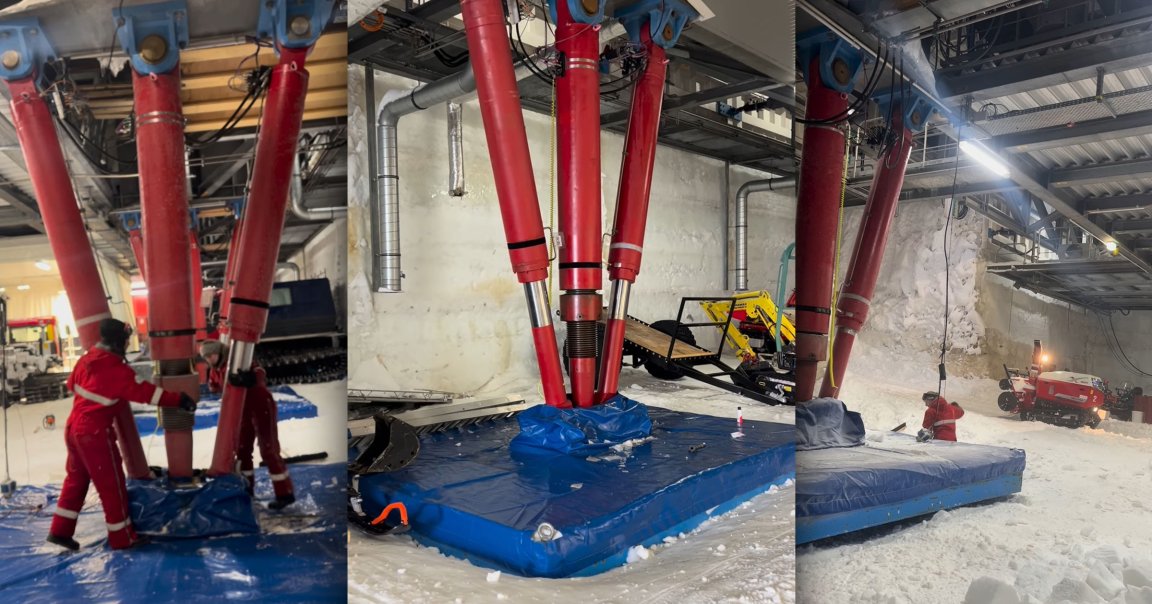
Neumayer III, which sits on over 650 feet of ice on the Ekstrom Ice Shelf and is one of 70 permanent research stations in Antarctica, was designed to host Antarctic researchers year-round, from meteorologists to geophysicists. It also has a fascinating design to fight back the hostile environment that destroyed its predecessors: it was built on 16 hydraulic stilts that lift the 20,000-square-foot and 2,200-ton facility over the surface of the ice.
As such, engineers there have the painstaking job of hoisting up each leg to scoop new snow underneath before balancing the whole station — an impressive feat of engineering allowing the establishment of a permanent presence in a hostile and rapidly changing environment.
In an astonishing video, Swiss engineer and Neumayer III technical lead Thomas Schenk — who’s been stationed at Neumayer III since 2024, where he oversees overwintering procedures — shows how the system works.
“Everything here in Antarctica that isn’t built on rock will inevitably sink into the snow sooner or later,” he wrote in the caption of the video, which has since gone viral on social media.
The 16 stilts are part of a sophisticated lifting system, developed by German engineering firm IgH to keep two enormous parallel steel tubes housing the complex hoisted above the quickly changing landscape.
“We align the station every week to ensure that it is always perfectly level,” Schenk added. “Every now and then, one of these bipods wanders off — then it’s time to lift and realign.”
The video shows Schenk and his collaborators first loosening horizontal brackets bracing the station against the surrounding snow, before slowly lifting each bipod leg with the help of hydraulic cylinders. The team then scoops fresh powder under the leg with the help of a snow blower.
Once enough snow is pushed under the bipod, the team transfers the weight of the station back onto the leg and checks its alignment.
“And that’s how we remain on the surface,” Schenk concluded in the video.
Overall, the station is “raised by about [6.5 feet] each year during summer season using a similar procedure,” he wrote.
More on the Antarctic: Horrible Things Are Happening at Antarctic Facilities