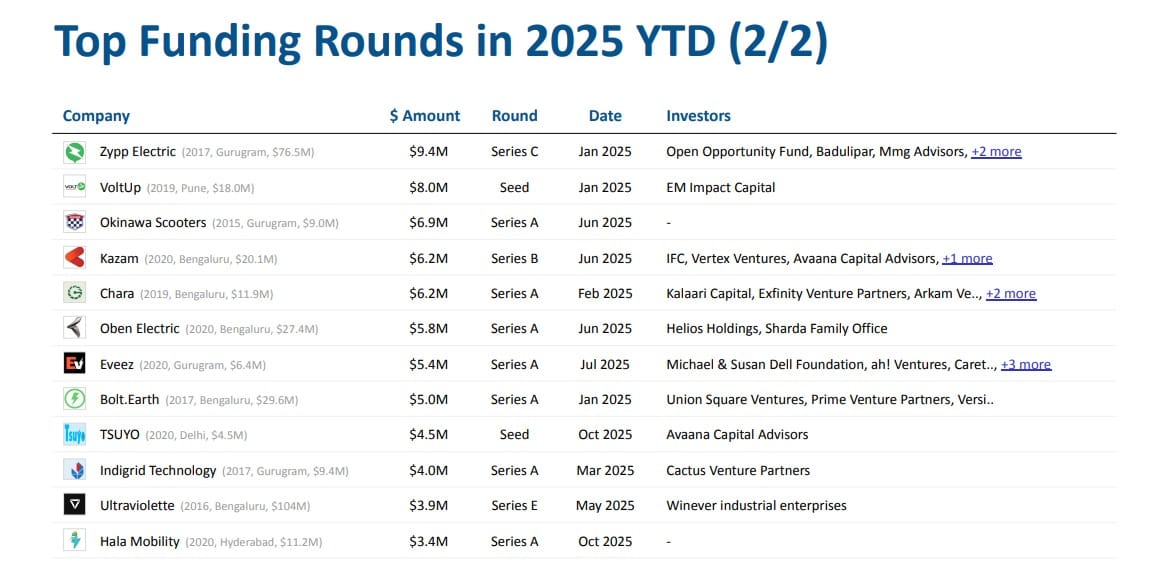
India’s electric vehicle sector got US$1.4 billion (around Rs 12,180 crore) this year till mid-November, marking a 27% increase over the $1.1 billion (around Rs 9,570 crore) raised in 2024, according to data from private market intelligence platform Tracxn. The jump in funding comes despite fewer deals, as investors focused on a smaller set of mature, scale-ready startups.
According to Tracxn’s EV in India Annual Funding Report 2025, funding rounds dropped to 65 year-to-date from 135 in 2024. But total investment still rose, showing investors are writing bigger cheques while backing fewer startups. Much of the funding went to electric vehicle manufacturers, which together drew $1.2 billion this year. Delhi dominated city-wise funding, accounting for $1.1 billion of the total, powered largely by one of the year’s largest EV deals.
The big driver of the overall surge was late-stage funding, which more than doubled year-on-year. Investments at this stage rose to $1.1 billion in 2025 from $536 million in 2024, reflecting growing investor confidence in established EV brands and infrastructure companies.
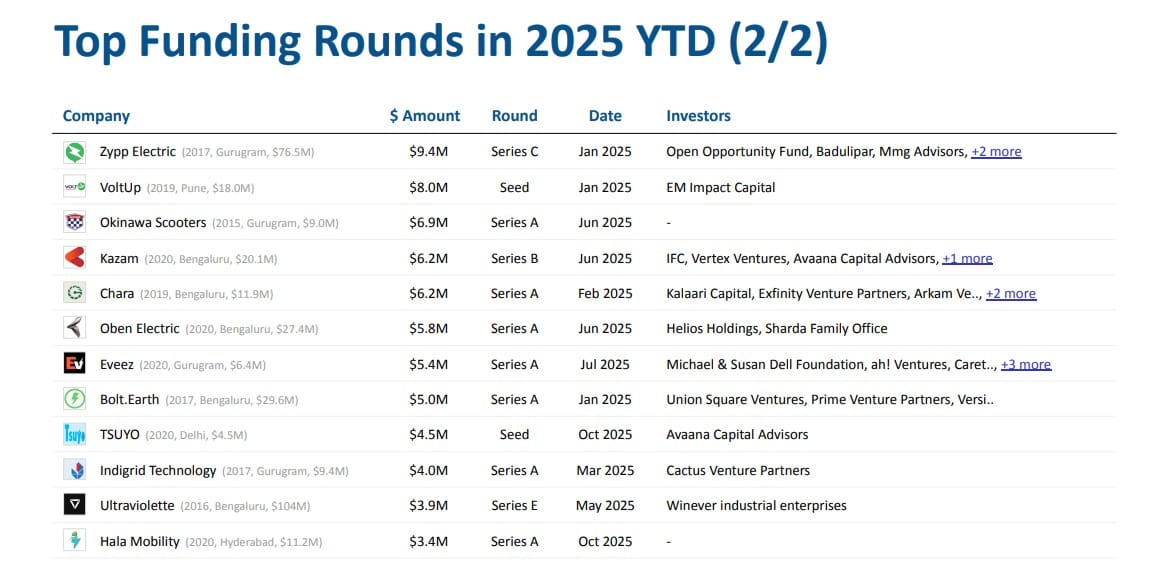
Tracxn said the shift signals “performance-led capital deployment” as the market moves past early experimentation. Seed and early-stage financing continued to decline sharply. Early-stage funding fell nearly 50% to $226 million, while seed-stage investment dropped to $61.2 million across only 32 rounds.
“The strong surge in late-stage capital, driven by a billion-dollar round supporting manufacturing and charging infrastructure, signifies India’s EV ecosystem has moved beyond early experimentation to embrace a phase of measurable, scaled maturity. It’s a clear signal that global and domestic investors now see EVs not just as a climate bet, but as a commercially viable, long-horizon opportunity,” said Neha Singh, co-founder of Tracxn.
Among the largest deals of the year, Delhi-based EV maker Erisha E Mobility closed a landmark $1 billion Series D round in March, making it the single biggest contributor to 2025’s funding tally. The company plans to use the capital to expand its EV three- and four-wheeler sales network, scale product development, and build manufacturing and hydrogen-based infrastructure.
Other notable rounds included Euler Motors’ $75 million Series D, Pune-based EKA’s $57 million Series A, and Blue Energy Motors’ $30 million Series A. Battery Smart, a leading battery-swapping network operator, raised $29 million in a Series B round.
Funding also remained geographically concentrated. Delhi led with $1.1 billion, followed by Pune with $120 million and Bengaluru with $105 million. Gurugram and Mumbai trailed further behind, with $57 million and $18 million respectively. These top-funded cities reflect a mix of strong EV manufacturing bases, established startup ecosystems, and expanding commercial EV demand, especially in logistics-rich markets such as Delhi.
Investor participation, however, declined significantly. First-time investors fell from 63 to 32 over the same period, pointing to increased reliance on existing backers who continue to fuel follow-on rounds. International investor participation also dipped to 25 entities this year, compared with 47 in 2024.
The EV sector recorded more exit activity this year. Acquisitions rose to three in 2025 from one last year. Remsons acquired Astro Motors for $1.7 million, while Yuma Energy bought battery-tech startup Grinntech Motors & Services. The number of IPOs remained steady at four. Ather Energy’s listing in May 2025, valued at $1.4 billion, was the largest of the year. Other companies that went public included Deltic Autocorp, Maxvolt Energy and Zelio E Bikes.
The Tracxn report notes that India’s EV investment landscape is now firmly in a maturity phase. Investor caution, combined with macroeconomic tightening and evolving state EV policies, has pushed the market away from early-stage risk and toward companies with clear pathways to profitability and scale. This selective deployment of capital, Tracxn says, marks the end of India’s early “hype phase” and the beginning of more disciplined, fundamentals-driven growth.
Note: INR conversion was done at a rate of Rs 87 per US$