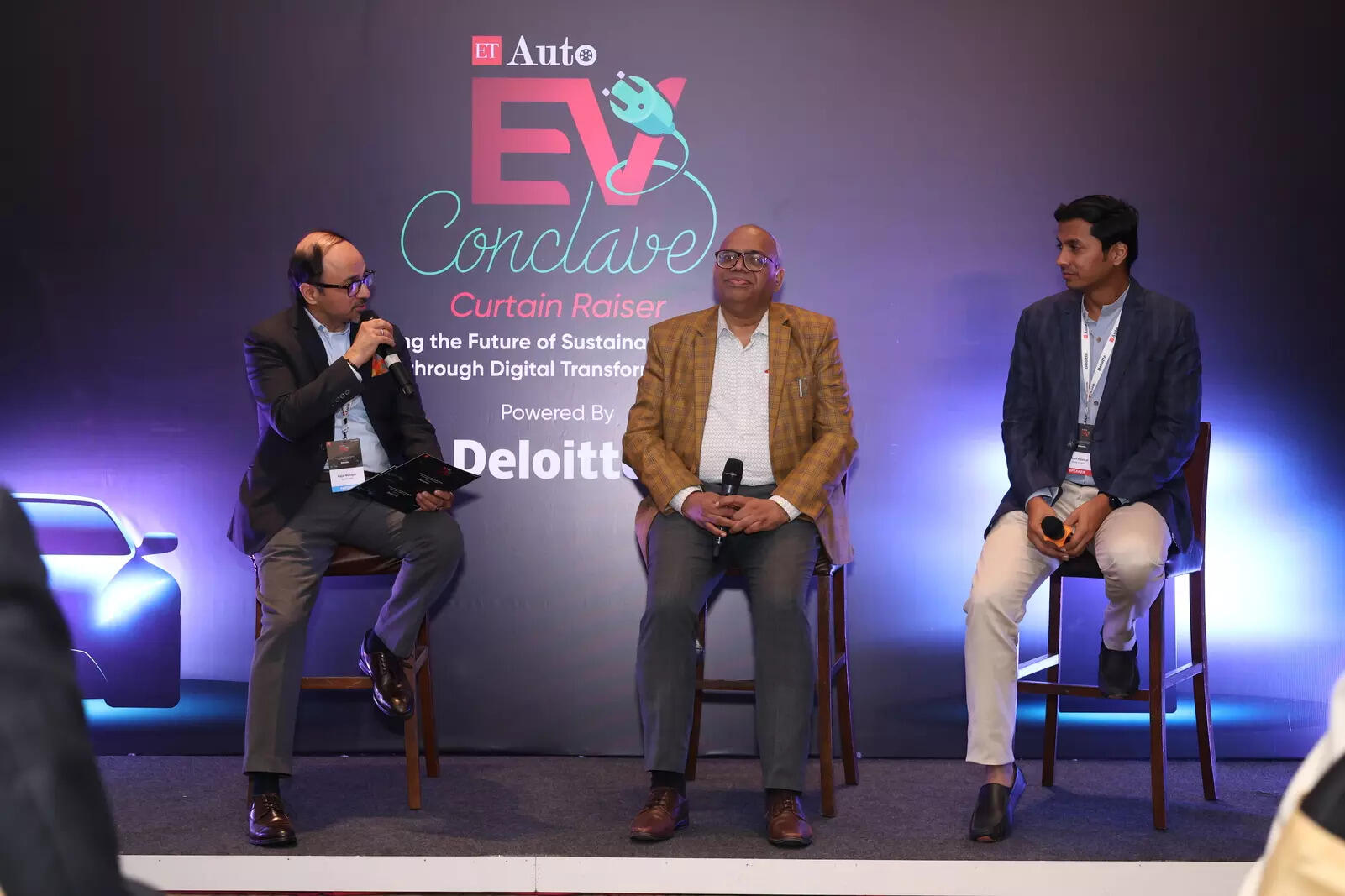
As India accelerates its push towards electric mobility, the divergence in adoption across vehicle segments is becoming increasingly visible and the transition is progressing at different speeds across segments, shaped largely by economics and policy design, according to speakers at the recently organised .
The speakers deliberated on why some EV segments have reached scale while others continue to lag, despite a broad policy push.
Sudhendu Sinha, former adviser at NITI Aayog, said EV adoption should not be judged only by percentages. “In percentage terms we may be wanting, but in absolute numbers we are doing very well,” he said.
Breaking it down by segment, Sinha noted that electric scooters account for “close to 28–32 per cent” of the two-wheeler market, while electric motorcycles continue to lag despite motorcycles forming the bulk of volumes. In three-wheelers, he said e-rickshaws are “almost 95 per cent electric”, though many still use lead-acid batteries, while “almost two out of three auto-rickshaws manufactured today are electric”.
On buses, Sinha said adoption has accelerated due to operating economics. “Over 70 per cent of the new buses entering the system are electric,” he said, adding that this is especially true for public sector fleets. Passenger cars, however, remain behind. “We are falling short in percentage terms, but more models, more OEMs and more partners are entering the space,” he said.
Policy reset and funding impact
Sinha said early EV policies underperformed, prompting a major rethink. “After two and a half years of running the scheme, we had achieved only 3.5 per cent of the target. It was awkward even to share,” he said. This led to a segment-specific redesign of incentives. “Two-wheelers, buses and trucks cannot be given the same medicine,” he said.
Following the reset in 2021, government spending rose from about ₹2,000 crore initially to ₹11,500 crore over the scheme period. “Targets were met and buses were positioned through demand aggregation,” Sinha said.
Looking ahead, he said government focus should remain on public transport, charging infrastructure and freight electrification. “Till a year back there were fewer than 100 electric heavy trucks. In the next four to six months, you could see 10 being added daily,” he said.
Investor view on EV economics
Arpit Agarwal, investment partner at Blume Ventures, said adoption follows economics. “India is an economics-centric country. The moment the economics work, people are happy to choose electric,” he said.
He said early-stage investor appetite remains strong, with around 100 EV-related startups having raised capital. “Some are moving to later-stage PE funding and some will hit IPOs,” Agarwal said, adding that two Blume portfolio companies are discussing IPOs in the next 24–36 months.
On returns, Agarwal said EV investments are judged against other sectors. “We expect at least 4x over 10–12 years, or about 20–25 per cent IRR. EV does not get special treatment compared with AI or consumer tech,” he said.
On policy, Agarwal said support should be time-bound. “Two- and three-wheelers don’t need subsidies anymore. Buses still do,” he said, adding that future emphasis should be on charging infrastructure, components and software.
Both speakers agreed that wider adoption will depend on consumer confidence beyond metros and sustained focus on cost and reliability.