With impressive understatement the John Deere website refers to its 9RX range of agricultural machinery as “high-horsepower tractors”.
We always like it when the Christmas road test has a unique claim to fame: the biggest, the newest, the fastest or whatever it might be. And this year’s Christmas road test subject takes that ‘high horsepower’ to a level not seen in – ahem – its field before, because it is the most powerful series-production tractor in the world.
Here we have the John Deere 9RX 830, the ‘9RX referring to its series model name, with the numeric suffix bearing a loose connection to its power output. There are also 640, 710 and 770 tractors in this range, although they all make more than their named and rated horsepower, because on overboost the 830 will produce 913bhp.
Unlike in a car, which may only make a peak overboosted output for a short amount of time, the John Deere can sustain this peak figure for hours at a time. This capability for continuous high-load performance is an important one, because the 9RX 830 is a vehicle that can and will operate for hour upon hour.
To do that it has to be not only extremely capable and reliable but also accommodatingly comfortable and usable for its operator. Although there is an element of automation in modern agriculture – as we’ll see – fundamentally this will mostly be a one-person-operated machine that’s out working in all weathers, and at certain times of the year it would be one of an arable farm’s most intensively used pieces of equipment.
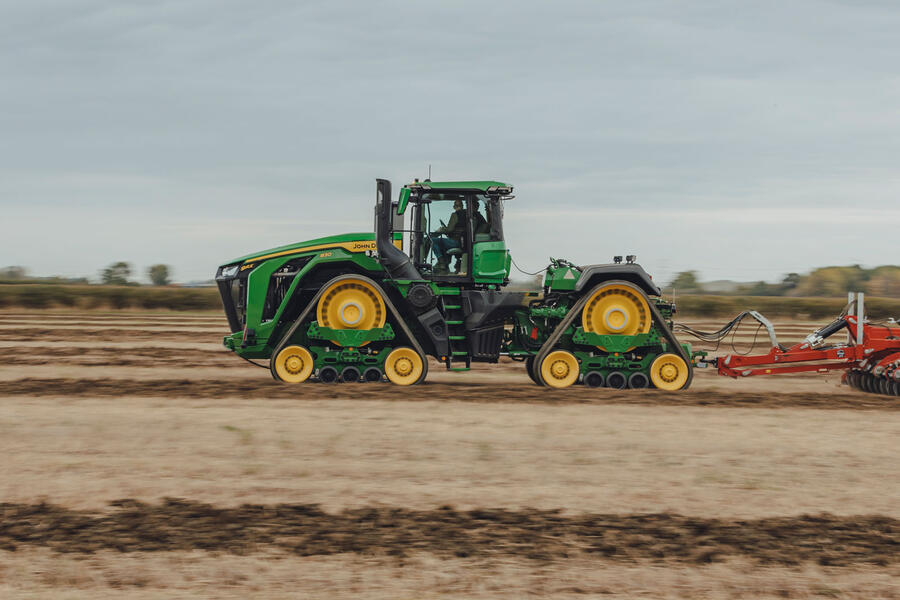
Design & Engineering
Even if you spend a lot of time in the British countryside you’ll note that, although there are a few very large articulated tractors like this on the market, models like the 9RX tend to be an unusual sight here. That’s because the UK is not a particularly large country and, by global standards, our fields aren’t big enough to make the most of them. This tractor’s size, purpose and price will only appeal to the biggest British arable farms.
The machine’s purpose is a relatively simple one: the 9RX is a tool for towing large implements across big fields. The idea is that the larger implement you can pull, and the faster you can do it, the fewer passes you have to make and less time it takes to cover the same ground as in a smaller tractor. When windows of opportunity between weather are small, such considerations become quite important. And ultimately it adds up to more profit.
To drag a large implement across a big field you need a certain number of things. One of those is traction and grip on the ground, another one is weight in the towing machine and the third is the power to make full use of the first two.
Even if you tow a caravan or a trailer behind a car you’ll know about all of those things, and the same principles of physics apply here, except on a much bigger scale. In this case, that scale is 8.8m of overall length, 3.8m high and just under three metres wide.
There are factors that limit, especially here in the UK, just how big this machine can be. In the US in the 1970s there were machines called Big Buds, the biggest tractors ever made, and in some individual cases they were fitted with engines that were even more powerful than the 9RX’s.
But with four wheels and tyres across each axle, machines like that will be far too wide for narrow rural UK roads, and when in the field (providing they can get through the gate) they still don’t spread their load broadly enough to avoid the unwelcome soil compaction that can become a problem where ground is softer.
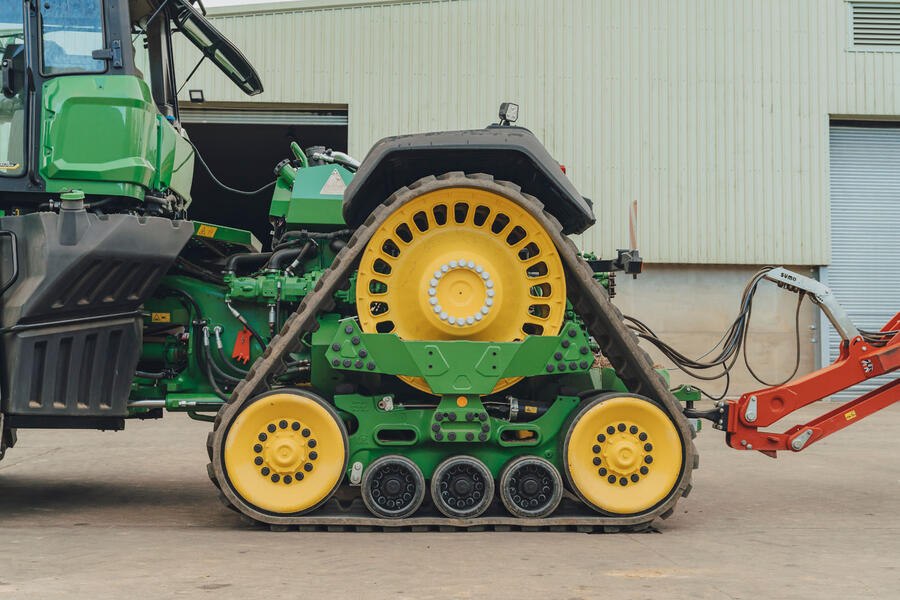
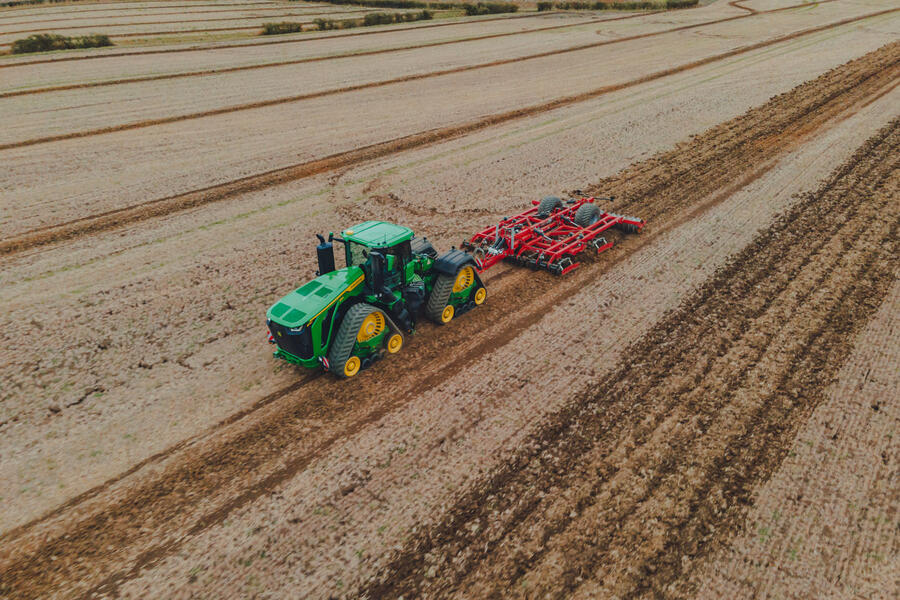
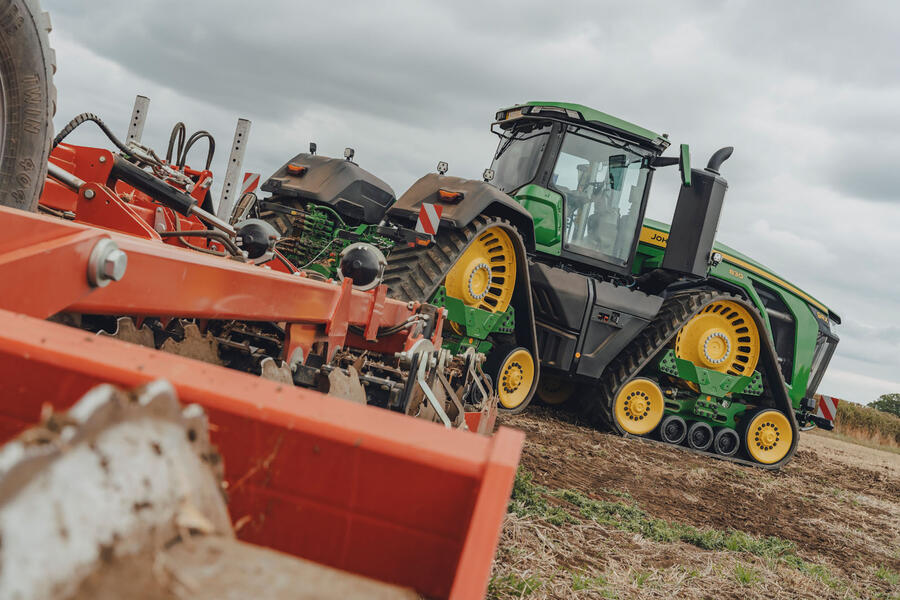
The 9RX circumnavigates these issues with perhaps its most obvious mechanical feature: the four sets of 762mm-wide tracks it runs on in place of wheels. The advantages are numerous. First, the tracks spread the load rather more softly.
This is a ductile cast-iron-chassis tractor with a 33.5-tonne dry weight, and today it has ballast weights that take it up to 34.8 tonnes (its maximum total vehicle weight is some 42.2 tonnes). If it were to run normal tractor wheels and tyres, even on low tyre pressures, it would spread its weight over too small a contact patch, limiting grip and hurting the soil beneath it.
Instead, with these caterpillars, it puts 1.5 square metres on the ground through each track, therefore spreading its weight per square centimetre to $0.58text{kg}$—or just less than an adult male.
So theoretically if the 9RX ran over your foot it would be uncomfortable rather than catastrophic—but alas, even though our tests are rigorous, we opted not to find out for sure. On the inside of those tracks are lugs gripped by the top drive wheel cog, each 1.2m in diameter.
“The bigger the drive lug, the more power you can get to the ground,” John Deere’s tractor specialist Harvey Cole tells us. The drive here engages seven lugs per wheel, meaning less slip and more grip. Or traction.
The 9RX is four-wheel drive, with mechanically locking front and rear differentials, and power goes to those drive wheels via what Cole calls the “heart of it”: a 21-speed transmission, hydraulically shifting but mechanically driven to the wheels from the engine.
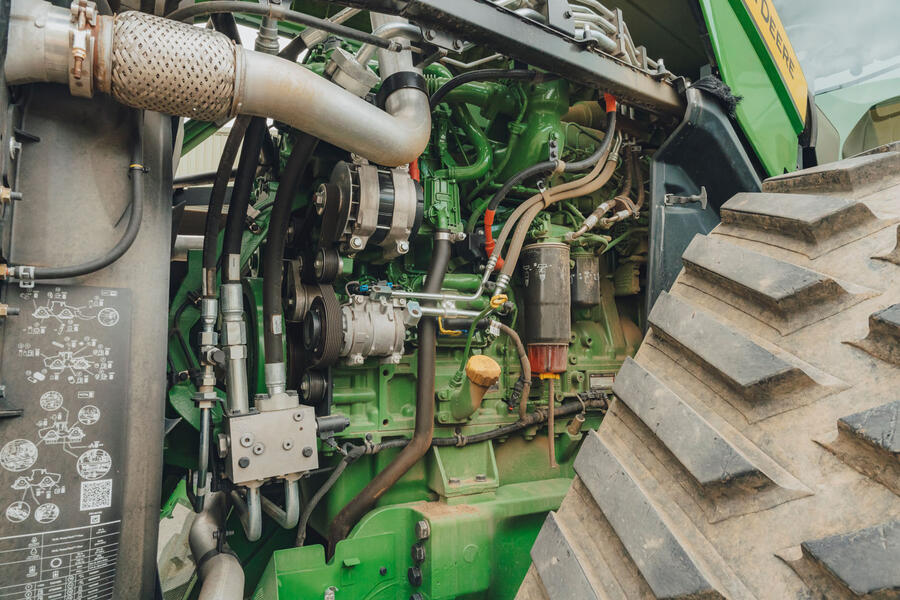
Under that imposing bonnet is an 18-litre, twin-turbocharged straight-six diesel making 913bhp and only revving to a peak of 1900rpm. More on that in a few moments. The engine and transmission are in the forward section.
The 1500-litre fuel tank (including baffles, but these can be removed in the UK to increase capacity to 1952 litres, which exceeds the EU’s limit) sits beneath the cabin, to keep weight distribution roughly the same as the diesel empties. Because of the engine’s power, the unit falls outside of regulations that necessitate a particulate filter; it doesn’t need AdBlue, either.
The articulated rear makes the 9RX relatively manoeuvrable, says John Deere. It’s no wider and is even a bit lower than the next model down, and while it’s 60cm or so longer, this has the advantage of articulation. It’s not as daunting as you might think, apparently.
That it’s less than three metres wide means it can be driven on UK roads without notifying the police, but in some markets you can spec both a wider track (as in the distance between drive wheels) and wider individual tracks, increased to 914mm.
In the rear section live the hydraulic tanks and pumps, plus power take-offs and the retractable implement drawbar. The 9RX has fewer hitch types than you may find on smaller tractors because it is very much focused on its primary job of pulling big implements.
Between them, its three hydraulic pumps can move 424 litres of hydraulic fluid per minute, and unusually there are separate tanks for the oil that serves the gearbox and axles, and the oil that serves the implements.
The idea behind this latter, separate, 200-litre tank is that it’s more likely, through coupling and uncoupling, for the oil to become contaminated. Here, even if it does, it can be swapped out easily, while operation of the ‘box and steering goes unhindered.
Interior
It’s quite the climb to the 9RX’s cabin, with seven steps up on the left-hand side, but there are grab handles on both the chassis and the open door. An additional grab rail at head height makes it possible to make your way around outside the cabin, should you need to, for cleaning or maintenance.
On entering the cabin itself it takes quite a pull to slam the door shut if the tractor is running. This is because the cockpit is ever so lightly pressurised, to keep dust and grime out as much as possible. There’s a small jump seat you must cross to get to the big, comfortable driver’s seat, which is the chair of choice and, naturally enough, the focus of our test.
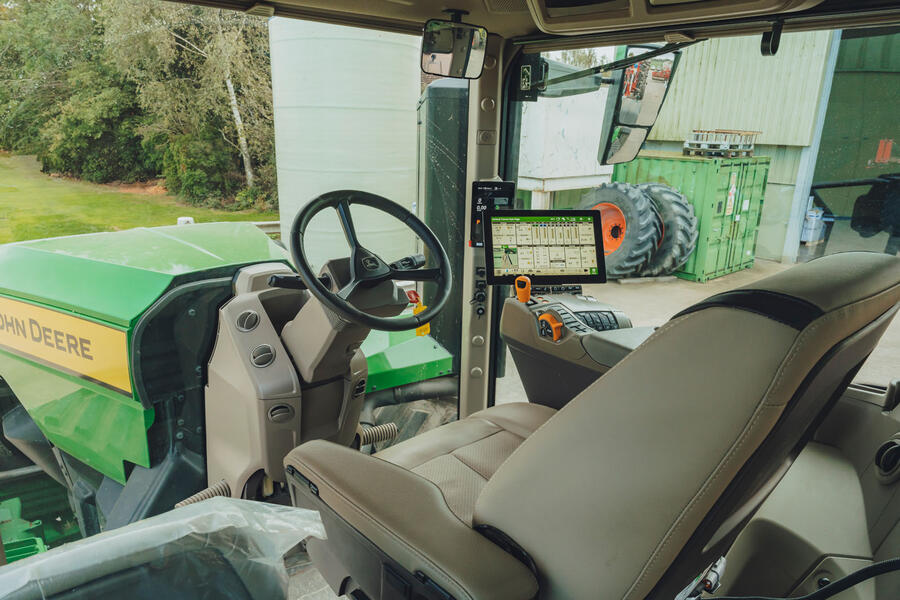
Access is easy and the steering column pulls down neatly; there are large pedals, there’s a smallish round steering wheel that has no ‘up’ marker because it’s steer-by-wire, electronically at the wheel but hydraulically actuated through one of the vast fluid systems. There are two steering controllers as well as a back-up system.
Visibility is amazingly good: there are 6.86 square metres of glass area, so you can see every single edge of the tractor, including the drawbar, from the driver’s seat. In places where there are often control system gubbins, the 9RX features floor-to-ceiling glass.
There’s comprehensive heating and air conditioning, of course, and the driver’s seat is not only heated, ventilated and sporting a massage function but also can swivel so you can more easily look backwards while pulling. If you really wanted to, that is—but such is the level of automation and precision, the chances are you might not need to.
Switchgear is a mix of very big physical buttons and some touchscreen controls, with a lot of commonality with other John Deere tractors, such as a display screen mounted to the A-pillar to keep an eye on the tractor’s own mechanical systems. A larger screen mounted to the right-hand armrest/control console (a 5G ‘CommandCenter) tends to deal more with implement-pulling info and controls.
Mounted high to the right is a unit that has Apple CarPlay and Android Auto compatibility, with physical buttons and a screen that John Deere will soon make bigger. So with all-round audio, climate control and even massaging, this is an easy place to get extremely comfortable. The cab itself is suspended, too, mechanically rather than hydraulically, on four posts.
Performance
Let’s talk about this engine, then. This is the first time John Deere has used the JD18X powerplant. The original engine concept was designed with the Swiss machine maker Liebherr, with which John Deere has an engine development partnership, but the unit is built, along with the rest of the 9RX, in John Deere’s factory in Waterloo, Iowa, in the US.
Cole says “nearly all” big tractors use straight-six engines. They’re very smooth because their harmonics are balanced, and there’s not really an exception to be made here even though the motor’s capacity is 18 litres.
This is a low-vibration engine. There is noise, of course, but it feels quite far away in the scheme of things. You’re also aware a lot of fuel is being burnt, but this is not a machine that shakes; it’s a stable and obviously powerful moocher. Gears tend to engage with a bit of a jolt here and there, though, but that is to be expected given they have to cope with 3135lb ft being sent through them.
To select your revs there is a floor-mounted throttle, but in general use you’ll more likely use the tortoise-to-hare slider on the handrest to set the revs you’d like, then another button to set the speed you’d like to go (there are two programmable cruise control speeds—one might be for manoeuvring, another for pulling).
Once you’ve told the machine about those settings and you push a button to stick your implement into the ground (today we’re using a 6m-wide Sumo ripper, aerating hard soil up to 450mm deep), then the machine works out the rest and puts itself in the right gear to do it.
Hence the transmission being the heart of things. As the implement runs across and into hard or soft bits of ground there are bumps and jolts into the cabin, but the 9RX maintains the speed you’ve set for it remarkably easily.
Today we’re pulling around 1200rpm and sitting at something like 50 per cent overall load. It has drizzled and rained a little, but Cole knows this is easy-going ground for a tractor of this capability. It would be more normal for an entire shift to be driven at more than 75 per cent load. Shorn of loads and anything else to do, the 9RX can reach 27mph.
Driving & operating
You can, and many operators will, drive the 9RX manually, especially on the way to set up the machine before putting it to work. The steering is light, consistently so, but because the visibility is so good and the turning radius is 6.75m (taken from the back axle centre line), it’s surprisingly manoeuvrable.
Changing direction wasn’t too daunting, although we were in a pretty big field at the time. There is no chassis suspension, but there is some give in the tracks and the cabin and seat are both suspended so the ride is very good. Besides, not much knocks a 38-tonne machine out of kilter.
Nevertheless, as the tool you’re pulling enters or leaves the ground or snags, it jolts into the cabin enough to upset a reporter’s notes. But it remains throughout all of that a quite refined driving experience.
Automation is coming in farming. There’s a level of it here already. Most farmers will have individual fields mapped out via GPS to within 2.5cm, and there’s software to help plot the ideal path depending on what you’re pulling.
The driver then uses the 9RX’s manoeuvrability to get close to one of those predetermined lines on a screen, and when that turns white, you click the auto-steer button and the 9RX drives itself on line.
Then you can push the cruise control, the implement-down button and go back to Radio 2 until the next turn. When more automation comes it will change farming even more, but who will take responsibility for running over errant dog walkers? That conversation is still being had. But Cole says: “Automation is essential for the future”.
Buying & owning
A bigger section than usual here because ownership and profitability are so key to owning an expensive working vehicle like the 9RX. Just like in the car world there are different trim options (two of them), and this is the Signature Edition, which you can think of as the Ghia model. It comes with more comfort options and costs £930,000.
But all tractors are expensive, and the thinking is that if it can save time, it will be worth it. Most British farmers will decide that it’s a step too far for the size of land they have. According to Farmers Weekly, its efficiency will only be rewarded “if buyers have the field sizes and implement options to match, but there will be a handful of cases”.
Cole says smaller tractors are the ones farmers use most frequently, because they tend to be more versatile, have greater functionality, are easier to manoeuvre and are cheaper to run. But models like the 9RX are not all-round farm vehicles. It’s a big specialist tool, but one that will find its niche.
Fewer are bought on finance than one might think, I’m told, because of the way cash goes in and out of farms—quite a lot of income can arrive at once, which means that a smaller amount of the total may be financed than would normally be the case in equipment investment.
Key to John Deere’s (leading) market share of around 30 per cent is the brand’s trustworthiness and reliability. “The operations centre [monitoring machines’ efficiency and maintenance and how they’re being used] is key to John Deere’s strategy at the moment,” says Cole. And because all of these things can be monitored by one system, there’s less of a headache than having several suppliers.
When it comes to routine maintenance, hydraulic fluid for the gearbox only needs to be changed every 4000 hours, engine oil changes are every 500 hours and all other fluids and filters are changed every 1500 hours. The 9RX is thirsty, but so is everything else of a similar remit. It’s likely to burn less than 1000 litres in 15 hours so is probably a daily refill—fast-fill systems can do this in under five minutes.
At the time of writing red diesel costs farmers around 72p per litre. All of the 9RX’s daily checks and maintenance can be done from the ground, so you don’t have to climb anything to perform any filter or fluid checks; there’s all-round LED lighting, too.
This stuff matters because farming is one of Britain’s most dangerous jobs: 17 lives were lost in the six months to September, and last year there were 27 deaths across the industry.
As I left our test site I saw a neighbouring farmer standing precariously on top of an implement and balancing on his shoulder a huge sack he was attempting to load into a hopper. It looked a little hairy even on a bright, clear and dry day.
In an environment where people are working shatteringly long hours in miserable conditions, often solitarily, and for precious little reward, a machine like a 9RX that lets you do all of the daily checks without leaving the ground is not just easier but safer, too.
Verdict
The most powerful tractor… in the world. Sounds like the kind of hyperbole with which you’d start an exaggerated social media post, but the 9RX 830 does have precious few natural rivals.
There are other big tractors, there are other articulated tractors and there are other powerful tractors, but few meld all of those things into a package like the 9RX 830 does. If all of its power does seem a bit much, remember there are less-powerful options.
But, like buying a Porsche 911 Turbo S or an AMG Mercedes, if you’re going to buy the biggest and most capable model, you might as well go all the way and pick the absolutely most powerful variant.
After all, there’s a good reason to do so: the pulling capability is unmatched by just about any alternative. Yes, it’s too big for most farms and, yes, it’s an incredibly expensive machine given that it has a very singular purpose, and there are other, smaller tractors that can do many jobs besides – it’s not like anyone will be cutting hedges or clearing snow with a 9RX.
But to hell with it: if you’re going to go large, you might as well go the whole hog and have a 9RX 830. Like all the best Christmas road test subjects, it’s brilliant, and there’s nothing else quite like it.