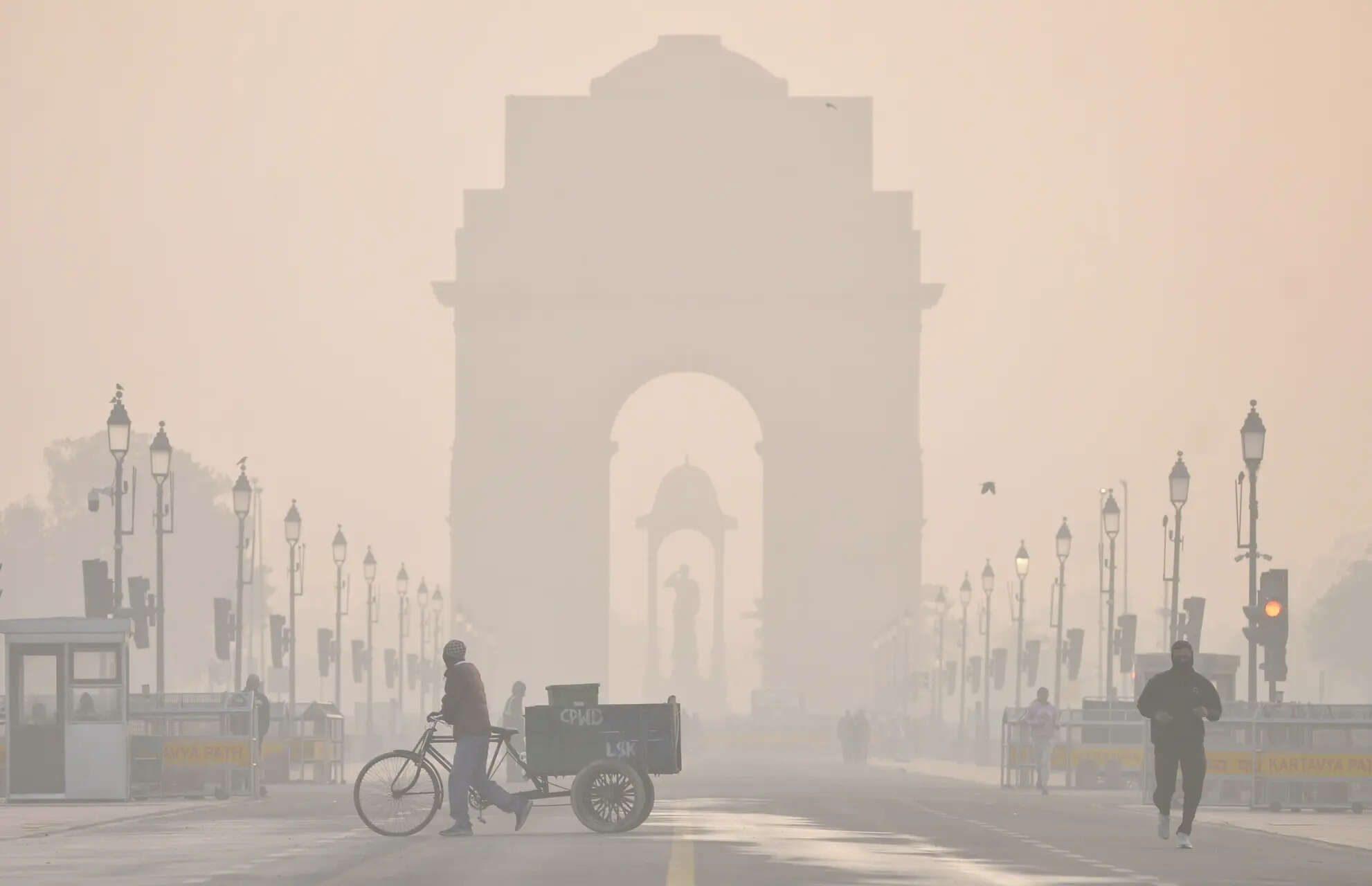
Tarun Kumar Pithode , a 2009-batch IAS officer from Madhya Pradesh cadre, took charge as the new full-time member secretary of the Commission for Air Quality Management in Oct.
Pithode was earlier serving as joint secretary in the Union ministry of environment, forest and climate change. In an exclusive interview, he told Priyangi Agarwal that concerted efforts have resulted in visible improvement in Delhi’s AQI, adding that a new emission inventory and source apportionment study for Delhi will be prepared using 2026 as the base year. Excerpts:
It has been five years since CAQM was formed. What would you describe as its biggest achievement so far?
There have been multiple achievements. The commission has developed a strong understanding of pollution sources, with clear strategies and actions already in place.
Significant progress has been made in reducing stubble burning, with fewer farm fires and a smaller burnt area. The effect is also visible, as AQI, which earlier used to shoot beyond 450 many times a year, has seen a drastic reduction in the number of such days.
At the same time, industries in NCR are operating on permitted fuels, vehicular pollution is being addressed through multiple directions, and legacy waste is gradually reducing due to continuous monitoring and concerted efforts.
Where has the commission fallen short?
I must say that the areas where action is required have already been identified. What remains is to address these issues in a logical and systematic manner, while taking into account all stakeholders and consulting them. This process naturally requires time.
Vehicular traffic and industrial emissions remain major pollution sources. What specific strategies does CAQM have to reduce emissions from these sectors?
Emissions from industries happen on the basis of their fuel type. Of the total 7,983 industries in NCR, 7,673 are running on approved fuel and the remaining 310 units are closed. Verification of the updated status of these 310 industries is under way. We have tackled the problem of industries running on non-cleaner fuel.
The second issue is how to reduce emissions from their stacks and chimneys. They have been mandated to install APCD (air pollution control device) instruments and OCEMS (online continuous emission/effluent monitoring system) to monitor emission levels. Union environment minister Bhupendra Yadav has instructed that all industries install OCEMS by Dec31.
Teams from all pollution control boards, CAQM and CPCB are physically inspecting industries to verify how many of them have installed OCEMS.
For vehicular pollution, we have already mandated that intercity buses coming to Delhi should switch to BS-VI, CNG or electric. Buses coming from NCR states have complied with this. In addition, we have directed that buses with all-India permits not be allowed to enter Delhi from Nov 1, 2026, unless they run on BS-VI, CNG or electric fuel.
Similarly, commercial goods vehicles from outside Delhi that are BS-III or below are not permitted to ply within the city. We have also issued clear directions for vehicle aggregators: from Jan 1, 2026, only electric or CNG vehicles will be additionally inducted into the existing fleet of vehicles. No conventional ICE vehicles running purely on diesel or petrol will be further inducted into the existing fleet of four-wheeler LCVs, four-wheeler LGVs (N1 category – up to 3.5 tonnes) and two-wheelers from Jan 1.
Beyond seasonal action plans, what does CAQM’s long-term roadmap look like to ensure sustained improvement in air quality?
We are in the process of significantly reducing vehicular emissions. We have urged all state govts to formulate EV policies that enable a smooth and rapid transition to electric mobility.
This must be supported by adequate infrastructure, including charging stations, battery-swapping facilities and allied services. Skill development is equally important—mechanics and othersshould be trained to service EVs so that a robust ecosystem is in place for a sustainable transition.
We are emphasising on the role of public transport. In the latest meeting chaired by the Union environment minister, states were asked to expand their fleets of electric buses, following the example set by Delhi’s Devi buses. We have recommended that state govtswork on first- and last-mile connectivity in such a way that a person does not have to walk more than 100 metres from the outer gate of their house.
For the first time, CAQM will monitor crop residue burning in rabi season. We will ensure that wheat residue is not burnt during the summer season. Besides this, we are framing norms for the use of mechanised road sweepers for cleaning all kinds of roads.
What steps is CAQM taking to strengthen the air quality monitoring network in NCR?
At present, 84 real-time continuous ambient air quality monitoring stations (CAAQMS) are operating in Delhi-NCR, of which Delhi alone has 40 stations. The number of monitoring stations is being augmented from 84 to 111 with the installation of 27 new CAAQMS in NCR.
Through our directions, we have mandated the installation of low-cost sensors at construction sites larger than 500 square metres to monitor dust emissions. We have also been encouraging road agencies to deploy similar sensors during road construction and even after completion to monitor dust levels. While no formal direction has been issued yet for this, we believe such monitoring would be beneficial.
The Early Warning System and Decision Support System still rely on the 2021 emissions inventory, and forecasts have at times been inaccurate. What steps are being taken to update the emissions data and improve forecast accuracy?
The development of a new emission inventory and source apportionment study is being undertaken through CPCB for Delhi-NCR, with 2026 as the base year. The work will be carried out by a consortium consisting of ARAI, TERI, IITM Pune and IIT Delhi.
The new emission inventory will be ready by 2027, and the algorithm will be improved and strengthened accordingly. It will take a year to assess the loopholes and improve the algorithm. I believe that these models have been giving good predictions, which have helped us in taking decisions related to the enforcement or revocation of GRAP. It is about becoming more precise. The new algorithm will help us predict better.
CAQM is often criticised for acting mainly as a crisis manager that invokes and withdraws GRAP. How do you respond to charges that the commission has failed to move beyond emergency measures?
CAQM is a regulatory body. All agencies operate in a coordinated manner under CAQM’s directions to ensure uniform action across states. The scale of change some people expect within a short span may not always be immediately visible. However, with concerted and coordinated efforts, pollution levels are gradually coming down—severe days have reduced and the average AQI is declining.
GRAP norms are frequently violated across NCR districts, many of which—according to the Decision Support System— significantly contribute to Delhi’s pollution. Despite having statutory powers, why has CAQM not taken more stringent action against these violations?
We issue the GRAP orders. Their implementation lies with the state agencies. We monitor compliance on a daily basis and receive regular reports detailing the actions taken by each agency. Based on this, we provide continuous feedback, highlighting gaps and specifying the corrective steps required.
Our flying squads have inspected 24,691 units or projects till Dec 26, and of these, closure notices have been issued to 1,609 units. In cases related to stubble burning, we have issued notices to several district collectors and SSPs, and we have also written to state govts to take action against officers who failed to act when required.
When can Delhi residents expect to breathe air that meets national ambient air quality standards on 300 days out of 365?
I believe this is achievable in a relatively short span of time, not over many years. While factors such as climate, weather patterns and geography will continue to influence Delhi’s air quality, a significant reduction in the average AQI is possible.
We can expect clearer skies and more blue-sky days over the next three-to-four years. Under the guidance of the Union environment minister and chairperson of CAQM, the commission is working on a war footing towards the abatement of air pollution in NCR and adjoining areas.