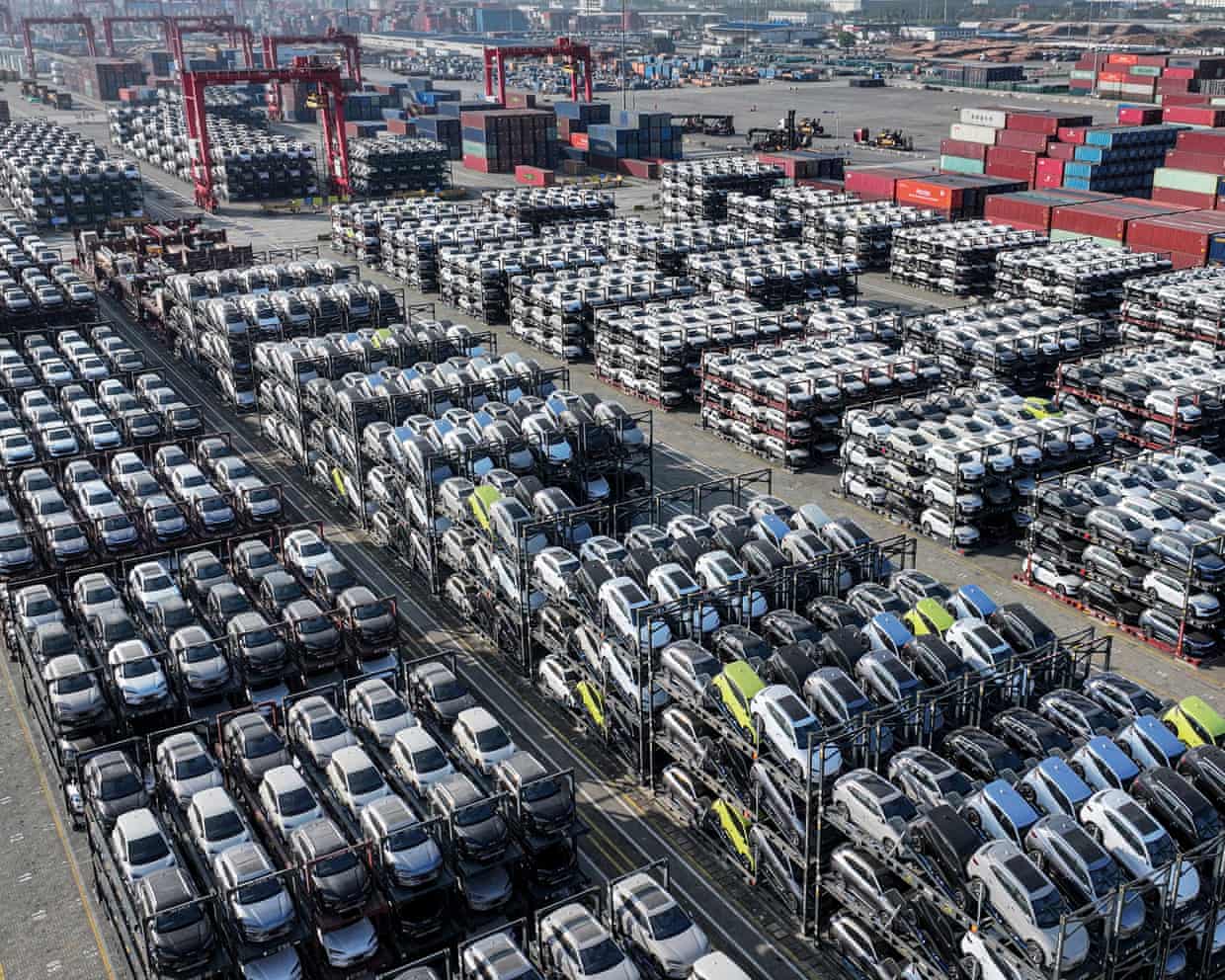
China forecast to have sold one in every 10 new cars in UK in 2025
Carmakers such as MG, BYD and Chery are set to pass 200,000 mark in sales, analysis suggests, double 2024’s total
Chinese brands are on course to account for one in every 10 new cars sold in Britain during 2025, a marked increase on last year as sales increase across Europe.
Manufacturers led by MG, BYD, and Chery are on track to break the 200,000 mark in UK new car sales in 2025, meaning they are very likely to account for 10% of the market, according to Matthias Schmidt, an analyst tracking electric cars across Europe.
Spain and Norway also get a tenth of their new cars from Chinese brands, with the average across western Europe at 6%, Schmidt said.
China has taken a commanding lead in the global industry for electric vehicles (EVs) thanks to years of heavy government subsidies, dominance of the supply chain for lithium ion batteries, and cheaper labour. The increase in Chinese sales has alarmed EU countries, particularly Germany and France, who fear losing millions of automotive jobs if the industry shrivels.
Graph showing increase of sales of Chinese brands in the UK in 2024 and 2025
Norway leads the world in EV take-up, helped by generous purchase subsidies, but in Spain and the UK a large number of the Chinese cars on offer are hybrids, which combine a petrol engine with a small battery.
Tu Le, the founder of Sino Auto Insights, a consultancy, said: “The Chinese are tackling the EU region by region since there are pockets of support in some areas and pockets of opposition in others.”
Neither the UK nor Norway have imposed tariffs on Chinese imports, as the EU has done, leaving them open to battery car sales.
According to the Society of Motor Manufacturers and Traders, a lobby group, Chinese manufacturers sold 187,800 cars in the UK out of total sales of 1.87m during the first 11 months of the year – double last year’s sales.
Schmidt said the UK was a particularly juicy target for Chinese brands because it is a large market with no British mass-market champions. Rover ceased trading in the early 2000s, Vauxhall is part of the Stellantis conglomerate, while MGs are made in China by state-owned SAIC.
“With no genuine domestic volume brands for UK consumers to choose from, UK consumers crucially can no longer participate in what is known as patriotic purchasing,” he said.
“In Germany and France, half of each country’s new-car market is effectively in the control of domestic brands. While in China, we now also see two-thirds of the market is accounted for by domestic brands.”
The manufacturers that are losing out on UK sales appeared to be Japanese. Nissan and Toyota have factories in the UK but that has not prevented them from losing nearly a percentage point of market share apiece in the past year. Honda and Suzuki sales also dropped, while Mitsubishi has pulled out completely.
The EU imposed tariffs of between 17% and 38% on Chinese electric cars last year, in an effort to level the playing field. However, the tariffs apply to electric cars only, leaving a large back door for Chinese manufacturers to win market share by undercutting European manufacturers on sales of hybrids as well.
Schmidt’s analysis showed that less than 40% of all Chinese-brand models entering western Europe during the third quarter of 2025 were pure battery electric. That means that the design of the EU tariffs has allowed Chinese manufacturers to continue to undercut European rivals, while also pushing them to sell more polluting models.
The EU watered down its targets for electric car sales recently, saying it will allow 10% of sales to continue to have internal combustion engines after 2035 – it had previously planned to ban them entirely. European carmakers had lobbied hard for the changes, arguing they need to continue selling petrol and diesel cars to earn enough profits to invest in battery car factories.
However, some car executives and analysts have argued that slowing the transition in Europe will allow Chinese carmakers to race further ahead. Schmidt has forecast that Chinese manufacturers’ share will peak just shy of 10% across Europe between 2028 and 2030, while China’s share of the battery car market will peak at 13%.