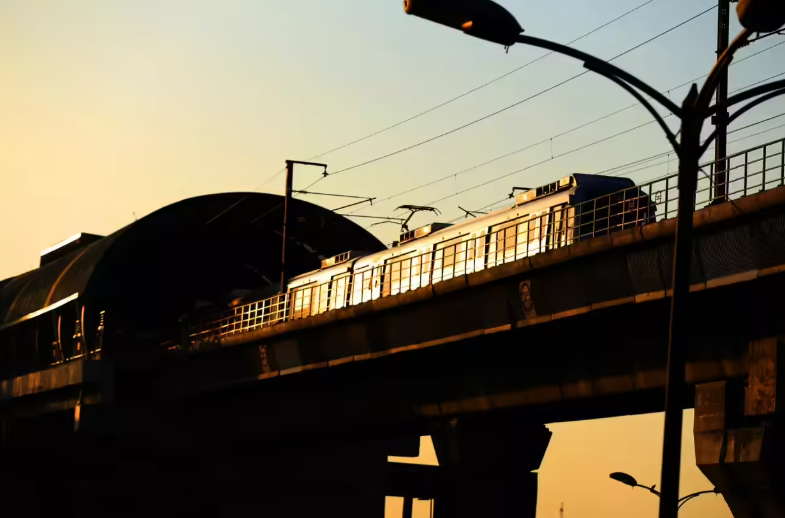
Commuters travelling by Delhi Metro experience the lowest exposure to fine particulate matter (PM2.5), while auto-rickshaw passengers face the highest levels, according to a new study by researchers from Council of Scientific and Industrial Research–Central Road Research Institute (CRRI) and the International Institute of Health Management and Research.
The study, published in the journal Discover Atmosphere on Monday, measured air pollution exposure across various modes of transport along a 10.46-km stretch of the Delhi Metro’s Magenta Line during peak hours. Over 18 days in March 2019, researchers measured PM1, PM2.5, PM10, carbon monoxide, and black carbon inside vehicles along the route between Kalkaji Mandir and Munirka, taking readings at the same time each day.
The study found that average PM2.5 exposure inside metro coaches was 34.2 micrograms per cubic metre, well below India’s safe limit of 60 micrograms per cubic metre. In comparison, auto-rickshaw commuters were exposed to an average of 113.2 micrograms per cubic metre, nearly twice the permissible standard.
Other transport modes recorded varying levels of exposure: 41.9 micrograms per cubic metre for two-wheelers; 68.9 micrograms per cubic metre for window-open buses; 63.1 micrograms per cubic metre for window-closed buses; 62.3 micrograms per cubic metre for window-closed cars; and 71 micrograms per cubic metre for window-open cars. The study noted that closed and air-conditioned vehicles significantly reduced pollution exposure.
S Padma, senior principal scientist for transport planning and environment at CRRI, said, “The PM2.5 concentration was higher in auto-rickshaws than in two-wheelers, as the latter has a more ventilated atmosphere. However, we did no go in depth.” The study was aimed to capture how commuters felt exposed to pollution across different modes of transport, she added.
Co-author Nitish Dogra, public health physician and Fulbright Fellow, said closed public transport, particularly the metro with its underground stations, showed lower pollution levels compared with open-road vehicles.
Researchers also conducted a questionnaire survey of 317 commuters at metro stations and bus stops, finding that while most found the metro as the least polluting mode, awareness of pollution differences in other transport modes was limited.