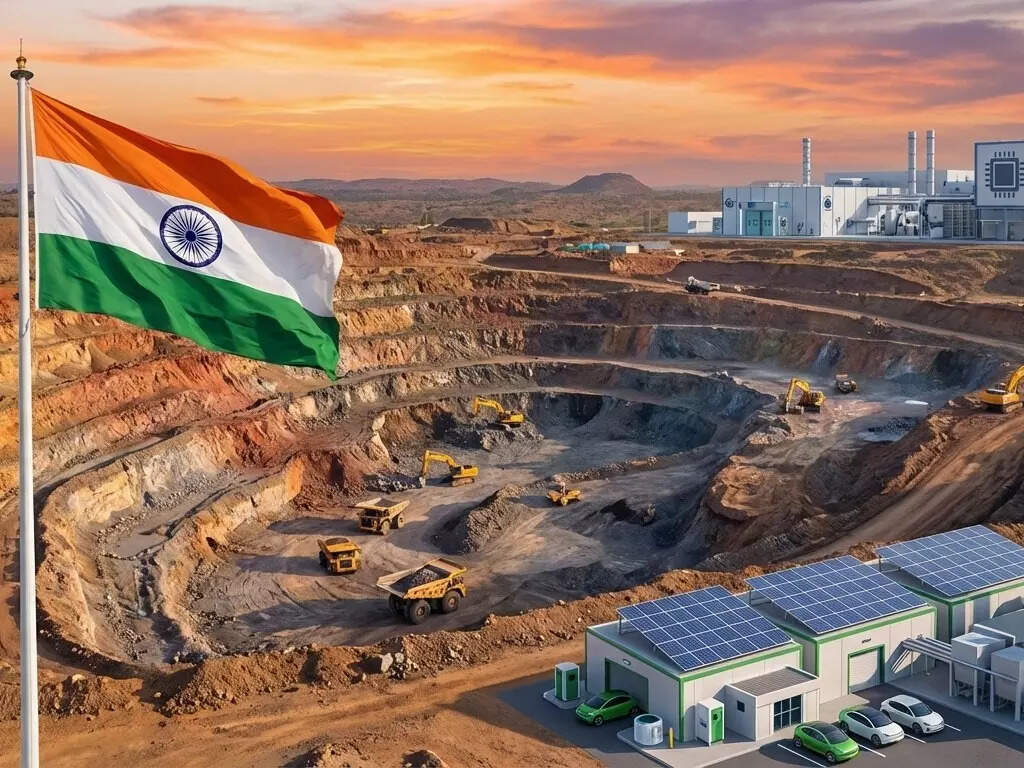
The Indian economy stands at a moment of unusual strategic opportunity. Global trade and production networks are being reshaped by tariff wars, supply-chain fragmentation, the shocks of the Russia–Ukraine conflict and an intensifying contest for technological dominance. In this fluid geopolitical environment, economic strength is no longer defined merely by GDP size, but by control over strategic sectors that underpin future industries. Rare earth elements (REEs) sit at the heart of this transformation.
Rare earths are indispensable for electric vehicles, renewable energy systems, semiconductors, defence equipment, electronics and advanced manufacturing. Control over their supply chains increasingly translates into geopolitical leverage. If India gets the policy framework right, rare earths could emerge as a true power-lifter sector, one that boosts domestic growth and self-reliance while also enhancing India’s global economic and strategic influence.
India’s rare earth paradox
India’s rare earth story begins with a paradox. According to a recent report by Amicus Growth, India holds around 6.9 million tonnes of rare earth oxide reserves, making it the world’s third-largest reserve holder after China and Brazil. This places India ahead of Australia, Russia, Vietnam and the United States in terms of geological potential.
Yet production tells a starkly different story. In 2024, India produced just 2,900 tonnes of rare earths, ranking seventh globally. China, by contrast, produced 270,000 tonnes, cementing its dominance not only in mining but across the entire rare earth value chain. The U.S., Myanmar, Australia, Thailand and Nigeria all outproduced India despite having smaller reserves.
The roots of this gap lie in structural and policy constraints. Most of India’s rare earth reserves are embedded in monazite-rich coastal sands that also contain thorium, a radioactive element. This has historically subjected rare earth mining to stringent regulations, slowing approvals and discouraging private participation. For decades, production was largely confined to PSU Indian Rare Earths Limited (IREL), with rare earths treated as incidental by-products rather than as strategic resources in their own right.
Processing is the real ‘rare’ power
Mining alone does not confer influence in the rare earth sector. The true power lies in processing and refining. While several countries possess rare earth reserves, processing capacity is heavily concentrated in China, which controls roughly 90 per cent of global refining and nearly the entire processing of heavy rare earth elements. This dominance allows China to exercise outsized control over downstream industries, from electric mobility to defence manufacturing.
India’s weakness is most pronounced here. The country has minimal processing and refining capacity, leaving it dependent on imports even when raw material exists domestically. This lack of value-chain integration means that India’s large reserves do not translate into either economic scale or strategic leverage. Until this bottleneck is addressed, rare earths will remain an unrealised opportunity rather than a power-lifter sector for the economy.
Why rare earths will be a power-lifter for India
Rare earths have the potential to act as a power-lifter for the economy because they sit at the intersection of economic growth, technological leadership and geopolitical leverage. Domestically, a strong rare earth ecosystem would support India’s ambitions in electric vehicles, renewable energy, electronics manufacturing, defence indigenisation and advanced materials. These sectors generate high-value jobs, promote technological upgrading and reduce import dependence.
Globally, the strategic value is even greater. As countries seek to de-risk supply chains away from China, alternative suppliers of rare earths and rare earth-based components are in high demand. If India can offer not just raw materials but refined products, magnets and components, it can position itself as a trusted partner in global clean energy and technology transitions. In an era of disrupted trade and shifting alliances, such leverage translates into economic power and diplomatic influence.
The government is on the job
Recognising the strategic stakes, the government has begun to reshape India’s rare earth policy architecture. A major step was the formal launch of the Rs 16,300 crore National Critical Mineral Mission, which places rare earths alongside other strategic minerals. The mission aims to expand exploration and mining, build domestic processing and refining capacity, promote recycling and circular supply chains and improve inter-ministerial coordination.
Legislative reform has reinforced this push. Amendments to the MMDR Act have brought 24 critical minerals, including rare earths, under Central government control. This gives the Centre exclusive authority to auction and regulate mining leases, enabling faster approvals and more standardised exploration and mining processes.
In 2025, the Ministry of Mines concluded auctions for several critical and strategic mineral blocks, including rare earth-bearing blocks. For the first time, private investors were invited to compete for rare earth mineral rights, marking a break from decades of near-exclusive public sector dominance. While some blocks attracted bids from both public sector units and private firms, the overall response was cautious. The cancellation of five critical mineral blocks, including a rare earth block in Karnataka, due to poor bidder interest in August 2025, shows lingering concerns about commercial viability and various risks.
The government has also targeted downstream manufacturing. A Rs 7,280 crore incentive scheme was introduced to build domestic rare earth permanent magnet manufacturing capacity of 6,000 tonnes per year. These magnets are critical for EVs, defence systems, electronics and renewable energy. The scheme offers a seven-year incentive framework and aims to reduce dependence on Chinese imports. Bids for setting up integrated magnet manufacturing facilities are expected to be invited by the end of January 2026.
In parallel, a Rs 1,500 crore incentive scheme for recycling critical minerals has attracted significant interest from companies. By promoting recovery of rare earths from secondary sources, the government is laying the groundwork for a more resilient and circular supply chain.
Despite these initiatives, industry participation remains measured. Rare earth projects are capital-intensive, technologically complex and subject to long gestation periods. Regulatory uncertainty, particularly around radioactive by-products, adds to perceived risk. The absence of assured offtake arrangements and limited domestic processing ecosystems further dampen investor enthusiasm. This suggests that policy push alone is not enough, and it must be complemented by risk-sharing mechanisms and long-term visibility.
What Budget 2025–26 can do to turbocharge the sector
While the government has already been quite proactive in promoting the sector, especially after China restricted rare earth exports, the upcoming Union Budget is likely to further streamline policy given the critical importance of this sector.
One priority can be targeted fiscal support for processing and refining facilities, including viability gap funding. Without scaling, processing and refining, India will remain trapped at the raw-material end of the value chain.
The Budget could also enable long-term offtake guarantees or offer procurement commitments for domestically produced rare earth magnets and components, especially for EVs, defence and renewable energy projects. This would reduce demand uncertainty and encourage private investment. Another important intervention would be funding for research and technology partnerships focused on separation, refining and recycling of rare earths, including heavy rare earth elements. Building domestic technological capability is essential to reduce dependence on foreign know-how. The Budget can support the creation of integrated rare earth industrial clusters that bring together mining, processing, manufacturing and recycling, backed by shared infrastructure and simplified regulatory clearances. Such clusters would help achieve scale and make the value chain more efficient.
India has the resources, a growing policy framework too and a favourable global context. What it needs now is efficiency, speed and sustained commitment. If nurtured with the right mix of policy support, investment incentives and institutional reform, rare earths can become one of India’s defining power-lifter sectors in the decades ahead.