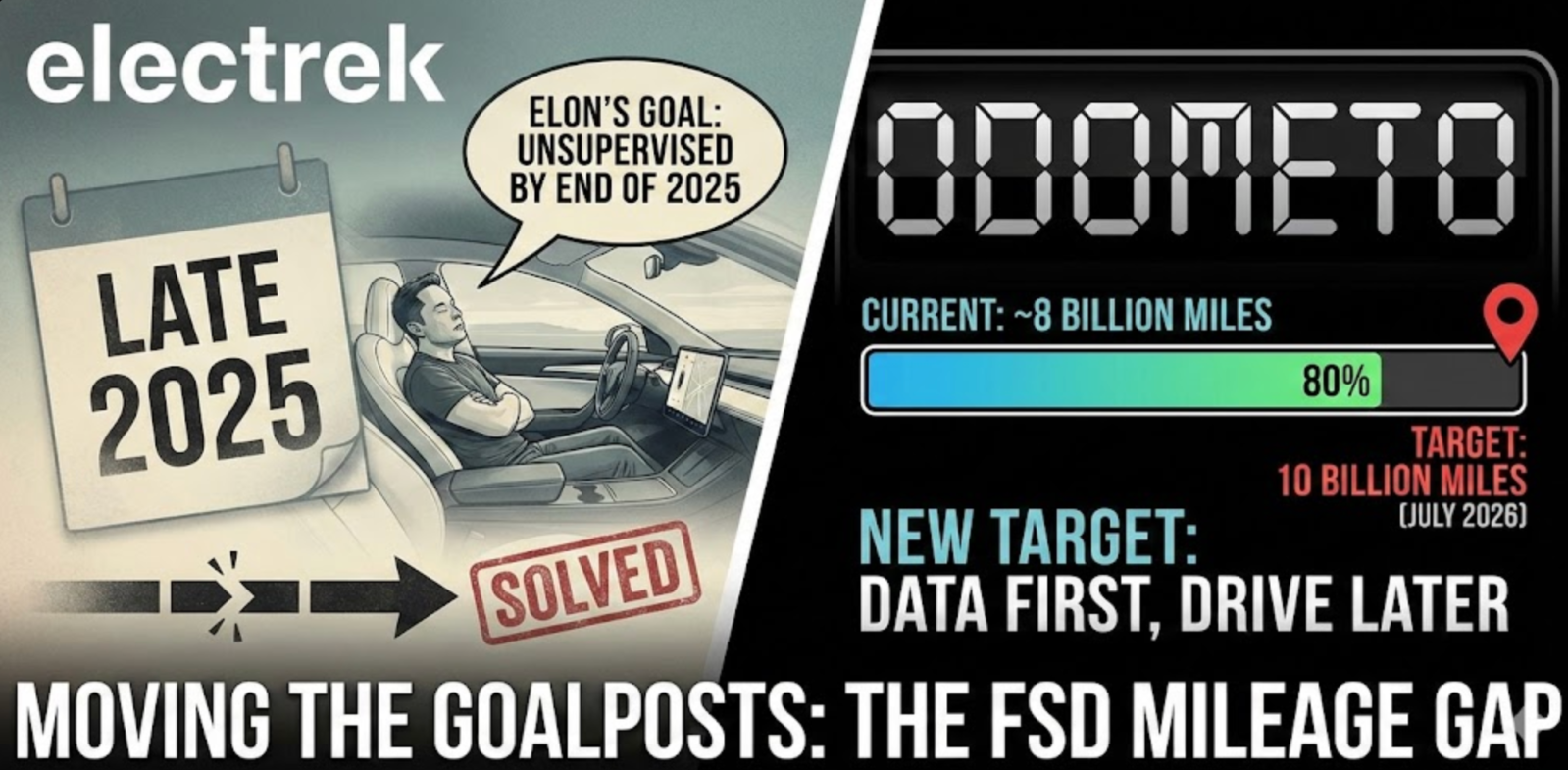
We are barely a week into 2026, and we are already seeing a significant shift in the narrative regarding Tesla’s Full Self-Driving (FSD) timeline. After missing yet another high-profile deadline to achieve unsupervised autonomy by the “end of the year” in 2025, Elon Musk has now dropped a new metric that explains a lot — and raises even more questions.
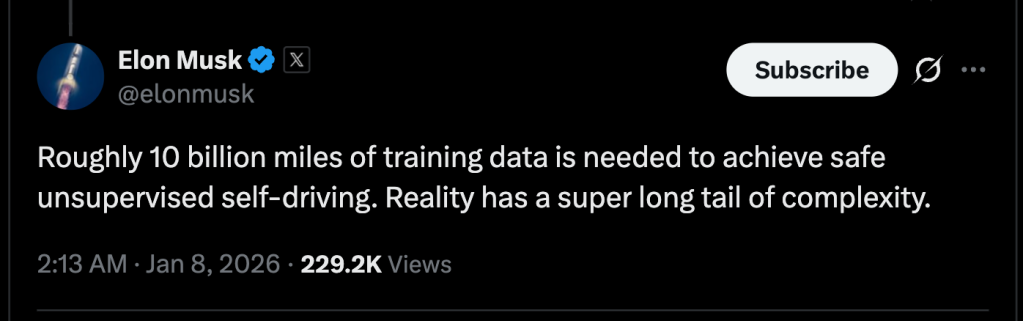
In a new comment today, Musk has stated that Tesla needs to accumulate roughly 10 billion miles of data to achieve “safe unsupervised self-driving.”
The new statement raises the question: why did Musk claim that Tesla would be unsupervised in Austin just a few weeks ago, when he knew that Tesla was nowhere near 10 billion miles?
Throughout late 2025, as with previous years, Musk was adamant that unsupervised autonomy was “solved” and imminent. We were told unsupervised robotaxis would be operating in Texas within weeks. Yet, in December 2025, Tesla’s cumulative FSD mileage was significantly below the 10 billion mark.
Tesla had accumulated about 7 billion miles of data.
This makes Musk’s latest admission incredibly strange. If the internal metric for true, safe, regulatory-grade autonomy is 10 billion miles, why on earth was the CEO promising it would launch last year when the company was mathematically nowhere near that goal?
Tesla’s new “safe unsupervised” timeline
Based on the current growth rate of the Tesla fleet and FSD engagement, Tesla is racking up miles faster than ever. We project that the fleet will likely cross this newly stated 10 billion-mile threshold around July 2026.
But as anyone following FSD development knows, collecting the data is only step one.
Once that milestone is hit, Tesla still needs to execute massive training runs on Dojo and its NVIDIA clusters, perform exhaustive validation testing, and go through the arduous debugging process for the millions of edge cases that 10 billion miles will inevitably uncover.
Therefore, based on Musk’s new timeline for Tesla unsupervised FSD, Tesla won’t achieve this for likely another year. And then, we have to consider that Musk has been consistently wrong about when Tesla will solve unsupervised FSD for a solid decade at this point.
Electrek’s Take
The problem with consistently lying is that you have to keep track of your lies; otherwise, they start contradicting each other.
Elon previously claimed that Tesla would need 6 billion miles. Now, it’s 10 billion miles.
Did he come to this realization before or after early December, when he said that Tesla would go unsupervised in Austin by the end of the month?
Then, instead of achieving that, why did Musk and Ashok post videos of themselves driving in what they claimed to be unsupervised robotaxis in Austin at the end of the month? To make it seem like they achieved their goal? Then why does Musk just now admit that much more data is needed.
If we look at Musk’s history of timelines, they are consistently wrong, usually by years. If the data is ready in July, and we factor in the necessary training, testing, and regulatory hurdles, plus the usual “Elon fudge factor”, it is highly probable that “safe unsupervised self-driving” is still at least a full year away, if not much more.


FTC: We use income earning auto affiliate links. More.