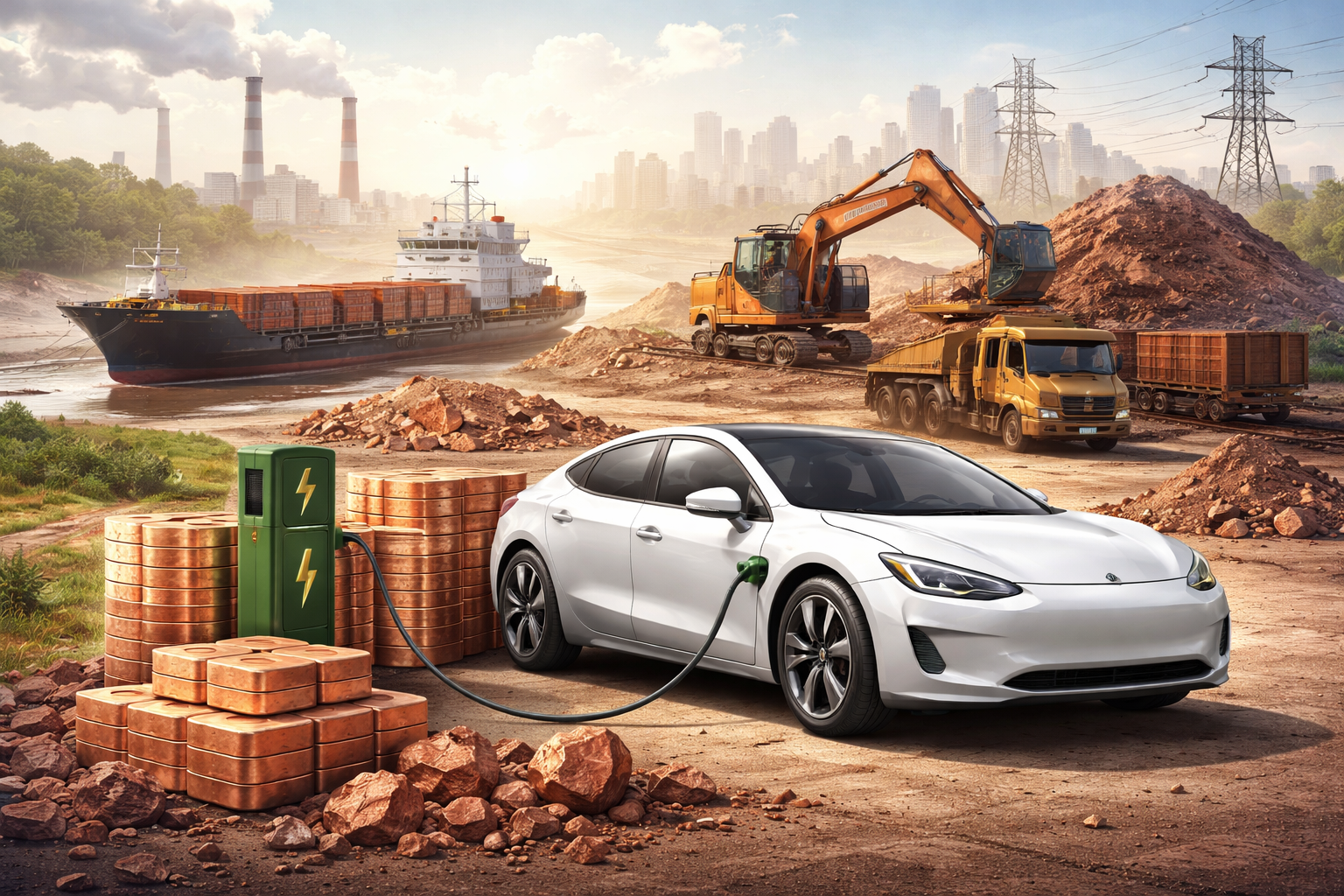
The entry of electric vehicles has virtually revolutionised the Indian roads as these sleek machines zip past their gas and petrol brethren, while slashing CO2 emissions and helping the cause of India’s climate. Driving this change is the humble metal Copper, which is expected to claim 40 per cent of global car sales by 2030. Such an explosion in copper demand only underscores its critical importance in batteries, motors, and charging infrastructure.
Moreover, India’s ambitious 30 per cent EV target by 2030 places the copper supply chain at the heart of this electric revolution—from mining, recycling to strategic processing.
Copper’s vital role stems from its inherent qualities, especially its unmatched conductivity and durability. In EVs, thin copper foils transfers electrons between lithium-ion cells and external circuits efficiently but requires 60 to 80 kg of copper for wiring harnesses, and traction motors, 3 times more than those running on internal combustion engines.
Moreover, its corrosion resistance quality, along with its ability to handle high currents—350 kilowatts (kw) without excessive heating- in fast-charging stations– makes it a must have for the automobile industry. Without such bursts of 350 kilowatts (kw), range drops, increasing greater risks of fire and costs spike.
Bridging the demand-supply gap
It also underlines the importance of the role of integrated domestic players in bridging this yawning demand-supply gap. For instance, at peak operations, Sterlite Copper contributed significantly to domestic refined copper output, supported downstream manufacturing, and reduced import dependence capabilities that are directly aligned with today’s EV localisation and PLI ambitions.
Yet policy lags: the outdated Mines and Minerals (Development and Regulation) Act, 1957— stifle auctions, pushing companies to demand amendments for exploration licenses and brownfield expansions—critical for EV battery supply chains. Compounding the issue, is the Chinese dominance—60 per cent of the refined copper market– risking pricing squeezes and other geopolitical issues.
Global parallels sharpen urgency. Battery giants like China’s CATL, BYD have already hoarded copper from different mines and futures contract, which has seen copper prices skyrocket by nearly 45 per cent in 2025 in the London Metal Exchange.
Similarly, the US government is investing billions of dollars in Arizona Resolution under the Inflation Reduction Act to extract billions of pounds of copper over 40 years. The EU in turn has mandated the use of 20 per cent recycled copper in EVs by 2030. India, too, must keep pace—provide a fine balance between government incentives and tax breaks. Incentives for setting up Special Economic Zones for scrapyards and R&D for copper-aluminium hybrids, and tax breaks for smelters.
Persistent challenges:
Challenges persist. Mining’s environmental toll—water guzzling, tailings pollution—and community pushback that echoes that Sterlite’s closure demands. Battery giants pivot to sodium-ion cells, potentially halving copper needs, yet lithium remains king through 2040. Geopolitics, too, threatens– export curbs from top producers could spike costs 30 per cent, putting a spoke in India’s EV journey.
A triangulation solution is called for. First, there is a need to recycle aggressively, While the recycling Rate has Improved from 22 per cent in 2019–20 to 43 per cent (2023–24), there is still immense scope for improvement. Second, diversify sourcing via Zambia Copperbelt (First Quantum/Kansanshi) and Australian producers (Glencore for Mount Issa). Third, innovate: industrial graphene coatings improve Cu wire conductivity by 1-3.6 per cent (due to enhanced crystallinity), enabling minor diameter reduction.
Beyond batteries there are the charging centres—the other copper guzzlers. India plans to instal 3.9 million total chargers by 2030 (mostly 7-22 kW AC), with1,000-2,000 fast DC chargers (50-120 kW) on highways, each requiring 100-300 kg copper. The state-of-the-art vehicle-to-grid (V2G) technology ensures two-way flow between EV batteries and the power grid but demands higher quantities of copper.
The metal’s critical dependency also stems from the fact that there are no real alternatives. Silver costs are astronomical; superconductors do not work at room temperatures. Higher efficiency in copper wiring can help improve the electron flow from existing copper wiring, and hence, reduce peak loads. India’s advantage flows from having large scrap reserves, a pool of engineering talent and the projected 10 million-strong EV market by 2030.
Copper shortages could derail India’s net-zero 2070 plan, inflating battery prices 25 per cent and curbing adoption. Prosperity hinges on supply: jobs in 50 new mines, forex savings from $15 billion imports avoided, energy security via domestic charging webs.
Copper wires the EV dream to reality. As batteries evolve, this red hot metal endures—conducting power, prosperity, and progress. India leads demand growth; now it must master supply, turning challenge into copper-clad opportunity by fast-tracking auctions, subsidising deep-sea nodules from Indian Ocean floors, and forging ASEAN supply pacts.
(Disclaimer- The author is Dilip Chenoy, Former Secretary General, FICCI and Director General, Society of Indian Automobile Manufacturers. Views are personal.)