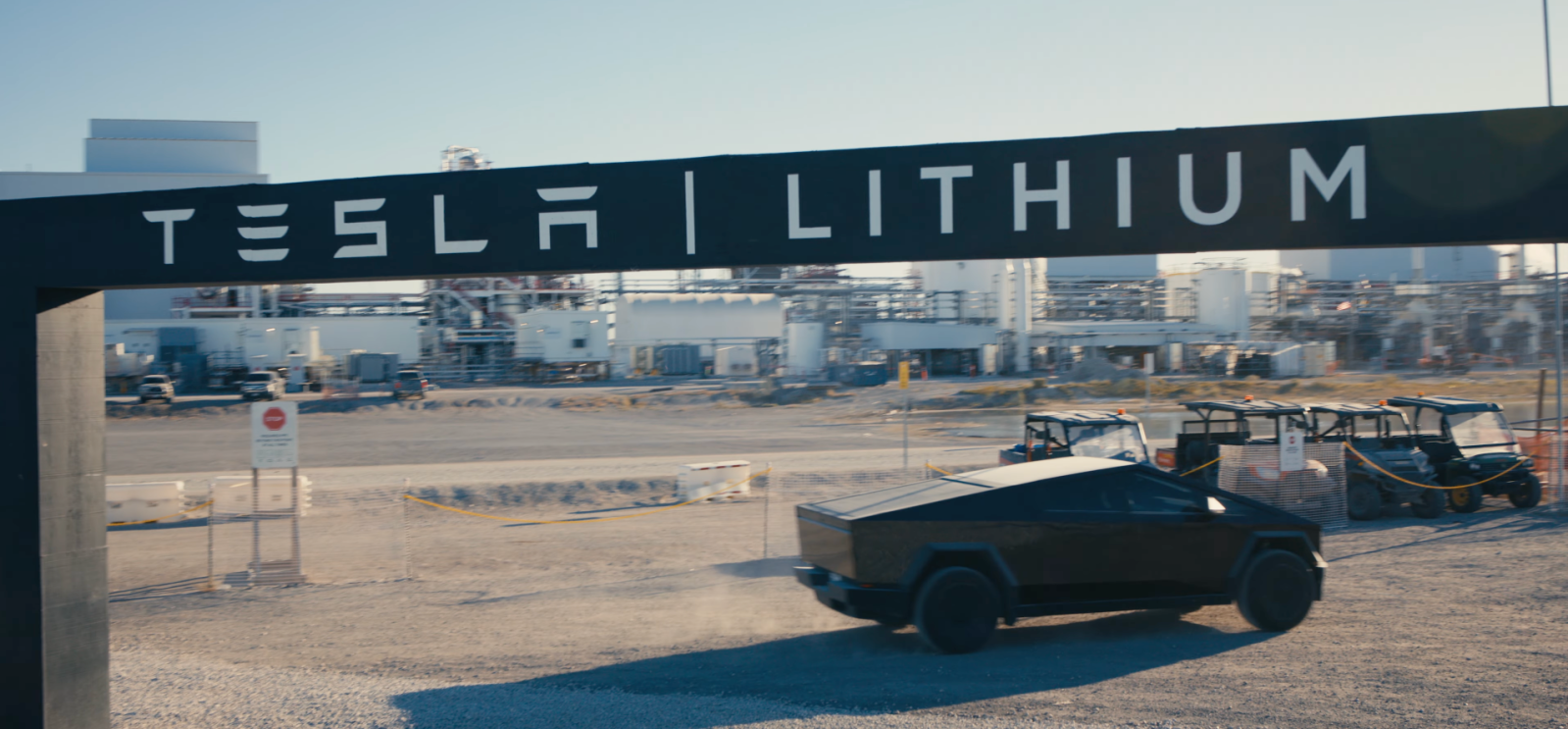
Tesla has released a new video giving us a closer look at its massive lithium refinery in Corpus Christi, Texas, and confirming that the facility has officially started production.
For years, CEO Elon Musk has been urging entrepreneurs to get into the lithium refining business, famously calling it a “license to print money.” He noted that while lithium ore is relatively abundant, the refining capacity to turn it into battery-grade lithium hydroxide was a major bottleneck in the electric vehicle industry.
Tesla eventually decided to take matters into its own hands. The automaker broke ground on its own refinery in Robstown, Texas, near Corpus Christi, in 2023 with the goal of deploying a new, more efficient refining process.
Now, just two years later, Tesla is showing off the operational plant.
The company released a new video update yesterday featuring Jason Bevan, Tesla’s Site Manager for the refinery:
In the video, Bevan confirms the impressive timeline of the project:
“From breaking ground in 2023 to running rock through the kiln in 2024 to start a full integrated plant startup now in 2025.”
(Note: While the video was released this week, the “now in 2025” comment implies the facility likely reached full integrated startup late last year).
Bevan highlights that this is the “first spodumene to lithium hydroxide refinery in North America,” marking a significant shift in the region’s battery supply chain.
The video details Tesla’s specific process, which differs significantly from traditional methods:
- Feedstock: Uses Spodumene (hard rock ore) rather than brine.
- Processing: The ore runs through a kiln and cooler before entering an alkaline leach process.
- Output: It moves to crystallization to produce battery-grade lithium hydroxide.
Crucially, Tesla confirms that this new “technology platform” is acid-free. Traditional lithium refining often involves acid roasting that produces hazardous byproducts like sodium sulfate.
Instead, Tesla’s process creates a benign co-product—which Bevan refers to as “analy” (likely Analcime or a similar aluminosilicate)—that consists of sand and limestone. Tesla says this byproduct is being used in concrete mixes, effectively turning waste into a construction material.
“Our process is more sustainable than traditional methods and eliminates hazardous byproducts,” Bevan said.
Tesla claims it achieved the “fastest time to market” for a project of this kind by performing feasibility, design, and construction in parallel, bypassing the traditional “stage-gate” hurdles that often slow down industrial projects.
Electrek’s Take
This is a big milestone not just for Tesla, but for the entire North American EV market.
We have been tracking this project closely since the groundbreaking, and seeing it go from a dirt lot to a fully operational refinery in roughly two years is impressive. In the mining and refining world, these projects typically take 5 to 10 years to come online.
Now, the project is certainly not as useful to Tesla today as it would have been when it was originally announced, as lithium prices have come down significantly since then.
However, they have been spiking again in recent months, and if they continue to rise, the refinery could prove a significant help to Tesla in the near future.


FTC: We use income earning auto affiliate links. More.