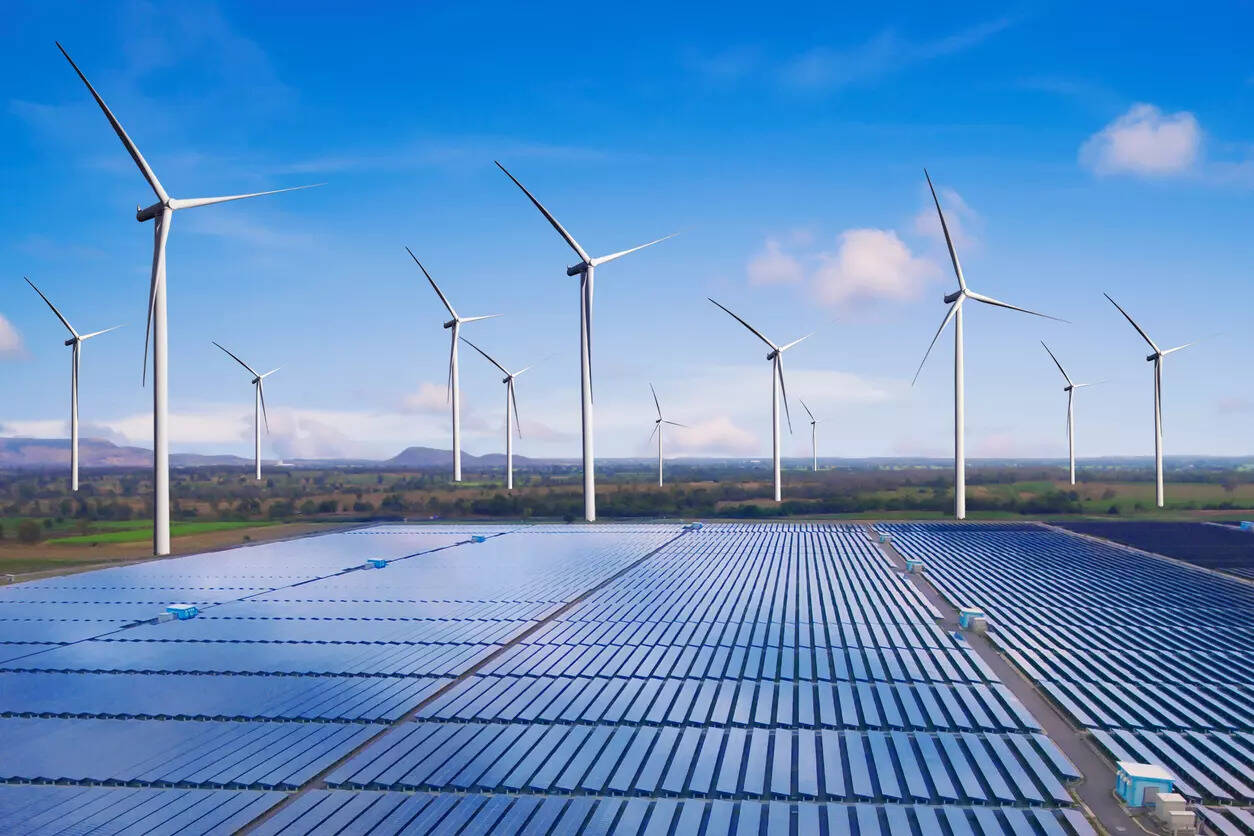
Confident of a huge growth opportunity in the Indian renewables space, clean energy major ReNew’s chief, Sumant Sinha, has said his group will expand in a “smart and measured” way, without being greedy or adopting an “all at once” approach.
He said AI and data centres are creating a huge demand for power, and renewables can provide more than 80 per cent of that going forward.
Speaking to PTI here during the World Economic Forum Annual Meeting, Sinha said, “We are already into generating clean energy, and we are looking at storage, that’s another important area.
“We are doing solar panel and solar cell manufacturing. So I think we’ll build a bit of a manufacturing ecosystem there.
“And then we’ll look at all the downstream areas, whether it’s green hydrogen, green ammonia, data centres, those kinds of things,” he said.
Asked whether ReNew will look to capture the entire value chain, he said, “We will do it in a smart way.”
“We don’t want to be greedy where everything is done all at once. Because it’s not a good strategy to do that. So we’ll do it in a measured way. But eventually the intention is to get into areas because they’re all exciting, interesting areas,” Sinha said.
Talking about the impact of AI on renewable energy, he said AI systems and tools can be used to enhance the performance of our assets, and that is something we’re already working on, and hopefully, over time, it will become better… and improve the performance of our assets a little bit more, maybe by 2-3 per cent.
“Though that is also a lot of improvement, the biggest impact is that AI, as a new paradigm, requires a tremendous amount of power to grow. And power has to come from mostly renewable energy,” he said.
“So, we see AI as being a huge new demand driver for more renewable energy capacity,” he said.
Citing reasons, he said renewable capacity can be set up relatively quickly, and then we see a lot of buyers who are setting up data centres are very focused on sustainability,” he said.
He also asserted that the cost of renewables is lower now, and even with storage, it costs less than coal-based power.
He said the adoption is moving as fast as it can. Last year, renewables added almost 50 gigawatts of new capacity. And the last five years, renewables have accounted for 80 per cent of capacity addition in the Indian power sector, he said.
“It is a new area, and it needs time to scale up. So it is scaling up,” he said.
On EVs still being charged with fossil-fuel-based power, he said, since the grid is 65-70 per cent fossil-fuel-based today, that’s what EVs will use today.
“But you should not stop the proliferation of EVs. Because the user side and the generation side both will not go hand in hand.
“In some cases, the usage side will go a little faster, and the generation side will catch up later on,” he said as he exuded confidence that fossil fuel-based power will come down to 40 per cent, 30 per cent and then 20 per cent.
But it is important for EVs to be there, because if they’re not, we’ll never shift away from petrol and diesel, he said.
“We need to have almost 1000 gigawatts of renewable energy capacity by 2040, and 1,800 by 2047, and then we will see renewables becoming the majority,” he said.
“But, today we are at 150 gigawatts, and therefore we need a 10 times growth in the installed capacity.
“We need that much land, we need that much transmission infrastructure, that many solar panels and modules, we need that many wind turbines. So it’s all going to take a lot of effort and time before it happens,” he said.
He gave an example of the country’s fossil fuel infrastructure, built over 70-80 years, and said we can’t expect renewables to replace it within 10 years.
It will take at least 20-30 years to replace, especially because India is an economy growing at 6-7 per cent a year, and you need power to support incremental demand growth and to replace the existing fossil-fuel-based capacity, Sinha said.
On self-reliance in the energy space, Sinha said energy is different and difficult.
“Because obviously we consume a lot of oil and gas mostly, and we import almost 150 to 200 billion dollars every year. Now, to replace oil, we can’t replace oil in all the use cases,” he said.
For example, only 20 per cent of vehicles sold in India are electric today, and even then, it will have to reach 100 per cent, after which all existing stock of vehicles will have to be phased out, which will take another 10-15 years, he argued.
“So it’ll take a lot of time. for us to stop being dependent on oil. And then of course, there are other areas where oil is used as a feed, for example, in plastic production and all of those things. Then we use gas for making fertilizers,” he said.
Besides, in some cases, the replacements are not yet cheaper than oil and gas. Though electricity has become cheaper, green hydrogen and green ammonia are not yet, he said.
Once they become cheaper, they will create a similar market pull to electricity, replacing fossil fuels with green energy, but that will take some time, he said.
He said renewable energy is currently seeing most of its demand in electricity, and with data centres becoming an additional demand driver, this space has huge growth opportunities and will keep growing for the next 40-50 years.