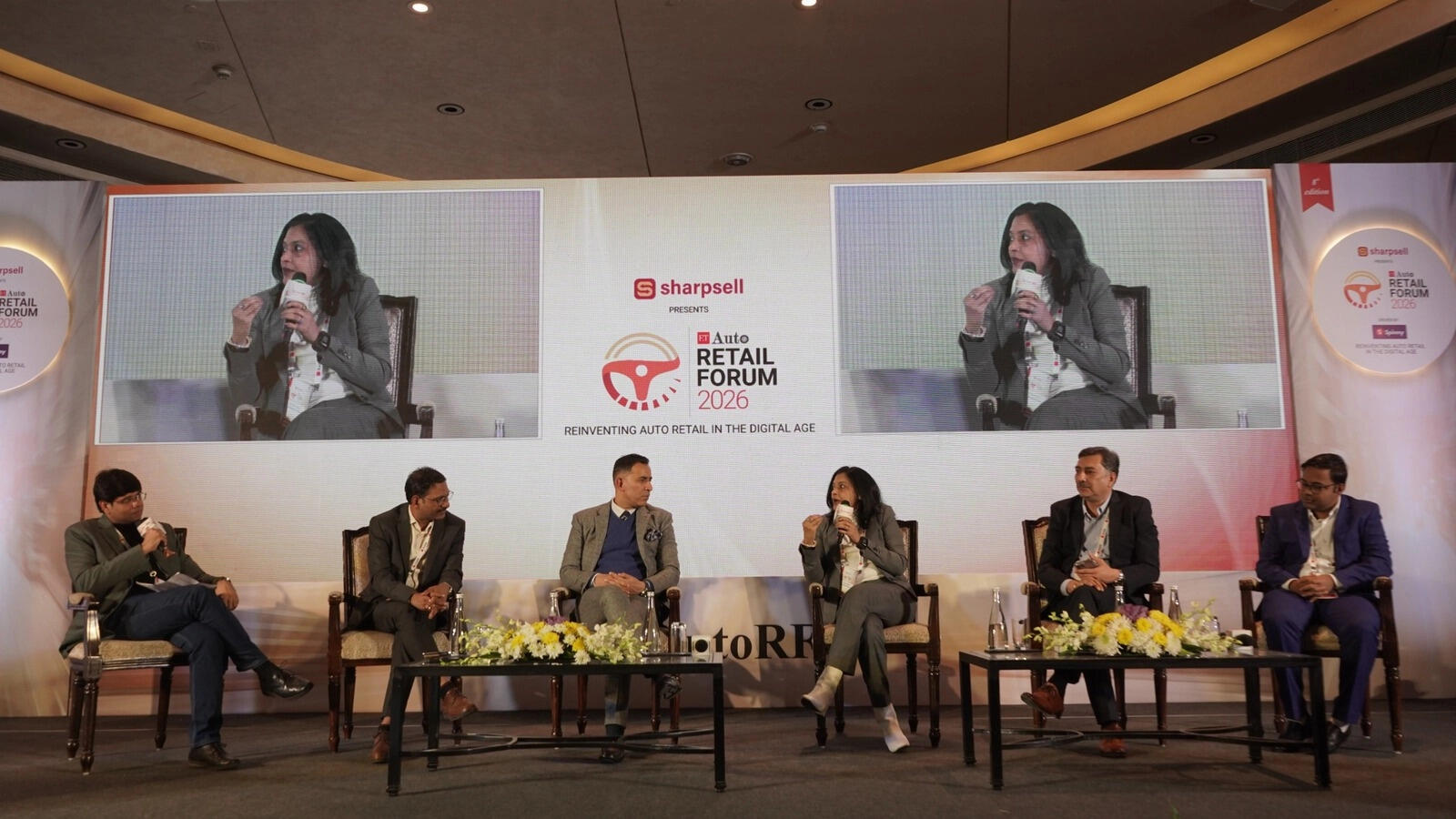
India’s electric mobility push is forcing a fundamental reset in auto retail, with trust, uptime and dealer readiness emerging as decisive factors that will shape EV adoption over the next five years, industry leaders said, as customer anxiety around batteries, reliability and total cost of ownership continues to influence buying decisions.
These themes came to the fore on Wednesday at the ETAuto Retail Forum 2026, where executives from OEMs, mobility startups and retail technology firms spoke about how electric vehicles (EVs) are reshaping customer expectations, dealer roles and the broader auto retail ecosystem.
A key theme that emerged was customer anxiety — particularly around batteries, running costs and reliability — which continues to influence EV adoption. Ravi Mittal, Director – Strategic Projects, JSW MG Motor India, highlighted that while EVs offer compelling advantages, trust-building remains critical.
“Electric vehicles address several major challenges, including zero tailpipe emissions and significantly lower running costs compared with internal combustion engine vehicles,” said Mittal, adding that customers still seek clarity on battery life, service support and total cost of ownership before making the switch.
From an OEM and fleet-focused perspective, Uday Narang, Founder & Chairman, Omega Seiki Mobility, stressed that retail success in EVs hinges on understanding real-world usage and uptime needs. “We focus on what drivers want and their requirements, and work to meet diverse customer needs, whether it is on the service side or in terms of parts availability,” Narang said.
He underlined that dealer sustainability, service readiness and spare parts availability across Tier 2 and Tier 3 cities will be central to scaling electric mobility beyond early adopters.
Technology maturity, rather than customer willingness, was flagged as another critical challenge. Naveen Chopra, CTO & COO – Manufacturing Operations, Sun Mobility, noted that EVs are still in a phase of rapid technological evolution. “EVs are still evolving, and as we expand into different domains, the key challenge lies in the technology. It is not about customer acceptance, but about resolving technical issues,” he said, pointing to the need for robust validation, battery safety, second-life planning and data-driven service models to build long-term confidence.
On the retail front, Garima Misra, Managing Director, Landmark Group, observed that buyers today are far more informed than before, often walking into dealerships with prior research and digital exposure.
“For the past six years, EVs have been a key topic at every auto forum. The Indian industry still grapples with whether electric vehicles will truly take off,” she said, adding that dealers must now play the role of educators — addressing range anxiety, service concerns and financing gaps, rather than merely selling products.
Complementing this view, Abhijit Paul, Head of India Sales and Demand Generation, Sharpsell, emphasised the role of technology and AI in empowering frontline sales teams. As products and propulsion technologies diversify, the panel agreed, retail champions of the future will be defined by knowledge, empathy and ecosystem thinking — with OEMs and dealers prioritising customer confidence, dealer viability and long-term sustainability over short-term gains.