The advent of generative AI has turned much of the internet into an unrecognizable flood plain of mind-numbing slop.
In the latest sign of the times, the Economic Times — the second most widely-read English-language newspaper in the world, as of 2012 — picked the word “Kafkaesque” as its “Word of the Day” earlier this week. But even the briefest glance at the accompanying illustration reveals that the piece involved little, if any, human oversight.
The issue is the image at the top of the piece — which, to be fair, is labeled as being AI-generated — that attempts to write the word on a blackboard. But it clearly struggles to even spell it, settling on mangled characters that spell something like “Kafkaesliue,” which obviously isn’t a word at all.
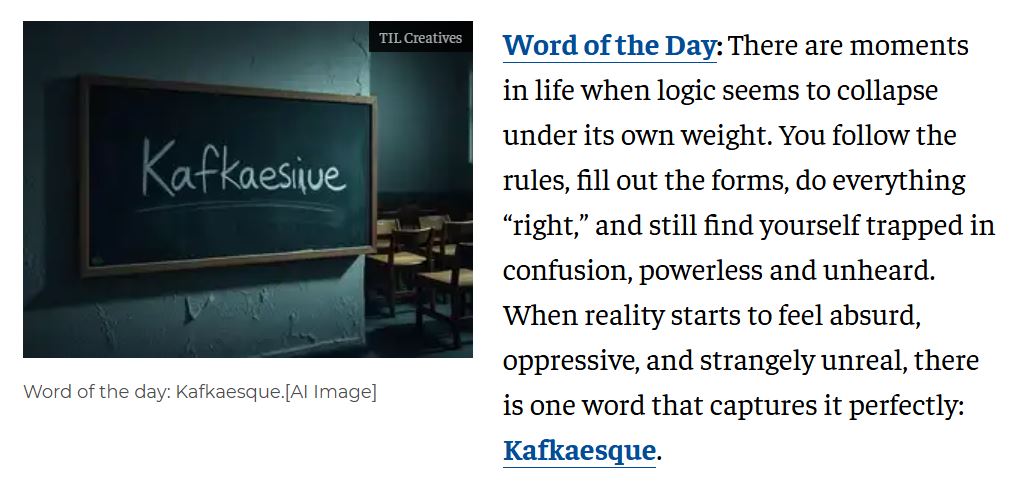
It’s a particularly galling fumble given the particular word. Trudging through a wasteland of AI slop online does frequently feel like being trapped in one of Franz Kafka’s works, in the sense that it’s a surreal and illogical experience that feels impossible to break out of.
Netizens have been dunking on the screwup all day, but so far the Economic Times has left the butchered image live on the article. The newspaper didn’t respond to a request for comment.
A quick perusal of the paper’s deluge of “Word of the Day” features — it seems to publish far more than one per day, running three on the day of its “Kafkaesliue” flub alone — suggests that the AI error isn’t a one off. A write-up about the word “pensive,” for instance, features an image showing a coffee cup labeled “celffee.”
The blunders highlight how the news industry is desperately trying to reinvent itself as publishers brace against a torrent of bottom-tier AI-generated content. Media executives have been gearing up for AI to deal the journalism industry a fatal blow as the advent of the tech has left devastating holes in web traffic.
A report published last year found that over half of the internet now consists of AI slop. The result might be described as Kafkaesque. Or maybe “Kafkaesliue.”
“In simple terms, Kafkaesque is what happens when reality stops making sense but still insists you comply,” the Economic Times‘ more-than-likely AI-generated copy explains. “The pronunciation of the word as per Merriam-Webster is- käf-kə-ˈesk.”
The cold rehashing of the word certainly invokes the reality we increasingly find ourselves trapped in. Tools like OpenAI’s ChatGPT have indeed turned our media environment upside down — in an “absurd, oppressive, and strangely unreal” fate, in the words of the Economic Times.
More on AI journalism: Media Execs Prepare for AI to Bring End of Journalism Industry