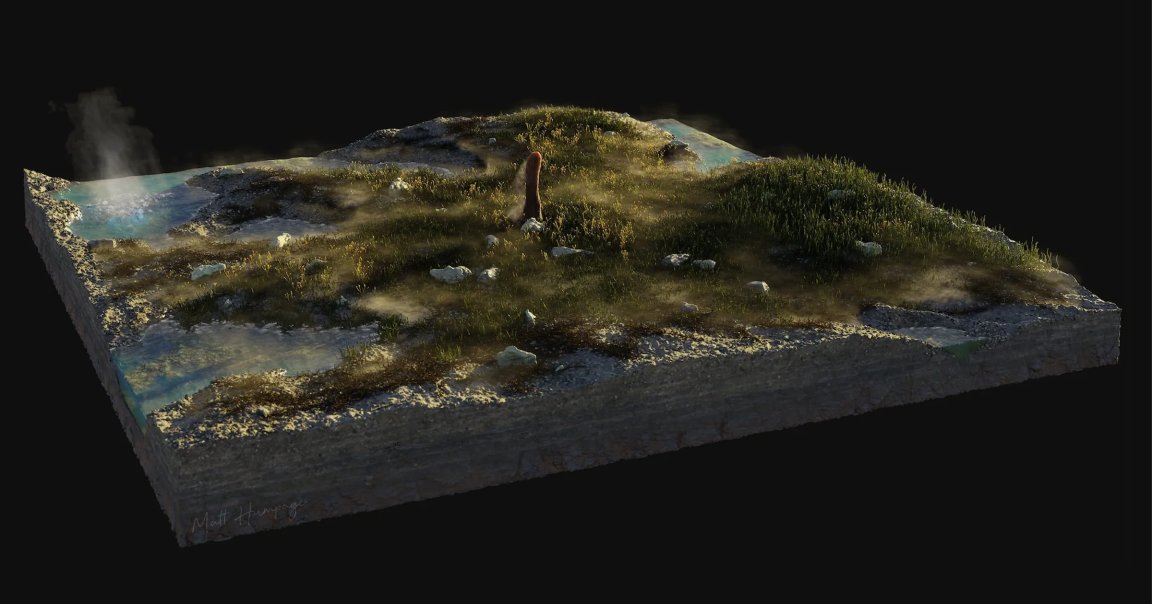
It’s a plant! It’s a fungus! It’s… an entirely new type of lifeform hitherto unknown to science?
That appears to be the case for a puzzling, spire-shaped organism that lived over 400 million years ago, according to a new study published in the journal Science Advances. After analyzing its internal structures, the authors argue that the mystifying ancient beings known as prototaxites don’t belong to any of the existing biological kingdoms.
“It feels like it doesn’t fit comfortably anywhere,” Matthew Nelsen, a senior research scientist at the Field Museum of Natural History who wasn’t involved in the work, told Scientific American. “People have tried to shoehorn it into these different groups, but there are always things that don’t make sense.”
The name Prototaxites means “early yew” or “first yew,” a misnomer that captures the debate that has surrounded its nature for over a century. With its resemblance to a tree trunk, scientists initially suspected it was some kind of extinct tree when its fossils were first unearthed in 1855.
This assumption would probably offend the prototaxites were they still alive to hear it. In reality, the peculiar pillars likely emerged before the first trees appeared on Earth some 400 million years ago, and at an estimated height of around 26 feet, would’ve absolutely towered over other land organisms at the time.
What was the nature of these colossi? Scientific speculation abounded once it became clear that it wasn’t a plant. In the decades that followed its discovery, the consensus flipped to it being a kind of algae. In more recent decades, the suspicion became that it was some kind of giant fungus, because it appeared that they contained carbon isotopes typically found in such organisms.
Boldly, the authors of the new paper — which we’ve been following since back before it was peer-reviewed — say that everyone’s got it all wrong. The tubelike structures in the fossils are wild and varied, unlike the structures in modern fungi, which are more ordered, SciAm noted. There were also no detectable traces of chitin, a chemical that makes up the cell walls of all known fungi.
“It doesn’t seem to have any of the characteristic features of the living fungal groups,” co-lead author Laura Cooper, a researcher at the University of Edinburg, told SciAm, adding that many facets of its biology elude our understanding, not just its taxonomy. “How it actually works energetically is still a complete mystery.”
Some argue that Prototaxites represent a completely extinct lineage of fungus, which, if true, means it would have had to independently evolve into a new form of complex life, according to Kevin Boyce, a paleobotanist at Stanford University who coauthored a 2022 paper with Nelsen on the organisms — something that would be astounding in its own right. “No matter what,” Boyce told SciAm, “it’s something weird doing its own thing.”
Cooper, however, remains adamant that the Prototaxites are too “fundamentally different” to shove it into the category of fungi. Science doesn’t like outliers, so if it is something entirely new, chances are there’s something else like it out there that we haven’t stumbled on yet. And so, according to Vivi Vajda, a paleobiologist at the Swedish Museum of Natural History, the “next step would be to find other fossil life forms with similar chemical fingerprints to trace this enigmatic life form through the tree of life,” she told Science.
More on biology: Tiny Deer Takes on 1.7-Ton Rhinoceros