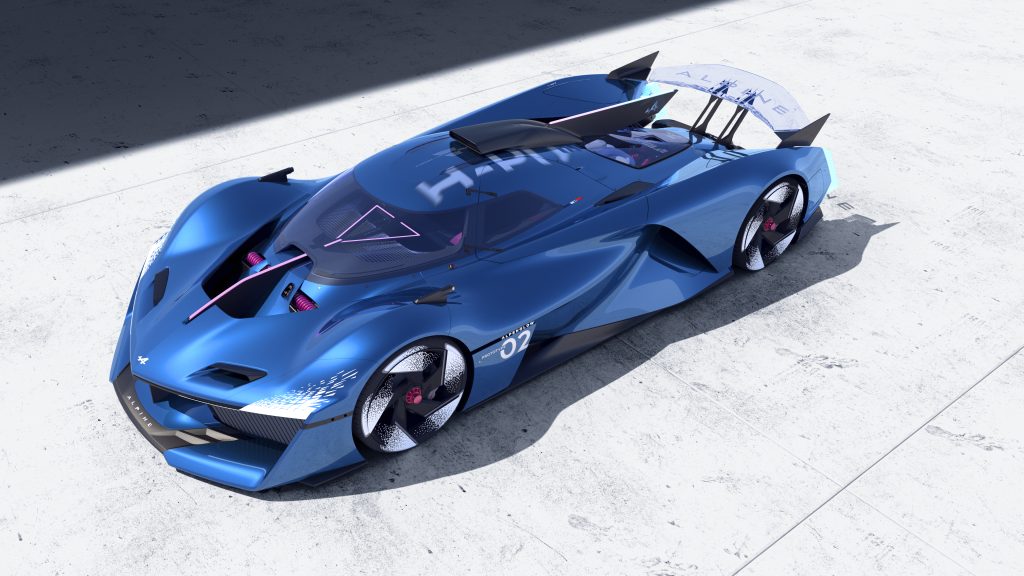
CRP Technology, an additive manufacturing materials and services provider, and CRP Meccanica, a precision machining company, have collaborated with high-performance sports cars manufacturer Alpine on the design and manufacture of an intake plenum and manifold system for the Alpenglow Hy6 hydrogen-powered rolling prototype.
Alpine’s initial intake configuration combined 3D printed polymer components with bonded aluminum flanges. Bench testing revealed sealing issues caused by differences in thermal expansion between materials, as well as vibration and high thermal loads during turbocharged operation. These factors affected interface stability and led Alpine to revise the intake architecture to address sealing performance under thermal and vibrational loads.

CRP Technology, a company specializing in additive manufacturing materials and processes, proposed replacing the hybrid assembly with a fully single-material design. The revised intake system was produced using Selective Laser Sintering (SLS) and Windform SP, a carbon fiber–reinforced thermoplastic developed by CRP Technology. Only minor design adjustments were required to implement the new configuration. The final system consists of three single-piece components: one intake plenum and two intake manifolds, each with integrated flanges. Eliminating aluminum parts enabled uniform material behavior under pressure and temperature conditions associated with turbocharged operation.
Post-processing operations were applied to meet functional and dimensional requirements. After sintering, vapor smoothing was used to optimize internal surfaces. Precision machining was then carried out by CRP Meccanica, the manufacturing division of the CRP Group, to achieve accurate tolerances and reliable sealing interfaces. This hybrid additive–subtractive workflow combined SLS production with CNC machining while maintaining a single-material architecture.

Validation testing was performed on an engine dynamometer, where the intake system maintained structural integrity during repeated pressure cycles of up to 5 bar. Following bench validation, the components were installed on the Alpenglow Hy6 prototype and used in on-track testing. According to the companies involved, the redesigned intake system supported faster development within Alpine’s hydrogen powertrain programme by resolving the limitations observed in the earlier hybrid configuration.
3D printing used to resolve iteration constraints in high-performance vehicle development
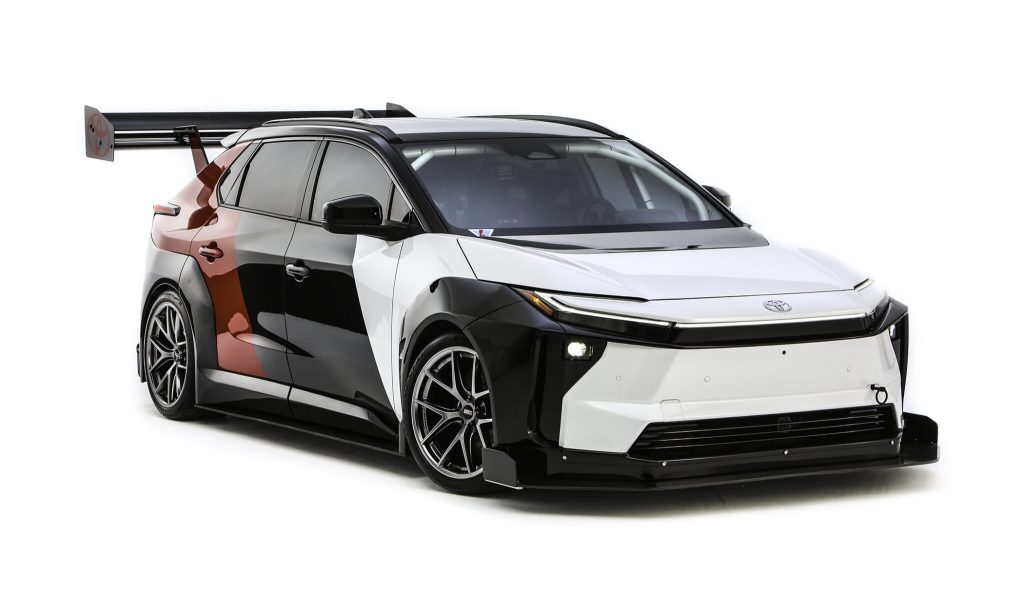
Recent automotive prototype programs have shown how 3D printing is applied when conventional fabrication methods slow down iteration under performance constraints. Toyota used additively manufactured components during the development of its bZ Time Attack Concept, a battery-electric motorsport prototype. Full-scale fender arches and aerodynamic elements were digitally modeled and 3D printed to address fitment, structural durability, and packaging challenges specific to an EV platform. Toyota engineers used the approach to iterate body and aero components within tight development windows, avoiding tooling delays while testing designs directly on a running vehicle.
A similar constraint-driven workflow was reported during Ford’s Nürburgring testing program for the 2025 Mustang GTD. Engineers produced and evaluated 3D printed aerodynamic components on-site to refine downforce characteristics during active track testing. Multiple design iterations were completed over a short period, allowing performance gains to be validated before final parts were bonded to the vehicle. Ford confirmed that this rapid iteration process was necessary to meet aerodynamic targets within limited testing sessions, demonstrating how additive manufacturing can remove iteration delays when performance margins are narrow and testing windows are limited.
The 3D Printing Industry Awards are back. Make your nominations now.
Are you building the next big thing in 3D printing? Join the 3D Printing Industry Start-up of the Year competition and expand your reach.
Subscribe to the 3D Printing Industry newsletter to stay updated with the latest news and insights.
Featured photo shows Alpine Alpenglow Hy6 hydrogen prototype. Photo via Alpine.