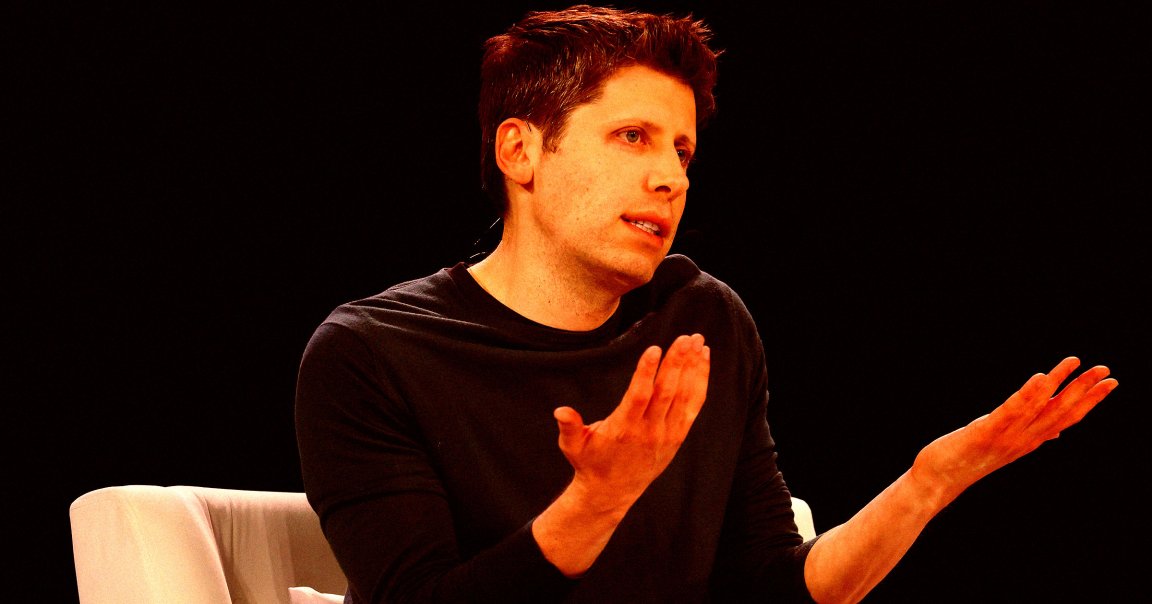
OpenAI is betting in the biggest way possible on a future ruled by AI. It’s committing to spending well over $1 trillion to build out enormous data centers — despite business fundamentals lagging far behind, stoking fears over troubling days ahead.
During a town hall livestreamed on Monday, CEO Sam Altman admitted that the company was looking to pump the brakes, revealing that it’s looking to “dramatically slow down” hiring as the company continues to burn through billions of dollars each quarter.
At the same time, Altman remained characteristically bullish about what his company’s tech will soon offer to the world. When asked if AI can be used to “solve economic gaps that have existed for decades,” the executive argued that it’s “going to be massively deflationary.”
“Given, certainly, progress with work you can do in front of a computer, but also what looks like it will soon happen with robotics and a bunch of other things, we’re going to have massively deflationary pressure,” he predicted.
As a result of this deflationary pressure, Altman promised that things would get “radically cheaper” and the “empowerment of individual people” will go up as money becomes more valuable — which, it’s worth noting, would be an inversion of virtually every economic system in history, which have overwhelmingly been inflationary.
Altman reasoned that these economic changes would be the result of AI allowing individuals to be vastly more productive. He argued that by the end of this year, an individual spending $1,000 on inference — essentially the cost of running an AI — could complete a piece of software in a short period of time, a task that would have previously taken a whole team a much longer period.
It’s not the first time Altman has argued that AI could make money more valuable. In March, he claimed that AI will have a deflationary impact on the global economy during a closed-door Morgan Stanley conference.
The broader argument that AI could lead to an age of “abundance” in which the cost of living starts to decrease — and that we could even choose not to work if we didn’t want to — has long been deployed by tech leaders, including Altman and xAI CEO Elon Musk, to drive the AI hype cycle.
But given the current state of the economy, such a point remains little more than a daydream. The reality is that AI is still incredibly far from boosting efficiency enough to offset inflation. Just earlier today, the US Federal Reserve held interest rates steady, citing ongoing concerns over “elevated” inflation.
In fact, AI has more frequently been linked to mass layoffs that make it harder to survive. Long-term unemployment hit a four-year high earlier this year as jobseekers struggled to find new work. The cost of living has also continued to climb, particularly in larger US cities.
Whether AI will come to the rescue and dramatically bring down prices remains to be seen, as uncomfortable questions surrounding the tech’s viability linger.
Researchers have shown that AI is largely failing to boost productivity, at least in its current form. Surveys have found that the number of people using AI at work is falling, a troubling trend that flies in the face of promises made by tech leaders. Many of these workers argue that AI is essentially useless to them, despite their employers’ insistence that it’s revolutionary, productivity-boosting tech.
To AI’s many critics, it’s a dead end. Some have argued that OpenAI itself could be a house of cards that’s one run on the banks away from collapsing in on itself.
In short, there are plenty of reasons to remain skeptical of Altman’s claims that AI will put more buying power into each of our pockets as productivity goes stratospheric. He’s also gone as far as to argue that AI could cure cancer, solve climate change, and alleviate our financial struggles with “universal extreme health.”
Musk has similarly prophesied that “there will be no poverty in the future, and so no need to save money.” Anthropic CEO Dario Amodei has also argued that we could one day work far less as a result of AI.
It’s an enormous bet — and Altman and his counterparts have plenty still to prove as reality continues to lag behind their lofty promises.
Even Altman himself isn’t entirely convinced that sudden abundance will actually be a good thing for the average person.
“Massively more abundance and access and massively decreased cost to be able to create new things, new companies, discover new science, whatever…” he said during this week’s town hall. “I think that should be an equalizing force in society and a way that people who have not gotten treated that fairly get a really good shot.”
“As long as we don’t screw up the policy around it in a big way,” he warned, “which could happen.”
More on Altman: Sam Altman Says OpenAI Is Slashing Its Hiring Pace as Financial Crunch Tightens