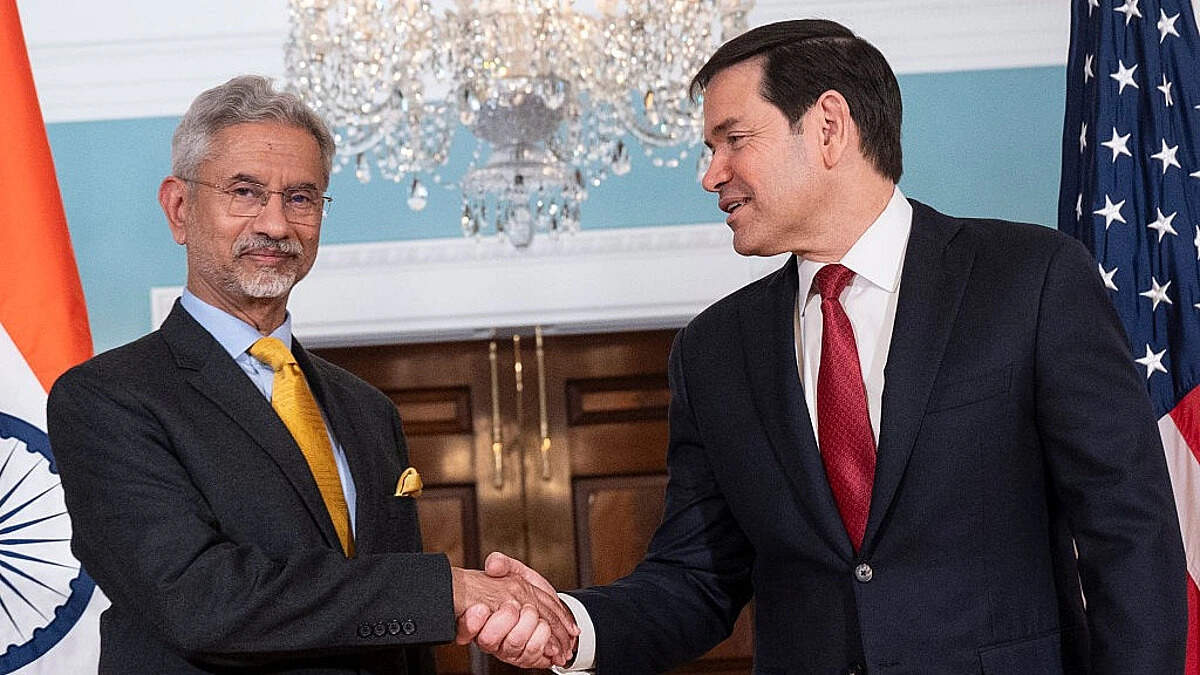
External affairs minister S Jaishankar met US secretary of state Marco Rubio on Wednesday in a deliberate effort by both sides to move ties beyond a narrowly transactional trade agreement and anchor it in longer-term strategic priorities, notably critical minerals, supply chains and the Indo-Pacific.
Coming on the heels of a trade deal that cut US tariffs on Indian goods to around 18 per cent, the talks underscored Washington’s push to stabilise — and deepen — ties with New Delhi at a time of global economic and geopolitical churn. Describing the engagement as “a wide-ranging conversation that covered our bilateral cooperation agenda, regional and global issues”, Jaishankar signalled continuity in India’s approach: pragmatic, multi-sectoral and increasingly confident.
“Facets of the India-US strategic partnership discussed included trade, energy, nuclear cooperation, defence, critical minerals and technology,” Jaishankar said. Both sides agreed on early meetings of various bilateral mechanisms to advance what they called their “shared interests”.
The meeting took place ahead of the inaugural Critical Minerals Ministerial, where the US hopes to rally partners around alternative supply chains for what officials call the “oil of the future”— lithium, cobalt and rare earths. The state department said Rubio and Jaishankar discussed formalising bilateral cooperation on critical minerals exploration, mining and processing. Jaishankar underlined challenges of excessive concentration and importance of de-risking supply chains through structured international cooperation. India’s role at the ministerial is central to a broader US ambition: forging an “Opec-like” arrangement for critical minerals among trusted producers and processors. The idea is not price-setting in the classical cartel sense, but coordinated investment, standards and supply assurances to dilute China’s dominance. For Delhi, participation offers a chance to position itself as a reliable hub in global value chains while accelerating domestic capabilities.
The Jaishankar-Rubio engagement also reflected Washington’s attempt to salvage and refocus the strategic narrative. US said the two leaders reaffirmed their commitment to expanding cooperation through the Quad and acknowledged that “a prosperous Indo-Pacific region remains vital to advancing our shared interests”. Notably, Jaishankar’s own public post made no mention of the Quad.
Rubio , in public remarks, spoke of “unlocking new opportunities” between the two democracies. Jaishankar, for his part, framed the talks as part of India’s push for a “full strategic partnership”. He also held talks with treasury secretary Scott Bessent.