” Volkswagen Group acquires a minority interest in the technology company FDTech GmbH of Chemnitz in Saxony FDTech develops software and future-oriented systems for automated and autonomous driving The Volkswagen Group has acquired a minority stake in the technology development com-pany FDTech GmbH. The company, which has its headquarters in Chemnitz and was estab-lished in… Continue reading Volkswagen reinforces competences in highly automated driving
Tag: Autonomous
Unterschleißheim applies for Autonomous E-Bus
The city of Unterschleißheim plans to introduce an autonomous electric bus in the city. The city Unterschleissheim in the north of Munich is especially known for the BMW location. Because BMW there bundles his ambitions regarding autonomous driving. Since it seems logical that the city wants to have to do with the technology. Autonomous E-Bus… Continue reading Unterschleißheim applies for Autonomous E-Bus
Elon Musk suspected sabotage when Tesla factory robots stopped working earlier this month
Joshua Lott | Getty Images
Engineer and tech entrepreneur Elon Musk of The Boring Company talks about constructing a high speed transit tunnel at Block 37 during a news conference on June 14, 2018 in Chicago, Illinois.
Elon Musk was up early on Saturday. He departed Los Angeles, where he runs SpaceX, his private rocket venture, and flew north in his white Gulfstream jet. Stopping in Silicon Valley, he picked up two engineers from Tesla, his electric-car company. They flew on to Reno, Nev., where they spent the day at Tesla's battery plant, the Gigafactory.
It might have been just another workday for Mr. Musk — a multistate jaunt to personally fix a drive-unit production line. But this was no ordinary morning. He was a brief night's sleep removed from one of his most consequential decisions: scrapping his plan to take Tesla private.
It was an abrupt about-face, and it capped a tumultuous two and a half weeks that began with a single tweet and wound up roiling markets, setting off regulatory alarms and raising questions about his judgment. Even by Mr. Musk's standards — this is a C.E.O. who believes Tesla is under attack by saboteurs, has a personal life playing out in the gossip blogs and is prone to fiery outbursts on Twitter — it has been a time of high intrigue.
“The reason Elon seems to attract drama is that he is so transparent, so open, in a way that can come back to bite him,” said Kimbal Musk, Mr. Musk's younger brother and a Tesla board member. “He doesn't know how to do it differently. It's just who he is.”
Mr. Musk, a brilliant but erratic billionaire, is the animating force behind Tesla, responsible for everything from its push into renewable energy to the design of the air vents in its newest electric car. His singular role gives him extraordinary influence over the fate of Tesla, its more than 40,000 employees and its investors.
Associates, including several people inside the company interviewed over the past week, portray him as a workaholic who zeroes in on the smallest details. His deep involvement suggests that the company can't do without him. Yet these days, it's not always clear that he knows what's best for Tesla.
More from The New York Times:
Google Attacked by Trump With Claim It Is Burying Conservative News
Silicon Valley Takes a (Careful) Step Toward Autonomous Flying
In a Shift in Driverless Strategy, Uber Deepens Its Partnership With Toyota
Even before taking Tesla investors on a roller-coaster ride, Mr. Musk was increasingly unpredictable, marketing flamethrowers online and dispatching a submarine to assist in a rescue in Thailand, then calling a critic of the gesture a pedophile. In an interview this month with The New York Times, Mr. Musk said he was physically exhausted and emotionally drained, causing some to question his fitness for the job.
Mr. Musk's personal life is no less chaotic. He was dating Grimes, the Canadian pop musician, but the two stopped following each other on social media last week, leading gossip blogs to speculate they had broken up. That followed a bizarre run-in with the rapper Azealia Banks, who intimated that Mr. Musk had written his going-private tweet while on acid. (He denied it.) Amid the fallout, he took to Twitter, posting cryptic messages about love and quoting T. S. Eliot.
And at the office, he is hardly a typical chief executive. Racing to resolve critical production issues, he can often be found on the factory floor, working to fix robots. At night, he sometimes sleeps under his desk. All the while, he has been confronting an exodus of senior employees, preparing to be interviewed by the Securities and Exchange Commission, and was working with Goldman Sachs and Saudi Arabia's sovereign wealth fund to take Tesla private — until he wasn't.
Some board members have been dismayed at Mr. Musk's behavior, according to people familiar with the directors' thinking, but no active search is underway for a replacement — although there have been fitful efforts to find a top lieutenant.
James Anderson, the head of the asset management firm Baillie Gifford, Tesla's biggest shareholder after Mr. Musk, said he still had faith in the 47-year-old chief executive, calling him a “visionary leader” who had unmatched technical expertise and remained “obsessive about the details.”
Yet Mr. Anderson said he had grown increasingly worried about Mr. Musk, believing that his volatile personal life and intense work ethic were taking a steep toll. “He is so demanding, so driven by the imperative to do something good for the world,” Mr. Anderson said. “You could always see something like this happening.”
'We feel like we are at war'
At 6:30 a.m. on Aug. 18, three robots in the paint shop at the Tesla factory in Fremont, Calif., started malfunctioning. The incident forced a production halt on the Model 3, the key to the company's future.
Made aware of the stoppage, Mr. Musk went to the factory and worked into the night. The problem was resolved, but Tesla reached a troubling conclusion: The robots had been infected with malware in an act of industrial sabotage. And though they could not prove it, executives suspected they knew the culprit: a rogue employee, working at the behest of short-sellers.
Tesla is among the most shorted stocks, meaning that hedge funds are betting against it and quick to note a missed production goal or cash shortfall. David Einhorn, the billionaire founder of Greenlight Capital, is in that camp. In a letter to investors last month detailing his argument, Mr. Einhorn wrote, “Elon Musk appears erratic and desperate.”
Mr. Musk believes that the short-sellers spread misinformation about the company, and perhaps much worse. In June, Mr. Musk accused an employee of sabotage that had slowed Model 3 production, and suggested short-sellers might be to blame.
Kimbal Musk, reflecting on the battles with short-sellers, said, “We feel like we are at war.”
Plenty of other companies face the wrath of short-sellers. The issue at Tesla seems to be that for Mr. Musk — who talks earnestly about weaning the world off fossil fuels with Tesla, and colonizing the solar system with SpaceX — these attacks are not just the cost of doing business. They are malicious and misguided efforts to derail his efforts to help humanity.
“Tesla is his baby,” said Deepak Ahuja, Tesla's chief financial officer. “He takes it extremely personally.”
But with Tesla now staying public, Mr. Musk will have to continue to contend with those who doubt his vision and are rooting for Tesla to fail.
The most difficult time
When Mr. Musk ceremonially unveiled the Model 3 last summer, he billed it as the first mass-market electric vehicle, and predicted monthly production of 20,000 by year's end. But in the final three months of 2017, just 2,425 were completed.
The delays were a result of what Mr. Musk called “manufacturing hell,” an inferno that has preoccupied him for much of the past year. “This has been the most difficult time for Tesla,” said JB Straubel, the company's chief technical officer. “We knew this was going to be the case, but it's been even harder than any of us expected.”
Some of the wounds were self-inflicted.
In preparing the assembly lines, Mr. Musk became convinced that the process should be close to fully automated, using robots rather than humans whenever possible. Doing so, he believed, could make cars move through the factory at one meter per second, 10 to 20 times the speed of existing lines.
So Tesla built a factory with hundreds of robots, many programmed to perform tasks that humans could easily do. One robot, which Mr. Musk nicknamed the “flufferbot,” was designed to simply place a sound-dampening piece of fiberglass atop the battery pack.
But the flufferbot never really worked. It would fail to pick up the fiberglass, or put it in the wrong place, frequently delaying production. It was eventually replaced by factory workers.
Mr. Musk has accepted responsibility for some of these missteps, occasionally with humor. In late June, he wore a T-shirt depicting a robot that passes butter. It was an inside joke, lampooning the notion of technology for technology's sake.
After the debacle, Mr. Musk tweeted: “Excessive automation at Tesla was a mistake. To be precise, my mistake. Humans are underrated.”
As the challenges have mounted, Mr. Musk has thrown himself into his work, spending hours each week walking factory floors, trying to diagnose and fix various problems on the assembly line.
“He demands personal accountability from the people that are closest to the machines,” Mr. Straubel said. “This freaks people out. They are worried that they wi..
‘I hate them’: Locals reportedly frustrated with Alphabet’s self-driving cars
Early rider use the Waymo driverless vehicles to get to school.
Alphabet's self-driving cars are annoying their neighbors in Chandler, Arizona.
More than a dozen locals who work near Waymo's office gave The Information the same unequivocal assessment of the cars, which reportedly struggle to cross a T-intersection there: “I hate them.”
One woman said that she almost hit one of the company's minivans because it suddenly stopped while trying to make a right turn, while another man said that he gets so frustrated waiting for the cars to cross the intersection that he has illegally driven around them.
The anecdotes highlight how challenging it can be for self-driving cars, which are programmed to drive conservatively, to master situations that human drivers can handle with relative ease, like merging or finding a gap in traffic to make a turn.
Waymo has been testing its vehicles in the Phoenix suburbs for little more than a year and is widely seen as the furthest along in the self-driving car space, but its safety drivers have to take control of the vehicles regularly, people with direct knowledge of the issues tell The Information.
A Waymo spokesperson says that its cars are “continually learning” and that “safety remains its highest priority” during testing. The spokesperson also said that Waymo is using feedback from its early rider program to improve its technology, though it declined to comment specifically on the intersection complaints mentioned in The Information story. The company has previously said that it plans to launch a commercial self-driving taxi service before the end of the year, but that its service will still include a Waymo employee in each car as a “chaperone.”
The potential for self-driving cars is so powerful because they eliminate aspects of human error and unpredictability that make driving dangerous, like speeding, texting, drinking or blowing through stop signs. However, as they start coexisting on roads alongside human drivers, that very unpredictability can confuse the cars, which may stop abruptly, endangering or aggravating people.
Waymo and other self-driving car companies will continue to try to work out software kinks and expand their regions of operation, but experts are divided on when self-driving cars will actually become mainstream.
As Waymo's CEO said in June during a talk at a National Governors Association meeting: the time period to make automated vehicles widespread “will be longer than you think.”
Read The Information story here.
Clarification: This piece previously referred to the Waymo employee who will be in the car when it launches its taxi service as a “safety driver.”
Behind the scenes at Waymo's top-secret testing site
10:02 AM ET Tue, 31 Oct 2017 | 02:08
UPDATE 1-Chinese EV maker Nio expects to raise $1.32 bln in IPO
(Reuters) – Chinese electric vehicle start-up Nio Inc [NIO.N], backed by Chinese tech heavyweight Tencent Holdings Ltd (0700.HK), on Tuesday said it expects to raise up to $1.32 billion in its initial public offering. The logo of electric car startup NIO is seen at a new NIO House “brand-experience” store, in Beijing, China November 25,… Continue reading UPDATE 1-Chinese EV maker Nio expects to raise $1.32 bln in IPO
China’s Byton is sending its electric SUV prototypes to the U.S.
That’s when self-driving vehicle technology startup Aurora will take over. Kirsten Korosec 7 hours Byton, the new China-based automaker founded by former BMW and Infiniti executives, has produced the first 10 prototypes of its tech-centric all-electric SUV and some of them will be in the U.S. before the end of the year, company president and co-founder… Continue reading China’s Byton is sending its electric SUV prototypes to the U.S.
Toyota and Uber Extend Collaboration to Automated Vehicle Technologies
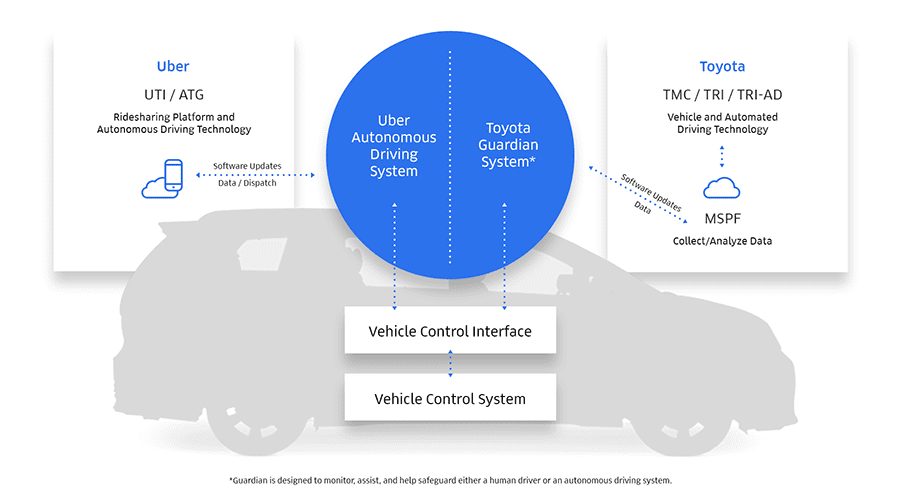
Aug. 28, 2018 August 28, 2018―TOKYO, Japan―Toyota Motor Corporation (TMC) and Uber Technologies, Inc. (Uber) today announced that they have agreed to expand their collaboration with the aim of advancing and bringing to market autonomous ride-sharing as a mobility service at scale. To accomplish this, technology from each company will be integrated into purpose-built Toyota… Continue reading Toyota and Uber Extend Collaboration to Automated Vehicle Technologies
AutoX is using its self-driving vehicles to deliver groceries
Autonomous vehicle startup AutoX has launched a grocery delivery and mobile store pilot in a partnership with GrubMarket.com and local high-end grocery store DeMartini Orchard. The pilot will initially be limited to an area of about 400 homes in north San Jose. The company, which employees nearly 90 people, has just two autonomous vehicles that… Continue reading AutoX is using its self-driving vehicles to deliver groceries
Elon Musk Claims a Tesla Semi Prototype Drove “Across the Country Alone”
NOT ALL DOOM AND GLOOM. Tesla might be sucking the life force of CEO Elon Musk, but at least the company’s got some some good news to show for it. On Saturday, Electrek tweeted a picture of one of Tesla’s autonomous Semi prototypes at the headquarters of trucking company J.B. Hunt. In response, Musk tweeted, “What’s cool… Continue reading Elon Musk Claims a Tesla Semi Prototype Drove “Across the Country Alone”
Elon Musk will sabotage his own plans if he takes Tesla private, Tesla bull says
Tesla investor writes open letter to Elon Musk on keeping Tesla public
5 Hours Ago | 02:43
Tesla CEO Elon Musk will sabotage his own goals for the electric car maker if he takes it private, said ARK Invest CEO Cathie Wood, who predicted Tesla stock could reach $4,000 per share.
“By going private [Musk] would deprive Tesla of reaching his own priorities — mobility as a service, autonomous truck platoons, utility energy storage, even air passenger drones,” Wood said Friday on CNBC's “Closing Bell.” “He's got big plans, and he needs to scale these plans. We don't think that it will happen nearly as effectively in the private markets as in the public.”
Tesla has battled widespread scrutiny, following Musk's Aug. 7 tweet that he was planning to take Tesla private and had “funding secured.” The Securities and Exchange Commission served Tesla with a subpoena last week, as it looks into whether Musk violated securities laws by claiming he had funding for the maneuver. In addition, Musk himself has been criticized for erratic behavior. He confessed in an interview with The New York Times the toll of the “excruciating” year he has had leading Tesla, particularly when crunching to meet Model 3 production goals.
Through it all, Wood, who is CEO of innovation-focused investment service ARK Invest, has remained bullish. Known for making bold calls, the money manager first revealed her $4,000 per share call in February. On Wednesday, she published a letter to Musk and Tesla's board of directors, imploring them not to take the company private. She sees the company trading anywhere from $700 to $4,000 per share within five years if it remains public.
Tesla closed the day up 0.85 percent at $322.82 per share, having gained 5.67 percent on the week.
Central to Wood's argument that Tesla could trade as high as $4,000 per share is the idea that Tesla will orient itself away from the capital-intensive vehicle manufacturing business toward software. And that's where Tesla excels, she said.
“We think he's already way ahead of the game. He's got the data, he's got the chip that's three years ahead of Nvidia's chip … He's got batteries, which are three years ahead of any other company's batteries. And he's had the vision about autonomous taxi networks from the very beginning,” Wood said on Friday.
Pierre Ferragu, head of technology infrastructure research at New Street Research, said, “Tesla will become one of the major premium car manufacturers, like Audi and Jaguar … within the next seven years,” but its success will be from a purely go-to-market perspective, as Tesla has lower costs for marketing and distribution than other automakers.
“Maybe one day mobility-as-a-service will be a thing, but today there is nothing tangible there,” he said.
New Street Research placed a 12-month price target of $530 on Tesla and sees it reaching $1,200 to $2,000 by 2025. It all hinges on production numbers.
“They have seven years to be able to produce 2.5 [million] to 3 million cars a year. As you can imagine, getting to the first couple hundred thousand is the most challenging part,” he said. “Once they are at scale of BMW, they will be significantly more profitable than” BMW.
On production, Wood was bullish, saying Tesla will “iterate and iterate until they get it right, and then, they are going to be able to scale enormously when they get it right.” But Wood's biggest hopes for the company concern software, and she worries those lofty mobility-as-a-service goals won't come to fruition if Tesla goes private.
Musk is “the kind of person you need, one with vision who ends up at times very frustrated with the short time horizon of public markets. But the public markets will reward him handsomely if he just sticks with it and starts performing with the production schedules,” she said.