Original Article
Tag: Tesla
Secretive robot-car maker Zoox opens up
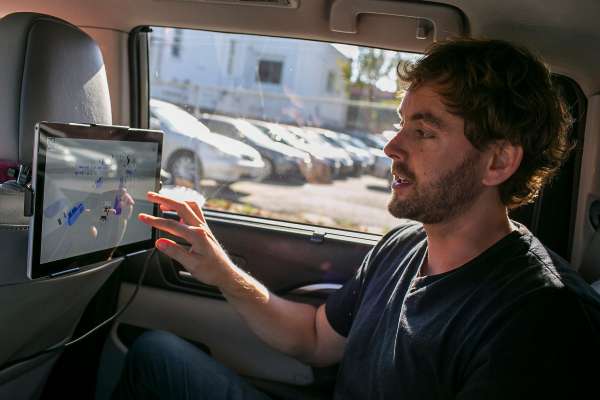
As the self-driving car navigated the narrow, winding streets leading to San Francisco’s Coit Tower, Jesse Levinson narrated from the back seat like a proud parent. “Isn’t that cool, how we slowed down for that person and then nudged around him?” said the chief technology officer of self-driving startup Zoox. “See how steep this street… Continue reading Secretive robot-car maker Zoox opens up
GM’s Cruise scores $750 million investment from Honda, teases new autonomous vehicle
As we have been discussing for a while, we are seeing more consolidation within the auto industry when it comes to autonomous driving technology as automakers are trying to bet on the right horse. In the latest example of that consolidation, Honda is betting on GM’s cruise to build autonomous vehicles. GM’s subsidiary, Cruise automation, scored… Continue reading GM’s Cruise scores $750 million investment from Honda, teases new autonomous vehicle
Chevy Bolt EV sales are slumping in the US, GM says production going to Canada and South Korea
GM is scheduled to increase production of the Chevy Bolt EV by the end of the year, but sales are slumping in the US in the meantime. The automaker says that it is because they are focusing production for other markets. Like Tesla, GM decided to stop giving monthly sale numbers and only release quarterly… Continue reading Chevy Bolt EV sales are slumping in the US, GM says production going to Canada and South Korea
Chinese automaker Borgward built gasoline vehicles in order to sell EVs in America
2019 Borgward BX6
Borgward is unorthodox even among the rapidly evolving cast of 21st-century automakers. It’s a Chinese company, with German heritage, that now wants to bring electric cars to the U.S.
Already in the gas-powered SUV market in China, it has sold more than 100,000 units over the past two years, Now Borgward is eyeing a 2020 or 2021 debut in the U.S. with its next-generation EVs.
Last month, Borgward announced at an artificial intelligence conference in San Francisco that it would open its U.S. headquarters and R&D center in Sunnyvale, California; it also outlined some of its AI safety tech for autonomous vehicles.
DON'T MISS: Borgward SUVs' Geneva debut: new plug-in hybrids, old German name, Chinese owners
President and CEO Jason Yang, speaking to Green Car Reports there, said that his company's strategy of selling gas vehicles before introducing EVs is different than what other new Chinese automakers like Byton and Nio are doing, because it has to be.
“We think EV business is not a profitable business in the short run, and every company needs to survive,” Yang said. “We can't just be burning cash.”
2016 Borgward BX7
Focusing only on electric vehicles would result in just that sort of financial waste, Yang said, but by building gas SUVs first, Borgward can make money as well as share parts and manufacturing facilities between the gasoline and electric models. As proof that his way of thinking is right, he pointed to Tesla.
READ THIS: Tesla founder, Chinese company launch SF Motors electric cars
“I think Elon Musk is a superhero,” he said, calling Musk “a lucky man” for his ability to be so personally tied-in with Tesla’s finances. “Not everyone can be so lucky, so we have to be realistic.”
Part of that realism will show in Borgward's AI platform, which Zhou Xing, Borgward's director of artificial intelligence for autonomous driving, said will be tested with supervised AI learning and repeating virtual tests tens of billions of times.
Yang said that Borgward's in-house AI strategy is better than what major automakers are coming up with. “All of our intelligent technology was designed by ourselves, not a Tier 1 supplier,” Yang said. “So we have our own IP, and we can modify and improve the intelligence system faster than the big automakers.”
CHECK OUT: Why China will beat U.S. in electric-car battle: urgency, regulations
Today, depending on how you look at it, Borgward embodies either much of what its original namesake stood for or very little of it. Originally started by Carl Borgward in Germany in 1919, the company’s products offered a successful combination of style and affordability. The fun ended in 1961, when the company went bankrupt and remained a quiet bit of automotive history—until Carl's grandson Christian set out to revive the brand in 2005.
1957 Borgward Isabella Coupe
In 2008, Chinese investors became involved, and the brand was officially relaunched in 2015, with its first vehicle—the BX7 gas-powered SUV—coming to market in 2016.
Since then, Borgward has sold over 100,000 SUVs, including both gasoline models and the all-electric BXi7. In 2019 in China, Borgward will launch the BXi5 and the BXi6, two new all-electric SUVs that are smaller than the BXi7. Plans for the next few years call for a BX7 plug-in hybrid and a long-wheelbase EV called the BXi3L, alongside BXi3 and BX5 plug-in-hybrid concepts still on the drawing board for 2020.
Tesla Is 2 Years Ahead Of Schedule On Gigafactory 1
Electric Cars
Electric Car Benefits
Electric Car Sales
Solar Energy Rocks
RSS
Advertise
Privacy Policy
Clean Transport
Published on October 1st, 2018 |
by Dr. Maximilian Holland
Tesla Is 2 Years Ahead Of Schedule On Gigafactory 1
Twitter
Google+
LinkedIn
Pinterest
Facebook
October 1st, 2018 by Dr. Maximilian Holland
Tesla’s 2014 vision for the Gigafactory
Tesla’s Gigafactory 1 in Nevada is solidly on track to achieve a battery production volume of 35 GWh per year (annualized run rate) by the end of 2018. This is two years ahead of the original 2020 target date for achieving these volumes.
Whilst Tesla is often criticized for slipping on its targets, let’s take a moment to recognize the remarkable Gigafactory volume achievement.
Tesla Gigafactory 2018
Where’s My Model 3?
With the obvious advantages of EVs being increasingly recognized by consumers, many folks are getting impatient for affordable EVs to arrive in volume. On the other side of the fence, commentators and incumbents across the automotive and fossil fuel industries, along with their lapdogs in the media, are dishing out daily disdain and skepticism upon the disruptive notions of electrifying transport and accelerating the move towards sustainable energy.
From both sides, Tesla, the world’s leading producer of EVs, is subject to heavy scrutiny of all of its plans and timelines. Even whilst folks queue around the block to get in line for an unseen car, they wonder and get impatient when it takes longer to arrive than they’d hoped.
The Model 3 was infamously 6 months delayed in reaching its 5,000 units per week production volume target, and the company came in for much criticism from all quarters. Most of us forgot that achieving even this interim volume target has put Tesla’s Model 3 at well over double the next best selling EV (the Nissan Leaf). In fact, even while the Model 3 is being produced and delivered at a volume that makes it the 5th best selling car in the US in terms of monthly unit sales, much attention is focused on possible remaining Tesla production challenges.
The habitually optimistic projections of Tesla have come to be taken with a pinch of salt by experienced EV watchers, and it is often joked that the company’s stated timelines need conversion from “Elon time” into the time scales that most of us live in.
Bucking the Trend
Tesla’s Gigafactory progress significantly bucks this trend. When the Gigafactory was first announced in early 2014, the plan was to hit 35 GWh of battery production in 2020. We covered the story extensively at that time, and saw Tesla and Panasonic formally sign onto the joint plan in July of 2014.
Related to bringing forward the timeline for the Model 3’s production in response to its massive and unexpected demand, at the start of 2017, Tesla announced an ambitious accelerated Gigafactory timeline. It brought the 35 GWh goal forward to the end of 2018. Given the focus on production delays of the Model 3 itself during the past couple of years, many of us (myself included) assumed that the seemingly over-ambitious Gigafactory production targets were likewise slipping.
But a couple of months ago (July 2018), news emerged that the accelerated Gigafactory production targets were indeed within reach by the Tesla–Panasonic partnership. Then, just last week, Zach covered the latest updates from Yoshio Ito, head of Panasonic’s automotive business. The news was of the further bringing forward the July plan, to even more quickly add 3 new production lines that were previously slated for “the the end of the year [2018].” This further advance means that the lines will be installed and operating well before the end of the year, thus giving real credence to the 35 GWh run rate being achievable by the end of 2018.
It’s worth pausing to celebrate this rare but strong example of Tesla being two full years ahead of schedule on the timeline it originally set out for the Gigafactory back in 2014. From an initial 2020 target, we now find the 35 GWh annualized production volume goal looks set to be achieved by the end of 2018. That’s 4 years to reach a goal that was initially planned to require 6 years.
Tesla and Elon Musk have come in for a lot of flack recently, but the progress on the ground at the Gigafactory should serve to remind us that — away from the negative press and frequent skepticism about the revolutionary company’s broader mission — Tesla is achieving remarkable goals to accelerate the move towards sustainable transportation and energy.
Related stories:
Elon Musk’s 2015 Tesla Forecasts Compared To Today — The Future Looks Bright
If A Tesla Pattern Has Emerged, What Does That Mean For Model 3?
Is Tesla Model 3 Actually On Original Schedule?
Is Tesla Ever Late? No, Not Really.
Tesla Executes
Support CleanTechnica’s work by becoming a Member, Supporter, or Ambassador.
Or you can buy a cool t-shirt, cup, baby outfit, bag, or hoodie or make a one-time donation on PayPal.
About the Author
Dr. Maximilian Holland Max is an anthropologist, social theorist and international political economist, trying to ask questions and encourage critical thinking about social and environmental justice, sustainability and the human condition. He has lived and worked in Europe and Asia, and is currently based in Barcelona.
Back to Top ↑
CleanTechnica Clothing & Cups
Advertisement
Advertise with CleanTechnica to get your company in front of our readers.
Top News On CleanTechnica
Advertisement
Follow @cleantechnica
Join CleanTechnica Today!
EV Charging Guidelines for Cities
Share our free report on EV charging guidelines for cities, “Electric Vehicle Charging Infrastructure: Guidelines For Cities.”
Advertisement
Cleantech Press Releases
Shift In Navajo Country As Coal Plant That Navajo Community Doesn’t Want Is Dropped
Capturing CO2 From Exhaust Pipes Is A Bad Idea That Won’t Die
No, Magnesite Isn’t The Magic CO2 Sequestration Solution Either
The EV Safety Advantage
Read & share our free report on EV safety, “The EV Safety Advantage.”
The State of EV Charging
Our 93-Page EV Driver Report
30 Electric Car Benefits
Blockchain × Cleantech
Our Electric Vehicle Reviews
Tesla News
Correcting the Cleantech Record
38 Anti-Cleantech Myths
Wind & Solar Prices Beat Fossils
Cost of Solar Panels Collapses
© 2018 Sustainable Enterprises Media, Inc.
Electric Cars
Electric Car Benefits
Electric Car Sales
Solar Energy Rocks
RSS
Advertise
Privacy Policy
This site uses cookies: Find out more.Okay, thanks
Tesla 3Q production numbers up as Musk rallies workers
Original Article
UPDATE 2-Tesla worried by China even as deliveries surge
(Reuters) – Tesla Inc (TSLA.O) announced record quarterly car production numbers on Tuesday but warned it was facing major problems with selling cars in China due to new tariffs that will force it to accelerate investment in its factory in Shanghai. FILE PHOTO: A row of new Tesla Model 3 electric vehicles is seen at… Continue reading UPDATE 2-Tesla worried by China even as deliveries surge
Citi downgrades embattled Tesla to sell, says the stock is too risky to buy even after big pullback
Citi downgrades Tesla
7:58 AM ET Fri, 28 Sept 2018 | 01:55
Citigroup downgraded Tesla's stock to a sell rating from neutral Friday, a day after the Securities and Exchange Commission filed a fraud lawsuit against CEO Elon Musk.
The brokerage detailed two paths forward for the electric car maker, one with Musk and one without. And both options aren't great for stakeholders.
“There's little question that Mr. Musk's departure would likely cause harm to Tesla's brand, stakeholder confidence and fundraising,” the note said. “If Mr. Musk ends up staying on, the reputational harm from this might still prevent the stock from immediately returning to 'normal.'”
“Ultimately it's a risk/reward call we approach from a 50/50 chance of 'bad' or 'Ok/good' outcomes; we think even after the post-close stock pullback (to $274), risk/reward is still tilted negatively,” state the note.
Citi also cut its price target on Tesla to $225, implying more than 25 percent downside from Thursday's close. Shares fell 13.9 percent Friday, posting their worst day since 2013.
The Securities and Exchange Commission filing in Manhattan federal court alleges that the CEO mislead shareholders on Aug. 7 when he announced he had secured funding for what might have been a corporate buyout.
Specifically, the government holds that Musk issued “false and misleading” statements and failed to notify regulators of material changes at the company.
Musk later explained that he had spoken to representatives of the Saudi Arabian sovereign wealth fund and felt confident that the funding take to the company private was assured at his proposed price of $420 per share.
Musk called the SEC's allegations “unjustified” and said he “never compromised” his integrity.
“This unjustified action by the SEC leaves me deeply saddened and disappointed,” Musk said in a statement. “I have always taken action in the best interests of truth, transparency and investors.
The SEC is seeking to forbid Musk from serving as an officer or director at any publicly traded company.
The lawsuit, which did not name Tesla as a defendant, comes as the company struggles to mass produce its Model 3 sedan. Since the company started to ramp up production last July, its already-slim cash hoard as dwindled, sparking concerns on Wall Street over whether Musk will need to raise additional capital.
For his part, Musk has repeatedly said Tesla won't need to seek new cash and guaranteed to keep Model 3 production at a steady clip in an effort to help the company turn cash-flow positive and profitable this quarter.
Disclaimer
Xing Mobility Is Leveraging Its Modular Batteries For Electric Vehicle Retrofits
Electric Cars
Electric Car Benefits
Electric Car Sales
Solar Energy Rocks
RSS
Advertise
Privacy Policy
Batteries
Published on October 1st, 2018 |
by Kyle Field
Xing Mobility Is Leveraging Its Modular Batteries For Electric Vehicle Retrofits
Twitter
Google+
LinkedIn
Pinterest
Facebook
October 1st, 2018 by Kyle Field
As the curtain is pulled back, the inner workings are exposed. What once was a lobby, suitable for the average passer by to see is no longer, as the gears and wires, batteries and motors that bring the machines inside to life are exposed. In an instant, it became clear that Xing Mobility (think “ZING”) is anything but a battery company. Xing invited CleanTechnica to its headquarters in Taipei, Taiwan, to chat with its top brass and to take a peak behind the curtain.
Fueled by innovation
Xing is a company that brings things to life. A company that energizes, powers, and tames the wild beast. In this case, in the back corner of the workshop that would be more at home in Mary Shelley’s Frankenstein than in an automotive factory, lies the stripped bones of the beast that lives in a perpetual state of evolution.
She’s called ‘Miss R’ and is the third in a line of a revolutionary racing vehicles that started off, of all things, with an internal combustion engine. That’s not a topic we frequent around these parts but as it turns out, the original dino-powered race vehicle was quickly followed by her much faster electrified progeny.
Xing Mobility was founded as a racing company. Not long thereafter, Azizi Tucker came on board fresh off of a stint at none other than Tesla Motors, and as you might expect, he joined Xing with a bias towards electrified powertrains. His passion for electrified powertrains led to the second generation of its race car being fueled with electrons and propelled by a set of electric motors.
Change is the only constant
At Xing, change is the only constant. As it built up its second generation vehicle, the company designed a battery pack that was flexible, as it had to be to keep up with the ever-evolving designs at Xing. Change was the price of entry, as it’s in their blood. The same can be said of the powertrain, as Xing upgraded its design from an internal combustion-powered car to one powered by a much smaller and much more efficient electric motor.
The conversion filled the veins of the team at Xing Mobility with a passion for improvement which paired well with the skillful young engineers they staffed up with as Xing grew. In the mad scientist’s lab that is the Xing Mobility headquarters, it is clear that this passion continues to fuel them today. In one corner of the lab, a Xing engineer preps a battery pack for its own destruction as Xing continues to validate the safety of its industry-leading immersion cooling battery tech.
The core of Xing’s business model is indeed its battery modules, but Xing is not a battery company. It is a full service emobility company that has been hard at work defining the building blocks of electric vehicles. Imagine you’re a tractor company and you want to build electric tractors, but the company you normally buy motors and transmissions from doesn’t have any options for you, so you call up the team at Xing.
Xing Mobility is the realization of a dream that CEO Royce YC Hong and CTO Azizi Tucker shared. They met at a TEDx Taipei conference and their mutual angst to do, to create, to start seemed to have a carry-on effect that grew and grew until before they knew it, they were partnering to bring their dreams to life through Xing Mobility.
Sitting big and bold at the center of the Xing Mobility logo is an oversized X. They believe that the X is the crossroads. That’s where things meet up, where things are encountered. Where people meet and where symbiotic ideas are joined together. Xing is an intersection, a crossing. It’s the place where they are bringing together an impressive team of engineers that share a passion for building the next generation of electric vehicles.
Xing Mobility electric delivery van retrofit prototype. Image credit: Kyle Field
More than that, the company is creating, testing and making production ready all of the disparate parts of an electric powertrain. Xing knows electric powertrains. That’s what it does. The team specializes in solving problems, especially when those problems are related to powertrains, electric motors, battery control units, vehicle control units, and all the little bits and bytes that bring the total system to life.
Modular Batteries = Endless Configurations
At the core of its system is its battery modules which, as the name implies, are truly modular. It’s not just that they can bolt together, but that they were designed to be bolted together. It’s much like Lego in the sense that they were designed to literally stack on top of each other or to be bolted onto each other to form a battery pack.
The multi-layered, variable configuration battery packs that Xing builds utilize a revolutionary immersion cooling technology that takes a unique non-conductive fire resistant liquid developed by the chemistry geeks over at 3M to replace the aging Halon fire systems. The new solution, called Novec, is also great at dissipating heat and acts as a fire retardant.
Flexible Components
On top of the modular battery pack, Xing has built a set of electric vehicle components including its own homegrown torque vectoring gearbox that dynamically optimizes the power output to all wheels in the vehicle, which maximizes the amount of power expended that is actually translated into forward motion.
Xing has also built up competency in electric motors, battery management systems, cabling, and all of the other components that are required to retrofit or build up the powertrain of an electric vehicle from the ground up.
To validate its approach, Xing is, in addition to working with numerous partners on in-flight projects, retrofitting a delivery van of its own. The process is being performed to get more intimate, hands-on experience with retrofits to allow them to more rapidly deploy retrofit kits for specific platforms. Delivery vehicles, with their low mileage per day, low average speeds in urban environments, and high impact on urban air quality make for great targets to retrofit to electric.
Retrofitting internal combustion vehicles with electric vehicle battery and powertrain kits is a much more resource efficient method of converting fleets and privately owned vehicles to electric. Xing is working to capitalize on this simple fact with an early push into the retrofit space, leveraging its mastery of modular batteries and durable, high performing electric vehicle propulsion systems.
A Veritable Electric Vehicle Laboratory
In the single day I spent at Xing Mobility’s office and workshop in Taipei, Taiwan, the company was working on electrifying a concrete moving vehicle for the construction industry, an autonomous personal electric vehicle, new PCBs for its battery management system, an upgrade to its infamous electric supercar Miss R, and a variety of other projects.
From this long list of projects in progress, you might expect that it employs a team of dozens or hundreds of engineers, but the reality is that they are only a handful of highly motivated, highly trained engineers, pushing the envelope for what electric vehicles might be. What they can be. Xing Mobility has established itself as a force to be reckoned with in the electric vehicle retrofit space and is leveraging Taiwan’s impressively diverse and localized supply chain to get there.
The Future
What immediately became clear when talking with Royce and Azizi about Xing Mobility is that Xing is not just a showy battery company, nor is it an electric supercar company. They aspire to do much more with the technologies they have built today as they continue to build competency in electric vehicle retrofits, one project at a time.
Support CleanTechnica’s work by becoming a Member, Supporter, or Ambassador.
Or you can buy a cool t-shirt, cup, baby outfit, bag, or hoodie or make a one-time donation on PayPal.
About the Author
Kyle Field I'm a tech geek passionately in search of actionable ways to reduce the negative impact my life has on the planet, save money and reduce stress. Live intentionally, make conscious decisions, love more, act responsibly, play. The more you know, the less you need. TSLA investor. Tesla referral code: http://ts.la/kyle623
Back to Top ↑
CleanTechnica Clothing & Cups
Advertisement
Advertise with CleanTechnica to get your company in front of our readers.
Top News On CleanTechnica
Advertisement
Follow @cleantechnica
Join CleanTechnica Today!
EV Charging Guidelines for Cities
Share our free report on EV charging guidelines for cities, “Electric Vehicle Charging Infrastructure: Guidelines For Cities.”
Advertisement
Cleantech Press Releases
Shift In Navajo Country As Coal Plant That Navajo Community Doesn’t Want Is Dropped
Capturing CO2 From Exhaust Pipes Is A Bad Idea That Won’t Die
No, Magnesite Isn’t The Magic CO2 Sequestration Solution Either
The EV Safety Advantage
Read & share our free report on EV safety, “The EV Safety Advantage.”
The State of EV Charging
Our 93-Page EV Driver Report
30 Electric Car Benefits
Blockchain × Cleantech
Our Electric Vehicle Reviews
Tesla News
Correcting the Cleantech Record
38 Anti-Cleantech Myths
Wind & Solar Prices Beat Fossils
Cost of Solar Panels Collapses
© 2018 Sustainable Enterprises Media, Inc.
Electric Cars
Electric Car Benefits
Electric Car Sales
Solar Energy Rocks
RSS
Advertise
Privacy Policy
This site uses cookies: Find out more.Okay, thanks