[% } %]
Category: Automotive
Via Announces Strategic Partnership with ITOCHU Corporation and Mori Building Company
Published April 14, 2019 10:00 pm, Via NYC
Via Announces Strategic Partnership with ITOCHU Corporation and Mori Building Company
The new partnership allows for dramatic growth of on-demand mobility in Japan
April 15, 2019 (Tokyo, Japan) — Via, the world’s leading provider and developer of on-demand shared mobility solutions, announced today a strategic partnership with ITOCHU Corporation and Mori Building Company. Following on the heels of the August 2018 launch of HillsVia, a commuter service for Mori employees, the new partnership will allow Via to rapidly expand its dynamic, on-demand transportation solutions and solve pressing transit issues across Japan.
“We are delighted for ITOCHU and Mori Building to join us as strategic partners and investors,” said Daniel Ramot, co-founder and CEO of Via. “ITOCHU’s bold vision to transform consumer experiences and mobility infrastructure and Mori Building’s success in innovating urban living make both companies invaluable partners as we work to provide cutting-edge mobility solutions that are smart, efficient, and help to reduce congestion and emissions in Japan.”
Via is able to seamlessly integrate with existing fixed-route transportation infrastructure, helping to fill in gaps where existing transit isn’t easily accessible. Via’s technology efficiently works to aggregate multiple passengers into shared vehicles, reducing single-occupancy vehicle trips, thus improving traffic congestion and curtailing carbon emissions. The easy-to-use mobile interface is suited to riders of all ages, including the elderly.
As one of the country’s largest general trading companies, ITOCHU has a deep understanding of the Japanese consumer market, leading the pack when it comes to investing in transformative technologies like Via that will both innovate transportation and solve local governments’ most pressing issues. Via’s technology and operational experience is uniquely suited to the Japanese market, where Via operates as Via Japan.
“We are excited to partner with Via to support a more convenient transportation system in Japan,” said Shunsuke Noda, ITOCHU Chief Digital & Information Officer. “We believe that Via’s cutting-edge solution will be widely accepted in the Japanese market through strategic partnerships with existing transportation operators.”
Leading Tokyo-based urban developer Mori Building began its partnership with Via in August 2018, developing the on-demand mobility HillsVia solution for travel between Mori Building properties, such as Roppongi Hills and Toranomon Hills. Using the Via-powered HillsVia mobile app, Mori Building employees can book rides in high-end V-Class vans provided by Mercedes-Benz to move amongst the properties. The program confirmed that Via’s solutions can be successfully applied to Japanese business customs and traffic conditions.
“Through our trial of HillsVia since last summer, we have experienced the usefulness of Via’s unique algorism for urban lifestyle. Via’s solution will contribute to solving the problems of urban transportation such as traffic congestion and environmental pollution,” said Masahiko Ogasawara, a Director & Executive Managing Officer for Mori Building. “This service will improve city life by increasing transportation options in urban areas.”
In partnership with ITOCHU and Mori Building, Via aims to provide Japanese transportation companies and drivers with new technology that will both improve their organizational profitability, as well as solve social problems throughout Japan.
Via has been tapped by cities and transit authorities in more than 60 markets in 15 countries around the world, including several deployments in Asia. In addition to Mori’s corporate shuttle system, Via also powers a public transportation network to transform Angot in Indonesia in cooperation with PT. Teknologi Rancang Olah Nusantara (affiliated with Digiasia Bios), and two on-demand bus services in Singapore, including one with Singapore’s Land Transportation Authority. To learn more about Via, visit www.platform.ridewithvia.com.
About Via
Via is re-engineering public transit, from a regulated system of rigid routes and schedules to a fully dynamic, on-demand network. Via’s mobile app connects multiple passengers who are headed the same way, allowing riders to seamlessly share a premium vehicle. First launched in New York City in September 2013, the Via platform operates in the United States and in Europe through its joint venture with Mercedes-Benz Vans, ViaVan. Via’s technology is also deployed worldwide through dozens of partner projects with public transportation agencies, private transit operators, taxi fleets, private companies, and universities, seamlessly integrating with public transit infrastructure to power cutting-edge on-demand mobility. For more information, visit www.platform.ridewithvia.com.
About ITOCHU Corporation
With 110 offices in 63 countries, ITOCHU, one of the leading sogo shosha, engages in domestic trading, import/export and overseas trading of various products such as textile, machinery, metals, minerals, energy, chemicals, food, general products, realty, information and communications technology, and finance, as well as business investment in Japan and overseas. ITOCHU Corporation was founded by Chubei Itoh in 1858 and now employs 4,380 people globally.
About Mori Building Company
Mori Building is an innovative urban developer based in Tokyo. The company is committed to maximizing the magnetic power of cities by creating and nurturing safe, sustainable and cosmopolitan urban centers based on its unique Vertical Garden City concept of high-rise centers for business, education, leisure and residence. The concept is applied in the company’s many leading-edge projects, including ARK Hills, Omotesando Hills, Roppongi Hills and Toranomon Hills in Tokyo and the Shanghai World Financial Center. Mori Building is also engaged in real estate leasing, project management and consultation. Please visit www.mori.co.jp/en
Read more
UPDATE 3-Former Volkswagen CEO Winterkorn charged with fraud by German prosecutors
FRANKFURT/BERLIN (Reuters) – German prosecutors charged former Volkswagen boss Martin Winterkorn with fraud on Monday over his role in the carmaker’s manipulation of diesel emissions testing, more than three years after the scandal came to light. The German case comes nearly a year after the United States filed charges against Winterkorn, accusing him of conspiring… Continue reading UPDATE 3-Former Volkswagen CEO Winterkorn charged with fraud by German prosecutors
Volkswagen hints it could jump back into the steaming hot US pickup market
Handout/Volkswagen Group of America, Inc.
Vokswagen Tarok concept pickup
Among an assortment of new cars, crossovers and concepts that will fill up the Volkswagen stand at this week's New York International Auto Show, plenty of attention will likely be focused on one dubbed the Tarok.
In recent years, the German automaker has made a big push into the light truck market, models like the big Atlas crossover helping it reverse years of declining sales. But the Tarok concept vehicle could see Volkswagen make its return into a segment it abandoned decades ago: the compact pickup truck.
“Although there are no plans to produce the vehicle for the U.S. market, the Tarok concept is being shown to gauge market reaction for a truly versatile and compact entry-level pickup,” the automaker said in a statement released ahead of the prototype's unveiling on Wednesday during a NY International Auto Show media preview.
Handout/Volkswagen Group of America, Inc.
Vokswagen Tarok concept pickup
VW currently offers pickups in a number of global markets, but it hasn't played in the segment in the U.S. since dropping a truck based on its old Rabbit hatchback in 1984. But company officials have clearly been reading the tea leaves, especially as the American market for midsize trucks has staged a rapid turnaround since mid-decade.
America is falling back in love with trucks and SUVs, and that's causing big changes at big car companies
10:38 AM ET Tue, 5 Feb 2019 | 04:45
Coming out of the Great Recession, all three of the Detroit-based automakers abandoned midsize trucks, as did Honda, many industry executives, including former Ford CEO Mark Fields, predicting the segment would all but dry up. But since General Motors made its return in 2014 with the Chevrolet Colorado and GMC Canyon models, sales have rebounded.
In 2016, Americans purchased 448,398 midsize pickup trucks, a figure that jumped to 524,231 last year, according to industry data. “And there is plenty of room to grow,” said Joe Hinrichs, president of automotive operations for Ford, which brought its own midsize model, the Ranger, back into production late in 2018.
Handout/Volkswagen Group of America, Inc.
Vokswagen Tarok concept pickup
Volkswagen first teased the possibility of reentering the U.S. pickup market at the 2018 New York auto show unveiling the Tanoak concept based on its three-row Atlas sport utility vehicle.
The Tarok concept that will be introduced at New York's Jacob Javits Convention Center this week was previously revealed at the Sao Paulo International Motor Show in Brazil late in 2018 but is being shown in the U.S. for the first time.
It measures 193.5 inches, bumper to bumper, or about 21 inches shorter than the Tanoak concept. The Toyota Tacoma, the segment leader with 245,659 sales in the U.S. last year, measures anywhere from 212.3 to 225.3 inches, depending upon the body and bed configuration.
Despite its diminutive size, the Tarok is designed to handle a payload of up to 73.2 inches, however, slightly longer than what many of the current crop of midsize trucks can fit in their bed. To pull that off, VW explained, the rear seats, along with the panel that normally separates the passenger compartment from the cargo bed, fold away, extending the cargo space.
Handout/Volkswagen Group of America, Inc.
Vokswagen Tarok concept pickup
The Tarok would be one of only two pickups based on a passenger car platform, rather than a classic, truck-like body-on-frame chassis. The other is the slow-selling Honda Ridgeline.
VW has taken pains to show that Tarok would be able to handle serious workloads, among other things fitting it with an underbody skidplate and an all-wheel-drive system that, with the turn of a rotary dial would be tuned to off-road conditions.
How serious the automaker is about getting back in the pickup segment is uncertain, though Scott Keogh, CEO of Volkswagen of America, told CNET's Roadshow last month that “Without a doubt, the biggest open space [in the VW lineup] is pickup. Without a doubt.”
Handout/Volkswagen Group of America, Inc.
Vokswagen Tarok concept pickup
Keogh told the website VW has “opportunities to do it ourselves,” should it choose to get back into the pickup market. But the German automaker in January signed a joint venture with Ford that will see them collaborate on the development of future commercial vehicles. Hinrichs has confirmed that the two companies are exploring other possible partnerships, including electric vehicles. And pickups are also reportedly under discussion.
For its part, Ford has confirmed it is also looking at opportunities for a pickup smaller than its new Ranger. Officials have declined to confirm whether they might work with VW on such a project.
The sales surge in the midsize truck segment has other manufacturers looking at their options, according to industry analysts. Hyundai, for one, has confirmed it is moving ahead on the development of the Santa Cruz, a model that would be based on a well-received concept vehicle of a few years back. Like the Tanoak concept, the Cruz prototype also used creative engineering to carry a large load, in this case, a pullout bed extender. Hyundai officials have said they hope to have the Santa Cruz in production by late 2020 or early 2021.
Handout/Volkswagen Group of America, Inc.
Vokswagen Tarok concept pickup
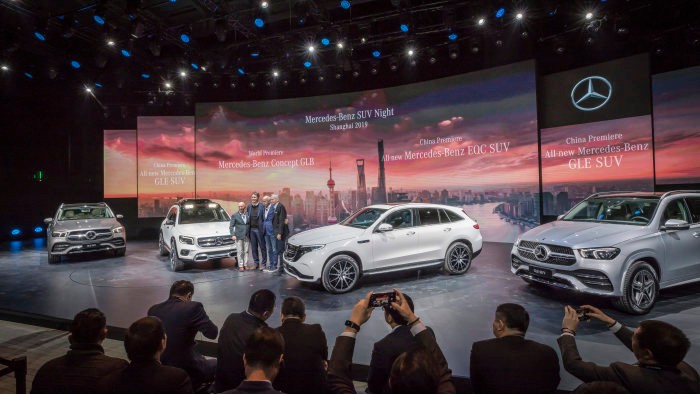
Mercedes-Benz Cars on the eve of Auto Shanghai 2019 : SUVs – from electric drive to aerodynamic champion
15.
April 2019
Shanghai
On the eve of the 18th Auto Shanghai, journalists were treated to an exclusive preview of the Mercedes-Benz show highlights that lie ahead. The brand with the three-pointed star presented no fewer than three SUVs: the Concept GLB, the battery-powered EQC (electricity consumption combined: 20.8 – 19.7 kWh/100 km; CO2 emissions combined: 0 g/km) and the Mercedes-Benz GLE. With the EQB, Mercedes-Benz announces an all-electric compact SUV that will be available in China from 2021.
The Concept GLB is an SUV idea based on the Mercedes-Benz compact car platform. The questions behind it are: Is there space within the successful Mercedes-Benz SUV line-up between the GLA and the GLC? And if so, what would such a vehicle look like? In response, Mercedes-Benz has developed a concept vehicle focused on space and sturdiness. It offers room for seven and also enjoys a natural habitat off-road on rough tracks. New in the Mercedes-Benz compact segment is a third row with two additional individual seats that can retract flush with the load floor to increase luggage space. The vehicle’s exceptional sturdiness is evident in an array of distinctive extras. Rising from the roof frame at the front and rear, for instance, are a total of four scoops housing LED spotlights, there to provide all-round illumination and aid orientation when driving off-road.
Mercedes-Benz EQC celebrates market premiere in China
The brand with the three-pointed star is presenting the Mercedes-Benz of electric vehicles, the EQC, for the first time in China. Its powerful proportions clearly define the EQC as a crossover SUV. The elongated roofline and the greenhouse with its low waistline and coupé-like roof, dropping towards the rear position it visually between an SUV and an SUV coupé. With its seamless, clean design and hallmark colour accents, it is the harbinger of an avant-garde electro-aesthetic, while at the same time representing the design language of progressive luxury. In terms of quality, safety and comfort, the EQC guarantees the accustomed quality of Mercedes-Benz that comes with a compelling package of characteristics. Added to that is outstanding performance thanks to two electric motors front and rear with a combined output of 300 kW. An intelligent operating strategy delivers an electric range of more than 445 km (NEDC)i. With Mercedes me, EQ offers a comprehensive range of services that make electric mobility convenient and practical for everyday use.
Market premiere for the GLE, the Mercedes-Benz SUV bestseller
In another China first, Mercedes-Benz is presenting the latest iteration of its trendsetting GLE SUV. More than two million customers have already opted for the premium SUV from the brand with the three-pointed star. The new GLE is set to continue this success story with a new operating concept, innovative driver assistance systems, a new range of engines and considerably more room. The exterior design of the new Mercedes-Benz GLE exudes not only great power and presence, it also sets a new aerodynamic best-in-class for the SUV segment with a cd of 0.29. The optional E-ACTIVE BODY CONTROL, which is paired with the redeveloped AIRMATIC air suspension, offers even more ride comfort and agility as well as completely new functions such as the recovery mode. It is the only system on the market that permits individual control of spring and damper forces at each wheel thus countering not only body roll but also pitch and lift movements.
Mercedes-Benz founded the premium SUV segment in 1997 with the launch of the M-Class. Today, the brand with the three-pointed star is exceptionally successful in this segment with no fewer than seven models – GLA, GLC, GLC Coupé, GLE, GLE Coupé, GLS, G-Class. Worldwide, more than six million customers have chosen a Mercedes-Benz SUV to date. SUVs now account for more than a third of total Mercedes-Benz sales.
Find videos of the press conference and the Mercedes-Benz Media Night as well as the Media Special on Auto Shanghai 2019 including all press materials, images and videos associated with the products on show on https://media.mercedes-benz.com/AutoShanghai2019.
EQC (electricity consumption combined: 20.8 – 19.7 kWh/100 km; CO2 emissions combined: 0 g/km)*
*Electric energy consumption and range have been determined on the basis of Regulation (EC) No. 692/2008. Electric energy consumption and range depend on the vehicle configuration.
Press Contact
Katja Bott
Head of Global Communications Mercedes-Benz Cars
katja.bott@daimler.com
Tel: +49 711 17 75841
Fax: –
Steffen Schierholz
Manager Communications C-Class, E-Class, CLS
steffen.schierholz@daimler.com
Tel: +49 711 17-75852
Fax: +49 711 17-98646
Koert Groeneveld
Head of International Product & Technology Communications
koert.groeneveld@daimler.com
Tel: +49 711 17-92311
Fax: +49 711 17-94365
Press Contact Overview
Media
Download
Pictures (44)
Media Contact (3)
Filter
Show thumbnails
Show list
Slideshow
Zoom
Preview
Details
Do you really want to delete the data record?
Please wait a moment …
Please wait a moment …
Please wait a moment …
Please wait a moment …
19C0302_001
19C0302_002
19C0302_003
19C0302_004
19C0302_005
19C0302_006
19C0302_007
19C0302_008
19C0302_009
19C0302_010
19C0302_011
19C0302_012
19C0302_013
19C0302_014
19C0302_015
19C0302_016
19C0302_017
19C0302_018
19C0302_019
19C0302_020
19C0302_021
19C0302_022
19C0302_023
19C0302_024
19C0302_025
19C0302_026
19C0302_027
19C0302_028
19C0302_029
19C0302_051
19C0302_050
19C0302_052
19C0302_053
19C0302_054
19C0302_055
19C0302_056
19C0302_057
19C0302_058
19C0302_059
19C0302_060
Loading
BacklotCars raises $25 million to accelerate its rapid growth nationwide in disrupting the $100 billion auto wholesale market
Searching for your content…
No results found. Please change your search terms and try again.
Ex-VW CEO, 4 others charged with fraud in Germany
Original Article
Kia Motors posts global sales of 197,647 vehicles in February
News
All
SUBSCRIBE TO RSS FEED
XML
Kia Motors Corporation announced February 2019 global sales figures for passenger cars, recreational vehicles (RVs) and commercial vehicles, recording a total of 197,647 units sold, which represents a 0.1 percent year-on-year increase. Kia’s best-selling model in global markets in February was Sportage SUV with 39,844 units sold. Overseas sales increased 2.5 percent compared to the previous year, posting 164,425 units. Sportage sales rose by 25.1 percent from the same month last year with 37,630 units sold. Rio subcompact sedan was the second-best seller with 22,273 units sold, followed by Picanto (Morning) mini car with 15,089 units sold. Sales in Korea totaled 33,222 units, representing a decrease of 10.2 percent from the same month of 2018. Kia’s best-selling vehicle in February was Sedona (Carnival) minivan for the 11th consecutive month with 4,312 units. K Series models (K3, K5, K7, K9) continued to generate solid sales with 9,311 units, ..
China plays key role in Volkswagen Group’s e-mobility strategy
China will play a key role in the Volkswagen group’s global transformation and its accompanying decarbonization program. Thus, this year will see an intensified roll-out of new energy models. Volkswagen Group China aims to produce more than half of the group’s global objective of 22 million BEVs by 2028. To speed up its e-offensive, it… Continue reading China plays key role in Volkswagen Group’s e-mobility strategy
Volkswagen launches model offensive in China
Volkswagen Group China CEO Wöllenstein Volkswagen plans an extensive model offensive in China. The brand will have doubled its SUV range by 2020. Volkswagen announced during the Auto Shanghai 2019, that the share of SUVs is expected to rise to up to 40 per cent. It is targeting the tradiotional part as well as the… Continue reading Volkswagen launches model offensive in China