Tesla Model 3 could charge faster in Europe, charging network results suggest

Follow Bengt

2018 Tesla Model 3
Deliveries of the Tesla Model 3 in Europe have just started. So too have some accounts of the most significant difference included in European-market versions of the electric sedan: their CCS Combo DC fast charging port.

One of those first accounts has come from the European charging network Fastned, which already operates many stations with 175-kw CCS hardware.

On that 175-kw hardware, Fastned showed that the Model S charged at a peak just above 125 kw. What’s especially of note, based on this graph, is that it stays at that maximum from around 10 percent state of charge all the way past 45 percent.

Fastned CCS charge curve for Tesla Model 3

Compared to what users have recorded with their Model 3 sedans on Tesla’s own Supercharger network, that’s both a higher peak power and a longer time near that peak. In order to be seen as a formidable alternative to Supercharging, it’s an important assertion for Fastned to make—that it’s quite certainly not slower with the CCS port. It may take many more examples and a deeper understanding to prove whether the Model 3 always charges faster on CCS, however.

DON’T MISS: What electric-car charging will satisfy a mass market? Twitter poll results

Some of Tesla’s Supercharger hardware is capable of delivering up to 145 kw; Tesla lists 120 kw as the peak charging rate for the Model 3.
That ceiling of around 125 kw that Fastned reports is, perhaps not coincidentally, the same peak charge rate that Volkswagen is planning to accommodate with the vehicles built on its MEB architecture—to arrive in Europe late this year with a model so far known as the ID Neo.

VW MEB platform

Volkswagen is aiming to build 15 million MEB vehicles globally by the end of its product cycle, later in the next decade, with the U.S. an important part of the plan (we get our first ID product around mid-2020).

So it’s likely that if VW’s electric vehicles arrive as promised and Tesla’s momentum continues to build with the Model 3 and Model Y (expected to share its battery and charging tech) we’ll have millions of vehicles that can take advantage of 125 kw.

CHECK OUT: Tesla will soon be compatible with all DC fast charging—in Europe

The Kia Niro EV that we covered in a first drive review on earlier this month offers a peak 100 kw, according to Kia, but officials confessed that it hits that peak for a very brief time—part of the reason why that model’s 64-kwh pack takes only 15 minutes less to get from 0 to 80 percent versus the Hyundai Kona with the same size pack (about 60 minutes versus 75 minutes, respectively).

2019 Audi e-tron first drive – Abu Dhabi UAE, December 2018

Several more vehicles are expected to hit the market yet this year in Europe with the capability to charge at 150 kw on CCS. The next vehicle due for widespread delivery and capable of even higher-power fast charging is the Audi e-tron SUV, which will arrive in Europe next month and in the U.S. by late spring. It will be able to sustain its peak 150 kw for a significant portion of the charge session, allowing it to regain 80 percent of the charge on its 95-kwh battery pack in about 30 minutes.
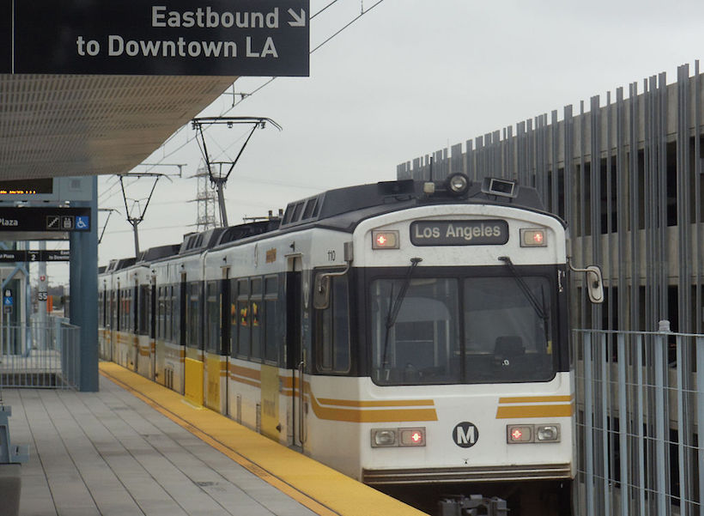
Via Provides First-,Last-Mile Mobility for LA Metro

The service utilizes Via’s algorithm to dynamically route shared vehicles to-and-from three busy Metro stations — Compton (Artesia), El Monte, and North Hollywood. Photo via METRO96/Wikimedia.  Via, a leading developer of on-demand shared transit solutions, and the Los Angeles County Metropolitan Transportation Authority (Metro), have launched a pilot program that provides first-and-last mile solutions for public transportation… Continue reading Via Provides First-,Last-Mile Mobility for LA Metro

Driverless delivery startup Nuro gets $940m from SoftBank Vision Fund

February 11, 2019 Autonomous technology startup Nuro said on Monday it raised $940 million from SoftBank Group Corp, which valued the Silicon Valley-based company at $2.7 billion. Nuro was co-founded in 2016 by two former engineers of Google’s self-driving car project, Dave Ferguson and Jiajun Zhu. The funding by SoftBank came through its $100-billion Vision… Continue reading Driverless delivery startup Nuro gets $940m from SoftBank Vision Fund

Tesla’s electric vehicle dominance is about to have ‘serious competition,’ Morgan Stanley says

Former Tesla CEO on electric vehicle growth
2:44 PM ET Thu, 7 Feb 2019 | 04:06

Tesla's domination of the electric vehicle market is “unsustainable” and will soon be disrupted by start-up Rivian, Morgan Stanley analyst Adam Jonas said Monday.

Jonas, whose thoughts on electric autos are widely followed on Wall Street, expects Rivian will be “the next serious competition from a 'clean sheet' start-up with access to talent & capital focused on the fastest growing segments of pickup trucks & SUVs.” He estimates that Tesla makes about 80 percent of the U.S. EV market, capturing as much as 90 percent of U.S. electric vehicle revenues.

Rivian, based outside Detroit, previewed its R1T electric truck prototype at the Los Angeles Auto Show in November. Rivian said the R1T will deliver 400 miles of range, with four individual motors allowing for all-wheel-drive. Additionally, Rivian CEO R.C. Scaringe said the R1T will be able to hit 60 mph in 3 seconds and tow up to 11,000 pounds.

Bloomberg | Bloomberg | Getty Images
RJ Scaringe, founder and chief executive officer of Rivian Automotive Inc., unveils the R1T electric pickup truck, left, and R1S electric sports utility vehicle (SUV) during a reveal event at AutoMobility LA ahead of the Los Angeles Auto Show in Los Angeles, California.

Tesla may unveil an electric pickup truck this summer, CEO Elon Musk said during the company's fourth-quarter conference call. In December, Musk talked extensively on Twitter about what he would like to include in a pickup truck design, including all-wheel drive with “crazy torque & a suspension that dynamically adjusts for load.”

Rivian is also building the R1S, an electric seven-passenger SUV. Rivian says the R1S will also have a range of over 400 miles.

Jonas said Morgan Stanley has a “strong belief that all-electric vehicle architecture will need a truly 'clean sheet' approach” to take on Tesla, rather than “adapting existing legacy [original equipment manufacturer] architecture.”

“We believe companies like Rivian will take elevated importance in investors' minds as EVs become the focus of OEM investment and strategy,” Jonas said.

– CNBC correspondent Paul Eisenstein and CNBC's
Michael Bloom
contributed to this report.

Softbank’s next bet: $940M into autonomous delivery startup Nuro

Nuro, the autonomous delivery startup, has raised $940 million in financing from the Softbank Vision Fund, a whopping amount that will be used to expand its delivery service, add new partners, hire employees and scale up its fleet of self-driving bots. Nuro has raised more than $1 billion from partners including SoftBank, Greylock Partners and… Continue reading Softbank’s next bet: $940M into autonomous delivery startup Nuro

Startup Nuro raises $940 million from SoftBank’s Vision Fund

FILE PHOTO – The unmanned delivery vehicle, Nuro, is seen during the Kroger annual shareholders meeting in Cincinnati, Ohio, U.S., June 28, 2018. Picture taken June 28, 2018. Courtesy of Kroger/Handout via REUTERS (Reuters) – Autonomous technology startup Nuro said on Monday it has raised $940 million from SoftBank’s Vision Fund, which valued the Silicon… Continue reading Startup Nuro raises $940 million from SoftBank’s Vision Fund

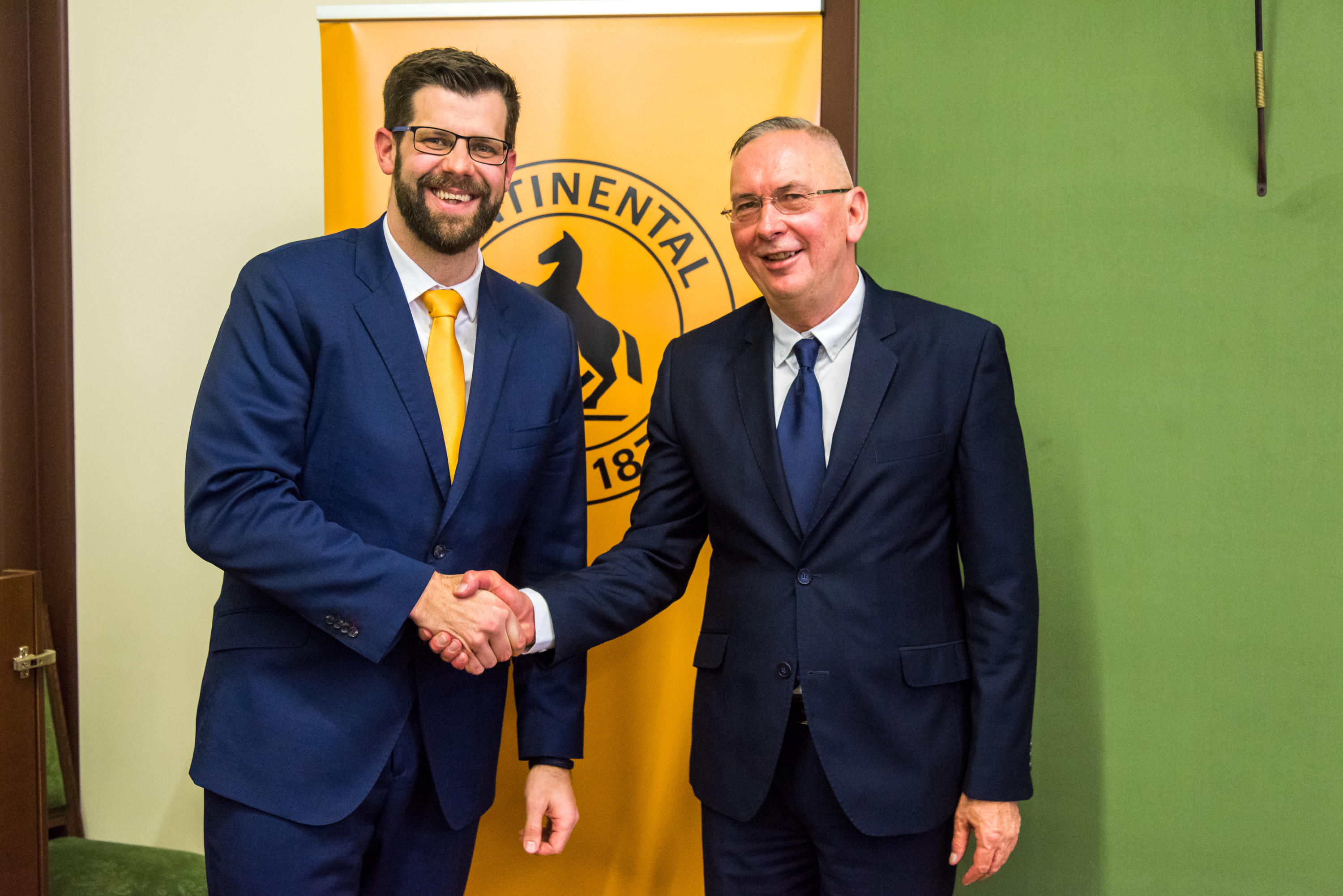
Continental Signs Strategic Cooperation Agreement with the University of Debrecen

Continental provides practical training valuable in the labour market and subsequent job opportunities for graduate students With its educational, research and other related professional activities Continental supports the University of Debrecen to create value together in the region The agreement was signed on the behalf of the University of Debrecen by Dr. Zoltán Szilvássy, Rector,… Continue reading Continental Signs Strategic Cooperation Agreement with the University of Debrecen