Mercedes-Benz sells about 182,000 vehicles worldwide in April

10.

May 2019

Stuttgart

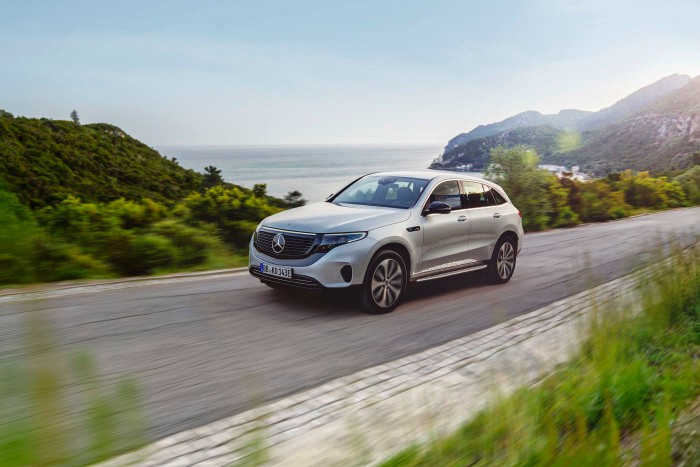
EQC Edition 1886 (combined electric energy consumption: 20.8 – 19.7 kWh/100 km; combined CO2 emissions: 0 g/km)*. *Electric energy consumption and range have been determined on the basis of Regulation (EC) No. 692/2008. Electric energy consumption and range depend on the vehicle configuration. Mercedes-Benz sold 181,936 automobiles worldwide last month (-5.5%). In the first four months of the year, 742,809 cars with the three-pointed star were handed over to customers (-5.6%). Sales in China increased to a new high of 232,050 units for the period of January to April (+2.2%). Positive sales momentum from the ongoing success of the new A-Class: More than 49,000 compact cars were delivered worldwide in April (+6.0%). Global sales of smart increased by 14.3% to 11,573 units in April. The Mercedes-Benz EQC (combined power consumption: 20.8 – 19.7 kWh/100 km; combined CO2 emissions: 0 g/km)* can be ordered since May 6. Stuttgart. Mercedes-Benz delivered 181,936 cars in April (-5.5%) and a total of 742,809 in the first four months of the year (-5.6%). The ongoing sales success of the new A-Class resulted in worldwide growth for the compact cars in April (+6.0%). A contribution to this sales success came from the new A-Class Saloon, a further model complementing the compact-car entry into the world of premium saloon cars from Mercedes-Benz. Unit sales of SUVs were still dampened in April by the model changes. Mercedes-Benz Cars expects especially for the new SUV models increasing vehicle availability in the coming months and therefore additional growth opportunities in a highly competitive market environment. Since the beginning of the year, Mercedes-Benz has maintained its market leadership in the premium segment in Germany, UK, France, Switzerland, Sweden, Portugal, Poland, Denmark, Czech Republic, Australia and Canada.
“With the EQC sales launch on May 6, we have reached another milestone along the way to a new era at Mercedes-Benz: The EQC is the pioneer of our future Mercedes-Benz EQ vehicle portfolio,” said Britta Seeger, Member of the Board of Management of Daimler AG responsible for Mercedes-Benz Cars Marketing and Sales. “We are delighted not only with the first fully electric SUV from Mercedes-Benz, but also with strong demand for our new premium SUVs: The new model year of the GLC and GLC Coupé, and also the new GLS, have been available for order since April, and together with the GLE and our new compact cars will provide further momentum in the course of the year.”
Mercedes-Benz unit sales by region and market
In Europe, 71,263 cars with the three-pointed star were delivered last month (-4.8%). In Germany, the region’s core market, sales of 24,970 units in April were slightly below the high prior-year level (-1.3%). In the major markets of France and Russia, unit sales increased in both April and the first four months of the year. In France, Mercedes-Benz actually achieved a new record for January to April (+2.8%).
In the Asia-Pacific region, Mercedes-Benz sold 79,125 vehicles (-1.4%). In China, the region’s core market, sales continued to grow and reached a new high of 232,050 units in the first four months of the year (+2.2%). Unit sales were at a new record level also in April, with deliveries of 57,707 vehicles (+0.8%). In Singapore and Vietnam, unit sales increased at double-digit rates in the first four months and also reached new record levels.
A total of 111,668 units were sold in the NAFTA region from January to April (-11.7%). In the region’s core market, the USA, Mercedes-Benz sold a total of 22,949 vehicles with the star last month (-15.7%). Sales in the USA in the first four months totalled 94,120 units (-10.9%).
Mercedes-Benz unit sales by model
Following sales growth in March, worldwide unit sales of the compact cars increased also in April: More than 49,000 units sold represents an increase of 6.0% for the A- and B-Class, CLA, CLA Shooting Brake and GLA. Worldwide unit sales of the new A-Class continued to grow by a strong double-digit rate in April (+45.3%). The B-Class achieved sales growth in the first four months of the year in the major markets UK and Spain.
With sales of more than 138,000 units in April, the C-Class Saloon and Estate reached the high prior-year level (-0.8%). Sales of the long-wheelbase version of the C-Class Saloon were higher than ever before in the past four months (+10.9%). Sales of the C-Class Estate in the period of January to April increased in markets including Germany, Japan and Belgium.
With deliveries of about 60,000 units of the GLA, GLC, GLC Coupé, GLE, GLE Coupé, GLS and G-Class models, sales of SUVs in April were below the high prior-year level due to model changes (-12.7%). The new G-Class was popular among customers around the world, with strong double-digit growth rates to highs in both April and the past four months.
smart
In April, 11,573 customers worldwide were delighted to receive their new two-door or four-door urban microcars from the smart brand – an increase of 14.3%. The two-door and four-door smart models were especially popular in Europe last month. Unit sales in this region increased by 25.8%, partially driven by double-digit growth rates in Germany, Italy, France, Switzerland, Belgium and Austria. Unit sales by smart in Germany reached a new record in the past four months (+16.2%).
Overview of Mercedes-Benz Cars unit sales
April 2019
Change in %
Year to April 2019
Change in %
Mercedes-Benz
181,936
-5.5
742,809
-5.6
smart
11,573
+14.3
38,621
-5.5
Mercedes-Benz Cars
193,509
-4.5
781,430
-5.6
Mercedes-Benz unit sales in the regions/markets
Europe
71,263
-4.8
295,941
-5.4
– thereof Germany
24,970
-1.3
95,512
-4.1
Asia-Pacific
79,125
-1.4
319,121
-3.1
– thereof China
57,707
+0.8
232,050
+2.2
NAFTA
27,557
-16.9
111,668
-11.7
– thereof USA
22,949
-15.7
94,120
-10.9

Press Contact

Katja Liesenfeld

Manager Global Business Communications
Sales & After Sales Mercedes-Benz Cars

katja.liesenfeld@daimler.com

Tel: +49 711 17-32972

Fax: +49 711 17-790-24594

Christopher R. Springer

Global Business Communications
Sales & After Sales Mercedes-Benz Cars

christopher_renz.springer@daimler.com

Tel: +49 711 17-33806

Fax: +49 711 17-7902-3252

Sofia Stauber

Head of Global Business Communications
Mercedes-Benz Cars

sofia.stauber@daimler.com

Tel: +49 711 17-40598

Fax: +49 711 17790-91184

Press Contact Overview

Media

Download

Pictures (3)

Documents (2)

Media Contact (3)

Filter

Show thumbnails
Show list
Slideshow

Zoom

Preview

Details

Do you really want to delete the data record?

Please wait a moment …

Please wait a moment …

Please wait a moment …

Please wait a moment …

18C1072_004

19C0258_072

18C0291_007

Loading

Geely Auto New Flagship CMA-based Coupe SUV Launched

Geely Auto’s first model based on Compact Modular Architecture (CMA), Xing Yue launched The world’s first Coupe SUV with PHEV option Comes with three powertrain options; traditional ICE, mild hybrid, and plug-in hybrid PHEV version comes in two battery options with pure electric range of 56km and 80km High performance 2.0T available with a record… Continue reading Geely Auto New Flagship CMA-based Coupe SUV Launched

Tesla Insurance: Information Arbitrage To Save You Money

Invest
Electric Cars
Electric Car Benefits
Electric Car Sales
Solar Energy Rocks
RSS
Advertise
Privacy Policy

Cars

Published on May 3rd, 2019 |

by Vijay Govindan

Tesla Insurance: Information Arbitrage To Save You Money

Twitter
LinkedIn
Facebook

May 3rd, 2019 by Vijay Govindan

Tesla Insurance will increase customer satisfaction
I recently went through the pain of looking for auto insurance for my new Tesla Model 3 Long Range. Some auto insurance companies are more sophisticated than others. Others … need some work. Some of the insurance sites I visited could not identify my Tesla VIN. One company said they would call me back. Another company that had an app for my phone would give me a quote in three weeks. One insurer thought our Tesla was a gas car. Facepalm.

Example A: Large, unnamed auto insurer thinks the Model 3 is a 4 door sedan running on gas.

Disclosure: I worked at several insurance companies for several years.

Consider two situations: One is a great customer experience for Tesla. The other is somewhere between bad and good, depending on the individual.

Imagine the following: You are ready to order your beautiful Tesla on your phone. You are super excited. You can’t wait to drive it and show it off. Before you place the order, you realize you need insurance before delivery. Magically, Tesla asks you if you want Tesla Insurance on your new vehicle. You add the insurance and you are all set! Painless! You are extremely satisfied with the ease of buying the car plus insurance. You look forward to delivery.

Contrast that with this situation below, which is not so pleasant. (Please note there is some exaggeration.)

Imagine the following: You are ready to order your beautiful Tesla on your phone. You are super excited. You can’t wait to drive it and show it off. You place the order. Then, horror of horrors — you need to find auto insurance before delivery. Yuck!

Panic ensues. How much will it be? Is it going to be super expensive? Do I need to visit a dozen sites to get the best insurance cost? Should you call that weird uncle of yours who knows the best deals in dark alleys with shady characters for everyone and everything? Suddenly, the purchase of your new Tesla got dimmed quite a bit.

Insurance companies can’t individually rate your driving characteristics. Instead, they bucket your experience and characteristics into similar “groups.” These groups are rated, usually by applying one multiplicative rating factor with another. Common groups include your age, when you first got your license, if you are married or single, if you own a home, your credit rating, your accident history, and anything else they ask for when you apply for auto insurance.

Sophisticated insurers use generalized linear models — think of y = a+ bx (instead of a and b being fixed, they can change based on your characteristics). Then expand that to y = a + b1x1 + b2x2 + b3x3 etc. (Linear algebra is very important here.) Even more sophisticated insurers are probably implementing or experimenting with Machine Learning and Big Data analysis.

Buying your insurance when you purchase the car will draw more people to Tesla. It saves you time, effort, frustration, and inconvenience.

Tesla knows how you drive better than you do
On Tesla’s Q1 2019 earnings call, Elon announced Tesla is creating its own insurance product. The company expects to launch it in about a month.

How could Tesla launch an insurance product without having any insurance experience? Very easily. They will have detailed information on how you drive your Tesla, better than an insurance company would. They also know their customers. Most people buying a Tesla probably have excellent credit. Excellent credit is a key factor determining your insurance costs.

“Your insurance score is based in large part on your overall credit rating.”

Last, Tesla knows the inherent safety of its vehicles. Safer vehicles mean reduced chances of having an accident, less chance of getting injured, and less chance of injuring someone else. New Teslas have a suite of cameras, radar, and sensors to keep you and others safe. They are moving towards Full Self Driving (FSD).

Obviously, Tesla would not classify your electric vehicle as a gas car. The company would be able to perform deeper classifications. In a word, it’s information arbitrage. I would define information arbitrage as one party having more knowledge about a situation than the other party in a contract. They use this “added” information to position themselves ahead of everyone else and generate profits from the opportunity. But this is not my term.

“Tesla has an ‘information arbitrage opportunity,’ Musk said. The company is able to capture driving data, giving the company direct knowledge of the risk profile of the driver and car. If customers want to buy Tesla insurance, they might have to agree to ‘not drive the car in a crazy way,’ said Musk, who added they can, they’ll just have a higher insurance rate.”

Tesla has the benefit of having Machine Learning expertise, continuously performing analysis on lots of Big Data, and to top it off, the company has an excellent neural networking team. The first two are keys skills for insurance companies, and the third includes skills the insurance companies wish they had. Tesla can take your vehicle information, anonymize it, group it together, perform statistical analysis, and figure out which combination of behaviors are safer or riskier. Use Autopilot more than 80% of your driving time? That could give you a discount. Drive the speed limit religiously? Could be another discount. Drive more highway miles than local? Discount! Take your Tesla and jump off cliffs? Penalty!

The beauty of this is Tesla only has to price the insurance at break even or a slight profit. It does not have to act as standalone insurers seeking profit as their primary source of income. This would cause a lot of havoc for auto insurance companies as Tesla’s fleet grows.

Now, with this in mind, Tesla Insurance saves you time, effort, frustration, inconvenience, and cost. It improves the customer experience.

Example B: Esurance, what’s going on with your rates? This is for an FSD model, which insurance companies don’t yet adequately rate.

What are some advantages Tesla has against insurance companies?
For a simpler format, I will list what I see as advantages for Tesla as an insurance company here.

Tesla creates the vehicles it will insure. These vehicles are some of the safest, if not the safest, on the road.
If a Tesla gets into an accident, occupants inside the Tesla are less likely to be injured. This reduces liability costs.
Features such as Traffic Aware Cruise Control and Navigate on Autopilot reduce the risk of rear ending someone (very common) or getting into an accident on the highway. This reduces insurance frequency and severity.
It is hard to steal a Tesla, reducing property damage costs.
Tesla software such as Sentry Mode and live camera recording can provide proof for theft, accidents, and who is at fault.
The Standard Range, Long Range, and Performance versions of the car are similar in body structure, allowing data to be grouped together if needed.
Tesla owns some body shops.
Tesla operates Mobile Ranger service.
Tesla has Machine Learning, Big Data, and neural net experience. It can leverage this experience to price the insurance.
Tesla gets detailed vehicle telemetry from each vehicle.
Tesla can supply the parts for repairs at cost and without markup.
Tesla already calls you within a few minutes if you are in a severe accident.
Tesla will give you a tow if you run out of charge.
Tesla can seek a nominal profit.
Due to all of the above, Tesla can undercut insurance companies on price.
Because of these inherent advantages Tesla can offer similar coverage for less, or offer more coverage for the same price versus competing insurance companies.
Bundling the purchase of insurance and purchase/lease of a Tesla together improves the customer experience greatly.

Many things that an insurance company offers, Tesla already does.

Detailed “Tesla Insurance” information
Below is some information recently found regarding Tesla Insurance Services. The link for the entire 4000+ page document can be found if you have the link to the actual insurance filing or visit the CA DOI’s headquarters. Source: Twitter. Thanks, Steve Jobs! (@tesla_truth)

Figure 1: Some states where Tesla already has set up Tesla Insurance Services. This includes MA, CA, NV, AL, NY, MT, OR, PA, VA, and TX.

Figure 2: Tesla’s rating algorithm filed with the California Department of Insurance.

Above, we see Tesla’s rating algorithm for Tesla Insurance Services. The base rate for each coverage is multiplied by the respective discount / surcharge. All the different coverages are added together for the final premium (Line 27).

Summary of coverage definitions
BI = Bodily Injury
PD = Property Damage
MED = Medical Payments
UM = Uninsured Motorist
COMP = Comprehensive
COLL = Collision
UMPD = Uninsured Motorist Property Damage
GAP = Gap Insurance
RR = Rental Reimbursement
RA = Roadside Assistance
CDB = Collision Deductible Buyback

What is most interesting is the Autonomous Vehicle Package on Line 28 (page 66)

AUTONOMOUS VEHICLE PROTECTION PACKAGE

Subject to all the terms, conditions and exclusions of the policy, we will provide the following coverages:

Autonomous Vehicle Owner Liability
Cyber Identity Fraud Expenses
Wall Charger Coverage
Electronic Key Replacement

We find out later that this coverage will be mandatory for Tesla drivers (page 868).

Vehicle Automation Package Endorsement
SNIC is proposing to add a Vehicle Automation Package endorsement that is mandatory for all Tesla vehicles, which includes:

Autonomous Vehicle Owner Liability
Cyber Identity Fraud Expense
Wall Charger Coverage
Electronic Key Replacement

On page 1772, we find the premiums for this coverage. It is not expensive at all.

Autonomous Vehicle..

Documents suggest sale of Jaguar Land Rover to PSA is “imminent” – Aberdeen Evening Express

(Jaguar Land Rover) Leaked information suggests a sale of struggling Jaguar Land Rover to French automotive group PSA could be imminent. It is understood a “post-sale integration document”, which outlines the benefits of the two companies joining forces, is already in circulation and the firms are exploring the detail of cost saving benefits after a… Continue reading Documents suggest sale of Jaguar Land Rover to PSA is “imminent” – Aberdeen Evening Express

BMW Startup Garage secures early access to pioneering innovations.

Munich. The BMW Startup Garage – part of the company’s Research, New Technologies and Innovations unit – has been tracking down the most innovative startups in the business for four years now, allowing the BMW Group to tap into their potential quickly and directly. So far, more than 50 up-and-coming technology companies have completed its… Continue reading BMW Startup Garage secures early access to pioneering innovations.

Volkswagen has already built 200 pre-production vehicles of the new electric car ID.3

Quality check of the new ID.3 at the Zwickau car plant (from left): Volkswagen-CEO Herbert Diess, Heiko Rösch, Head of body construction, and Reinhard de Vries, Managing Director Technology & Logistic Volkswagen Saxony. Transformation of Zwickau to a pure e-car plant is right on schedule Production of the ID.3 will start as scheduled at the… Continue reading Volkswagen has already built 200 pre-production vehicles of the new electric car ID.3

Already more than 10,000 registrations for the ID.3

Customers’ interest in the Volkswagen ID.3 significantly exceeded expectations. Expectations significantly exceeded: in some cases, IT systems cannot handle flood of customers Pre-booking for limited special edition started yesterday Already strong interest from customers on first day At a press event held yesterday in Berlin, Volkswagen launched pre-booking in Europe for the first model in… Continue reading Already more than 10,000 registrations for the ID.3

Self-Driving Robot Makes Life Easier for Ford Employees

Ford is using a self-driving robot to deliver parts directly to where they are needed Programmed to know the plant layout, the robot nicknamed “Survival” modifies its route after encountering obstacles in its path; is first of its kind to be used in a Ford facility in Europe Trials shows “Survival” frees up to 40-employee… Continue reading Self-Driving Robot Makes Life Easier for Ford Employees

Audi delivered around 140,300 automobiles to customers in April

AUDI AG delivered around 140,300 cars to customers worldwide in April, down 12.8 percent year-on-year. Model changeovers affecting volume models such as the Audi A6 continued to have an adverse effect. The new Audi Q3 has developed its potential in Europe so far, with strong growth in countries such as France (+109.0%) or Germany (+97.6%);… Continue reading Audi delivered around 140,300 automobiles to customers in April

Mazda forecasts continued global growths

Mazda Motor Corporation today announced its global full-year financial and sales results, reporting global sales of 1,561,000 vehicles during the twelve-month period that ended 31 March 2019. The ASEAN region again saw the highest year-on-year increase with unit sales up 18% to 137,000 vehicles. Mazda’s domestic market Japan also contributed to the growth with a… Continue reading Mazda forecasts continued global growths