
Tokyo, October 3, 2018 – Mitsubishi Motors has today announced it is to increase the production capacity at its state-of-the-art manufacturing facility in Bekasi, Indonesia in response to strong demand for the XPANDER crossover MPV in Indonesia and export markets. The expansion will increase capacity to 220,000(*) units from the current 160,000(*) units by… Continue reading Mitsubishi Motors increases the production capacity in Indonesia
-The engine of XPANDER shifts to localization –
Category: OEMs
Tesla Is 2 Years Ahead Of Schedule On Gigafactory 1
Electric Cars
Electric Car Benefits
Electric Car Sales
Solar Energy Rocks
RSS
Advertise
Privacy Policy
Clean Transport
Published on October 1st, 2018 |
by Dr. Maximilian Holland
Tesla Is 2 Years Ahead Of Schedule On Gigafactory 1
Twitter
Google+
LinkedIn
Pinterest
Facebook
October 1st, 2018 by Dr. Maximilian Holland
Tesla’s 2014 vision for the Gigafactory
Tesla’s Gigafactory 1 in Nevada is solidly on track to achieve a battery production volume of 35 GWh per year (annualized run rate) by the end of 2018. This is two years ahead of the original 2020 target date for achieving these volumes.
Whilst Tesla is often criticized for slipping on its targets, let’s take a moment to recognize the remarkable Gigafactory volume achievement.
Tesla Gigafactory 2018
Where’s My Model 3?
With the obvious advantages of EVs being increasingly recognized by consumers, many folks are getting impatient for affordable EVs to arrive in volume. On the other side of the fence, commentators and incumbents across the automotive and fossil fuel industries, along with their lapdogs in the media, are dishing out daily disdain and skepticism upon the disruptive notions of electrifying transport and accelerating the move towards sustainable energy.
From both sides, Tesla, the world’s leading producer of EVs, is subject to heavy scrutiny of all of its plans and timelines. Even whilst folks queue around the block to get in line for an unseen car, they wonder and get impatient when it takes longer to arrive than they’d hoped.
The Model 3 was infamously 6 months delayed in reaching its 5,000 units per week production volume target, and the company came in for much criticism from all quarters. Most of us forgot that achieving even this interim volume target has put Tesla’s Model 3 at well over double the next best selling EV (the Nissan Leaf). In fact, even while the Model 3 is being produced and delivered at a volume that makes it the 5th best selling car in the US in terms of monthly unit sales, much attention is focused on possible remaining Tesla production challenges.
The habitually optimistic projections of Tesla have come to be taken with a pinch of salt by experienced EV watchers, and it is often joked that the company’s stated timelines need conversion from “Elon time” into the time scales that most of us live in.
Bucking the Trend
Tesla’s Gigafactory progress significantly bucks this trend. When the Gigafactory was first announced in early 2014, the plan was to hit 35 GWh of battery production in 2020. We covered the story extensively at that time, and saw Tesla and Panasonic formally sign onto the joint plan in July of 2014.
Related to bringing forward the timeline for the Model 3’s production in response to its massive and unexpected demand, at the start of 2017, Tesla announced an ambitious accelerated Gigafactory timeline. It brought the 35 GWh goal forward to the end of 2018. Given the focus on production delays of the Model 3 itself during the past couple of years, many of us (myself included) assumed that the seemingly over-ambitious Gigafactory production targets were likewise slipping.
But a couple of months ago (July 2018), news emerged that the accelerated Gigafactory production targets were indeed within reach by the Tesla–Panasonic partnership. Then, just last week, Zach covered the latest updates from Yoshio Ito, head of Panasonic’s automotive business. The news was of the further bringing forward the July plan, to even more quickly add 3 new production lines that were previously slated for “the the end of the year [2018].” This further advance means that the lines will be installed and operating well before the end of the year, thus giving real credence to the 35 GWh run rate being achievable by the end of 2018.
It’s worth pausing to celebrate this rare but strong example of Tesla being two full years ahead of schedule on the timeline it originally set out for the Gigafactory back in 2014. From an initial 2020 target, we now find the 35 GWh annualized production volume goal looks set to be achieved by the end of 2018. That’s 4 years to reach a goal that was initially planned to require 6 years.
Tesla and Elon Musk have come in for a lot of flack recently, but the progress on the ground at the Gigafactory should serve to remind us that — away from the negative press and frequent skepticism about the revolutionary company’s broader mission — Tesla is achieving remarkable goals to accelerate the move towards sustainable transportation and energy.
Related stories:
Elon Musk’s 2015 Tesla Forecasts Compared To Today — The Future Looks Bright
If A Tesla Pattern Has Emerged, What Does That Mean For Model 3?
Is Tesla Model 3 Actually On Original Schedule?
Is Tesla Ever Late? No, Not Really.
Tesla Executes
Support CleanTechnica’s work by becoming a Member, Supporter, or Ambassador.
Or you can buy a cool t-shirt, cup, baby outfit, bag, or hoodie or make a one-time donation on PayPal.
About the Author
Dr. Maximilian Holland Max is an anthropologist, social theorist and international political economist, trying to ask questions and encourage critical thinking about social and environmental justice, sustainability and the human condition. He has lived and worked in Europe and Asia, and is currently based in Barcelona.
Back to Top ↑
CleanTechnica Clothing & Cups
Advertisement
Advertise with CleanTechnica to get your company in front of our readers.
Top News On CleanTechnica
Advertisement
Follow @cleantechnica
Join CleanTechnica Today!
EV Charging Guidelines for Cities
Share our free report on EV charging guidelines for cities, “Electric Vehicle Charging Infrastructure: Guidelines For Cities.”
Advertisement
Cleantech Press Releases
Shift In Navajo Country As Coal Plant That Navajo Community Doesn’t Want Is Dropped
Capturing CO2 From Exhaust Pipes Is A Bad Idea That Won’t Die
No, Magnesite Isn’t The Magic CO2 Sequestration Solution Either
The EV Safety Advantage
Read & share our free report on EV safety, “The EV Safety Advantage.”
The State of EV Charging
Our 93-Page EV Driver Report
30 Electric Car Benefits
Blockchain × Cleantech
Our Electric Vehicle Reviews
Tesla News
Correcting the Cleantech Record
38 Anti-Cleantech Myths
Wind & Solar Prices Beat Fossils
Cost of Solar Panels Collapses
© 2018 Sustainable Enterprises Media, Inc.
Electric Cars
Electric Car Benefits
Electric Car Sales
Solar Energy Rocks
RSS
Advertise
Privacy Policy
This site uses cookies: Find out more.Okay, thanks
Ford F-Series Tops 70,000-Truck Mark for Seventh Consecutive Month, While Ford Expedition Sales Jump 27.4 Percent; Lincoln Navigator Sales Up 77.3 Percent
About Ford Motor Company Ford Motor Company is a global company based in Dearborn, Michigan. The company designs, manufactures, markets and services a full line of Ford cars, trucks, SUVs, electrified vehicles and Lincoln luxury vehicles, provides financial services through Ford Motor Credit Company and is pursuing leadership positions in electrification, autonomous vehicles and mobility solutions.… Continue reading Ford F-Series Tops 70,000-Truck Mark for Seventh Consecutive Month, While Ford Expedition Sales Jump 27.4 Percent; Lincoln Navigator Sales Up 77.3 Percent
Technical specifications of the BMW i3 (120 Ah) and the BMW i3s (120 Ah), valid from 11/2018.
Do you need help? Please contact our support team from 9 to 17 CET via support.pressclub@bmwgroup.com. PressClub Global · Article. Tue Oct 02 17:56:17 CEST 2018 Fact & Figures Attached please find the technical specifications of the BMW i3 (120 Ah) and the BMW i3s (120 Ah), valid from 11/2018. Technical Data My.PressClub Login BMW Group… Continue reading Technical specifications of the BMW i3 (120 Ah) and the BMW i3s (120 Ah), valid from 11/2018.
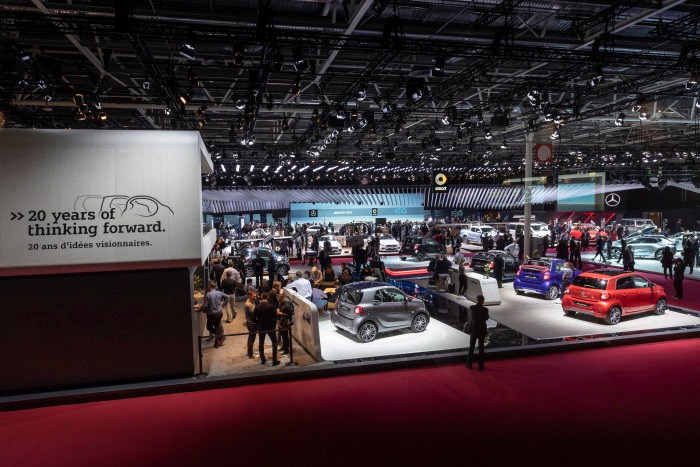
smart at the Paris Motor Show 2018: Electric, urban, unconventional
02.
October 2018
Stuttgart/Paris
Press Contact (2)
Ariane Fiedler
Manager International smart Communications
ariane.fiedler@daimler.com
Tel: +49 711 17-75924
Fax: –
Willem Spelten
Head of international Brand & smart Product Communications
willem.spelten@daimler.com
Tel: +49 (0)711 17-75847
Fax: +49 (0)711 17-79099473
car2go will have 400 smart EQ fortwos (power consumption, combined: 14.5–12.9 kWh/100 km(1); CO2 emissions, combined: 0 g/km(2); smart fortwo: fuel consumption, combined: 5.0-4.8 l/100 km(1); CO2 emissions, combined:114-110 g/km(2); smart EQ fortwo (power consumption, combined: 18.3–13.2 kWh/100 km(1); CO2 emissions, combined:0 g/km(2); smart EQ fortwo and smart EQ forfour: power consumption, combined: 20.8-12.9 kWh/100 km(1); CO2 emissions, combined:0 g/km(3)
Download
Filter
Do you really want to delete the data record?
Please wait a moment …
Please wait a moment …
Please wait a moment …
Please wait a moment …
smart at the Paris Motor Show 2018
Stuttgart/Paris, Oct 2, 2018
New special model: smart fortwo | edition pureblack
Oct 2, 2018
New functions in the “ready to” app: Sharing your smart and the costs
Stuttgart/Paris, Oct 2, 2018
Intelligent app for smart EQ fortwo and smart EQ forfour: smart EQ control app: the perfect digital companion
Stuttgart/Paris, Oct 2, 2018
smart forease: As uncompromising and fresh as the brand
Stuttgart/Paris, Oct 2, 2018
Chocks away for car2go in Paris, too: Allez les Bleus!
Stuttgart/Paris, Oct 2, 2018
The smart story: 20 years of smart
Stuttgart/Paris, Oct 2, 2018
Loading
Renault EZ-ULTIMO: a robo-vehicle for a premium mobility experience
Imagining tomorrow’s mobility means redefining the paradigm of the car almost entirely. We are on the brink of a new world in which shared mobility services will become increasingly prevalent. As cities become more congested and urban trends make it easier for people to travel short distances using shared services, the reality of what’s possible… Continue reading Renault EZ-ULTIMO: a robo-vehicle for a premium mobility experience
Xing Mobility Is Leveraging Its Modular Batteries For Electric Vehicle Retrofits
Electric Cars
Electric Car Benefits
Electric Car Sales
Solar Energy Rocks
RSS
Advertise
Privacy Policy
Batteries
Published on October 1st, 2018 |
by Kyle Field
Xing Mobility Is Leveraging Its Modular Batteries For Electric Vehicle Retrofits
Twitter
Google+
LinkedIn
Pinterest
Facebook
October 1st, 2018 by Kyle Field
As the curtain is pulled back, the inner workings are exposed. What once was a lobby, suitable for the average passer by to see is no longer, as the gears and wires, batteries and motors that bring the machines inside to life are exposed. In an instant, it became clear that Xing Mobility (think “ZING”) is anything but a battery company. Xing invited CleanTechnica to its headquarters in Taipei, Taiwan, to chat with its top brass and to take a peak behind the curtain.
Fueled by innovation
Xing is a company that brings things to life. A company that energizes, powers, and tames the wild beast. In this case, in the back corner of the workshop that would be more at home in Mary Shelley’s Frankenstein than in an automotive factory, lies the stripped bones of the beast that lives in a perpetual state of evolution.
She’s called ‘Miss R’ and is the third in a line of a revolutionary racing vehicles that started off, of all things, with an internal combustion engine. That’s not a topic we frequent around these parts but as it turns out, the original dino-powered race vehicle was quickly followed by her much faster electrified progeny.
Xing Mobility was founded as a racing company. Not long thereafter, Azizi Tucker came on board fresh off of a stint at none other than Tesla Motors, and as you might expect, he joined Xing with a bias towards electrified powertrains. His passion for electrified powertrains led to the second generation of its race car being fueled with electrons and propelled by a set of electric motors.
Change is the only constant
At Xing, change is the only constant. As it built up its second generation vehicle, the company designed a battery pack that was flexible, as it had to be to keep up with the ever-evolving designs at Xing. Change was the price of entry, as it’s in their blood. The same can be said of the powertrain, as Xing upgraded its design from an internal combustion-powered car to one powered by a much smaller and much more efficient electric motor.
The conversion filled the veins of the team at Xing Mobility with a passion for improvement which paired well with the skillful young engineers they staffed up with as Xing grew. In the mad scientist’s lab that is the Xing Mobility headquarters, it is clear that this passion continues to fuel them today. In one corner of the lab, a Xing engineer preps a battery pack for its own destruction as Xing continues to validate the safety of its industry-leading immersion cooling battery tech.
The core of Xing’s business model is indeed its battery modules, but Xing is not a battery company. It is a full service emobility company that has been hard at work defining the building blocks of electric vehicles. Imagine you’re a tractor company and you want to build electric tractors, but the company you normally buy motors and transmissions from doesn’t have any options for you, so you call up the team at Xing.
Xing Mobility is the realization of a dream that CEO Royce YC Hong and CTO Azizi Tucker shared. They met at a TEDx Taipei conference and their mutual angst to do, to create, to start seemed to have a carry-on effect that grew and grew until before they knew it, they were partnering to bring their dreams to life through Xing Mobility.
Sitting big and bold at the center of the Xing Mobility logo is an oversized X. They believe that the X is the crossroads. That’s where things meet up, where things are encountered. Where people meet and where symbiotic ideas are joined together. Xing is an intersection, a crossing. It’s the place where they are bringing together an impressive team of engineers that share a passion for building the next generation of electric vehicles.
Xing Mobility electric delivery van retrofit prototype. Image credit: Kyle Field
More than that, the company is creating, testing and making production ready all of the disparate parts of an electric powertrain. Xing knows electric powertrains. That’s what it does. The team specializes in solving problems, especially when those problems are related to powertrains, electric motors, battery control units, vehicle control units, and all the little bits and bytes that bring the total system to life.
Modular Batteries = Endless Configurations
At the core of its system is its battery modules which, as the name implies, are truly modular. It’s not just that they can bolt together, but that they were designed to be bolted together. It’s much like Lego in the sense that they were designed to literally stack on top of each other or to be bolted onto each other to form a battery pack.
The multi-layered, variable configuration battery packs that Xing builds utilize a revolutionary immersion cooling technology that takes a unique non-conductive fire resistant liquid developed by the chemistry geeks over at 3M to replace the aging Halon fire systems. The new solution, called Novec, is also great at dissipating heat and acts as a fire retardant.
Flexible Components
On top of the modular battery pack, Xing has built a set of electric vehicle components including its own homegrown torque vectoring gearbox that dynamically optimizes the power output to all wheels in the vehicle, which maximizes the amount of power expended that is actually translated into forward motion.
Xing has also built up competency in electric motors, battery management systems, cabling, and all of the other components that are required to retrofit or build up the powertrain of an electric vehicle from the ground up.
To validate its approach, Xing is, in addition to working with numerous partners on in-flight projects, retrofitting a delivery van of its own. The process is being performed to get more intimate, hands-on experience with retrofits to allow them to more rapidly deploy retrofit kits for specific platforms. Delivery vehicles, with their low mileage per day, low average speeds in urban environments, and high impact on urban air quality make for great targets to retrofit to electric.
Retrofitting internal combustion vehicles with electric vehicle battery and powertrain kits is a much more resource efficient method of converting fleets and privately owned vehicles to electric. Xing is working to capitalize on this simple fact with an early push into the retrofit space, leveraging its mastery of modular batteries and durable, high performing electric vehicle propulsion systems.
A Veritable Electric Vehicle Laboratory
In the single day I spent at Xing Mobility’s office and workshop in Taipei, Taiwan, the company was working on electrifying a concrete moving vehicle for the construction industry, an autonomous personal electric vehicle, new PCBs for its battery management system, an upgrade to its infamous electric supercar Miss R, and a variety of other projects.
From this long list of projects in progress, you might expect that it employs a team of dozens or hundreds of engineers, but the reality is that they are only a handful of highly motivated, highly trained engineers, pushing the envelope for what electric vehicles might be. What they can be. Xing Mobility has established itself as a force to be reckoned with in the electric vehicle retrofit space and is leveraging Taiwan’s impressively diverse and localized supply chain to get there.
The Future
What immediately became clear when talking with Royce and Azizi about Xing Mobility is that Xing is not just a showy battery company, nor is it an electric supercar company. They aspire to do much more with the technologies they have built today as they continue to build competency in electric vehicle retrofits, one project at a time.
Support CleanTechnica’s work by becoming a Member, Supporter, or Ambassador.
Or you can buy a cool t-shirt, cup, baby outfit, bag, or hoodie or make a one-time donation on PayPal.
About the Author
Kyle Field I'm a tech geek passionately in search of actionable ways to reduce the negative impact my life has on the planet, save money and reduce stress. Live intentionally, make conscious decisions, love more, act responsibly, play. The more you know, the less you need. TSLA investor. Tesla referral code: http://ts.la/kyle623
Back to Top ↑
CleanTechnica Clothing & Cups
Advertisement
Advertise with CleanTechnica to get your company in front of our readers.
Top News On CleanTechnica
Advertisement
Follow @cleantechnica
Join CleanTechnica Today!
EV Charging Guidelines for Cities
Share our free report on EV charging guidelines for cities, “Electric Vehicle Charging Infrastructure: Guidelines For Cities.”
Advertisement
Cleantech Press Releases
Shift In Navajo Country As Coal Plant That Navajo Community Doesn’t Want Is Dropped
Capturing CO2 From Exhaust Pipes Is A Bad Idea That Won’t Die
No, Magnesite Isn’t The Magic CO2 Sequestration Solution Either
The EV Safety Advantage
Read & share our free report on EV safety, “The EV Safety Advantage.”
The State of EV Charging
Our 93-Page EV Driver Report
30 Electric Car Benefits
Blockchain × Cleantech
Our Electric Vehicle Reviews
Tesla News
Correcting the Cleantech Record
38 Anti-Cleantech Myths
Wind & Solar Prices Beat Fossils
Cost of Solar Panels Collapses
© 2018 Sustainable Enterprises Media, Inc.
Electric Cars
Electric Car Benefits
Electric Car Sales
Solar Energy Rocks
RSS
Advertise
Privacy Policy
This site uses cookies: Find out more.Okay, thanks
MAZDA ROTARY ENGINE TO RETURN AS EV RANGE-EXTENDER
Mazda will launch its first Electric Vehicles (EV) in 2020 as part of its ‘Sustainable Zoom-Zoom 2030’ long-term technology development programme. Unique technology approach Mazda will initially launch two battery EVs. One powered solely by battery, the other pairing a battery with Mazda’s small, lightweight and exceptionally quiet rotary engine as a range-extender. The range-extender… Continue reading MAZDA ROTARY ENGINE TO RETURN AS EV RANGE-EXTENDER
Statements Paris Motor Show 2018
Harald Krüger, Chairman of the Board of Management of BMW AG Bonjours à toutes et tous! Our passion is premium mobility. And, we chart our own course. We are setting the pace in electro-mobility: The BMW Group is clearly Number ONE in Europe in electrified vehicle sales. By the end of September, we already sold… Continue reading Statements Paris Motor Show 2018
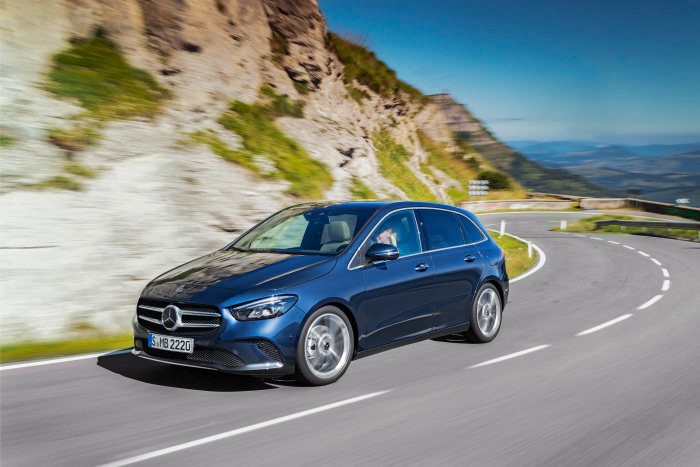
The new Mercedes-Benz B-Class: More Sports for the Tourer
02.
October 2018
Stuttgart/Paris
Fuel consumption combined: 5.6-4.4 l/100 km; combined CO2 emissions: 129-115 g/km*Stuttgart/Paris. The new Mercedes-Benz B-Class puts the emphasis on sport with the Sports Tourer. It looks more dynamic than its predecessor and is more agile on the road while offering greater comfort. Its avant-garde interior makes for a unique feeling of space with the distinctive design of the instrument panel. One of the special features is a basic volume, which drops away towards the occupants and has cutouts in the area of the driver and front passenger. The intuitive user interface of the adaptive MBUX multimedia system is ground-breaking. Its strengths include brilliant graphics, “Hey Mercedes” voice control, a standard touch screen and functions such as MBUX Augmented Reality. When it comes to active safety, state-of-the-art driving assistance systems make the B-Class one of the segment leaders with functions carried over from the S-Class. In addition, the interior is now more spacious, while the engines are more efficient and cleaner. The eight-speed dual-clutch transmission makes its debut. Start of sales for the new B-Class is 3 December 2018, with delivery due to begin in February 2019.
“More practical than ever, more chic than ever,” is how Britta Seeger, Member of the Board of Management of Daimler AG, responsible for Mercedes‑Benz Cars Marketing & Sales, characterises the new B‑Class. “In our portfolio of compacts, it’s the perfect vehicle for the whole family. And MBUX – the new Mercedes‑Benz User Experience – provides also the B‑Class with an all-new customer experience with functions that were previously the reserve of the luxury class.”
“The latest derivative of the new generation of compact cars from Mercedes‑Benz, the B‑Class writes a further punchy chapter in the success story of the dynamic Mercedes‑Benz Sports Tourer,” says Gorden Wagener, Chief Design Officer of Daimler AG. “With its emotional yet purist design, the new B‑Class blends seamlessly into the design language of Sensual Purity.”
The designers’ brief was to make the new B-Class stand out visually from the world of minivans. That brief was accepted and executed, with the long wheelbase (2,729 mm) with short overhangs, slightly lowered roof line and larger, 16- to 19-inch wheels making for dynamic proportions. The relatively squat, progressive front end with flowing transition from bonnet to A‑pillar and on to the windscreen, along with the muscular shoulder of the body, underlines the sporty overall look.
The same is true of the low-profile headlamps, the inside of which is already high-grade, detailed and precisely designed on the basic model with H7 headlamps and LED daytime running lights. When ordered with LED headlamps or higher, the B-Class comes with its own daytime running light signature in the form of a double torch. The optional MULTIBEAM LED headlamps have an especially sporty look. They allow fast, electronically controlled adjustment of the headlamps to suit the current traffic conditions. This feature from the luxury class, which made its debut in the compact segment in the new A-Class, now produces striking looks and added safety also in the new B-Class.
At the back, the width of the vehicle is accentuated by two-part lamps, reflectors integrated in the bumper and a distinctive black bumper bottom section with diffuser look and chrome trim strip. The large roof spoiler, along with high-gloss black spoilers at the sides of the rear window, makes for improved aerodynamics while ensuring a sporty appearance.
The cd value of the new B-Class starts at 0.24 (predecessor: 0.25). The lower roof line further contributes to a best-in-class airflow due to the smaller frontal area of the car. In addition, the aerodynamics engineers have reduced the wind noise thanks to extensive detail work. The benefits: stress-free driving as well as the ability to engage in a relaxed conversation.
The improved seat geometry and lower belt line make for an even more generous feeling of space than in the previous model. The driver sits 90 millimetres higher than in an A-Class, thus enjoying an especially good all-round view – also thanks to optimised cross-sections of the roof pillars, which obscure less of the surroundings.
Interior design: revolution, the second
The interior of the B-Class is as avant-garde as the much-praised revolutionary interior architecture of the new A-Class, yet distinctive: while the instrument panel of the sister model is split into two horizontal basic bodies, that of the B-Class has a single basic volume, which drops away towards the occupants and has cutouts in the area of the driver and front passenger. The cutout in front of the driver houses the fully free-standing display unit, which comes in three different versions: with two 7-inch displays (17.78 cm), with one 7- and one 10.25-inch display (26 cm) and, in the Widescreen version, with two 10.25-inch displays. A head-up display is optionally available.
The five round air vents feature a high-grade turbine look with finely styled air ducts, inspired by the world of aviation. In the Style equipment line, the vent surround is colour-accentuated in the depth of the vent geometry to give the impression of an afterburner. The centre console with touch-based control and input system comes with a black panel look similar to the E-Class. The ambience lighting with 64 colours and ten colour worlds, unique in this segment, allows individual adjustments, even to suit the mood.
The seats offer a flatter and, therefore, more comfortable seating position as well as a larger adjustment range, which also increases the maximum headroom. There is also more space in the width: at 1,456 millimetres (plus 33 mm), the front elbow width now has the dimensions of a mid-range vehicle.
ENERGIZING seat kinetics: supports changes of posture
With seat climate control and multicontour seats with massage function, the new B-Class is available with optional extras that were previously reserved for vehicles from much higher segments. This opens the way to even better seating comfort.
The new ENERGIZING seat kinetics is particularly good for the back. It can support orthopaedically beneficial changes of posture by regularly making minute adjustments to the angle of the seat cushion and backrest. The innovation is available for the front seats in combination with all-electric seat adjustment with memory function.
Variable rear seats and optimised luggage compartment layout
The interior has been fine-tuned in many places: the improved passage over the centre tunnel in the rear makes for a more accessible middle seat. The rear seat backrest comes as standard with a 40:20:40 split. Depending on version, from mid-2019 it will be possible to slide the rear seats forward by 14 centimetres and to move the backrest into a more upright position to vary the capacity of the luggage compartment behind the rear seats between 455 and 705 litres. Although the capacity is roughly the same as in the previous model, the luggage compartment can be more efficiently used thanks to the improvements.
With the rear seat folded down and luggage loaded to the roof, the luggage compartment, which is flat thanks to the adjustable load compartment floor, can accommodate up to 1,540 litres behind the front seats. A folding backrest of the front passenger seat (optional extra, expected to be available from mid-2019) makes for an even longer loading length.
An EASY-PACK tailgate is optionally available. It can be conveniently opened or closed automatically at the press of a button, even by means of a foot movement in combination with optional HANDS-FREE ACCESS.
MBUX – Mercedes-Benz User Experience: unique experience
What goes for A also goes for B: the new B-Class is the second car model after the A-Class to feature the MBUX (Mercedes-Benz User Experience) multimedia system, which ushered in a new era with Mercedes me Connectivity. Its ability to learn thanks to Artificial Intelligence makes the system unique. MBUX is customisable and adapts to the user. It thus creates an emotional link between vehicle, driver and passengers.
Its other strengths include touch screen control as standard as well as, depending on equipment, a high-resolution Widescreen cockpit, navigation display with Augmented Reality technology plus intelligent voice control with natural speech recognition, which is activated by saying “Hey Mercedes”. The touch screen is part of the integrated MBUX touch control concept – a trio consisting of touch screen, touchpad on the centre console (optional) and touch controls on the steering wheel.
MBUX is a revolution of the user experience in the car. Emotively appealing showcasing features underline the comprehensibility of the control structure and thrill through brilliant 3-D maximum-resolution graphics which are rendered, i.e. calculated and displayed, in real time. A head-up display is also available.
New and improved Mercedes me connect services were launched with the new MBUX infotainment generation. These include navigation functions based on Car-to-X communication and Vehicle Tracking, which makes it easier to find the parked vehicle, as well as a notification function in the event of the parked vehicle being bumped or towed away.
The Mercedes me collection of apps can be placed as an icon on the screen in a user-friendly way, and can be freely sorted on the homepage like all other main applications. In addition, online content, such as current petrol station prices, can optionally be displayed. Online updating is a simple way of allowing new content to be made available in MBUX.
The new B-Class is already set up for private car sharing: Mercedes me allows the new compact car to be shared with friends and family members. Operation is simple and secure using the Mercedes me Car Sharing app.
The new Mercedes me connect services On-Street Prediction, Real-Time Information and Off-Street Information can save Mercedes-Benz drivers valuable time and reduce their stress levels while at the same time cutting their fuel consumption and emissions when searching for a parking space. The real-time information is based, among other things, on Mercedes-Benz vehicles that have just left a parking space or driven past potential parking spaces.
Intelligent Drive: functions from the S-Class
The new B-Class comes with driving assistance systems with cooperative driver support, thus providing one of the highest levels of active safety in this segment with functions from the S‑C lass. For the first time, the B-Class is able to drive semi-autonomously in certain situations. To do so, it employs improved camera and radar systems to anticipate the traffic up to 500 metres ahead while using map and navigation data for assistance functions. For example, Active Distance Assist DISTRONIC as part of the Driving Assistance package is able to support the driver in many route-specific situations, anticipatory and conveniently adjusting the speed, e.g. when approaching bends, junctions or roundabouts. Also on board are Active Emergency Stop Assist and intuitively understandable Active Lane Change Assist.
The new B-Class comes as standard with extended Active Brake Assist, which can help mitigate the severity of rear-end collisions with slower-moving, stopping or stationary vehicles ahead – and now even with crossing pedestrians or cyclists – or prevent them altogether.
The new B-Class was developed and tested at the new Vehicle Safety Technology Centre (TFS), too. The design of the vehicle structures with regard to geometry, material thickness, joining technique and material quality incorporates findings from real-world accidents. Many bodyshell components are made of high-strength and ultra-high-strength steel to obtain high strength with lowest possible weight, because the core of the safety design of the body is the highly stable passenger cell.
Driver and front passenger are provided with three-point seat belts with pyrotechnic belt tensioners and belt force limitation. In combination with the PRE-SAFE® system (optional extra), the front seats are additionally equipped with electrically reversible belt reel tensioners. Both of the outer rear seats are fitted with a seat belt with reel tensioner and belt force limiter. The new B‑Class comes as standard with airbags for driver and front passenger, kneebag for driver and windowbags and sidebags (combined thorax/pelvis bag). Rear sidebags are optionally available.
Double powertrain debut: new powerful two-litre diesel is Euro 6d compliant, new eight-speed dual-clutch transmission
Compared to its predecessor, the new B-Class is in all cases powered by new, efficient engines, all of which comply with the Euro 6d-TEMP limits. Making its debut is a transverse-mounted version of the OM 654 two-litre diesel with 110 kW and 140 kW, aluminium crankcase and stepped-bowl combustion process. Thanks to extended exhaust aftertreatment with an additional underfloor SCR catalyst, the B-Class with the OM 654q is the first compact model from Mercedes-Benz to be certified in accordance with the Euro 6d standard, which will become mandatory for new models only on 1.1.2020. The large diesel represents an addition to the four-cylinder diesel (OM 608) already known from the A-Class with 1.5-litre displacement, up to 85 kW and up to 260 Nm.
Also available are two four-cylinder petrol engines of the M 282 series with 1.33-litre displacement and 100 kW/120 kW. Innovations include cylinder management (in combination with 7G-DCT transmission), delta shape of the cylinder head and particle filter.
The new B-Class is initially available exclusively with dual-clutch transmissions. New here is the eight-speed 8G-DCT, which is used in combination with the larger diesel engine. Other new engines will follow, as will models with 4MATIC all-wheel drive. A 43-litre tank is installed as standard, while a 51-litre tank is optionally available, depending on the engine.
The following five engine variants will be available at the launch of the B‑Class:
B 180 (100 kW/136 hp, 200 Nm); with 7G-DCT dual-clutch transmission (combined fuel consumption 5.6-5.4 l/100 km, combined CO2 emissions 128-124 g/km)1 B 200 (120 kW/163 hp, 250 Nm); with 7G-DCT dual-clutch transmission (combined fuel consumption 5.6-5.4 l/100 km, combined CO2 emissions 129-124 g/km)1 B 180 d (85 kW/116 hp, 260 Nm); with 7G-DCT dual-clutch transmission (combined fuel consumption 4.4-4.1 l/100 km, combined CO2 emissions 115-109 g/km)1 B 200 d (110 kW/150 hp, 320 Nm); with 8G-DCT dual-clutch transmission (combined fuel consumption 5.4-4.2 l/100 km, combined CO2 emissions 119-112 g/km)2 B 220 d (140 kW/190 hp, 400 Nm); with 8G-DCT dual-clutch transmission (combined fuel consumption 4.5-4.4 l/100 km, combined CO2 emissions 119-116 g/km).2 [1]The stated fuel consumption and CO2 emission figures are provisional, were determined by the technical service for the certification process in accordance with the WLTP test procedure and correlated as NEDC figures. No EC type approval or certificate of conformity with official figures is yet available. There may be differences between the stated figures and the official figures.
[2] The stated figures were determined in accordance with the prescribed measuring method. These are the “NEDC CO2 figures” according to Art. 2 No. 1 Implementing Regulation (EU) 2017/1153. The fuel consumption figures were calculated based on these figures.
The new OM 654q diesel engine: lighter, more powerful, cleaner
The transverse-mounted version of the latest premium diesel engine family makes its debut in the new B-Class. Despite its lower displacement – just under two litres – the around 16 percent lighter new diesel engine with 140 kW (190 hp) puts out 10 kW more than the previous engine. On the inside, the OM 654q offers efficiency-enhancing technological highlights such as steel pistons with stepped bowls in an aluminium block. The cylinder liners are coated using the further-improved NANOSLIDE® process.
With a cylinder spacing of just 90 mm instead of 94 mm, the new engine is more compact than its predecessor thus allowing the exhaust aftertreatment components to be installed directly on the engine, where the exhaust temperature is higher, making for more efficient aftertreatment. Thanks to further improved exhaust aftertreatment, the powerful four-cylinder from the modern OM 654 engine family already meets the Stage 2 RDE (Real Driving Emissions) standard coming into force from 2020, and is certified to Euro 6d. Even in demanding driving situations and under challenging environmental conditions, the B-Class remains within all the emissions limits.
This is achieved by additional selective catalytic reduction (SCR) with an ammonia slip catalyst (ASC) in the exhaust system of the B-Class. This allows a more generous dose of the reduction agent AdBlue, as any surpluses can be reduced and converted in the second SCR. These surpluses (ammonia slip) particularly occur during fast temperature changes in the exhaust tract, e.g. when moving from city traffic to the motorway.
Suspension: agile and comfortable
At least as agile as its predecessor while even more comfortable – that was the development brief handed to the suspension specialists for the new B-Class. Depending on the version, several options are available for the basic configuration, including a lowered comfort suspension and a suspension with active adaptive damping, which lets the driver control the damper tuning while driving using DYNAMIC SELECT. The system uses an electronic valve, the control of which additionally analyses the driving state and optimises the damping rate individually for each wheel.
In all versions of the new B-Class, the front wheels feature McPherson struts and forged-aluminium wishbones, to which are attached cast-aluminium steering knuckles. This makes the unsprung mass as low as possible in the interests of road-holding and comfort.
At the rear, the models with the entry-level engine variants come with a compound crank rear axle in the basic configuration. In combination with the more powerful engine variants or if the customer opts for one of the optional suspension systems, use is made of a sophisticated four-link rear axle, which is made extensively of aluminium to reduce the unsprung mass. The three wishbones and one trailing arm on each of the rear wheels are mounted on a subframe, which is isolated from the bodyshell by rubber bushings to reduce the transfer of vibration and noise from suspension to body. Single-tube shock absorbers and separate coil springs are used for both the four-link and the compound crank rear axle.
Press Contact
Christian Anosowitsch
Manager Communications SUV
christian.anosowitsch@daimler.com
Tel: +49 711 17-75849
Fax: +49 711 17-98646
Koert Groeneveld
Head of International Product & Technology Communications
koert.groeneveld@daimler.com
Tel: +49 711 17-92311
Fax: +49 711 17-94365
Press Contact Overview
Media
Download
Pictures (55)
Videos (6)
Documents (5)
Media Contact (2)
Filter
Show thumbnails
Show list
Slideshow
Zoom
Preview
Details
Do you really want to delete the data record?
Please wait a moment …
Please wait a moment …
Please wait a moment …
Please wait a moment …
18C0753_006
18C0753_007
18C0753_008
18C0753_009
18C0753_010
18C0753_011
18C0753_012
18C0753_013
18C0753_014
18C0753_015
18C0753_016
18C0753_017
18C0753_018
18C0753_019
18C0753_020
18C0753_021
18C0753_022
18C0753_023
18C0753_024
18C0753_025
18C0619_119
18C0619_126
18C0619_128
18C0619_141
18C0619_142
18C0619_144
18C0619_148
18C0619_149
18C0619_166
18C0619_155
18C0619_167
18C0753_001
18C0753_002
18C0753_003
18C0753_004
18C0753_005
18A0826
18C0619_001
18C0619_0..