Thanks to the rise of cryptocurrency, it’s never been easier to place inscrutable bets with shady grey-market bookies. The kingpin presiding over this dubious corner of the gaming industry is currently Polymarket, a crypto platform which lets users place bets on the outcomes of weather catastrophes, political elections, and economic crises.
Aided in large part by Trump administration deregulations, Polymarket has become the go-to for bettors eager to cash in on geopolitical strife. As Forbes recently reported, the platform has stimulated over $2 billion in trading volume in 2025 from lines on “major events,” with questions like “will Russia capture all of Pokrovsk before 2026?” generating over $2.7 million in trades.
But with so many global conflicts these days, it can be tough to keep track of all the minute-to-minute action. Will Israel strike Lebanon on December 5? Will India strike Pakistan by March 31st? Who knows!
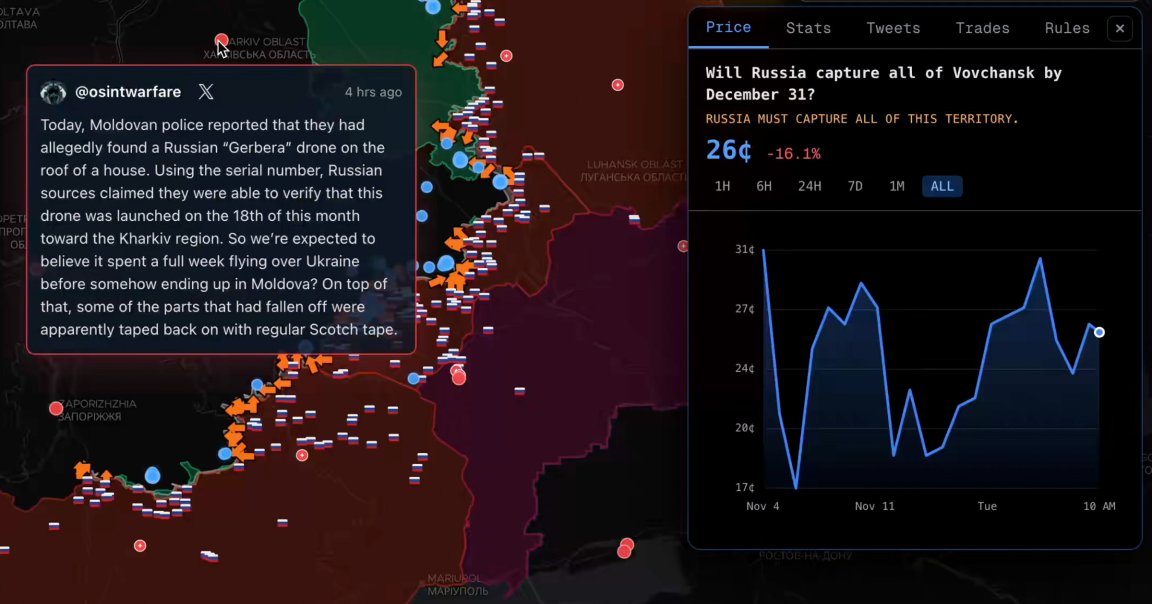
Luckily, some enterprising developers have come up with a solution to help gamblers keep up with the ever-changing nature of global conflicts. It’s called PolyGlobe, an app designed to visualize Polymarket bets on a real-world map. With PolyGlobe, users can scroll its digital map for geomarkers — along the front lines of the Ukraine-Russia war, for example — that contain direct links to the Polymarket dashboard for that given conflict.
Beyond visualizing bets, the app also aggregates “real-time OSINT [open source intelligence]” data from tweets by the “most credible sources of OSINT reporting on X,” the development team told Futurism. There’s no strict criteria for selecting sources, but a quick look at the feed shows a small number of anonymous, amateur media accounts like “Conflict_Radar” and “Osint613” make up the bulk of them.
PolyGlobe is the work of the team behind the Pentagon Pizza Watch project, which tracks pizza deliveries near the US pentagon as a possible sign of clandestine NatSec activity. In an email, PolyGlobe’s creators stated they’re official partnered with Polymarket through its Builder’s Program.
In a post on X-formerly-Twitter announcing the launch of a live Ukraine war map, the team behind PolyGlobe showed off a robust interface complete with directions of attack and color-coordinated control zones, alongside real-time price charts for relevant bets. The graphs look exactly like a stock chart — tracking the market’s financial appetite for deadly conflict and streamlining the process of betting on it.
“Now, when you hover a market, we draw the exact area of operation it resolves on and spell out the rule in plain English,” PolyGlobe declares. “No more rule debates, no more guessing what actually settles. The only way to monitor the situation.” (That feature now seems to be in limbo following backlash from the developer group DeepState, which created the Ukraine frontline map.)
According to PolyGlobe’s website, the app was designed for “traders, analysts, and journalists who need to see the financial impact of geopolitical events as they unfold, in real-time.” The Pentagon Pizza Watch team doesn’t profit from Polymarket bets directly, they told Futurism. For now, they’re primarily funded through “creator fees” via their proprietary cryptocurrency, but that could change.
“We’re exploring other monetization routes such as data licensing and enabling trading on the site,” the creators said.
But beyond the obvious ethical dilemma of gambling on whether people live or die, there are other major issues with using betting odds to predict how political struggles — let alone armed conflict — will resolve.
To ask Polymarket, PolyGlobe and their supporters about it, prediction markets seem like a democratic way to gauge the probability of certain events by tapping into the wisdom of the crowd. But in practice, prediction markets are plagued with biases. In the first round of wagers after a bookmaker sets the opening odds, for example, a professional gambler can easily skew the odds simply by betting a huge amount of money, creating a distorted consensus from the jump.
There’s also the psychological angle to consider. According to a 2023 study on sports betting, structural bias in prediction markets is possible in large part due to the guarantee that people will place irrational bets, following phenomena like the gambler’s fallacy or the near-miss effect. When it comes down to it, gambling on war and politics is, at best, hardly any different from putting it all on black.
A recent case in point came during elections in the Netherlands this October. Prior to the elections, the Polymarket odds were skewed 95 percent in favor of the victory of the far-right Party for Freedom over the liberal party, Democrats 66. The first exit poll of the election decimated millions of dollars in confident bets, however, when it showed D66 far overperforming expectations, almost immediately securing victory.
Within minutes, D66’s odds of victory had gone from 5 percent to 100 percent. When all was said and done, over $32 million had changed hands, with $1.2 million coming from open interest positions against D66. (A significant number of those bets came from accounts with names like WhiteLivesMatter, which just about says it all.)
The moral here is that betting markets are, at best, poor predictors of geopolitical outcomes. At worst, they represent a profound evil: not just a gambling market built directly on pain and destruction, but a new frontier for corruption on a global scale. It’s a casino where the house always wins, and every spin of the wheel ends in tragedy.
More on gambling: Gannett Is Using AI to Pump Brainrot Gambling Content Into Newspapers Across the Country