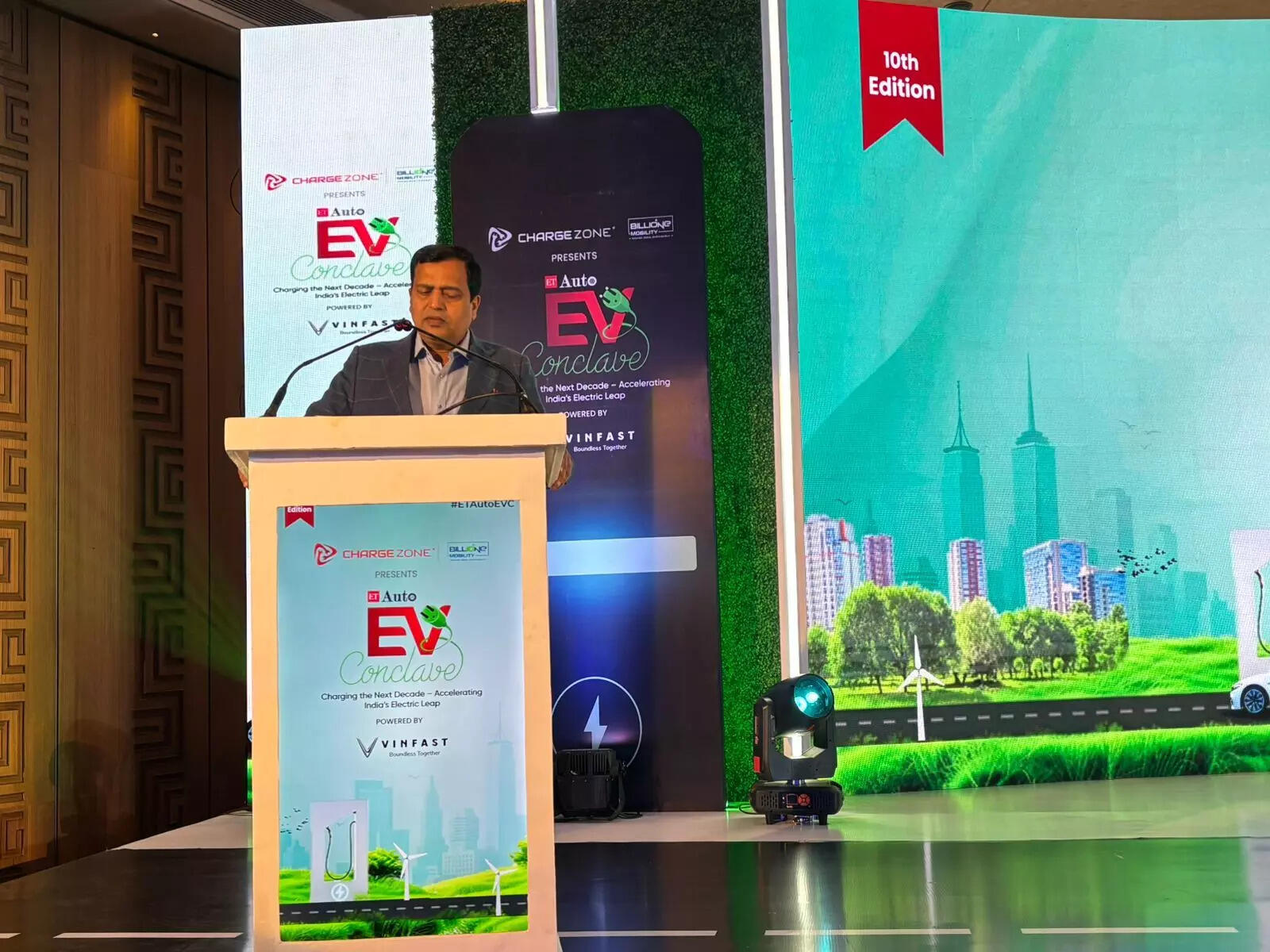
India’s shift toward cleaner mobility is no longer just an environmental imperative but a strategic economic opportunity, said Vaibhav Dange, Former Advisor to NHAI, addressing industry leaders at the ETAuto EV Conclave 2025. Calling the EV transition “the most defining shift of our times,” he highlighted the need for deep alignment between industry, policymakers and infrastructure providers as India moves from early adoption into the more complex phase of mass-scale electrification. “India is not just adopting electric mobility, India is shaping the future of mobility,” he said.
The country now has more than three million EVs on the road, supported by over 45 OEMs and hundreds of component manufacturers. “We’re not catching up anymore. India is charting its own path,” he emphasised, adding that global investors are viewing India as a future hub for EV R&D and manufacturing.
Upcoming hurdles
However, he cautioned that the next phase will be significantly more challenging. Mass adoption, he said, requires robust product reliability, a stronger indigenous value chain and a reinforced after-sales ecosystem. “Battery safety, thermal management and long-term reliability must be non-negotiable,” Dange said, urging OEMs to focus on total cost of ownership, modular designs and localisation to drive affordability. He also called for innovation beyond vehicles, highlighting the role of shared mobility, battery swapping and connected ecosystems in expanding EV accessibility.
Policy stability will play an equally crucial role, especially as India transitions from subsidy-led to innovation-led growth. Dange said the industry needs long-term clarity over eight to ten years on GST, incentives, import duties and manufacturing norms to unlock sustained investment. Regulatory frameworks for battery recycling, mineral recovery and second-life applications must be strengthened to support a circular battery economy. Standardisation across charging connectors, swapping interfaces and payment systems, he added, will be vital to reduce fragmentation and accelerate scale.
The backbone of consumer confidence, Dange said, will be a resilient and widespread EV charging network. India needs to expand from a few thousand chargers today to at least one million by 2030 across public, semi-public and private spaces.