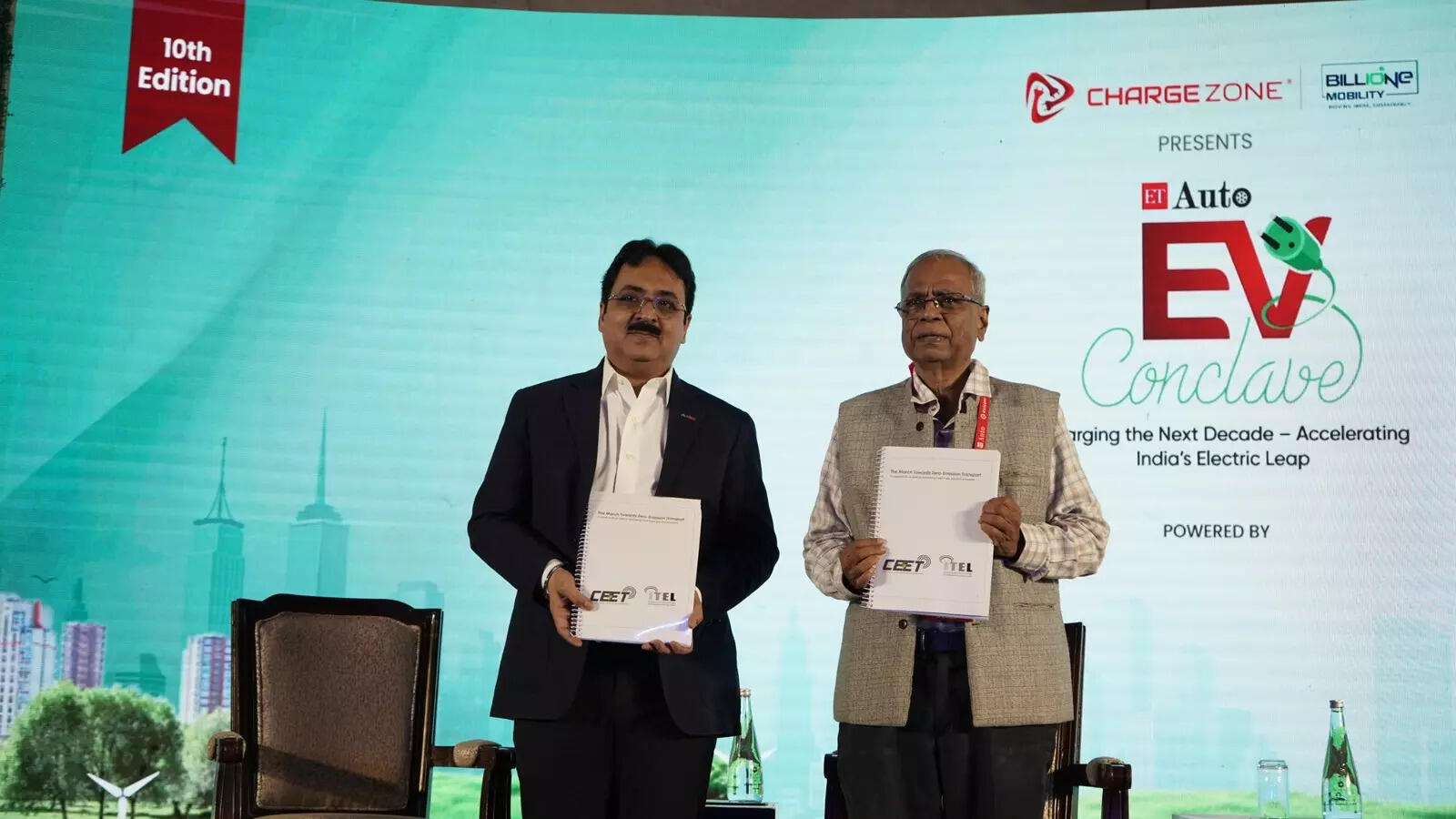
India’s transition to zero-emission mobility requires far deeper industry action, policy alignment and cross-sector coordination, according to a new report by IIT Madras.
The report, titled The March Towards Zero-Emission Transport, was unveiled on Thursday at ETAuto EV Conclave 2025 by Ashok Jhunjhunwala, Professor, IIT Madras, Founder, IITM Research Park and IITM Incubation Cell and Vinkesh Gulati, Chairman, ASDC.
The report says that auto manufacturers must significantly scale their electrification and green-technology commitments to meet national climate goals, that includes reaching Net Zero target by 2070.
Road transport currently accounts for nearly 15 per cent of India’s CO₂ emissions, and as vehicle ownership accelerates, the report notes that without aggressive intervention, emissions could rise sharply through the next decade.
The report lays out a detailed roadmap for India’s clean-mobility transition, covering consumer behaviour shifts, industry preparedness, advances in green technologies–especially hydrogen and fuel cells–charging networks, and supportive public policies. It recommends that the auto industry’s decarbonisation journey be rooted in technology neutrality, deeper localisation, and clear long-term regulatory visibility.
Driving green transition
As per the report, emphasis should be placed on rapid electrification of mass-market segments, which form the bulk of India’s vehicle population. With two-wheelers and three-wheelers already demonstrating strong adoption momentum, there is a need for sustained incentive frameworks, better financing solutions, and robust battery-swapping and charging ecosystems specifically designed for high-utilisation fleets.
The report argues that four-wheelers and commercial vehicles require targeted policy pushes and industry innovation to overcome cost and infrastructure barriers. Electrification of buses particularly through STUs will be one of the most impactful interventions for reducing urban emissions and diesel dependence.
Multi-fuel approach
On the technology front, “March Towards Zero Emission” identifies hydrogen and fuel-cell technologies as crucial long-term enablers, especially for heavy-duty mobility. However, the report stresses the need for massive green-hydrogen scaling, cost reductions and safety frameworks before commercial viability is achieved. The report also highlights the auto industry’s role in ramping up R&D, collaborating with academia, and co-developing next-generation drivetrain and storage solutions.
A significant portion of the assessment focuses on infrastructure readiness, noting that India must rapidly deploy charging points across highways, cities, industrial hubs and logistics corridors. Intelligent load management, renewable-powered charging and grid modernisation are cited as essential to ensure sustainable EV integration.
India’s march towards zero-emission mobility is both a climate imperative and an industrial opportunity. For the auto sector—already a pillar of manufacturing and employment this decade will be defined by how decisively it shifts toward electrification, invests in clean technologies and embraces a systems-level transformation.
The report states that a coordinated effort across government, industry and consumers will determine whether India can emerge as a global hub for clean mobility innovation.
To read the full report, click here.