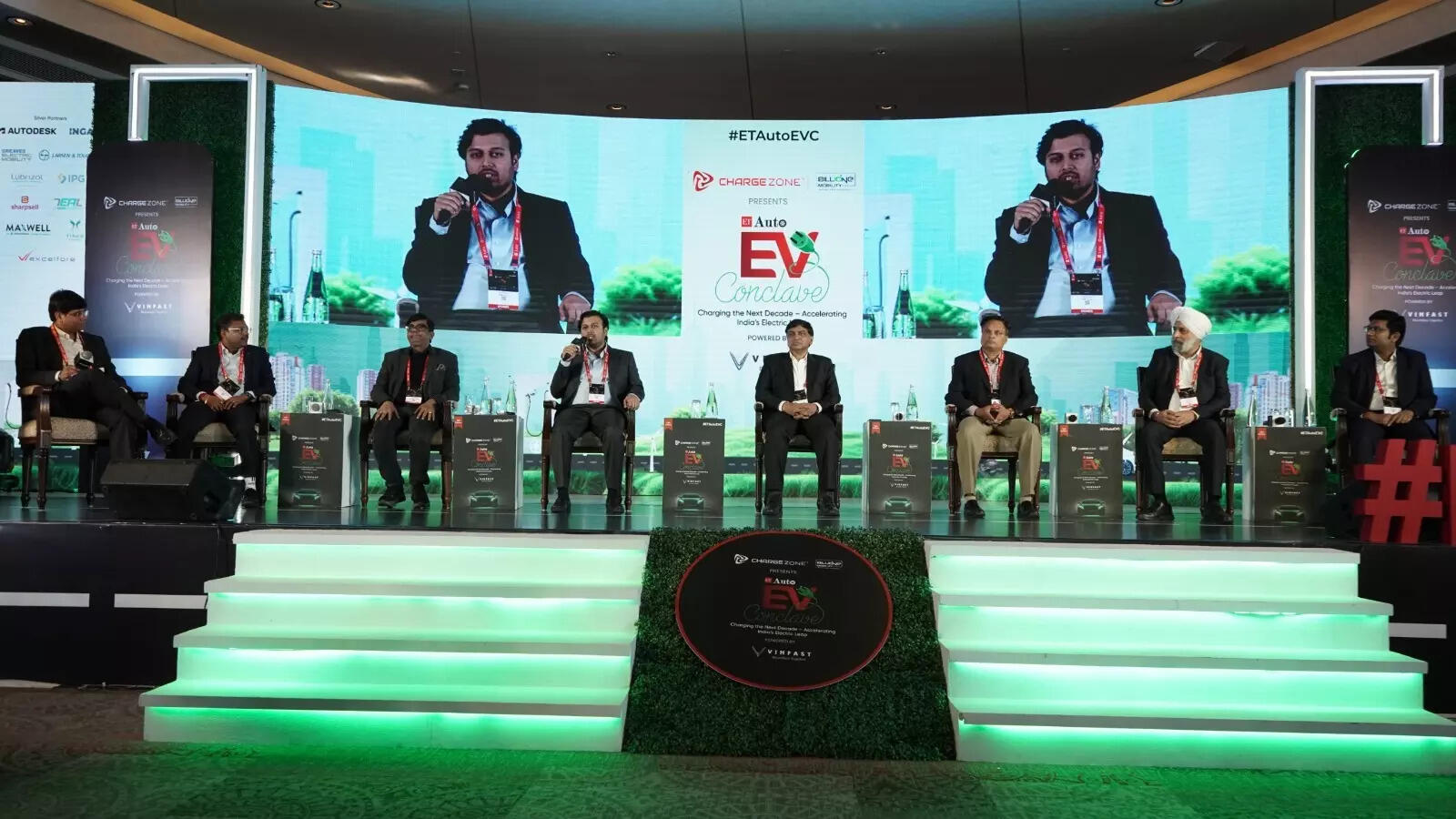
India’s ambition to become a global EV manufacturing hub will depend on how effectively it builds vehicles tailored to the country’s diverse and demanding use conditions, industry leaders said during the 10th edition of ETAuto EV Conclave. The foundation of India’s EV strategy must be local relevance, affordable, durable, and efficient designs rooted in frugal engineering.
Nishant Arya, Vice Chairman, JBM Group, emphasised that reliability and lifecycle economics remain the defining differentiators in India’s value-conscious market. “It’s not just about the upfront product; the total cost of ownership over its lifetime is what matters,” he said, adding that customisation, remote diagnostics and high localisation are now essential capabilities for Indian manufacturers. These elements, he noted, directly influence time-to-market and give domestic players a competitive edge.
Digitalisation
Digital transformation emerged as a central enabler in compressing development timelines and managing growing product complexity. Dr Tapan Sahoo, Executive Officer, Digital Enterprise, MSIL, highlighted the rising importance of simulation, AI-led modelling and virtual validation. “Doubling production is not a 2x challenge; it can be a 40x challenge in terms of complexity. Digital tools help break this down into something manageable,” he noted. Companies such as Autodesk are embedding generative design and real-time simulation into design workflows, enabling faster iterations and lighter, more cost-efficient structures. Shubham Garg, Head of Strategy, Manufacturing, Autodesk India said “With the help of AI, we can design multiple models in a very short time, while keeping our brand data intact.”
Affordability, however, must not compromise safety or global competitiveness. Ram Rajappa, COO, Greaves Electric Mobility, noted that India’s climate and road conditions demand stronger durability while keeping products accessible. “Importing products gives only part of the solution. India requires local innovation and system integration to address safety, reliability and cost together,” he said. Government schemes like PLI and FAME, he added, have helped the ecosystem mature but significant gaps remain in battery safety, consumer trust and high-value localisation.
Commercial vehicle side
Commercial-vehicle suppliers such as ZF are also adapting global technologies for Indian EVs. Paramjit Singh Chadha, MD, ZF Commercial Vehicle Solutions India, explained how electric platforms shift component-level requirements. “When you remove the engine in an electric bus, suddenly the compressor becomes the loudest part. EV-specific components need different engineering and, over time, local volumes will drive deeper localisation,” he said.
For segments such as three-wheelers and small commercial vehicles, behavioural patterns across regions further complicate product development. Jalaj Gupta, Managing Director, Montra Electric, stressed the need for market-specific validation rather than a one-size-fits-all design philosophy. “The way a three-wheeler operates in UP is very different from how it runs in the South. If you start with the consumer and use conditions at the centre, your design decisions become much sharper,” he said. Gupta added that modular platforms that stretch across applications from small CVs to agriculture are key to achieving both affordability and scale.
The panel said that India’s EV transition will be led by frugal engineering, digital-first design, modular platforms, and a collaborative ecosystem spanning suppliers, startups and OEMs.