The roll call of cars that were on the scene 50 years ago and which are still being built today is short. It gets shorter still if you stipulate a perfect, unbroken run of production.
If you then dismiss those cars whose name has lingered but whose physical form has flitted from one class to another, a mere handful are left to consider. All of them are, at least in automotive terms, household names: Ford Mustang, VW Golf, Mercedes S-Class, Toyota Land Cruiser, Honda Civic, Porsche 911.
BMW is possibly unique in that it contributes to the list twice. The BMW 5 Series arrived in 1972 and the BMW 3 Series came along in 1975 (the BMW 7 Series followed in 1977). The impact of both has been colossal, but it is the junior partner, which turns 50 this year, whose legacy hits hardest. Think 20 million cars sold and a remit spanning from top-tier motorsport to diesel repmobile. There’s even been an M-badged track-day estate.
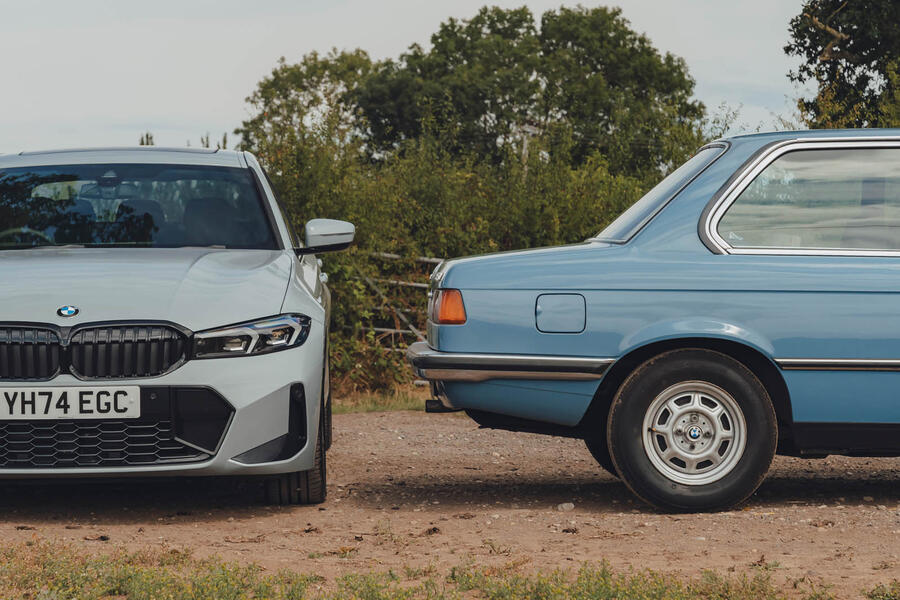
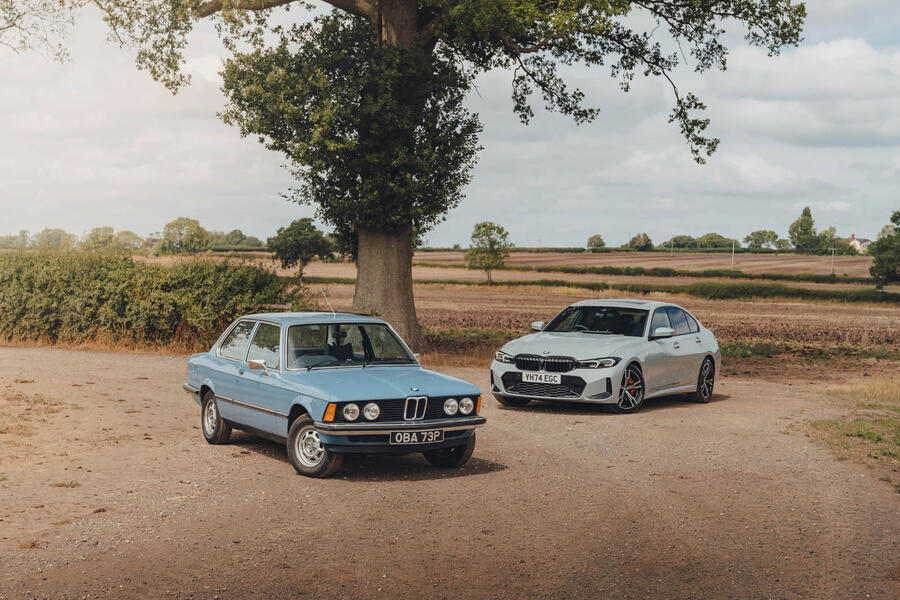
It is a hell of a legacy – one whose start and current end points are sitting on the edge of a field and being photographed by chief snapper Max Edleston. Neither we nor this lovely E21’s owners, Thom Williams and Neil Phipps, anticipated what a reflective moment it would turn out to be. Parked up are two cars, one unsullied philosophy, half a century of automotive development and the bookends of a model that melded pedigree handling with practicality better than any other.
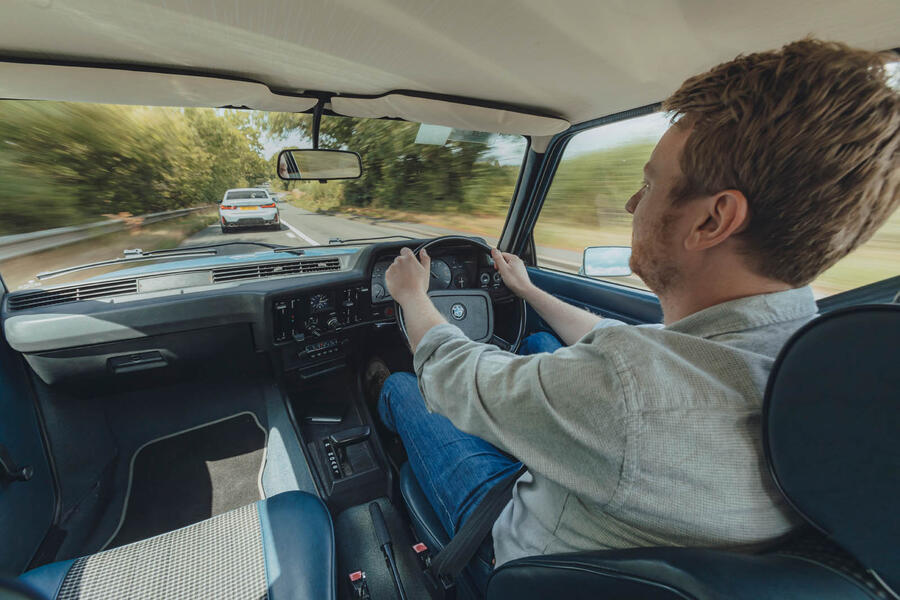
So what exactly do we have here? To celebrate the 3 Series’ birthday, we sought to bring the current car together with one of its ancestors. Tempting as it was to enlist the 523bhp M3 Competition to represent today’s line-up, in the end a 2025-model-year 320i M Sport was selected as the chosen contemporary representative.
It’s a car that seats four in comfort, will return more than 40mpg at a cruise, costs a little over £40k and will satisfy you on a B-road despite the on-paper meagreness of its 181bhp powertrain. If you ever needed one sensible but rewarding steed to see you through, the 320 is surely it.
Similar thinking unfolded when it came to tracking down an ancestor. BMW UK has a covetable E30 M3 on its books, and we nearly put in a call to score a few days with the homologation special that is widely regarded as the greatest 3 Series that has ever existed. But then, with a little internet digging, I came across this charmingly original E21 320 for sale, in right-hand drive, from 1975. Ground zero, in other words.
Never mind the UK market, this is one of the earliest 3 Series to exist, full stop. You can tell as such from the fact that it lacks the plastic panel between the tail-lights. But yes, it is an automatic, and no, this isn’t ideal from a driving perspective. But it’s a rare opportunity for direct comparison with our G20-generation car. The number of doors aside, we have the same model, same flavour, only a lifetime apart.
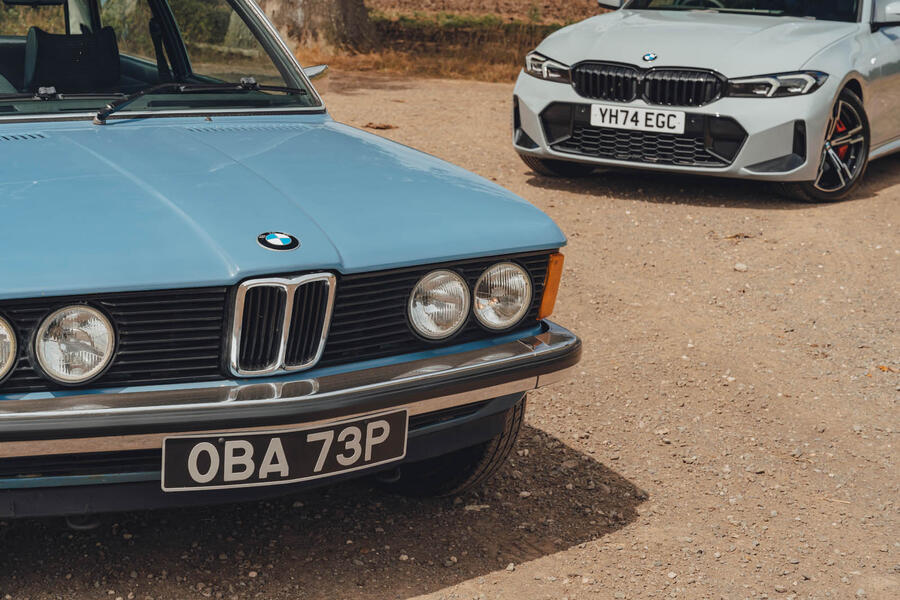
If there is any pathos here it stems from the thought that there may well be no 60th bash for the 3 Series. Next year the critical Neue Klasse i3 arrives as a de facto electric 3 Series. BMW will continue to offer a combustion-engined 3 Series for a while.
According to head of design Adrian van Hooydonk, that car – the G20’s replacement – will look very similar to the i3, with an appealing Italianate-ness in the silhouette and the kidney grille in its historical, upright form. But let’s not pretend this arrangement will last. BMW has no fixed date for the termination of ICE sales, but if you want to buy a showroom-fresh Bavarian junior executive saloon in, say, 2035, you’ll probably have one option: an i3 EV.
Let’s not get ahead of ourselves. The first 3 Series was really just a pretty, shark-nosed shawl, designed by Paul Bracq and thrown over the original Neue Klasse – the saloon that was introduced in the 1960s and credited with saving BMW’s independence after it was nearly bought by Daimler. The most famous car in that line-up was the 2002, the fizzing Tii and liveried Turbo versions of which were in essence proto-M cars that presaged the M3 and today are worth enormous money.
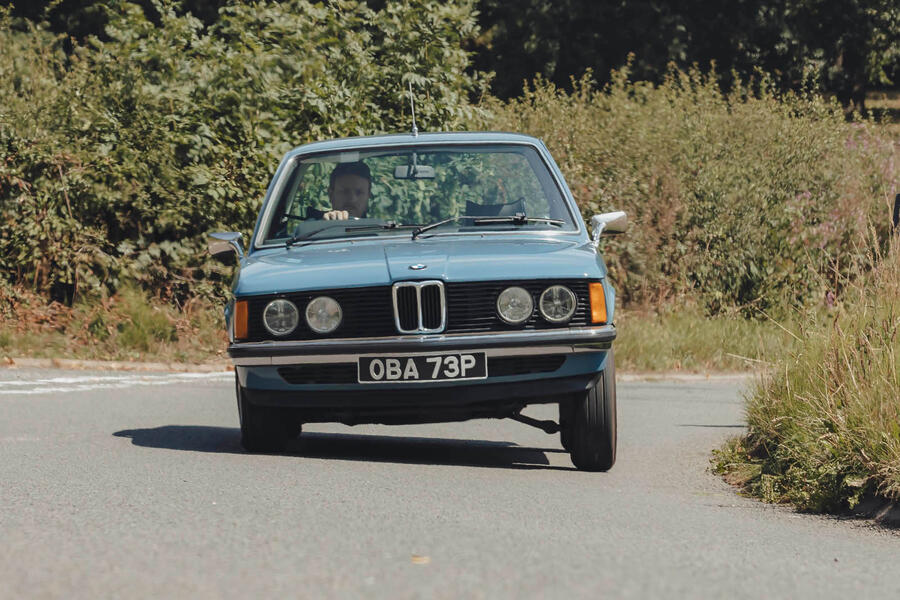
BMW spent a serious 35 million Deutschmarks developing the successor to the 02 (still an utter bargain by today’s standards, though, at the equivalent of £19m), even though the resulting E21 was mechanically fairly similar. Maturity, quality and big-car feel in a small-car package were the primary goals. Sportiness was less critical at first, although rack-and-pinion steering was a noteworthy development for the 3 Series, even with its slower ratio.
All cars got a front anti-roll bar, too. The E21 soon gained power steering, fuel injection and smooth six-cylinder engines, plus optional shorter gearing and a limited-slip diff that made the 323i a delight on a damp road. Spring rates also rose over time as the car morphed into something more driver-centric.
That said, our early carburetted E21 still has the hallmarks of its type: fantastic ergonomics and an easy balance that has you pushing it harder than a 50-year-old deserves. It also feels absurd today that this magazine complained the A-pillars were too chunky compared with those of the 02 – by modern standards visibility out of our cream-headlined E21 is nothing short of liberating. And the instruments really are faultless; sadly, this is something BMW appears to have recently given up trying to achieve. In the main the E21 just feels well engineered, barring the awkward clunk as the automatic gearbox slots into the first of only three forward ratios.
It’s also a sensationally diddy thing next to the whopper that is the G20, in a way the raw figures simply can’t convey. And handsome. When we arrived at the lock-up the car was wearing Alpina-style multi-spoke wheels, but Williams and Phipps set to work swapping it back onto the original 13in steels. They’re perfect – as is the little toolkit that presents itself when you open the boot. And the micro-check upholstery and the inspired, heavily angled centre console.
On the road, performance is laid-back. It doesn’t quite live up even to the expectation of 109bhp pushing a little over a tonne, which sounds quite promising on paper. In fairness, a lot of this is down to the gearbox, which always seems in a hurry to hole up in its lofty third and final ratio, although the shift quality en route is actually very good. Near-seamless at times, in fact. BMW still turns to ZF today.
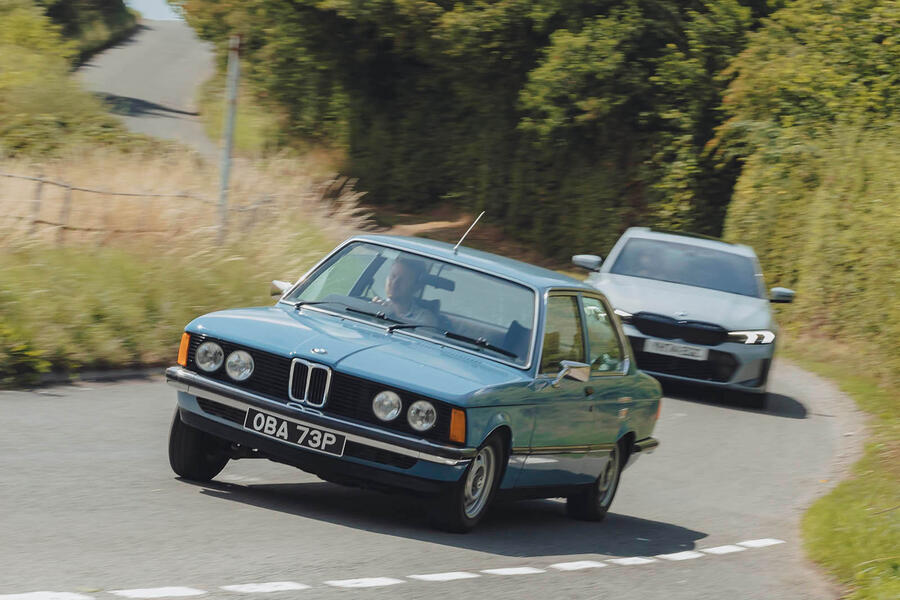
The handling is genuinely interesting, though. As we know, the mechanicals of the 3 Series would iterate rapidly in the years following 1975, but even this early car has traces of the good stuff. For one thing, while the suspension is soft, the cornering balance is neutral. What’s more, while the trailing-arm rear axle doesn’t always feel exceptionally well located, trimming the throttle mid-corner generates a controlled flicker of rotation that is primordial M3-type behaviour. It’s an old softy, but one that is mischievous and oh so easy to run along with.
BMW would sell more than 1.3 million versions of the E21, the majority in four-cylinder form. However, it was the E30’s arrival in 1982 that marked the point at which the 3 Series started to take off. This era ushered in the option of four-door, convertible and touring bodies. It also introduced diesel to the gene pool, and in 1986 the first M3 wailed into showrooms. E30 production was vast at 2.2 million units, with outputs ranging from 86bhp to 238bhp in the case of the M3 Sport Evolution – a car that pushed pricing to breaking point.
At the time, Porsche charged less for a 3.0-litre S2 944. ABS and M styling kits were also newly available to buyers, as was four-wheel drive (BMW even built a handful of 325iX mules with an electrically driven front axle). Turbocharging technically first appeared on the 320i Turbo of 1981, but that was a Group 5 firebreather. The first blown road-going 3 Series was the six-pot E30 324td.
The E30 set the template for the 3 Series we know today. The only material changes to the recipe since then have been the brief adoption of a V8 engine for the E90-generation M3, dual-clutch gearboxes for the following M3 and PHEV technology. The E30 was also the generation that cemented the 3 Series’ appeal as a driving tool for anybody. If the M3 was out of reach, models such as the twin-cam 318iS were still phenomenally enjoyable while offering sophisticated road manners.
Group test wins became the norm. However, the best-selling 3 Series of all time was the E46 introduced in 1998, with around 3.3 million sold. On one hand, this was rather an unnecessary refinement of the aerodynamic E36 that had been introduced just six years earlier.
On the other, it was an evolution that resulted in the properties of the 3 Series aligning beautifully with the expectations of enthusiasts. You got an upmarket silhouette, a manual gearbox and a strong, soulful six-cylinder engine if you so desired, plus an elegant cockpit and real touring ability. For many, the E46 was the platonic ideal of the performance coupé. It also spawned the M3 CSL.
That car’s S54 3.2 generated an intake wail that once heard can never be forgotten. It also had the ability to glamorise what amounted to a cardboard boot floor. Of course, you could also have your E46 as a svelte diesel estate, happy in the knowledge it could carry the dog and also skin its opposite number from Mercedes-Benz or Audi at any time.
After that point crossovers began to creep in, and as the market share of traditional bodystyles was diluted, E90 sales fell to 3.1 million. That car was introduced in 2005 and followed much the same template as its E46 predecessor, but without quite the reverence from fans.
Then came the F30, with which BMW generated consternation by turning what had always been the 3 Series coupé into the 4 Series. A decade later, it still doesn’t sound quite right, although the car’s dynamic appeal undoubtedly took another step forward. This was also the last point at which you could buy a manual, six-cylinder 3 Series in rear-wheel-drive form, courtesy of the 340i. You could even have one on 18in wheels and with untinted glass. Try finding one now.
In its six years on sale, the G20-generation has only just scraped beyond one million sales. The blame again lies mostly with SUVs, but it means there is a distinct possibility the current 3 Series will suffer the ignominy of being the least-loved member of its long-lived family. And talk about an injustice: the current 320i M Sport is arguably the most talented all-rounder on sale today. With the exception of its overbearing digital array, the G20 really does have no weaknesses.
This example looks drab, but its carefully honed dynamism is immediately palpable and lovable. The steering response is alert but matched precisely with the rate that body roll builds. It is half a tonne heavier than the E21 but somehow feels lighter. The ride is taut, but the damping shows a cultured plushness. The downsized turbo engine is responsive and linear and heroically efficient, even without electrical assistance. The ergonomics are spotless. It is comfortable in the back. It has a good-size boot.
It’s a wonderful car, in short – one we would never hesitate to recommend. BMW has earned that accolade as a result of spending five decades assiduously honing an unchanging, driver-centric philosophy while carefully adapting to regulation. With the charming E21 and G20 parked beside one another, so different yet the same, you realise what a precious thing the 3 Series has been and still is. So happy anniversary, 3 Series. Whether this is a celebration or a wake, well, time will tell.