India’s Production Linked Incentive scheme for the automotive sector has achieved significant milestones, with cumulative investments reaching ₹35,657 crore and incentive disbursements totaling ₹2,321.94 crore as of December 31, 2025. The scheme has catalyzed the production of over 13.6 lakh electric vehicles while generating nearly 49,000 jobs, according to an official announcement by the Ministry of Heavy Industries.
The PLI Auto scheme, introduced to enhance India’s manufacturing capabilities in Advanced Automotive Technology products, has a total budgetary outlay of ₹25,938 crore and spans a five-year performance period from FY 2023-24 to FY 2027-28. The program aims to position India as a global hub for electric vehicle manufacturing while advancing the nation’s self-reliance in automotive technology.
Record Incentive Disbursement

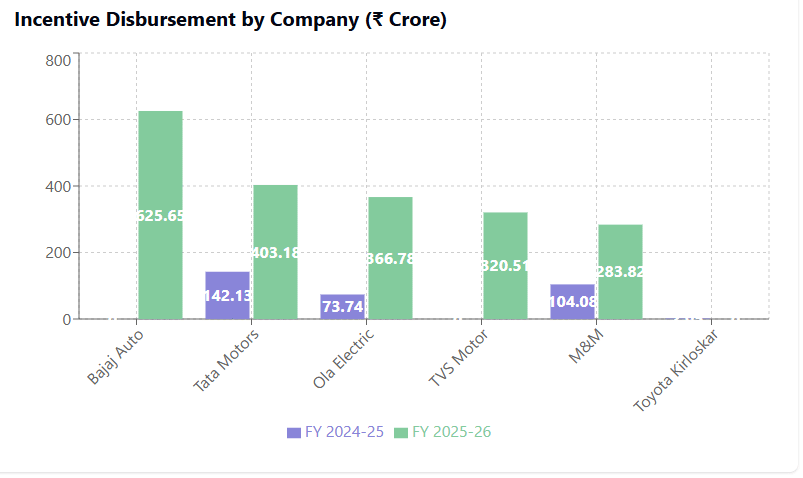
For the performance year 2024-25, the government has disbursed a substantial ₹1,999.94 crore to five approved applicants, marking a dramatic increase from the ₹322 crore distributed in FY 2023-24. Major beneficiaries include automotive giants Bajaj Auto, which received the highest payout of ₹625.65 crore, followed by Tata Motors at ₹403.18 crore, and Ola Electric Technologies at ₹366.78 crore.
TVS Motor Company and Mahindra & Mahindra also received significant incentives of ₹320.51 crore and ₹283.82 crore respectively, reflecting the broad-based industry participation in India’s electric vehicle transformation.
Electric Vehicle Production Surge
The scheme has incentivized production across all electric vehicle categories, with electric two-wheelers leading the charge. A total of 10,42,172 electric two-wheelers have received incentives, representing the lion’s share of the 13.6 lakh total electric vehicles supported by the program.
Electric three-wheelers accounted for 2,38,385 units, while electric four-wheelers reached 79,540 units. The scheme has also supported 1,391 electric buses, crucial for public transportation electrification in Indian cities. The dramatic year-on-year growth from 76,838 units in FY 2023-24 to 12,84,650 units in FY 2024-25 demonstrates the scheme’s accelerating impact on the market.
Domestic Value Addition Achievements
A key requirement of the PLI Auto scheme is achieving a minimum 50% Domestic Value Addition, ensuring that incentivized products contribute meaningfully to India’s manufacturing ecosystem. To date, eight applicants under the Champion OEM category have received DVA certification for 94 vehicle variants, while ten applicants under the Component Champion category have secured certification for 37 component variants.
Bajaj Auto leads with 25 certified variants, followed by Mahindra & Mahindra with 22 variants and Tata Motors with 20 variants. This achievement underscores the industry’s commitment to localizing production and reducing import dependency.
Economic Impact and Employment Generation
Beyond vehicle production, the scheme has catalyzed substantial economic activity. Cumulative determined sales have reached ₹32,879 crore as of September 30, 2025, while employment generation stands at 48,974 workers. These figures represent significant progress toward the five-year targets of ₹2,31,500 crore in incremental sales and 1,48,147 new jobs.
The investment achieved represents 83.9% of the five-year projection, indicating strong industry confidence and capital deployment in India’s electric vehicle ecosystem. Component manufacturers have also benefited, with companies like Sona BLW Precision Forgings certifying 11 variants and Delphi-TVS Technologies certifying seven variants of critical automotive components.
The scheme directly supports Prime Minister Narendra Modi’s Atmanirbhar Bharat initiative by strengthening domestic manufacturing capabilities in advanced automotive technologies. By incentivizing both vehicle manufacturers and component suppliers, the program creates a comprehensive ecosystem that reduces reliance on imports while building export potential.
With two and a half years remaining in the five-year program timeline, industry observers expect continued momentum in electric vehicle adoption and manufacturing investments. The scheme’s performance trajectory suggests India is well-positioned to emerge as a major player in the global electric vehicle supply chain.
Launched to boost Advanced Automotive Technology manufacturing in India, the scheme covers electric vehicles across all categories and critical automotive components. It operates on a performance-based incentive structure requiring minimum 50% domestic value addition and runs from FY 2023-24 to FY 2027-28.