Automotive YouTuber Mike Lake is documenting a long-term experiment in additive manufacturing: producing full-size exterior body panels for a Porsche 992 GT3 RS using consumer desktop 3D printers and mounting them onto a Porsche Boxster 986 donor vehicle. The project focuses exclusively on non-structural components, with the Boxster’s original chassis, suspension, drivetrain, and safety systems retained throughout the build.
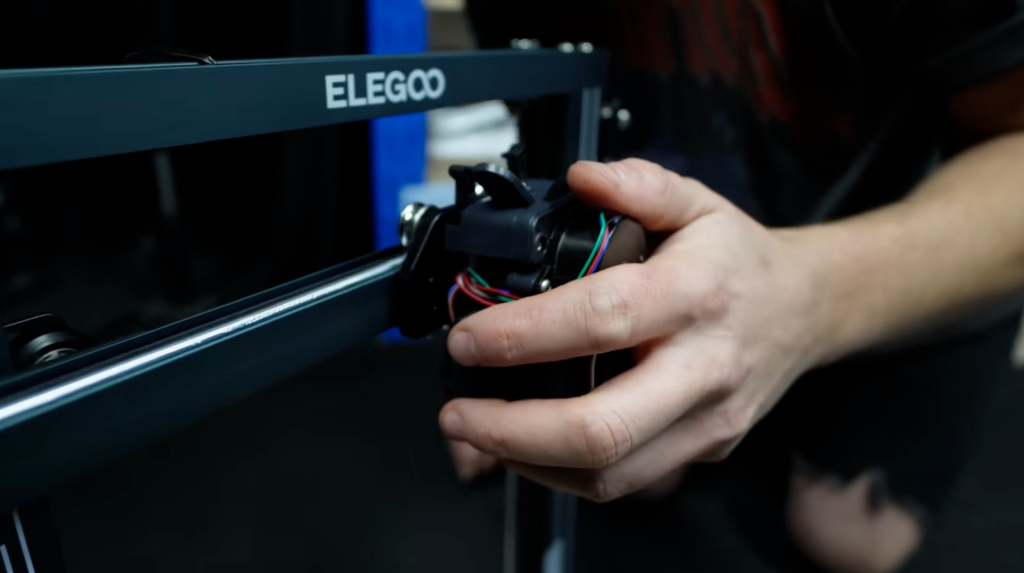
The build relies on fused filament fabrication systems rather than industrial additive manufacturing equipment. Lake uses multiple Neptune 4 Pro machines from Elegoo, each priced at approximately AUD $549. These printers operate continuously for extended periods, accumulating hundreds of hours of print time per vehicle section. Material extrusion is performed using PETG filament, selected for its resistance to ultraviolet exposure, dimensional stability at elevated temperatures, and relatively forgiving print characteristics for large parts.
Each exterior component is digitally segmented to fit within the printers’ build volume. Individual sections are sliced using Ultimaker Cura software, then printed sequentially and assembled manually. A single front fender consists of 21 separate printed pieces and required approximately 55 hours of machine time, consuming 1.89 kilograms of PETG filament. At prevailing material costs, this equates to roughly AUD $40 in filament for the finished part, excluding failed prints.
Printing process and failure modes
Early print attempts exposed several process limitations typical of large consumer-grade prints. Ambient winter temperatures in the workshop caused adhesion failures and warping, particularly on tall or narrow sections. Print collapse and base deformation were initially frequent. These issues were mitigated by manually leveling each print bed, increasing extrusion temperature, and enclosing the printers to stabilize the thermal environment.
Print strategy evolved during the project. Early parts were produced as fully solid sections, increasing material consumption and print duration. Subsequent components adopted wall thicknesses of approximately 1.2 to 2 mm with a 20 percent internal infill structure. This approach reduced weight and material usage while maintaining sufficient stiffness once reinforced.

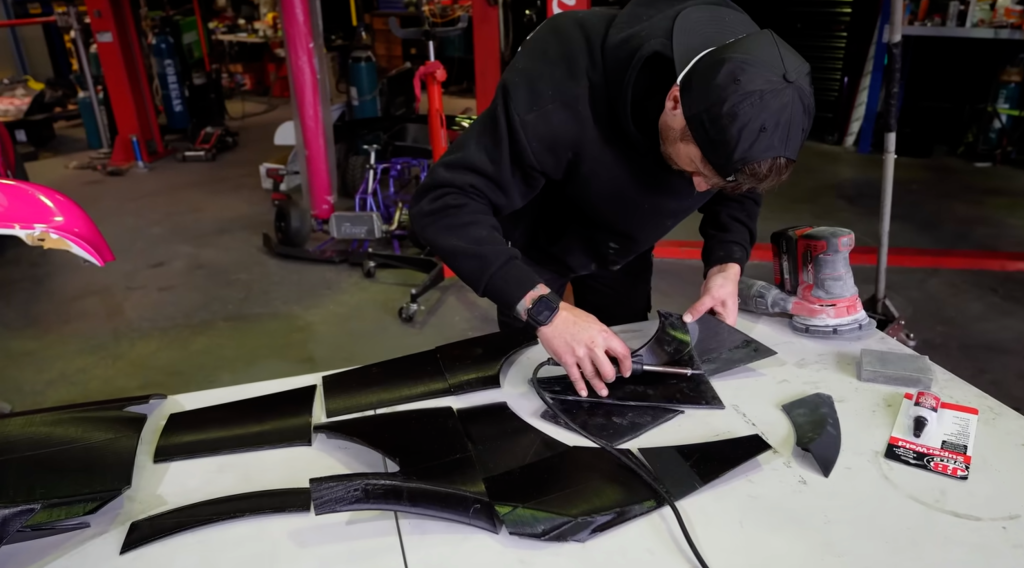
Printed sections are joined using a soldering iron to plastic-weld mating edges, supplemented by cyanoacrylate adhesive applied along internal seams. Once assembled into full panels, each component receives a fiberglass backing layer. This composite reinforcement increases rigidity, allowing panels to be lifted, sanded, and test-fitted without fracture. Fiberglass is applied only after initial fitting to preserve flexibility during alignment.
Surface finishing is performed using mechanical sanding with coarse grit abrasives. PETG responds predictably to material removal, allowing high points and print artifacts to be reduced without excessive deformation. Sanding confirmed that consistent panel geometry could be achieved despite the segmented print approach.

Integration with the donor vehicle
The donor platform is a manual Porsche Boxster 986 purchased for AUD $13,000. Exterior body panels are removed, while doors and structural elements remain in place. Printed components are initially mounted using clamps, masking tape, and temporary fasteners to establish reference geometry and panel gaps.
For the bonnet, the Boxster’s original inner skin is retained. The factory outer skin is removed, and the 3D printed bonnet surface is bonded to the remaining frame using panel adhesive and fiberglass reinforcement. This approach preserves factory hinge points and latch mechanisms while providing structural support for the printed exterior surface.
Rear quarter panels represent the most complex assemblies. Each quarter comprises 56 uniquely shaped printed sections integrating side skirt geometry and roof transitions. Material removal from both the printed parts and the original bodywork is required to achieve correct alignment. Cutting operations on unreinforced PETG sections required sustained use of rotary tools, indicating higher-than-expected material toughness.

Scale, time, and material use
Completion of the front clip required approximately 681 hours of print time and 19 kilograms of PETG filament, excluding an estimated additional 100 hours and 5 kilograms lost to failed prints. The bonnet required roughly 140 hours of printing and 5.2 kilograms of material, while the front bumper consumed over 380 print hours and more than 10 kilograms of filament.
Weight measurements indicate that the reinforced printed fender approaches the mass of a factory GT3 RS equivalent, reported at approximately 3.5 kilograms, once fiberglass is applied. Final weights will be recorded after surface finishing is complete.
Rear bodywork, roof sections, interior components, and permanent mounting hardware remain in progress. The project continues to document the performance limits of consumer desktop 3D printers when used for full-scale exterior automotive body panels combined with manual assembly and composite reinforcement.
The 3D Printing Industry Awards are back. Make your nominations now.
Are you building the next big thing in 3D printing? Join the 3D Printing Industry Start-up of the Year competition and expand your reach.
Subscribe to the 3D Printing Industry newsletter to stay updated with the latest news and insights.
Featured photo shows The assembled 3D printed Porsche GT3 RS body panels. Photo via Mike Lake.