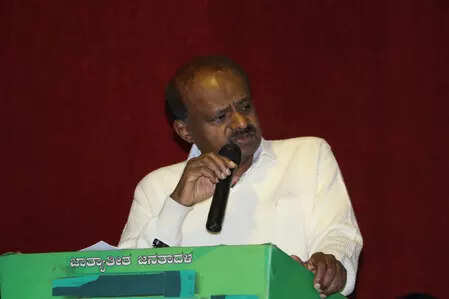
Union Minister for Heavy Industries H D Kumaraswamy on Tuesday said electric mobility lies at the centre of India’s transition towards achieving net-zero emissions by 2070, as the country strengthens its focus on clean manufacturing and sustainable growth.
According to PTI, the minister was speaking at the inauguration of the three-day Symposium on International Automotive Technology (SIAT) 2026.
Highlighting India’s rapid economic progress, Kumaraswamy said the country has emerged as the world’s fourth-largest economy, with a gross domestic product of $4.18 trillion. He added that India is firmly on track to become the third-largest economy in the coming years.
“The projected GDP of $7.3 trillion by 2030 reflects India’s growing confidence, capability and industrial strength,” he said.
Net-zero 2070 and focus on self-reliance
Kumaraswamy reiterated that the Narendra Modi government has laid out a clear and ambitious roadmap to achieve net-zero emissions by 2070. He said initiatives such as Make in India and Aatmanirbhar Bharat are strengthening advanced manufacturing sectors that will shape India’s future growth and global standing.
“Electric mobility lies at the heart of this transformation. It reduces dependence on imported fossil fuels, lowers emissions and creates new opportunities for Indian industry, innovators and our young workforce,” the minister said.
Government schemes accelerating EV adoption
Detailing policy measures, Kumaraswamy said the FAME-II scheme, with an outlay of ₹11,500 crore, has supported the adoption of over 16.71 lakh electric vehicles and enabled the sanctioning of more than 9,000 public charging stations across the country.
He added that the PM E-DRIVE scheme, with an outlay of ₹10,900 crore, has further strengthened EV adoption through demand incentives and expansion of charging infrastructure, with over 20 lakh electric vehicles sold under the scheme.
The PLI Auto scheme, backed by an outlay of ₹25,938 crore, is promoting domestic value addition and enhancing the global competitiveness of India’s automotive sector, he said.
Battery manufacturing and critical components
The minister said the government aims to establish 50 GWh of advanced chemistry cell battery manufacturing capacity in India to strengthen long-term energy security and resilience.
He also referred to the recently approved Rare Earth Permanent Magnet (REPM) scheme, with a budgetary outlay of ₹7,280 crore, which is aimed at promoting indigenous manufacturing of critical components used in electric vehicles, wind turbines, defence systems and electronics.
Drawing attention to environmental concerns, Kumaraswamy said electrification of the commercial vehicle segment requires special focus, as such vehicles contribute more than 40 per cent of transport-related pollution.
Under the PM E-DRIVE scheme, ₹2,000 crore has been earmarked for setting up over 70,000 charging stations nationwide to support EV adoption in the commercial vehicle segment, he said.
Vehicle production and exports on the rise
Presenting industry performance data, the minister said vehicle production rose from 28.4 million units in FY2023-24 to 31 million units in FY2024-25, while exports increased from 4.5 million units to 5.36 million units during the same period.
“These figures reflect the success of government efforts in promoting a clean, competitive and sustainable automotive sector,” Kumaraswamy said.