Tesla has started pushing out a software update that will change battery charge and thermal management settings in Model S sedans and Model X SUVs following a fire in a parked vehicle in Hong Kong earlier this week. The software update, which Tesla says is being done out of “an abundance of caution,” is supposed… Continue reading Tesla issues battery software update after Hong Kong vehicle fire
Tag: Apple
Vacuum-maker Dyson releases patents for new electric vehicle line set to debut in 2021
James DysonLarry Busacca | WireImage | Getty ImagesDyson, a British manufacturer best known for vacuums, fans, air purifiers and hand dryers, could add electric vehicles to its product portfolio, the company confirmed this week, releasing images of new patents it has received.
“We've been researching motors, batteries, aerodynamics, vision systems and robotics for 22 years. Now the time is right to bring all our knowledge and experience together into one big project – an electric car,” founder and CEO Sir James Dyson said in a statement on the company's website.
The UK firm has been dropping hints of its interest in electric vehicles since mid-decade, last November revealing plans to set up an assembly line in Singapore, with Dyson indicating the project will cost around $2.7 billion to bring to market.
The patent images, among other things, show what looks like a three-row crossover-utility vehicle that follows the latest industry approach to electric vehicle design, with its battery pack and motors mounted below the floorboards. But while the patents “provide a glimpse” of what the company is working on, the Dyson founder wrote that they “don't reveal what our vehicle will really look like or give any specifics around what it will do.”
Launched in 1991, Dyson Ltd. today offers a broad array of products, mostly consumer household goods like the vacuums and fans that are widely advertised. But Dyson has done little to hide his interest in getting into the auto industry.
In 2015, he underscored his commitment with the purchase of Michigan-based Sakti3, a start-up that was developing a new type of battery known as solid state. Proponents contend the technology could offer significant advantages over the more familiar lithium-ion technology in widespread use today by boosting range and reducing charge times, particular pluses for electric vehicles, but also useful for the cordless appliances Dyson has been shifting towards.
Questions about the vehicle program cropped up last year when Dyson wrote off £46 million, or about $60 million, of its £58 million investment in the University of Michigan spin-off due to problems with the technology. But it subsequently announced new details that made it clear the automotive venture was moving forward. That included word that it would build an assembly plant in Singapore, which the company now says will be complete next year.
“Singapore has a comparatively high cost base, but also great technology expertise and focus,” CEO Jim Rowan told employees in a letter last November. “It is therefore the right place to make high quality technology loaded machines, and the right place to make our electric vehicle.”
The founder's latest e-mail revealed that the project is centered at the old RAF base at Hullavington Airport, 2.5 hours west of London and employees about 500 workers, though with testing set to accelerate next month, that job count is expected to grow.
“Our bespoke automotive development site at Hullavington, UK is a £200m investment in the Dyson electric car. It's 517 acres house restored hangars, with some of the most advanced Research, Design and Development (RDD) labs in the world,” the company says on its website.
Dyson said the patent filings reveal an “androgynous vehicle,” rather than a specific product under development. But he did offer a few hints at what is coming.
“Significantly, many of our competitors base their electric vehicles on existing formats and adapt them for electric propulsion systems,” Dyson wrote in an email to employees. “Such an approach is cost effective, however, it tends to miss opportunities for mass-reduction and aerodynamic improvements which would improve the energy efficiency of the vehicle. Another approach has been to focus on smaller vehicles, as this generally keeps the mass of the vehicle low which can extend driving range. However, the size and ride comfort of such vehicles tends to limit their attractiveness and utility.”
Referencing the patent renderings, Dyson did note that the basic shape, a bit lower than today's typical SUV and CUV, would reduce aerodynamic drag while “the long wheel base could be employed, increasing the driving range and enabling a larger cabin capacity.”
Based on comments James Dyson has made over the last year and reports in various news outlets, the expectation is that three vehicles are in various stages of development, company officials indicating production should launch by 2021. They have offered no details on pricing nor where they plan to launch the product line, though Dyson is expected to set up its own dealer network.
The outspoken company founder has, meanwhile, taken a publicly proactive position in support of a proposal now being studied by Britain's government that would eliminate the sale of all new gas and diesel vehicles. The original concept set a target date of 2040 but British regulators have begun considering the option of pushing that up to 2035. Dyson, for his part, would like the ban to go into effect in 2030.
Similar measures are under study in a number of countries, including China, India, Germany and France. In Norway, where electric vehicles currently account for more than half of the new car market, a ban has already been approved.
Such a move would improve the odds that start-ups like Dyson could carve out a market niche, though traditional automakers like Daimler AG, General Motors and Volkswagen, are intent on reclaiming market dominance. That said, the arrival of upstart Tesla has shown the potential for new entrants, of which plenty more are looking to launch, such as Rivian and Faraday Future. There is also Apple, the technology giant working on its own vehicle program, though it has sent a number of conflicting signals about what it is developing in recent years.
The Hyundai Ioniq Electric Offers Serene Simplicity

There’s an elegance in simplicity and luxury in refined minimalism. The Hyundai Ioniq Electric Limited may at first seem like an exercise in Marie Kondo–style automaking, but after spending several days with Hyundai’s compact EV, I found joy in a well-executed electric runabout. The Ioniq looks and functions very much like a normal and only… Continue reading The Hyundai Ioniq Electric Offers Serene Simplicity
As Uber gears up for IPO, many Indian drivers talk of shattered dreams
MUMBAI/NEW DELHI (Reuters) – In 2016, Rajesh Raut started driving an Uber taxi in Mumbai, hoping he could earn more than the $215 he received each month for making flatbreads at a roadside stall. Rajesh Raut, a former Uber driver, prays inside the truck that he currently drives and lives in, at a street in… Continue reading As Uber gears up for IPO, many Indian drivers talk of shattered dreams
Google refreshes Android Auto with new features and a darker look
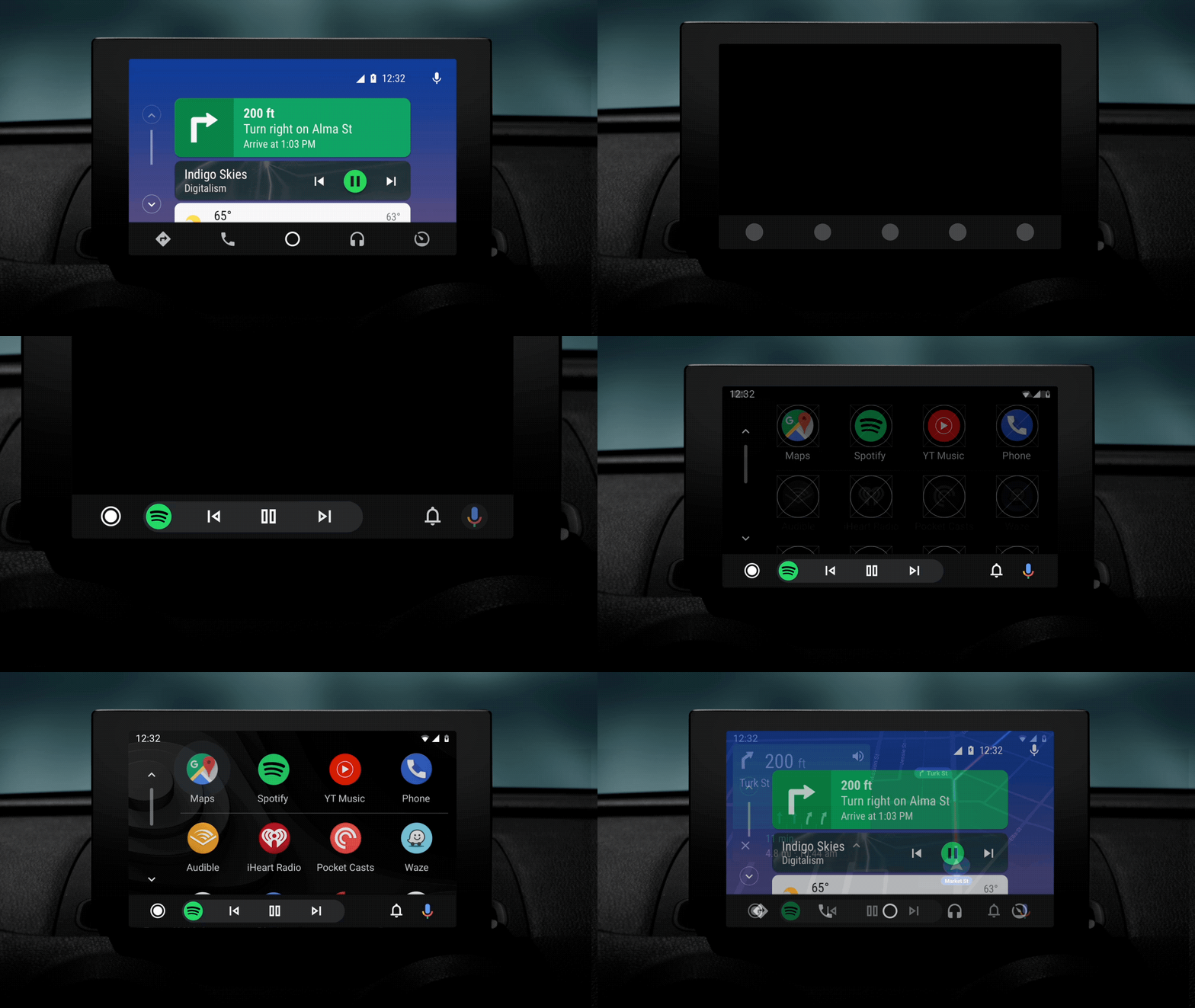
Android Auto — the in-car platform that brings the look and functions of a smartphone to the vehicle’s central screen — is getting a new look and improved navigation and communication features that will roll out this summer. The improvements and new look were revealed Monday during Google I/O 2019, the annual developer conference. The… Continue reading Google refreshes Android Auto with new features and a darker look
Hyundai’s Ioniq EV gets a bigger battery and more connectivity

Sponsored Links Hyundai Hyundai is refreshing its Ioniq line-up with the hybrid, plug-in hybrid, and electric models all getting design tweaks and new features. The EV in particular will get a larger, 38.3 kWh battery pack that has 36 percent more storage capacity than its predecessor. Under the WLTP standard, Hyundai’s target range for the… Continue reading Hyundai’s Ioniq EV gets a bigger battery and more connectivity
Liam O’Connor, hired to help build Lyft’s bike and scooter business, has left after 7 months
The emerging business of offering bikes and scooters on demand has not always been very smooth, and today comes one of the latest bumps: TechCrunch has learned and confirmed that Liam O’Connor, an executive hired to help transportation company Lyft build its bike and scooter operations, has left after seven months with the newly-public company.… Continue reading Liam O’Connor, hired to help build Lyft’s bike and scooter business, has left after 7 months
Apple files patent for new thermal management system for EVs
Apple files patent for new thermal management system for EVs
Tesla Autopilot, Full Self Driving, Elon Musk, ARK Invest — CleanTech Talk with Tasha Keeney
Invest
Electric Cars
Electric Car Benefits
Electric Car Sales
Solar Energy Rocks
RSS
Advertise
Privacy Policy
Autonomous Vehicles
Published on April 20th, 2019 |
by Zachary Shahan
Tesla Autopilot, Full Self Driving, Elon Musk, ARK Invest — CleanTech Talk with Tasha Keeney
Twitter
LinkedIn
Facebook
April 20th, 2019 by Zachary Shahan
For our hot new CleanTech Talk podcast interview series, I recently sat down with ARK Invest Analyst Tasha Keeney to discuss various aspects of autonomous vehicles, Tesla, Tesla, and Tesla. Tasha is focused on autonomous cars and 3D printing in her position at ARK Invest. She and ARK Invest CEO Cathie Wood recently hosted Tesla CEO Elon Musk in the studio for their new podcast series, so we built off of that chat and I also brought in several key autonomy topics I’m always eager to learn more about.
The conversation was approximately 45 minutes long, so to cut it down into more manageable portions, I’ve split it into two episodes. This is the first episode, and the second will be published tomorrow. Listen to the discussion on your favorite podcast platform (options linked below) or via this embedded player:
You can subscribe and listen to CleanTech Talk is on: Anchor, Apple Podcasts/iTunes, Breaker, Google Podcasts, Overcast, Pocket, Podbean, Radio Public, SoundCloud, Spotify, and Stitcher.
To kick off, I asked Tasha about her background and how it fit into ARK Invest. She was previously a management consultant, mostly in the auto industry on the supply chain side of the story. We slid into a short chat about the autonomous vehicle industry as a whole and suppliers in the industry before making our way to Tesla and the large team of experts at the company who are focused on advancing Tesla Autopilot on a daily basis, and who meet with Elon on a weekly basis.
I then brought up my favorite CleanTechnica article on Tesla autonomous driving, one written by Mike Barnard in 2015 and republished last year when Tesla hit 1 billion miles on Autopilot. I highly recommend reading that article before or after listening to the podcast. Tasha took that summary and got more technical, explaining part of why they are bullish about Tesla’s autonomy approach.
I also touched on a Navigant Research report that puts Tesla near the bottom of the list for self-driving vehicle strategy and development. I had found those conclusions to be confusing, but also had a general hunch why they were what they were, so I was curious to hear Tasha’s take on that. She focused on the point that Tesla doesn’t use prototype vehicles, which may confuse analysts, and that there’s perhaps over-reliance on California disengagement reports (which are actually not standardized and are self-reported).
Another top topic of curiosity for me for years has been exactly how and how much Tesla uses “ghost driving” or “shadow mode” to improve Autopilot and eventual Full Self Driving. Clearly, Tesla’s approach involves learning from drivers who have Autopilot on and then disengage for some reason, but I also wonder how much Tesla’s software is learning how to drive simply from monitoring what the human drivers do without Autopilot activated. Tasha’s take on this from talking to Elon is that the Autopilot disengagements are particularly important but that the system must be learning to some degree from the shadow mode testing. (This is really a topic it would be cool to talk about with Elon or one of his Autopilot team members, as there’s still plenty of mystery here.)
Lex Fridman at MIT has been tracking Tesla Autopilot miles and last we heard had the figure just over 1 billion. Tasha has built on that work for ARK Invest to come to the conclusion that Tesla vehicles with “Autopilot hardware 2” have driven 10 billion miles, better capturing or quantifying the miles that are potentially involved in ghost/shadow learning.
Getting to the topic of full self driving, Tasha touches on Elon’s comment on the ARK Invest podcast that he and the crew think Tesla vehicles “will be feature complete — full self-driving — this year,” and could be ready for drivers to go to sleep behind the wheel a year later — but that depends mostly on regulators. Tasha said that is probably an aggressive timeline, but considering it’s coming from Elon, how could it not be? Going back to the ARK Invest interview with Elon, these were his words on that matter: “My guess as to when we would think it is safe for somebody to essentially fall asleep and wake up at their destination? Probably towards the end of next year. That is when I think it would be safe enough for that.” Again, though, it’s up to regulators when that is permitted, so Tasha and I discussed that topic of regulators/regulations for a few minutes.
We then briefly talked flying taxis and electric vertical takeoff and landing (eVTOL) aircraft — fun topics, but that will be a topic for another analyst and podcast discussion.
We ended the first part of this two-part discussion by chatting about the processing power needed in autonomous vehicles, the importance of that for over-the-air software updates, and Tesla’s overall hardware and software leadership. Highlighting this challenge for conventional, established automakers, Tasha had this to say:
“We call it here at ARK the sort of ‘old DNA’ issue — when innovation happens that you can sort of be caught flatfooted if you’re very stuck in your ways. I think that’s a huge problem for the traditional autos. And same thing with autonomy.
“If they were to do this, they have an even larger fleet than Tesla, right? They could get this data. But Tesla started years ahead of them. So, we think it’s possible they could just totally run away with this opportunity.”
As part of this whole matter, Tasha and I talked about a presentation from George Hotz (aka geohot) and a brief Q&A I had with him in which he emphasized Tesla was so far ahead on software in part because the company was so far ahead on hardware. For more on that, I recommend this CleanTechnica exclusive: Geohot: Tesla Autopilot = Apple iOS, Comma.ai = Android.
The second part of our interview with Tasha Keeney will be published tomorrow here on CleanTechnica, including on the CleanTech Talk portion of our site. In the meantime, I recommend this article and podcast for more on these topics: Elon Musk: Full Self-Driving Teslas This Year, “Unequivocal” Tesla Autopilot Improves Safety.
Interested in buying a Tesla Model 3, Model S, or Model X? Need a referral code to get 1,000 miles of free Supercharging? Use ours: http://ts.la/tomasz7234 (or not).
About the Author
Zachary Shahan Zach is tryin' to help society help itself (and other species). He spends most of his time here on CleanTechnica as its director and chief editor. He's also the president of Important Media and the director/founder of EV Obsession and Solar Love. Zach is recognized globally as an electric vehicle, solar energy, and energy storage expert. He has presented about cleantech at conferences in India, the UAE, Ukraine, Poland, Germany, the Netherlands, the USA, and Canada.
Zach has long-term investments in TSLA, FSLR, SPWR, SEDG, & ABB — after years of covering solar and EVs, he simply has a lot of faith in these particular companies and feels like they are good cleantech companies to invest in. But he offers no professional investment advice and would rather not be responsible for you losing money, so don't jump to conclusions.
Back to Top ↑
Advertisement
Advertise with CleanTechnica to get your company in front of millions of monthly readers.
CleanTechnica Clothing & Cups
Top News On CleanTechnica
Join CleanTechnica Today!
Advertisement
Advertisement
Follow CleanTechnica Follow @cleantechnica
Our Electric Car Driver Report
Read & share our new report on “electric car drivers, what they desire, and what the demand.”
The EV Safety Advantage
Read & share our free report on EV safety, “The EV Safety Advantage.”
EV Charging Guidelines for Cities
Share our free report on EV charging guidelines for cities, “Electric Vehicle Charging Infrastructure: Guidelines For Cities.”
30 Electric Car Benefits
Our Electric Vehicle Reviews
Tesla News
Cleantech Press Releases
Wiesbaden Orders 56 Electric Buses From Mercedes-Benz
Volkswagen Group Secures Lithium Supplies From Ganfeng Lithium
New Flyer Infrastructure Solutions Completes New York’s 1st Interoperable, On-Route Charger Solution For Transit Buses
38 Anti-Cleantech Myths
Wind & Solar Prices Beat Fossils
Cost of Solar Panels Collapses
© 2018 Sustainable Enterprises Media, Inc.
Invest
Electric Cars
Electric Car Benefits
Electric Car Sales
Solar Energy Rocks
RSS
Advertise
Privacy Policy
This site uses cookies: Find out more.Okay, thanks
From Smartphone to Big Screen: Ford Owners Can Now Enjoy Streaming Music on the go With Anghami
Anghami – the region’s leading music streaming platform – can be enjoyed on-the-go by Ford SYNC®3 owners Owners can now match their commute with their favourite music, all via the large Ford SYNC3 screen and voice commands, for seamless and safe motoring Anghami joins community-based navigation and traffic app Waze on AppLink, allowing Ford drivers… Continue reading From Smartphone to Big Screen: Ford Owners Can Now Enjoy Streaming Music on the go With Anghami