
*/ ]]> Opel endurance runner: Kai-Uwe Wehrheim drives for decades Opel. His current trophy is the Vectra C. “Instead of using a company car, I prefer to use my Vectra. I’ve been able to rely on that for years. “ – Kai-Uwe Wehrheim – owner of the kilometer hero The community Heidenrod extends in 19… Continue reading Loyal trophy collector
Tag: PSA
Tesla Downplays Self-Driving Mode, And That’s A Good Thing [Opinion]
The Tesla automobile had two jobs when it was launched: First, it would finally and formally usher in the era of the electric car. No more false starts. No more wondering who killed the electric car. With the introduction of Tesla Motors, the electric car was here to stay.
The other job was to introduce the self-driving car. While this was never intended to become an immediate reality, it was the official first step toward a near-future where cars would drive themselves. Tesla has succeeded in the first goal. Thanks largely to Elon Musk, electric cars are for real. The second goal, not so much.
According to the Verge, “Tesla stopped promoting the ‘Full Self-Driving’ option for its cars.”
“Tesla has pulled a long-standing promise of a “Full Self-Driving” option for its cars from the order page on the company’s website.
Elon Musk, Tesla’s CEO, said on Twitter that the option will be temporarily available “off menu,” much like Animal Style fries at an In-N-Out burger joint. It will quickly leave the secret menu, though, and won’t come back until the company is ready to roll it out. The Full Self-Driving option was “causing too much confusion” for customers to justify keeping it front and center, he said. The company declined to comment.”
One gets the impression Musk is still not taking the matter seriously enough. This is an issue of safety. Lives are on the line, and at least one has been lost. This is not something to be compared to an item on a fast-food menu.
Just last year, CNBC reported on a man dying in a car crash while depending on Tesla Autopilot. The article is quick to point out that the man received a number of warnings to keep his hands on the wheel, something he failed to do. But that is ultimately not the point. The man died because of confusion. He was sold a dream of a car driving itself and died because he believed it.
At the current stage of technology, it is irresponsible to sell a car with the promise of a Full Self-Driving mode, or something that currently bills itself as autopilot. Airplanes have autopilot. That is fitting because planes really can fly themselves. Cars cannot drive themselves except in very limited circumstances.
The German Government has asked Tesla to stop calling its features “Autopilot.” While that is unlikely to happen without regulation, at least Musk is being a bit more conservative about what he promises.
As a PSA, consumers need to understand that regardless of the car you own and the features it boasts, no car is even close to being able to drive itself. Licensed and attentive drivers are still a requirement.
BYTON Unveils a Closer Look at the M-Byte SUV Production Model at 2019 CES Las Vegas – PRNewswire
“BYTON’s M-Byte represents the transformation of the traditional car into a next-generation smart device for every user,” said Dr. Carsten Breitfeld, CEO and Co-founder of BYTON. “We achieve this through the combination our state-of-the-art EV platform and our proprietary BYTON Life digital ecosystem.” A Digital Cockpit That Improves The Driver ExperienceBYTON’s Shared Experience Display (SED)… Continue reading BYTON Unveils a Closer Look at the M-Byte SUV Production Model at 2019 CES Las Vegas – PRNewswire
GM is transforming Cadillac into an electric brand
General Motors is turning Cadillac into its lead electric vehicle brand in a bid to compete against Tesla as well as a host of other automakers bringing EVs onto the market. Plans are already underway to introduce the first model from the company’s new battery electric vehicle architecture, GM said Friday during an investor meeting.… Continue reading GM is transforming Cadillac into an electric brand
Under pressure to change, Ford is reinventing itself
The company has not ruled out leaving Europe altogether if its strategy fails, said a source. New York: Struggling with a sagging stock price and sluggish sales, US car giant Ford took steps to regain its footing this week with the announcement of a massive restructuring effort in Europe — even as it prepared for… Continue reading Under pressure to change, Ford is reinventing itself
Quickly is born, the first carsharing exclusive for dealers
Quikly is the first platform that will make dealerships more relevant in the mobility scenario, because with this initiative they will be able to offer, not only a new mobility system in the area, but also one-click substitution cars. In addition, billing for substitutes will increase significantly. Quikly has become the new way in which… Continue reading Quickly is born, the first carsharing exclusive for dealers
Volkswagen CEO: More car companies will merge – CNN
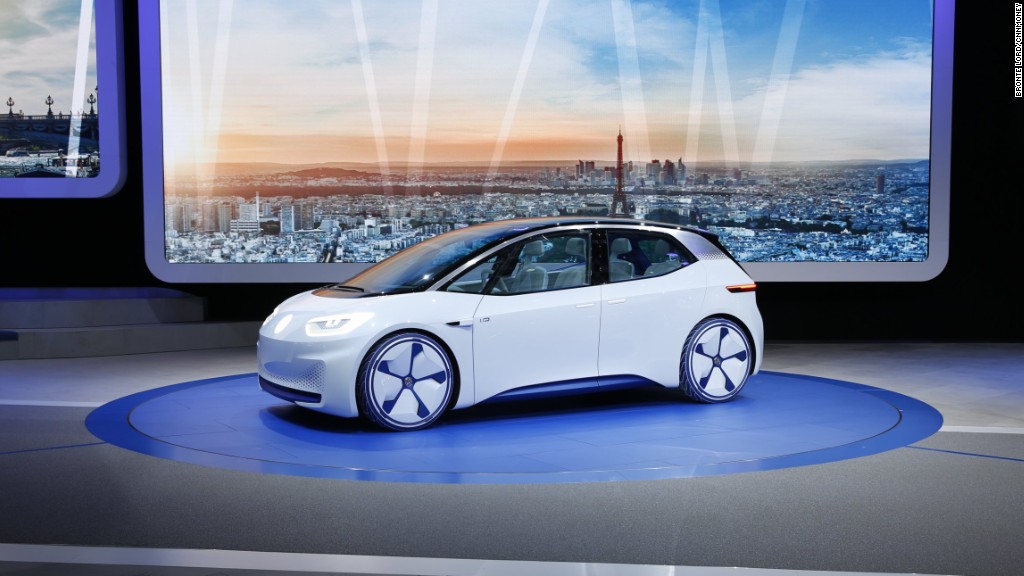
VW unveils better, cheaper electric car Get ready for more mega mergers in the automotive industry. General Motors (GM) dumped its European business on Monday — selling its Opel and Vauxhall brands to France’s PSA Group, which makes Peugeot (PUGOY) and Citroen cars. Volkswagen (VLKAY), the world’s biggest carmaker, says that won’t be the last… Continue reading Volkswagen CEO: More car companies will merge – CNN
Byton brings its big-screen electric SUV back to CES, a step closer to production
Follow Bengt
Byton M-Byte
The China-based electric vehicle maker Byton brought a close-to-production prototype version of its M-Byte SUV to the 2019 Consumer Electronics Show this week.
The debut of the vehicle, still headed for a starting price of around $45,000 and an available driving range of up to 325 miles, marks another step toward production for what was one of the surprise stars of last year's CES show.
Prior to last year’s show, few had heard of, Byton. And in all fairness, the real star of the show wasn’t the vehicle (then just called Byton Concept) so much as what it called the Shared Experience Display—a massive 49-inch screen tamed with gesture controls—and an elaborate, detailed proof-of-concept presentation to CES attendees and media.
DON’T MISS: Startup Byton: EVs aren't the innovation; personal-tech features are
Much of the Concept’s screen actually worked, and responded well to gesture controls, as demonstrated. It was what amounted to an effective distraction, at an electronics show, from the fact that the rest of the vehicle was still very much a cobbled-together concept car, with roughly a year of actual vehicle development underway.
What a difference a year can make. This year Byton reported at CES that the M-Byte, as it became called, is currently in prototype testing, and it brought the close-to-production prototype to CES 2019 with some significant tweaks—to the cabin design especially.
Byton M-Byte interior – production prototype for CES 2019
In addition to all the screen real estate that’s already accessible to those in front, Byton has added a new tablet-style screen between the driver and passenger, while keeping and redesigning the steering-wheel screen that serves as a small control tablet. Two big screens bring entertainment and other functions to rear-seat passengers, and face-recognition functions automatically recall personalized settings; directional microphones will accept voice inputs separately from each passenger.
CHECK OUT: Byton electric SUV promised for 2019 at $45,000 after CES debut: first-ride video
Otherwise the dashboard itself has been given more of a wrap-around design, with pragmatic concessions like climate-control vents and hard buttons added to the center-console area.
That said, the concept-car-style front seats still swivel 12 degrees, to allow those in front to converse, when the car isn’t in motion (or at some point in the future, when an autonomous mode is activated). And Byton says that the screen will meet crash standards in all target markets.
Byton M-Byte interior – production prototype for CES 2019
Byton is working on a Level 4 autonomous-driving system, but the M-Byte will only launch with some driver-assistance features (smart cruise control and limited steering assist).
READ MORE: Byton reveals self-driving living-room on wheels, the K-Byte, in LA
The company states that it “aims to create a premium brand rooted in China which has a global reach.” It has an impressive roster of executives from BMW, Tesla, Apple, and Google, and it emphasizes its international building blocks. The carmaker is building an assembly plant in Nanjing, China, with production equipment from Japan and Germany. The company’s strategic investors include Chinese automaker FAW, Chinese battery giant CATL, and key suppliers such as Bosch, BOE, and Faurecia.
Byton M-Byte and K-Byte
Byton revealed its first drivable prototype of the M-Byte just last year and, in concept form, the K-Byte, an electric sedan that it plans to follow the M-Byte.
In what has to be one of the tightest timelines yet, for from-scratch development of a vehicle intended for the U.S. and Europe, the company is targeting mid-2019 for the debut of a production version of the M-Byte, with a mass-production start at the end of the year. If all things go right, and the company avoids Faraday Future–style drama, it could reach the U.S. sometime in 2020.
ZF will unveil a steering wheel and pedal-free robo-taxi at CES 2019
ZF will unveil a steering wheel and pedal-free robo-taxi at CES 2019
Robo-taxi featuring ZF technology at CES 2019 provides a preview of autonomous ride-hailing
Mobility-as-a-Service is one of the biggest drivers of the development of autonomous driving
ZF offers automotive systems competence for innovative mobility providers
Friedrichshafen, Germany / Las Vegas, NV, USA, 07-Jan-2019 — /EuropaWire/ — Novel urban mobility choices are one of the biggest drivers behind the development of autonomous driving. A primary example is autonomous ride-hailing, a service based on shared rides in robo-taxis or robo-shuttles. ZF offers extensive systems competence to companies offering Mobility-as-a-Service solutions. It includes radar, camera and LiDAR systems as sensors to help detect the vehicle’s environment, powerful computers such as the ZF ProAI RoboThink with software and algorithms, as well as mechatronic actuators and safety systems. Customers can also benefit from ZF’s ability to intelligently network these systems and integrate them into vehicles. This adds value for customers who want to offer not just vehicles, but mobility services.
At CES 2019, ZF will unveil a steering wheel and pedal-free robo-taxi to show how its technologies enable new forms of urban mobility. Users can hail the taxi using their smartphone or tablet and it will maneuver autonomously to pick them up. It can then chauffeur them to where they wish to go.
“Automation, electrification and networking are critical enablers as the transport of people and goods continually increase in urban centers. With our extensive systems competence, ZF is enabling and shaping next-generation mobility,” said Torsten Gollewski, head of Advanced Engineering at ZF and general manager of Zukunft Ventures GmbH. “Our flexible and modular system solutions are not only attractive for conventional car manufacturers, but also for new companies entering the mobility market.”
Networked systems link vehicles to the cloud
With the robo-taxi, ZF is demonstrating that it can provide the necessary solutions for the development of robo-vehicles and related services. In line with the company’s “see. think. act.” philosophy, the ZF range of sensors helps enable the demo vehicle to precisely detect its surroundings. ZF ProAI RoboThink, the high-performance supercomputer for autonomous driving is designed to process the vast amount of sensor data, translate it into a coherent picture and derive the right commands for the vehicle. These commands are then implemented by connected ZF systems that enable vehicle motion control and enhanced safety – including chassis, drive, steering system, brakes or occupant safety systems.
ZF has also been hard at work networking its intelligent mechanical systems with its cloud-based platform for mobility services. It will be possible to integrate functions across all kinds of providers, for instance for ride-hailing, innovative delivery services and fleet management. The vehicle software can be updated via the cloud.
Cockpit with no steering wheel or pedals
With increasing automation, new concepts for seat positions in fully automated delivery vehicles or robo-taxis are also in demand. The Trendsetting Cockpit from ZF and Faurecia installed in the CES demo vehicle demonstrates where development is heading. It can maneuver without a steering wheel and pedals and is equipped with three screens. Deliverers or passengers can freely choose where to sit. This provides greater flexibility, freedom of movement and new options for interior space utilization.
MEDIA CONTACTS
Florian Stemmler
Technology and Product Communication
+49 7541 77-2367
florian.stemmler@zf.com
Robert Buchmeier
Head of Technology and Product Communications
+49 7541 77-2488
robert.buchmeier@zf.com
SOURCE: ZF Friedrichshafen AG
Tweet
Share
0
+1
0
Lost world: Germany’s forgotten car companies – Autocar
Borgward (1924-1961) If you wanted a premium German car in the 1950s, Borgward was the place to go, with its stylish saloons, coupés and estates, most notably 1954’s Isabella, pictured. Carl Borgward started making cars under his own name in 1924, but in the pre-war years he also set up or acquired the Hansa, Lloyd… Continue reading Lost world: Germany’s forgotten car companies – Autocar