TORONTO, March 02, 2020 (GLOBE NEWSWIRE) — Martinrea International Inc., a diversified and global automotive supplier engaged in the design, development and manufacturing of highly engineered, value-added Lightweight Structures and Propulsion Systems, today announced it has completed the acquisition of the Structural Components for Passenger Cars operations of Metalsa S.A. de C.V. The purchase price… Continue reading Martinrea International Inc. Completes Purchase of Structural Components for Passenger Cars Division of Metalsa S.A. de C.V.
Tag: Daimler
Daimler says cost cut plans may see entire platforms eliminated
Mercedes logo is seen as Ola Kaellenius, CEO of German luxury car manufacturer Daimler AG, speaks at the annual results news conference in Stuttgart, Germany, February 11, 2020. REUTERS/Andreas Gebert FRANKFURT (Reuters) – Mercedes-Benz is embarking on a sweeping cost cutting plan to free up cash to build electric and self-driving cars, a step which… Continue reading Daimler says cost cut plans may see entire platforms eliminated
(LEAD) Renault Samsung to launch XM3 SUV next week
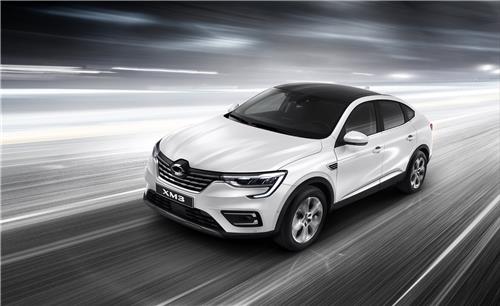
(ATTN: UPDATES with details in paras 5-7) SEOUL, March 3 (Yonhap) — Renault Samsung Motors Corp., the South Korean unit of Renault S.A., said Tuesday it will launch its all-new XM3 sport utility vehicle next week to revive lackluster sales. The XM3 SUV, which hits the domestic market on Monday, comes in two versions, one… Continue reading (LEAD) Renault Samsung to launch XM3 SUV next week
Mercedes to reduce model line-up, platforms and powertrains
Mercedes will dramatically reduce its model line-up as well as platform and powertrain options, as the maker seeks to reduce complexity and optimise profit. Markus Schafer, Mercedes R&D boss said the drive came as a result of its focus on electric vehicles, and would range from cutting car lines to single components used in its… Continue reading Mercedes to reduce model line-up, platforms and powertrains
Mercedes R&D boss: EQC production is “learning curve”
The supply chain issues for Mercedes’ EQC electric SUV have presented a steep learning curve, according to Mercedes R&D board member Markus Schafer, but he says the maker is back on track to produce 50,000 EQCs this year. Issues with Mercedes’ battery supplier, LG Chem, had led to widespread reports that Mercedes would not fulfil its… Continue reading Mercedes R&D boss: EQC production is “learning curve”
Mega-power electric hypercar “not a priority” for Porsche
Porsche has no desire to follow the array of electric hypercars with four-figure power outputs into the market, according to the brand’s design chief. Talking to Autocar in a phone interview that would have taken place at the cancelled Geneva motor show, Michael Mauer expressed that he has other ideas about what is important for enthusiasts. … Continue reading Mega-power electric hypercar “not a priority” for Porsche
@Daimler: Mercedes-Benz and Mercedes-AMG present product highlights live on Mercedes me media
Stuttgart. A swift alternative programme for the Geneva Motor Show: Mercedes-Benz and Mercedes-AMG presented the highlights of their product premieres live on the media portal Mercedes me media. The digital press conference, which is available as an on-demand video, focuses on the world premiere of the comprehensively updated E-Class with numerous model variants – including… Continue reading @Daimler: Mercedes-Benz and Mercedes-AMG present product highlights live on Mercedes me media
BMW, Daimler aim to cut emissions 20% this year with new electric models
FRANKFURT (Reuters) – New electric models will help BMW and Daimler cut emissions from the cars they sell by an average of 20% this year, the German automakers predicted on Tuesday, as they strive to meet tough new European pollution rules. FILE PHOTO: BMW i3 drives during electric car E-Rallye Baltica 2019 near Iecava, Latvia… Continue reading BMW, Daimler aim to cut emissions 20% this year with new electric models
Mercedes-Benz and Mercedes-AMG present product highlights live on Mercedes me media
03.
March 2020
Stuttgart
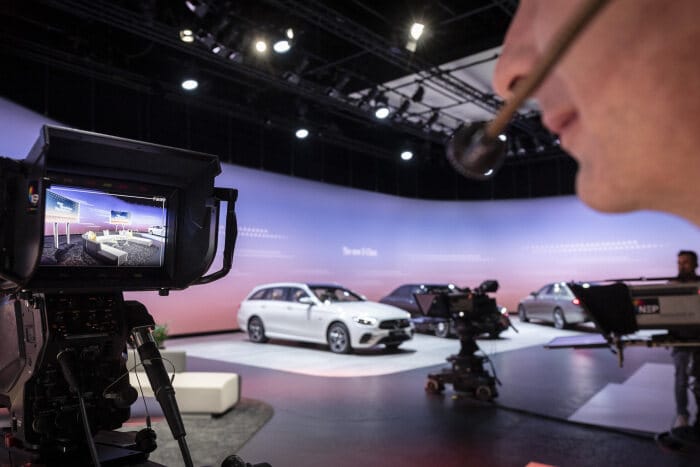
Stuttgart. A swift alternative programme for the Geneva Motor Show: Mercedes-Benz and Mercedes-AMG presented the highlights of their product premieres live on the media portal Mercedes me media. The digital press conference, which is available as an on-demand video, focuses on the world premiere of the comprehensively updated E-Class with numerous model variants – including the plug-in hybrid versions of the Sedan and Estate as well as the Mercedes-AMG E 53 4MATIC+ (combined fuel consumption 9.0–8.8 l/100 km; combined CO2 emissions 207–200 g/km)1[i]. With the new plug-in hybrid models in the compact car segment, Mercedes-Benz is pushing ahead with its electrification offensive. The CLA 250 e as Coupé and Shooting Brake (combined fuel consumption 1.6-1.5 l/100 km, combined CO2 emissions 37-35 g/km, combined electrical consumption 15.5-15.1 kWh/100 km)1, and the GLA 250 e (combined fuel consumption 1.8-1.6 l/100 km, combined CO2 emissions 42-38 g/km, combined electrical consumption 16.1-15.5 kWh/100 km)2 will complement the range. There are also new engine variants with 48-volt technology and integrated starter-generator (ISG) in the E-Class. In addition to the press conference, experts will explain the highlights of the new E-Class in detail in three “walkarounds” shown on Mercedes me media.
In the summer of 2020, the comprehensively updated and significantly upgraded E-Class will be launched, initially as Sedan, Estate and All-Terrain models. Coupé and Cabrio – as well as the China-exclusive long-wheelbase version of the sedan – will follow soon after. The most important highlights of the model update are a more dynamic design, the next generation of driver assistance systems, the higher level of comfort and the expansion of the model portfolio to include numerous electrified drive systems.
“This year, we are consistently pushing ahead with digitization and electrification. Our goal is to reduce CO2 emissions from our fleet by more than 20%. To achieve this, we are rolling out 48-volt technology in all model series, currently in the new E-Class. By the end of 2020, we want to double our sales of mild hybrids and quadruple the share of xEVs. Following the purely electric smart EQ, EQC* and EQV** models, we will present the compact EQA at the end of the year. Our plug-in family is also growing: we are adding three new compact models – the new E-Class will have at total of seven variants,” said Ola Källenius, Chairman of the Board of Management of Daimler AG and Mercedes-Benz AG.
(*Mercedes-Benz EQC 400 4MATIC: combined electrical consumption 20.8-19.7 kWh/100 km, combined CO2 emissions 0 g/km)1 ; (**Mercedes-Benz EQV 300: combined electrical consumption 26.4-26.3 kWh/100 km, combined CO2 emissions 0 g/km)1
Markus Schäfer, Member of the Board of Management of Daimler AG and Mercedes-Benz AG, responsible for Group Research and Mercedes-Benz Cars Development, Procurement and Supplier Quality: “Our compact plug-in hybrid vehicles have an electric range of more than 70 kilometres (NEDC) and are therefore absolutely suitable for everyday use. And with their quick-charging function, our models can be charged from 10 to 80% in just 25 minutes. By the end of the year, we will more than double the number of plug-in hybrids and electric models – to five all-electric vehicles and more than 20 plug-in hybrids from the A- to S-Class. In the new E-Class alone, we are offering seven variants of plug-in hybrids. In addition, the E-Class comes with new, electrified four-cylinder engines that set new standards in efficiency: a gasoline engine and, for the first time, a diesel with a 48-volt electrical system and integrated starter generator.”
Britta Seeger, Member of the Board of Management of Daimler AG and Mercedes-Benz AG, responsible for Marketing & Sales: “With over 14 million models delivered, the E-Class is the best-selling model series in the history of Mercedes-Benz – and has always been the heart of the brand. The current E-Class alone has sold more than 1.2 million units worldwide. E-Class buyers are our most loyal customers: eight out of ten buyers choose a Mercedes-Benz again the next time they buy a car.”
Experts present new E-Class in detail on me media
In addition to the digital press conference with the Daimler AG and Mercedes-Benz AG board members, three “walkarounds” can be seen on the Mercedes me media portal, in which experts present the new E-Class in detail (https://media.mercedes-benz.com/gims2020). Robert Lesnik, Director Exterior Design, presents the highlights of the new design. Michael Kelz, Chief Engineer E-Class, explains the technical highlights of the Mercedes-Benz
E-Class and Philipp Uttikal, Product Manager Mercedes-AMG E-Class, presents the new E 53 4MATIC+ performance sedan.
Sustainability in motorsport: Engineering a better future
As a further digital highlight, the all-star “Motorsports & Sustainability” media talk will be available today starting at 5:30 p.m. as an on-demand video on Mercedes me media. The talk will feature Markus Schäfer, Member of the Board of Management of Daimler AG and Mercedes-Benz AG, responsible for Group Research and Mercedes-Benz Cars Development, Procurement and Supplier Quality; Toto Wolff, Team Principal & CEO of Mercedes-AMG Petronas Formula One Team; Lewis Hamilton, six-time Formula 1 world champion from Mercedes-AMG Petronas Formula One; and Nyck de Vries, from the Mercedes-Benz EQ Formula E Team; who will discuss sustainability in motorsports as well as the transfer of technology to series development.
For Mercedes-Benz, motorsport as the “fastest research laboratory in the world” has always been the innovation driver of series production. Formula 1 and Formula E are therefore an integral part of Daimler’s holistic sustainability strategy. This motorsport strategy builds on the two technologies that will determine the future of Mercedes-Benz production vehicles: hybrid drive and battery electric drive.
Mercedes me media
The complete press conference, the expert walkarounds and the media talk on sustainability in motorsports can be seen in full length as an on-demand video on Mercedes me media: https://media.mercedes-benz.com/gims2020. The complete media special on the latest product innovations can be found there as well. All current information is also available on Twitter @MB_Press.
1 The stated figures are the measured “NEDC CO2 figures” in accordance with Article 2 No. 1 Implementing Regulation (EU) 2017/1153. The fuel consumption figures were calculated based on these figures. The range and the electrical consumption have been determined on the basis of Regulation (EC) No. 692/2008. A different figure may apply as the basis for calculation as per the German Electric Mobility Act (EmoG). A higher value may apply as the basis for calculating the motor vehicle tax.
Further information on the official fuel consumption and the official specific CO₂ emissions of new passenger cars can be found in the “Guide to Fuel Consumption, CO₂ Emissions and Electricity Consumption” for new passenger cars, which is available free of charge at all sales outlets and from Deutsche Automobil Treuhand GmbH at www.dat.de.
2 Figures for the fuel consumption, electrical consumption, range and CO2 emissions are provisional, and were determined by the Technical Service for the certification process acc. to the WLTP test procedure, then correlated for NEDC values. EC type approval and certificate of conformity with official figures are not yet available. Differences between the stated figures and the official figures are possible.
Press Contact
Katja Bott
Head of Global Communications Mercedes-Benz Cars & Vans
katja.bott@daimler.com
Tel: +49 711 17 75841
Melanie Cecotti
Manager Global Communications Mercedes-AMG
melanie.cecotti@daimler.com
Tel: +49 7144 302-6332
Koert Groeneveld
Head of Global Product and Technology Communications
koert.groeneveld@daimler.com
Tel: +49 160 8614747
Press Contact Overview
Media
Download
Pictures (32)
Documents (1)
Media Contact (3)
Filter
Show thumbnails
Show list
Slideshow
Settings
Preview
Do you really want to delete the data record?
Please wait a moment …
Please wait a moment …
Please wait a moment …
Please wait a moment …
20C0112_001
Legend
:
A swift alternative program for the Geneva Motor Show: Mercedes-Benz and Mercedes-AMG presented the highlights of their product premieres live on the media portal Mercedes me media. The digital press conference, which is also available as an on-demand video, focuses on the world premiere of the comprehensively updated E-Class with numerous model variants. The higlights are presented by the Daimler Board Members Ola Källenius, Britta Seeger and Markus Schäfer, hosted by Katie Linendoll.
Release date
:
Mar 3, 2020
20C0112_002
Legend
:
A swift alternative program for the Geneva Motor Show: Mercedes-Benz and Mercedes-AMG presented the highlights of their product premieres live on the media portal Mercedes me media. The digital press conference, which is also available as an on-demand video, focuses on the world premiere of the comprehensively updated E-Class with numerous model variants. The higlights are presented by the Daimler Board Members Ola Källenius, Britta Seeger and Markus Schäfer, hosted by Katie Linendoll.
Release date
:
Mar 3, 2020
20C0112_003
Legend
:
A swift alternative program for the Geneva Motor Show: Mercedes-Benz and Mercedes-AMG presented the highlights of their product premieres live on the media portal Mercedes me media. The digital press conference, which is also available as an on-demand video, focuses on the world premiere of the comprehensively updated E-Class with numerous model variants. The higlights are presented by the Daimler Board Members Ola Källenius, Britta Seeger and Markus Schäfer, hosted by Katie Linendoll.
Release date
:
Mar 3, 2020
20C0112_005
Legend
:
A swift alternative program for the Geneva Motor Show: Mercedes-Benz and Mercedes-AMG presented the highlights of their product premieres live on the media portal Mercedes me media. The digital press conference, which is also available as an on-demand video, focuses on the world premiere of the comprehensively updated E-Class with numerous model variants. The higlights are presented by the Daimler Board Members Ola Källenius, Britta Seeger and Markus Schäfer, hosted by Katie Linendoll.
Release date
:
Mar 3, 2020
20C0112_006
Legend
:
A swift alternative program for the Geneva Motor Show: Mercedes-Benz and Mercedes-AMG presented the highlights of their product premieres live on the media portal Mercedes me media. The digital press conference, which is also available as an on-demand video, focuses on the world premiere of the comprehensively updated E-Class with numerous model variants. The higlights are presented by the Daimler Board Members Ola Källenius, Britta Seeger and Markus Schäfer, hosted by Katie Linendoll.
Release date
:
Mar 3, 2020
20C0112_008
Legend
:
A swift alternative program for the Geneva Motor Show: Mercedes-Benz and Mercedes-AMG presented the highlights of their product premieres live on the media portal Mercedes me media. The digital press conference, which is also available as an on-demand video, focuses on the world premiere of the comprehensively updated E-Class with numerous model variants. The higlights are presented by the Daimler Board Members Ola Källenius, Britta Seeger and Markus Schäfer, hosted by Katie Linendoll.
Release date
:
Mar 3, 2020
20C0112_009
Legend
:
Three new plug-in hybrid models of the compact-car family also celebrated their world premieres presented by Markus Schaefer. Mercedes Benz Cars is continually increasing its range of plug-in hybrids under the EQ Power label. With the CLA 250 e Coupé (combined fuel consumption 1.5-1.4 l/100 km, combined CO2 emissions 35-31 g/km, combined electrical consumption 15.1-15.0 kWh/100 km)1, CLA 250 e Shooting Brake (combined fuel consumption 1.6-1.4 l/100 km, combined CO2 emissions 37-33 g/km, combined electrical consumption 15.4-14.8 kWh/100 km)[2 ] and GLA 250 e (combined fuel consumption 1.8-1.6 l/100 km, combined CO2 emissions 42-38 g/km, combined electrical consumption 16.1-15.5 kWh/100 km)[3 ] , Mercedes-Benz is completing the range of EQ Power models in the compact-car family with the third-generation hybrid drive system.
Release date
:
Mar 3, 2020
20C0112_010
Legend
:
Three new plug-in hybrid models of the compact-car family also celebrated their world premieres presented by Markus Schaefer. Mercedes Benz Cars is continually increasing its range of plug-in hybrids under the EQ Power label. With the CLA 250 e Coupé (combined fuel consumption 1.5-1.4 l/100 km, combined CO2 emissions 35-31 g/km, combined electrical consumption 15.1-15.0 kWh/100 km)1, CLA 250 e Shooting Brake (combined fuel consumption 1.6-1.4 l/100 km, combined CO 2 emissions 37-33 g/km, combined electrical consumption 15.4-14.8 kWh/100 km)[2 ] and GLA 250 e (combined fuel consumption 1.8-1.6 l/100 km, combined CO2 emissions 42-38 g/km, combined electrical consumption 16.1-15.5 kWh/100 km)[3 ] , Mercedes-Benz is completing the range of EQ Power models in the compact-car family with the third-generation hybrid drive system.
Release date
:
Mar 3, 2020
20C0112_011
Legend
:
Three new plug-in hybrid models of the compact-car family also celebrated their world premieres presented by Markus Schaefer. Mercedes Benz Cars is continually increasing its range of plug-in hybrids under the EQ Power label. With the CLA 250 e Coupé (combined fuel consumption 1.5-1.4 l/100 km, combined CO2 emissions 35-31 g/km, combined electrical consumption 15.1-15.0 kWh/100 km)1, CLA 250 e Shooting Brake (combined fuel consumption 1.6-1.4 l/100 km, combined CO2 emissions 37-33 g/km, combined electrical consumption 15.4-14.8 kWh/100 km)[2 ] and GLA 250 e (combined fuel consumption 1.8-1.6 l/100 km, combined CO2 emissions 42-38 g/km, combined electrical consumption 16.1-15.5 kWh/100 km)[3 ] , Mercedes-Benz is completing the range of EQ Power models in the compact-car family with the third-generation hybrid drive system.
Release date
:
Mar 3, 2020
20C0112_012
Legend
:
Three new plug-in hybrid models of the compact-car family also celebrated their world premieres presented by Markus Schaefer. Mercedes Benz Cars is continually increasing its range of plug-in hybrids under the EQ Power label. With the CLA 250 e Coupé (combined fuel consumption 1.5-1.4 l/100 km, combined CO2 emissions 35-31 g/km, combined electrical consumption 15.1-15.0 kWh/100 km)1, CLA 250 e Shooting Brake (combined fuel consumption 1.6-1.4 l/100 km, combined CO 2 emissions 37-33 g/km, combined electrical consumption 15.4-14.8 kWh/100 km)[2 ] and GLA 250 e (combined fuel consumption 1.8-1.6 l/100 km, combined CO2 emissions 42-38 g/km, combined electrical consumption 16.1-15.5 kWh/100 km)[3 ] , Mercedes-Benz is completing the range of EQ Power models in the compact-car family with the third-generation hybrid drive system.
Release date
:
Mar 3, 2020
20C0112_013
Legend
:
A swift alternative program for the Geneva Motor Show: Mercedes-Benz and Mercedes-AMG presented the highlights of their product premieres live on the media portal Mercedes me media. The digital press conference, which is also available as an on-demand video, focuses on the world premiere of the comprehensively updated E-Class with numerous model variants. The higlights are presented by the Daimler Board Members Ola Källenius, Britta Seeger and Markus Schäfer, hosted by Katie Linendoll.
Release date
:
Mar 3, 2020
20C0112_014
Legend
:
A swift alternative program for the Geneva Motor Show: Mercedes-Benz and Mercedes-AMG presented the highlights of their product premieres live on the media portal Mercedes me media. The digital press conference, which is also available as an on-demand video, focuses on the world premiere of the comprehensively updated E-Class with numerous model variants. The higlights are presented by the Daimler Board Members Ola Källenius, Britta Seeger and Markus Schäfer, hosted by Katie Linendoll.
Release date
:
Mar 3, 2020
20C0112_015
Legend
:
A swift alternative program for the Geneva Motor Show: Mercedes-Benz and Mercedes-AMG presented the highlights of their product premieres live on the media portal Mercedes me media. The digital press conference, which is also available as an on-demand video, focuses on the world premiere of the comprehensively updated E-Class with numerous model variants. The higlights are presented by the Daimler Board Members Ola Källenius, Britta Seeger and Markus Schäfer, hosted by Katie Linendoll.
Release date
:
Mar 3, 2020
20C0112_019
Legend
:
The new Mercedes-Benz E-Class, presented by Ola Källenius, Chairman of the Board of Management of Daimler AG and Mercedes-Benz AG, celebrated its world premiere at the digital Mercedes-Benz press conference.
E 53 4MATIC+ Limousine (Kraftstoffverbrauch kombiniert: 8,8-8,5 l/100 km; CO2-Emissionen kombiniert: 200-194 g/km)*
Release date
:
Mar 3, 2020
20C0112_020
Legend
:
The new Mercedes-Benz E-Class, presented by Ola Källenius, Chairman of the Board of Management of Daimler AG and Mercedes-Benz AG, celebrated its world premiere at the digital Mercedes-Benz press conference.
E 53 4MATIC+ Limousine (Kraftstoffverbrauch kombiniert: 8,8-8,5 l/100 km; CO2-Emissionen kombiniert: 200-194 g/km)*
Release date
:
Mar 3, 2020
20C0112_021
Legend
:
A swift alternative program for the Geneva Motor Show: Mercedes-Benz and Mercedes-AMG presented the highlights of their product premieres live on the media portal Mercedes me media. The digital press conference, which is also available as an on-demand video, focuses on the world premiere of the comprehensively updated E-Class with numerous model variants. The higlights are presented by the Daimler Board Members Ola Källenius, Britta Seeger and Markus Schäfer, hosted by Katie Linendoll.
E 53 4MATIC+ Limousine (Kraftstoffverbrauch kombiniert: 8,8-8,5 l/100 km; CO2-Emissionen kombiniert: 200-194 g/km)*
Release date
:
Mar 3, 2020
20C0112_022
Legend
:
The new Mercedes-Benz E-Class, presented by Ola Källenius, Chairman of the Board of Management of Daimler AG and Mercedes-Benz AG, celebrated its world premiere at the digital Mercedes-Benz press conference.
E 53 4MATIC+ Limousine (Kraftstoffverbrauch kombiniert: 8,8-8,5 l/100 km; CO2-Emissionen kombiniert: 200-194 g/km)*
Release date
:
Mar 3, 2020
20C0112_023
Legend
:
The new Mercedes-Benz E-Class, presented by Ola Källenius, Chairman of the Board of Management of Daimler AG and Mercedes-Benz AG, celebrated its world premiere at the digital Mercedes-Benz press conference.
E 53 4MATIC+ Limousine (Kraftstoffverbrauch kombiniert: 8,8-8,5 l/100 km; CO2-Emissionen kombiniert: 200-194 g/km)*
Release date
:
Mar 3, 2020
20C0112_024
Legend
:
The new Mercedes-Benz E-Class, presented by Ola Källenius, Chairman of the Board of Management of Daimler AG and Mercedes-Benz AG, celebrated its world premiere at the digital Mercedes-Benz press conference.
Release date
:
Mar 3, 2020
20C0112_025
Legend
:
The new Mercedes-Benz E-Class, presented by Ola Källenius, Chairman of the Board of Management of Daimler AG and Mercedes-Benz AG, celebrated its world premiere at the digital Mercedes-Benz press conference.
Release date
:
Mar 3, 2020
20C0112_026
Legend
:
The new Mercedes-Benz E-Class, presented by Ola Källenius, Chairman of the Board of Management of Daimler AG and Mercedes-Benz AG, celebrated its world premiere at the digital Mercedes-Benz press conference.
Release date
:
Mar 3, 2020
20C0112_027
Legend
:
The new Mercedes-Benz E-Class, presented by Ola Källenius, Chai..
Renault’s Alpine high-end brand expects sales to fall in 2020-CEO
PARIS, March 3 (Reuters) – Renault’s Alpine brand will launch a more luxurious version of its sleek A110 sportscar as it looks to branch out beyond its core French market and tries to counter an expected fall in vehicle sales this year, its chief executive said. The Renault group, which also makes Dacia cars, revived… Continue reading Renault’s Alpine high-end brand expects sales to fall in 2020-CEO