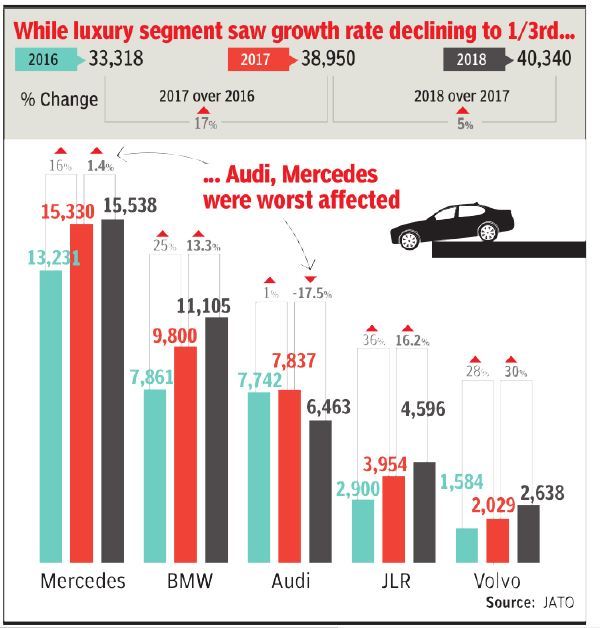
NEW DELHI: Luxury car sales have decelerated. With the stock market remaining volatile through most of last year and liquidity pressure growing, reluctant buyers stayed away from new purchases or upgrades, leading to 5 per cent growth in volumes in 2018 against a 17 per cent surge in the previous year. Luxury car makers like… Continue reading Luxury car sales slow down in India
Tag: Daimler
Exclusive: British Lotus cars to be ‘Made in China’ at new Geely plant: documents
BEIJING/SHANGHAI (Reuters) – The Chinese owner of Lotus plans to start producing the British sports car brand in China for the first time with the opening of a new 9 billion yuan ($1.3 billion) factory in Wuhan city, company job advertisements and government documents showed. FILE PHOTO: The Lotus Exige Sport 410 is seen during… Continue reading Exclusive: British Lotus cars to be ‘Made in China’ at new Geely plant: documents
British Lotus cars to be ‘Made in China’ at new Geely plant: documents
BEIJING/SHANGHAI (Reuters) – The Chinese owner of Lotus plans to start producing the British sports car brand in China for the first time with the opening of a new 9 billion yuan ($1.3 billion) factory in Wuhan city, company job advertisements and government documents showed. A building of the Geely Auto Research Institute is seen… Continue reading British Lotus cars to be ‘Made in China’ at new Geely plant: documents
FCA to pilot car-sharing, subscription for Jeep owners
FCA to pilot car-sharing, subscription for Jeep ownersFiat Chrysler Automobiles NV is exploring new ways to boost sales of its money-minting Jeep brand through a three-month pilot with peer-to-peer car-sharing startup Turo and a trial subscription service for Jeep owners.
The automaker is recruiting owners to rent out their vehicles through Turo, which lists 350,000 models on its platform and pitches itself as a a way for motorists to offset their car payments. Fiat Chrysler also is partnering with Avis Budget Group Inc. on a three-month subscription service that will let owners swap their Jeeps for other vehicles, such as a Ram pickup or Dodge Challenger, said Tim Kuniskis, head of the Jeep brand in North America. Both pilots start next week in Boston and will be limited to the first 100 owners who register for each.
“All these people who are casually going, Is it for me or not for me?,’ I can then get them as potential prospects to sell them a brand-new Wrangler,” Kuniskis said in an interview at the Detroit auto show this week. “We’ll find out what’s good and what’s bad, what customers like and what they don’t like, and ultimately from that we’ll decide if we want to do this as something we promote to our dealerships at the time of sale.”
Mixed Success
Automakers and car dealers have been dabbling with flexible-ownership models, with mixed success. The goal is attracting younger consumers whose tastes have been shaped by the likes of Airbnb Inc. and Uber Technologies Inc.
General Motors Co. started a program last summer that lets owners rent out their GM vehicles using its car-sharing unit, Maven. GM’s Cadillac brand, BMW AG, Daimler AG’s Mercedes-Benz and Porsche AG all have tried out subscription pilots, though Cadillac paused its program and BMW slashed the initial pricing of its subscriptions after Mercedes offered a lower rate.
The biggest stumbling blocks in figuring out the subscription model are pricing and delivery, Kuniskis said. Avis will supply the inventory for the pilot to spare local dealers the depreciation risk of holding the cars. Participants will be able to flip models as many as six times during the three-month period, two with delivery and the rest requiring them to pick up the vehicle themselves.
“We know all the pluses and minuses of subscription services, we’ve seen some challenges,” Kuniskis said. “Let’s step our toe in, let’s see if this is, No. 1, right for the brand. If it makes sense, let’s try it.”
Read or Share this story: https://www.detroitnews.com/story/business/autos/chrysler/2019/01/16/fca-pilot-car-sharing-subscription-jeep-owners/38908385/
Press Releases – Steel import restrictions now definitive, leaving EU auto manufacturers “extremely disappointed”
Brussels, 16 January 2019 – The European Automobile Manufacturers’ Association (ACEA) is extremely disappointed by the decision of EU member states to support the European Commission’s proposal to adopt definitive measures that will continue to restrict imports of steel into the EU. These measures do not take into account the needs of downstream users of… Continue reading Press Releases – Steel import restrictions now definitive, leaving EU auto manufacturers “extremely disappointed”
What the cooperation of Volkswagen and Ford means: VW and Ford – the emergency alliance of the giants

Cooperation was and is not uncommon in the automotive industry. For decades she has been practicing different style flowers – usually with moderate success. At the beginning of the 1990s, there was only one panacea for the CEOs of large manufacturers: growth through takeover. So Daimler bought the American manufacturer Chrysler, BMW, the British carmaker… Continue reading What the cooperation of Volkswagen and Ford means: VW and Ford – the emergency alliance of the giants
German carmakers warn hard Brexit would be “fatal”
FRANKFURT (Reuters) – German carmakers on Wednesday warned of fatal consequences if Britain left the European Union without a divorce deal, predicting job losses in Britain and Europe and urging lawmakers to redouble efforts to ensure tariff-free trade can continue. FILE PHOTO: Cars for export stand in a parking area at a shipping terminal in… Continue reading German carmakers warn hard Brexit would be “fatal”
https://media.daimler.com/marsMediaSite/en/instance/ko.xhtml?oid=42312762
16.
January 2019
Sindelfingen
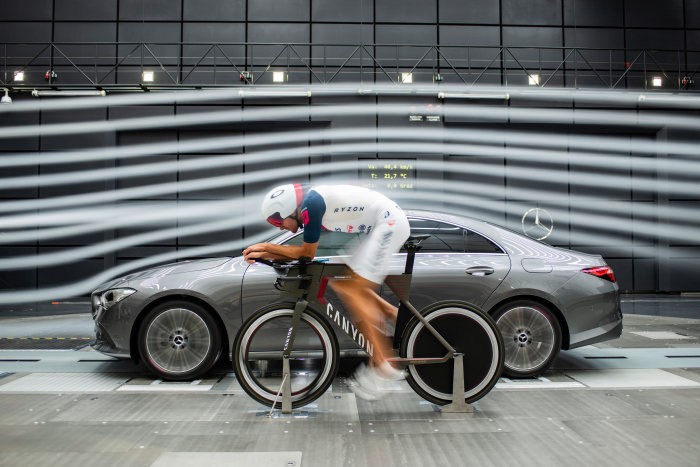
Sindelfingen. Those who know Ironman Jan Frodeno describe him as a perfectionist who looks for the tiniest technical advantage that could save him time. And in the complex triathlon world it is the cycling leg that is by far the most dependent on optimum technique – in particular on the aerodynamics of the cyclist and their bicycle. Dr Teddy Woll has also made this one of his main missions. However the Head of Aerodynamics at Mercedes-Benz is predominantly concerned about mobility that is as efficient as possible rather than world records or victories. A meeting in the state-of-the-art wind tunnel at Mercedes-Benz in Sindelfingen.
What is the significance of aerodynamics as far as you are concerned?
Jan Frodeno: Aerodynamics plays a really fundamental role in the central part of a long-distance triathlon, the 180 km cycle ride. In particular at the World Championships in Hawaii we have to fight against strong gusts of wind as well as the wind resistance. This makes the issue especially complex. And you need to know that it's not just the aerodynamics of the wheel that makes the difference, it's the decisive interplay between the bike and its rider. Because the body causes around 80 percent of the contact surface for the wind. It's definitely worth a few hours in the wind tunnel to find the ideal seat position. Teddy Woll: Aerodynamics are an intelligent way of cutting fleet consumption and also help to close the gap between certified and actual consumption. As the wind resistance grows with the square of the speed, a cd value reduction brings advantages above all at a higher speed. An aerodynamic design is also so important because the vehicles' frontal area is tending to increase: people are getting taller, the battery in electric vehicles needs space and lots of customers prefer an SUV. We are all the prouder that in the new compact cars we have managed for the first time to cut the cd figure yet again and also made the frontal area smaller, in spite of wider wheels and more space in the vehicle. When it comes to the aerodynamics of the bicycle or car, what kind of ballpark figures are we talking about?
Frodeno: Anyone out for a leisurely ride on a touring bike has a Cd value of around 0.7 m². A mountain biker has about 0.6 m², a racing biker 0.5 m². With me – in combination with a helmet, the pre-determined seat position and an aerodynamically optimised bike – a Cd figure of 0.21 m² was measured. So anyone riding a Dutch bike has to overcome three times the resistance, and at as much as nine times the resistance at twice the speed! Woll: Our best is currently the A-Class Saloon. With a cd value of 0.22 it achieves the current world record amongst series vehicles and has a frontal area of around 2.19 m². This adds up to a drag coefficient of 0.49 m². Two people in an A-Class are therefore much more aerodynamic then two racing bike riders – despite triple the frontal area. Is it possible to put the benefit of better aerodynamics in figures?
Frodeno: As the external circumstances are permanently changing, it is so difficult to quantify it in absolute terms. But one thing is clear: the less energy I need the faster I can cycle – or I can save energy for the marathon to come. So we cyclists measure aerodynamics in watts – the power we have to generate in order to overcome the wind resistance – or how many watts we can save at a target speed of, say, 45 km/h. Woll: If it is possible to cut the cd figure by one hundredth, so for example 0.24 to 0.23, the fuel consumption in the customer average falls by one tenth of a litre, at a motorway speed of 140 km/h by approx. 0.2 litres per 100 kilometres or 5 grams of CO2 per kilometre. Today there is no measure that cuts this much consumption at such low costs. To achieve the same saving with lightweight-construction measures in real traffic we would have to reduce the weight of our cars by at least 50 kilograms, and at a motorway speed of 140 by as much as 200 kg. What improvement have you achieved in the course of your career?
Frodeno: In the last few years we have concentrated on working on the bike itself with my bike partner Canyon and we have improved the handlebars and the cockpit. We also tinkered with my seat position and developed a new helmet too. This all resulted in successes. But you also always have to keep an eye on the biomechanics. Because you also have to put power on the pedal too and above all in an Ironman you have to be able to stay in the seat position for 4 hours. It doesn't help one bit if you save 10 W of air resistance in the wind tunnel but the position is then so “uncomfortable” that your performance decreases by 20 W or you can't run properly afterwards. Finding this balance and the perfect point between aerodynamics and biomechanics is our biggest challenge. Woll: We also have a conflict of interests with different demands when it comes to a vehicle – that's why not every model is always more aerodynamic than its predecessor. But generally speaking we have made huge progress in the last few years. One spectacular example is the leap the SUVs have made, from the first M-Class with cd 0.40 to the new GLE, which achieves a new best cd figure in the segment, 0.29. In this period the saloons have clocked up an improvement of some 20 percent. In recent years we have made great progress thanks to the digitisation of the development process, as calculations are very much faster and much more refined. Digital vehicle models nowadays have over 100 million cells, and can produce results overnight with a precision of over 99 percent. Not that long ago, this same simulation would have taken 6 months and would have been very imprecise. Then there is the fact that today we collaborate very well with our colleagues from Design and we have developed a huge mutual understanding. And it certainly makes us proud that we are setting the trend for the entire car industry in this field. And where are the improvements taking place?
Frodeno: Take a look at my current racing bike. My partners at Canyon really took care of every last detail. For instance, my Speedmax CF SLX has a tailor-made cockpit: in order to keep the frontal area as small as possible Canyon milled a special attachment that sits in the centre of the stem. And Continental made me a special tyre with the low rolling resistance of the GrandPrix TT and the reduce wind resistance of the GrandPrix 4000 S2: through the profile in the tread the wind dissipates faster, which saves one to two W compared with the smooth tread of the TT. Woll: This encompasses three areas – the air flow through the engine compartment, the air flow around and within the front wheels, and the underbody. These measures include, for example, the latest generation of active radiator shutters, a complex interplay between 3D wheel spoilers, slotted wheel arch liners and aero wheels, fully trimmed underbodies and also the active level control system on some vehicles. But we take a close look at every nook and cranny of the vehicle, from the front apron with all its edges and apertures to the small spoiler lips in the lenses of the tail lights, to perfect the breakaway of the air flow at the rear. Will the development then continue or has the end of the road been reached?
Frodeno: Development is always ongoing as long as weirdos like me are so obsessed with every detail. If you want to win you have to be better than the rest. And this means that if you stand still you fall behind. We constantly have to learn, measure, buy, develop – and start all over again. Woll: And that is precisely our attitude too. Our company motto “The best or nothing” amounts to the same thing. Of course we are gradually approaching an asymptotic limit if we do not dramatically change the appearance of our cars, e.g. by making them much longer and sleeker, and equipping them with slim rear ends and narrow wheels. Fortunately, however, we can always still find details where improvements are possible — both in the wind tunnel and, increasingly often, on the computer. After all, aerodynamics is the most efficient way to even more efficiency. In conversation
Jan Frodeno (37) was the first triathlete to win both Olympic gold (Peking 2008) and the Ironman World Championship title in Hawaii (2015, 2016). He is Germany's most successful triathlete and also a legend worldwide. Since July 2016 he has held the record for the best time in the world, 7:35:39 hours for a long-distance triathlon, which he set at Challenge Roth.
Dr-Ing Teddy Woll (56) studied business engineering sciences, specialising in electrical engineering at the TU Darmstadt. His doctorate was on the topic of “Measurement of intraocular pressure with a closed eyelid” and in parallel, with the Akasol he developed solar-powered and light electric vehicles, which achieved successes such as winning the Tour de Sol three times. After two years at smart Woll moved to Advance Development at Daimler AG in 1996 and since 1999 he has headed the Aerodynamics and Wind tunnels department.
The aeroacoustic wind tunnel: measurements up to 265 km/h
With its “large wind tunnel” in Stuttgart-Untertürkheim – the first measurement was recorded 75 years ago, on 5 February 1943 – Mercedes-Benz was the first automotive manufacturer to have its own wind tunnel. The new aeroacoustic wind tunnel at the development centre in Sindelfingen, which commenced operation in September 2013, once again put the company at the forefront of aerodynamic testing. The wind tunnel follows the so-called Göttingen design, whereby the air is redirected to the blower after the measuring section and then re-accelerated to 265 km/h. Before the air accelerated by the blower reaches the measuring section, via a nozzle system that encompasses 28 sq m, it must be straightened and smoothed to eliminate unwanted turbulence and eddies. This is done using rectifiers and sieves. Extensive noise insulation measures are integrated to allow use as an acoustic tunnel where interior and exterior wind noise can be measured for the relevant test vehicle. Even at 140 km/h the air flowing through the measuring section is therefore as quiet as a whisper.
The centrepiece of the 19-metre-long measuring section in the wind tunnel is the roughly 90-ton conveyor belt/balance system with a turntable. Five separate belt conveyors simulate the road, whose movement relative to the vehicle influences the air flow in particular on the underbody. The conveyor belt/balance system is integrated into a turntable with a diameter of twelve metres, which means that the test vehicles can also be subjected to an angled flow of air in order to simulate cross-winds.
The aerodynamics world champion from Mercedes-Benz: A-Class Saloon
Fresh wind for saving fuel: for three decades now, the aerodynamics engineers at Mercedes-Benz have been setting one record after another. The world record for series production vehicles is currently held by the new A-Class Saloon with a cd value of 0.22 and a drag of less than 0.49 m2. It thus defends the original world record set by the CLA Coupé, the new model of which achieves 0.23 cd, still an outstandingly good figure.
The good aerodynamic properties make a key contribution to low fuel consumption under everyday conditions. The A-Class Saloon was improved down to the smallest detail by a multiplicity of computation loops, CAE simulations (computer-aided engineering) and measurements in the wind tunnel in Sindelfingen. In addition to the outstanding exterior shape, there are many small measures that led to the new record: a sophisticated reduction of the frontal area despite significantly improved interior comfort dimensions, an extensive sealing concept (such as the sealing of the headlamp surroundings) as well as almost complete panelling of the underbody, which includes the engine bay, main floorpan, parts of the rear axle and the diffuser.
The front and rear wheel spoilers were optimised specifically to route the air around the wheels as efficiently as possible. The rims and tyres also underwent aerodynamic fine-tuning. Depending on the market, an optional two-part shutter system behind the radiator grille is available, which minimises the airflow through the engine bay.
The A-Class Saloon was launch at the end of 2018. The four-door notchback has the wheelbase of the hatchback (2729 millimetres) as well as the proportions of a dynamic and yet compact saloon with short overhangs at front and rear. It is at the top of its segment with regard to rear headroom. In addition, the saloon model has the familiar A-Class virtues. These include modern, efficient engines, a high level of safety thanks to state-of-the-art driving assistance systems with S-Class functions, and the intuitively operated and learning MBUX – Mercedes-Benz User Experience infotainment system.
Press Contact
Markus Nast
Manager Communications Compact Cars
markus.nast@daimler.com
Tel: +49 711 17-96357
Fax: +49 711 17-79055289
Koert Groeneveld
Head of International Product & Technology Communications
koert.groeneveld@daimler.com
Tel: +49 711 17-92311
Fax: +49 711 17-94365
Press Contact Overview
Media
Download
Pictures (9)
Documents (1)
Media Contact (2)
Filter
Show thumbnails
Show list
Slideshow
Zoom
Preview
Details
Do you really want to delete the data record?
Please wait a moment …
Please wait a moment …
Please wait a moment …
Please wait a moment …
18C0895_003
18C0895_010
18C0895_023
18C0895_030
18C0895_032
18C0895_035
18C0895_037
18C0895_038
18C0895_046
Loading
European car sales drop 8.7 percent in December – ACEA
MILAN, Jan 16 (Reuters) – European car registrations fell 8.7 percent year-on-year in December, with sales at all major carmakers except Daimler and Jaguar Land Rover contracting as the introduction of tougher new emissions tests continued to weigh on demand. Registrations fell to 1.04 million cars in the European Union (EU) and European Free Trade… Continue reading European car sales drop 8.7 percent in December – ACEA
Tesla To Release ‘Midrange’ Model 3 Sedan, Its Cheapest Car Yet
For most car buyers, the average Tesla may be more than a bit too pricey for comfort. But that could be changing, as the company’s CEO and co-founder, Elon Musk, announced Thursday that it is now taking orders for a more affordable version of the Model 3 sedan.
According to Business Insider, the “lower cost, midrange” Tesla Model 3 will be sold at $45,000, with federal and state tax rebates reducing the base cost to $35,000 for California buyers. In a Twitter post, Musk said that the “true cost of ownership” could be closer to $31,000 once gas savings are taken into account. Interested buyers can now choose the midrange version on Tesla’s newly updated Model 3 configurator, where it joins the existing high-performance and long-range battery versions.
The lower-priced Tesla Model 3’s base variant comes with a single motor and rear-wheel drive, and an estimated range of 260 miles per charge for its battery pack. This sets the new version apart from the performance and long-range editions, which both have dual-motor setups, all-wheel drive, and battery packs that allow the vehicle to last about 310 miles between full charges.
According to Mashable, the midrange Model 3 has an estimated 0-to-60 mph time of 5.6 seconds and a top speed of 125 mph. The car is being offered in black, deep blue metallic, midnight silver metallic, red, and white, though all color options but the black version will cost an additional $1,500 to $2,500.
As noted by USA Today, the Model 3’s initial announcement last year put Tesla “on the radar of average car buyers,” as its usual price tag of around $55,000 made the car substantially more affordable than the Model S and the Model X, which could both set customers back by more than $100,000 for some of the higher-end trims. The publication speculated that the release of the new midrange Model 3, combined with Tesla’s steady improvements in quarterly production, could help the Palo Alto-based automaker become more competitive in a premium midsize sedan market that also includes cars from Audi, BMW, Jaguar, Lexus, and Mercedes-Benz.
Despite the midrange Tesla Model 3’s lower price point, Business Insider wrote that the new version falls short of what Elon Musk had originally promised ahead of the car’s announcement. The publication pointed out that Musk previously teased a version that would cost $35,000 before tax incentives, or $10,000 less than the midrange edition’s base price. Likewise, Musk’s previous comments that the cheaper Model 3 will be shipping by the end of the year were also cited, as automotive industry analysts predicted last month that Tesla might not be able to make good on its promise of a late 2018 rollout.
A spokesman for Tesla told Business Insider that deliveries for the midrange Tesla Model 3 are expected to start in about four months from now.