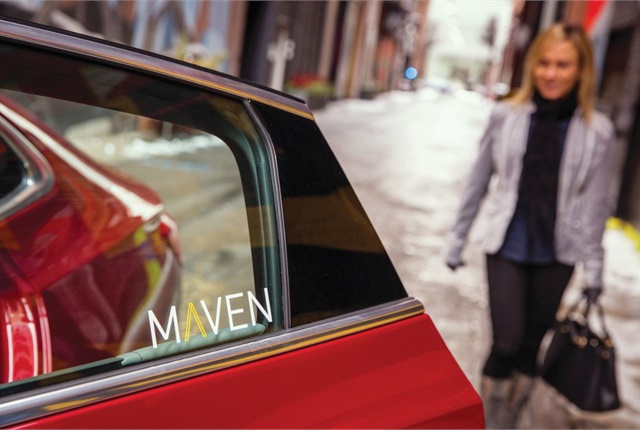
The service will continue to be available in Los Angeles, Washington, D.C., Detroit, and Toronto. Photo via Maven. General Motors’ carsharing service Maven is closing down operations in eight of the 17 North American cities where it operates, The Verge reports. In a statement, the company said it was shuttering its programs in certain cities —… Continue reading GM Ends Carsharing Service Maven in 8 Cities
Tag: GM
Lyft adds more safety features including in-app emergency assistance, reminders to check the plate
Earlier this spring, both Uber and Lyft introduced new safety features and policies following the death of a university student who was kidnapped and murdered after getting into a vehicle she believed to be her Uber ride. Today, Lyft is announcing an expanded set of safety features and programs, including those that help riders find… Continue reading Lyft adds more safety features including in-app emergency assistance, reminders to check the plate
GM builds new electric architecture for EVs, self-driving cars
General Motors next-generation electrical platform
As future cars go electric, self-driving, and more connected with the outside world, they're going to faster connectivity inside the vehicle.
To that end, General Motors just introduced a new electronic platform for its vehicles that it says can carry 4.5 terabytes of processing power per hour, five times what the current system can carry.
General Motors next-generation electrical platform
It will also bring GM vehicles the ability to receive updates over the air, similar to Teslas.
In a statement announcing the new architecture, GM President Mark Reuss said, “Our new digital vehicle platform and its eventual successors will underpin all our future innovations across a wide range of technological advancements, including EVs and expanded automated driving.”
The company says the system will be necessary to meet its goal of building cars that can support a world with “zero accidents, zero emissions, and zero congestion.”
DON'T MISS: Long-range Cadillac SUV to lead GM's next electric-car push, in 3 years
Reuss announced that the new electronic architecture will arrive in the 2020 Cadillac CT5 sedan, which debuted at the New York auto show in April, and is expected to go on sale later this year. Reuss said the system will roll out across most of GM's lineup by 2023. GM has said that Cadillac will become its lead electric-car brand starting with a new generation of electric models in 2022.
Future Cadillac long-range electric large luxury utility vehicle (rendering), 2019 Detroit auto sho
The new system will offer three levels of ethernet connectivity: 100 megabaud, 1 gigabaud, and 10 gigabaud. Those will also allow the system to be expanded over the life of the vehicle.
GM says the new system rides on top of an updated CAN bus architecture, which the company says will give it even higher speeds, along with the ethernet capability.
General Motors next-generation electrical platform
Perhaps more importantly, the system will bring new cybersecurity protocols to GM's cars. Until now, most cars relied on being removed—or “air-gapped”—from the Internet to resist hacking attempts. But several hackers have demonstrated the ability to break in and take control of cars and raised doubt about the security of those systems as more cars receive software updates at dealers, use electronic keys, and connect their infotainment systems to drivers' cell phone network connections.
READ MORE: Barra blogs again: GM plans to double EV, self-driving investments
GM chairs the Automotive Information Sharing & Analysis Center, a community of private and public-sector partners that shares and analyzes intelligence about emerging cybersecurity risks for the automotive industry.
“The critical role of software and its importance to our vehicles, both now and for years to come, cannot be overstated,” Reuss said.
Self-driving trucks begin mail delivery test for U.S. Postal Service
(Reuters) – The U.S. Postal Service on Tuesday started a two-week test transporting mail across three Southwestern states using self-driving trucks, a step forward in the effort to commercialize autonomous vehicle technology for hauling freight. The TuSimple self-driving truck is pictured in this undated handout photo obtained by Reuters May 20, 2019. TuSimple/Handout via REUTERS… Continue reading Self-driving trucks begin mail delivery test for U.S. Postal Service
The ultimate list

*/ ]]> We say thank you! Whether from Kaiserslautern, Eisenach, Bochum, Rüsselsheim or Rest Germany: In recent weeks, we have many original, creative and sometimes bizarre proposals for the list “120 things that an Opel fan must have done” achieved. “The result is a great list that makes any Opel fan reminisce and reflects the… Continue reading The ultimate list
GM’s car-sharing service Maven to exit eight cities
GM is scaling back its Maven car-sharing company and will stop service in nearly half of the 17 North American cities in which it operates. A spokesperson who confirmed Maven was shutting down in some cities, without identifying the locations or number that will remain, said the company plans to focus on markets that have… Continue reading GM’s car-sharing service Maven to exit eight cities
GM Digital Vehicle Platform Debuts, Enables Adoption of Future Technologies
GM Digital Vehicle Platform Debuts, Enables Adoption of Future Technologies Installed on newly-unveiled Cadillac CT5, with rollout to most GM vehicles globally by 2023 2019-05-20 DETROIT — Today, General Motors President Mark Reuss debuted the company’s all-new electronic platform necessary for its next-generation of vehicles, EVs, active safety, infotainment and connectivity features, and the evolution… Continue reading GM Digital Vehicle Platform Debuts, Enables Adoption of Future Technologies
Series hybrids were the next big thing 100 years ago: Are they any more likely today?
Follow Bengt
1916 Owen Magnetic Tourer – Bonhams Tupelo Automobile Museum Auction (2019)
The 1916 Owen Magnetic Tourer that crossed the Bonhams auction block last month was more than a beautiful snapshot from an obscure moment in American automotive history.
As one of the technological wonders of its time, the Magnetic Tourer didn’t have any mechanical connection between its big 374-cubic-inch (6.1-liter) inline-6 engine and the drive wheels. And it could store energy through regenerative braking, or use its battery power to drive the vehicle for short distances.
It was by today’s definition a series hybrid. The engine has no physical link to the wheels; it drives a generator, supplying electricity that powers a motor system, with a battery acting as a buffer.
DON'T MISS: Nissan e-Power series hybrid builds on electric-car expertise
Series hybrids have a long history, but outside of non-automotive applications like locomotives and submarines it’s mostly a history rooted in concept cars and research-and-development projects. No automaker has gone big with series hybrids in the way that Toyota has with its series-parallel systems in the Prius and many other vehicles, which can mechanically drive the wheels with both the engine and electric motor simultaneously.
Nissan Note e-Power hybrid
Nissan continues to say it has a lineup of series hybrids on the way—badged e-Power in upcoming vehicles—although that system hasn’t arrived yet in more robust form for the U.S. Although a few other vehicles like the Karma Revero (originally Fisker Karma) use a true series-hybrid system, the ones that have seen wider production, like the Chevrolet Volt (Voltec) and the Honda Accord Hybrid (i-MMD) have used a combination of series and parallel modes.
As pointed out by Hemmings, the Magnetic Tourer used a version of the so-called “electric transmission” that had been developed by Justus B. Entz as early as 1902, with a neatly packaged drive unit employing two identical motor-generators, plus a 24-volt electrical system.
CHECK OUT: Why two-motor hybrids are better than those with just one
The car had no clutch, but with a system of controllers providing five forward speed settings for the propulsion system via and a steering-column speed selector (and we suspect, with the throttle), the driver could choose the speed—and even use regenerative braking, which spared the mechanical rear brakes. There’s no clutch, and as with many vehicles from its time it may have taken some patience to drive it smoothly (and safely).
Some who have experienced the Owen have described it as locomotive-like—which isn’t all that surprising given how the technology is popularly used.
1916 Owen Magnetic Tourer – Bonhams Tupelo Automobile Museum Auction (2019)
This particular Owen Magnetic Tourer was part of the collection of the late Frank Spain and the former Tupelo Automobile Museum. At the Bonhams April 27 auction, selling the contents of the museum for charity, the Magnetic Tourer sold for $128,800, including the sale premium.
The car up for sale, one of about 800 examples built in 1916, had just 2,500 miles and was described as “in nice older restoration condition…with a high degree of originality.”
READ MORE: Will electric cars eliminate conventional hybrids from the market?
“Although they were popular with celebrities, they were ultimately a market failure and the company failed in 1921,” summed Bonhams.
Hybrids like the Magnetic Tourer could have become a larger part of the market during that time as they merged two technologies consumers were already familiar with. By 1916 gasoline had become widely accepted as the solution for getting the quantum leap in mobility—the personal automobile—to the masses, but that was a relatively recent development. In 1900, 38 percent were battery-electric.
Two things doomed the system then. It was abandoned at the time for being too heavy and expensive, at a cost of more than $3,000 in 1916 money—the equivalent of $70,000+ today.
2018 Toyota Prius
Today, the thing that has driven most automakers to series-parallel hybrids rather than pure series hybrids is a common scenario in U.S. driving: high-speed freeway driving. In such environments, multiple engineering teams over multiple decades have concluded that a mechanical connection to the engine offers better efficiency.
Nevertheless, this car and its technology can be cause for taking stock of what happened then and why certain technology is favored today. And today the current may be changing, with many automakers accepting electric cars as the future and, perhaps (like Nissan), seeing series hybrids as a cost-effective incremental technology.
Would electric cars have caught on earlier had this Owen been more popular and affordable? Would hybrids have taken a different preferred form in modern vehicles? Or would transmissions have existed in the same way? Some obscure models from the past, like this one, may yet help frame the future.
GM’s car-sharing service is pulling out of eight cities, including Chicago and NYC
Maven, the car-sharing service owned by General Motors, is ending operations in several major North American cities. According to The Wall Street Journal, the mobility brand will wind down service in eight of the 17 cities in which it operates, including Boston, Chicago, and New York City. Maven will continue to operate in Detroit, Los… Continue reading GM’s car-sharing service is pulling out of eight cities, including Chicago and NYC
Honda, GM blockchain project to examine how EV owners could earn revenue from smart grids
Honda and GM have joined forces in a new research project that aims to examine how electric cars and smart grids can work together in the future, with EV owners possibly leveraging their car batteries into new streams of revenue. The project hopes to determine if electric vehicles can be used to stabilize the power… Continue reading Honda, GM blockchain project to examine how EV owners could earn revenue from smart grids