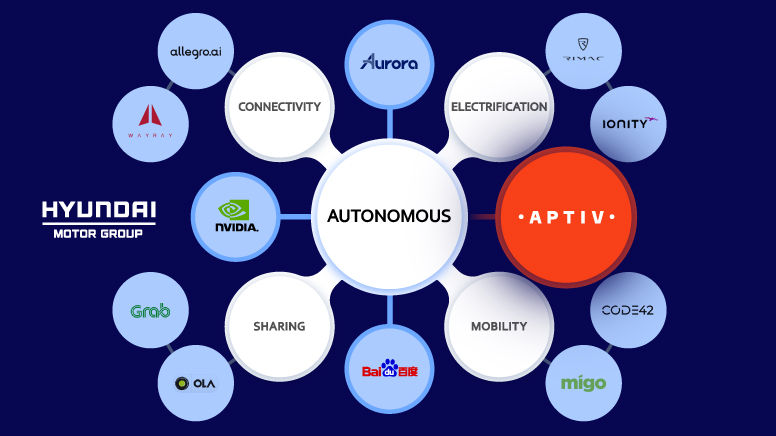
Hyundai Motor Group announced today that it will be forming an autonomous driving joint venture in the U.S. with Aptiv, one of the industry’s most innovative vehicle technology providers. The joint venture will advance the design, development, and commercialization of SAE Level 4 and 5 autonomous technologies. HMG will collectively contribute 2 billion US dollars.… Continue reading Hyundai: Hyundai Motor Group Investing in Joint Venture with Aptiv
Tag: Autonomous
Analysis: The numbers behind the FCA-PSA merger
The FCA-PSA tie-up gathers 15 brands under the same roof The agreed merger between Fiat Chrysler Automobiles and the PSA Group will create the world’s fourth-largest car company based on sales. The two European firms last week announced their intention to create a new entity owned 50/50 between the two but led by PSA’s CEO, Carlos Tavares. PSA will… Continue reading Analysis: The numbers behind the FCA-PSA merger
Uber’s Self-Driving Car Didn’t Know Pedestrians Could Jaywalk

The software inside the Uber self-driving SUV that killed an Arizona woman last year was not designed to detect pedestrians outside of a crosswalk, according to new documents released as part of a federal investigation into the incident. That’s the most damning revelation offered up in a trove of new documents related to the crash,… Continue reading Uber’s Self-Driving Car Didn’t Know Pedestrians Could Jaywalk
AEye Team Profile: Ove Salomonsson
On October 30th, AEye’s Sr. Director, LiDAR Product Architect, Ove Salomonsson, will speak at two sessions during SAE Innovations in Mobility in Novi, Michigan: Using Intelligent Sensing to Achieve Accurate, Fast Perception and Bringing Intelligence to the Edge.
Ove Salomonsson has 30+ years of experience in engineering of automotive safety electronics. He came to AEye from Lucid, where he was director of Autonomous Driving and ADAS. Before that, he led long range ADAS system development at Magna Electronics and directed technology development at Autoliv Electronics, where he was also General Manager for the Night Vision camera division. Salomonsson was also VP of Traffic Systems at Saab Systems and in DSRC (V2V) at Saab Combitech. He began his career at Volvo, where he managed safety technology projects. Salomonsson holds a BSC in Innovation Engineering from the University of Halmstad.We sat down with Ove to learn about how ADAS, self-driving technologies, and perception sensors have evolved over the years, and what he misses most about Sweden.
Q: You’ve been working in ADAS and autonomy for quite some time – how have you seen these technologies evolve over the years?Radar has been around for quite some time and continues to evolve into smaller, better, and less costly sensors. In fact, cost has come down so significantly that they are now on close to every new car delivered – either providing standalone applications like cross traffic alert or blindspot detection, or as part of a larger ADAS system. However, radar is still quite limited because of its relatively low resolution and multi-path problems.
It was certainly a big deal when cameras became qualified for automotive and low cost enough to make it on to vehicles in greater volume, such as backup cameras and forward facing cameras for collision alerts. There is so much more information captured in a camera image than by radar, and the resolution nowadays has increased up to 8 megapixel. However, the costly and energy consuming AI compute portion of ADAS and AV systems will still need time to catch up to that amount of information rushing into the AI algorithms.
Based on recent test information from AAA, performance is still flawed in automatic emergency braking (AEB) systems, which highlights the importance of LiDAR. LiDAR is the final sensor modality that is needed to make ADAS systems (and eventually full autonomy) work effectively in all conditions. LiDAR is more deterministic by nature, as it can detect and measure the distance to all objects. And with an agile LiDAR, such as AEye’s iDAR, this can be done incredibly fast with the added ability to classify objects and determine their velocity.
Q: How have perception sensors for AVs evolved during this time?I have seen this evolution take place from both the OEM and Tier 1 point of view. However, the most important part is end-customer and societal benefits, such as a reduction in automotive accidents. The lowering of costs and increased capability in terms of resolution and Field-of-View has meant that new applications have been created, expanded upon, and deployed in the market. The list of driver assistance systems is growing: from lane departure warning, forward collision warning, and automatic high beam assist systems to newer features like front and rear automatic emergency braking (AEB) and adaptive cruise control (ACC) with lane following.
With improved sensors and perception algorithms, the focus has now shifted to allowing “hands off” the wheel and, more recently, “eyes off” the road under certain conditions. This happens to be the first (and most challenging) step towards true autonomy since responsibility is transferred to the vehicle for at least some amount of time. Any time we allow the driver to hand over driving tasks to the vehicle, it also becomes important to constantly monitor the driver’s awareness in case there is a need to transfer control back. For example, driver monitoring cameras have been introduced in certain circumstances.
However, perception sensors still need to achieve enough redundancy for autonomous driving systems to be able to “fail operationally.” For example, in a truly autonomous vehicle, the passenger may be sleeping, and the vehicle will have to be able to continue to drive by itself, say, if the camera loses power or a bird hits the windshield right in front of the camera. The vehicle still needs to be able to operate for a certain time period (or until it reaches a safe place to stop) using LiDAR and radar together.
The last and most important piece of the puzzle needed to provide enough redundancy for these systems to “fail operationally” (and also cover additional edge cases) is indeed LiDAR. LiDAR’s deterministic range measurements, high resolution, and low light capability makes it a great complement to both radar and camera.
Q: You grew up in Sweden! What Swedish traditions (holidays, foods, activities) do you miss most here in the States?I moved to the US almost 25 years ago, but I still go back to Sweden at least once a year to celebrate Midsummer.
What I miss the most is Swedish chocolate and fresh seafood, including Sweden’s wide variety of marinated herring. And, believe it or not, Sweden is home to an exquisite kebab pizza (not a Viking tradition, but rather, a new delicacy).
By the way, did you know that one of Sweden’s biggest exports is music? ABBA, of course, ruled the seventies; Roxette the eighties, Robyn and the Cardigans the nineties; and, more recently, Tove Lo and Zara Larsson. Even Spotify is Swedish!
—–
Connect with AEye at SAE Innovations in Mobility.
AEye Team Profile: Ove Salomonsson —AEye’s New AE110 iDAR System Integrated into HELLA Vehicle at IAA in FrankfurtAEye Wins Award for Most Innovative Autonomous Driving Platform at AutoSens BrusselsAEye Team Profile: Jim RobnettAEye Adds VP of AI and Software to Executive TeamAEye: Developing Artificial Perception Technologies That Exceed Human PerceptionAEye Redefines the Three “Rs” of LiDAR – Rate, Resolution, and RangeAEye Extends Patent Portfolio, Creating Industry’s Most Comprehensive Library of Solid-State Lidar Intellectual PropertyAEye Expands Business Development and Customer Success Team to Support Growing Network of Global Partners and CustomersUnique iDAR Features That Drive SAE’s 5 Levels of Autonomy
Hyundai Autron Selects BlackBerry QNX to Power Next-Generation ADAS and Autonomous Driving Software Platform
WATERLOO, Ontario and SEOUL, South Korea, Nov. 5, 2019 /PRNewswire/ — BlackBerry Limited (NYSE: BB; TSX: BB) today announced that Hyundai Autron has selected BlackBerry QNX to power its next-generation advanced driver-assistance systems (ADAS) and autonomous driving software platform. Hyundai Autron, a subsidiary of South Korea’s largest automobile manufacturer Hyundai Motor Group, is a leading research and development… Continue reading Hyundai Autron Selects BlackBerry QNX to Power Next-Generation ADAS and Autonomous Driving Software Platform
Take a peek inside Lyft’s lab where 400 engineers are working on self-driving cars – CNBC
Lyft, the second largest ride-hailing service in the U.S., once helped disrupt the taxi industry. Now, the company is working hard to avoid being disrupted itself as self-driving cars turn from sci-fi into reality. According to Taggart Matthiesen, vice president of product at Lyft’s Autonomous Group, the company has assigned around 400 of its engineers… Continue reading Take a peek inside Lyft’s lab where 400 engineers are working on self-driving cars – CNBC
Beyond the Robo-Taxi: Great Customer Experiences Will Define Self-Driving
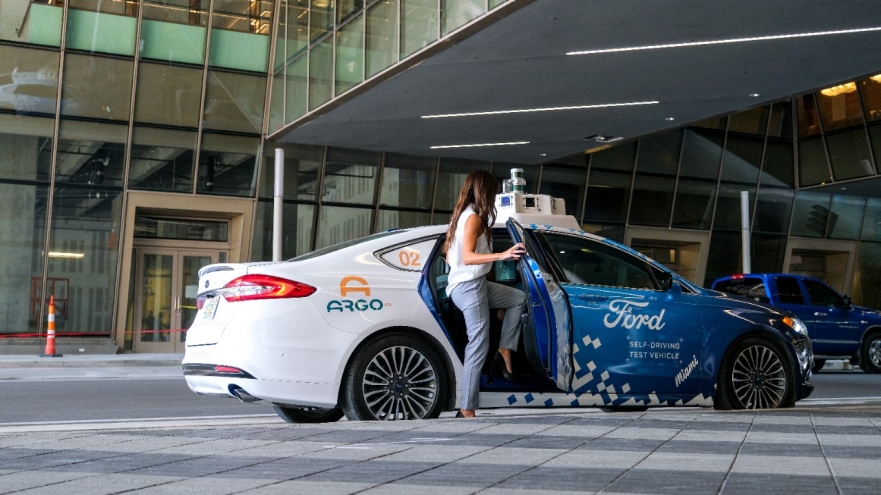
By Jim Farley, President, New Business, Technology and Strategy, Ford Motor Company When most people talk about why autonomous vehicles will be successful, they tend to focus on the self-driving software alone. Don’t get me wrong, the self-driving system is incredibly important to develop, but it’s just one part of building a safe and scalable… Continue reading Beyond the Robo-Taxi: Great Customer Experiences Will Define Self-Driving
Walmart ends legal feud with Tesla after accusing the company’s solar panels of causing fires at 7 stores (TSLA, WMT)
Walmart has dropped its lawsuit against Tesla, which accused the company’s solar panels of causing fires at seven stores. Tesla engaged in “widespread negligence” as it installed more than 200 systems at Walmart stores nationwide, the original complaint said. A Walmart representative said the two companies had reached a settlement outside of the court to… Continue reading Walmart ends legal feud with Tesla after accusing the company’s solar panels of causing fires at 7 stores (TSLA, WMT)
Hyundai: Hyundai Motor offers glimpse of Smart Future Mobility in new campaign

Campaign demonstrates a renewed commitment to customer experience innovations with five commercials on how Hyundai Motor offers quality time, real-life connections The films illustrate the various ways Hyundai’s autonomous, micro, clean and robotics mobility solutions empower people to pursue their passions at full throttle Hyundai continues its pursuit of human progress via diverse open innovation channels;… Continue reading Hyundai: Hyundai Motor offers glimpse of Smart Future Mobility in new campaign
Tesla and Walmart settle dispute over the fires at solar installations
Tesla and Walmart announced that they have settled their dispute over the fires at Tesla’s solar installations at Walmart stores that led to de-energizing 240 large solar installations. Earlier this year, we reported on Walmart filing a lawsuit that revealed several fires occurred at stores where SolarCity installed rooftop solar arrays. The lawsuit alleged that… Continue reading Tesla and Walmart settle dispute over the fires at solar installations