Stuttgart, Germany – Bosch is preparing systematically for connected manufacturing and logistics: effective July 1, 2019, Sven Hamann, 46, took over as head of the Bosch Connected Industry business unit. Hamann succeeds Dr. Stefan Assmann, 55, who is joining the company’s Industrial Technology business sector as its business chief digital officer. Changes are also underway… Continue reading Bosch sets the stage for the factory of future
Tag: Autonomous
Beep Selects Bestmile To Plan, Manage, And Optimize Autonomous Vehicle Fleets
Searching for your content…
No results found. Please change your search terms and try again.
May 21, 2019 Blog The Must-read Guide to Using the New LeddarSDK for your Mobility…
The Must-read Guide to Using the New LeddarSDK for your Mobility Application
Blog post by Julien Stanguennec, Product Engineer, LeddarTech®
LeddarTech’s LiDAR technology provides Tier-1 suppliers and selected Tier-2s the key components and tools to develop and produce differentiated SSL solutions tailored to the specific Advanced Drivers Assistance Systems, Autonomous Driving, and mobility application requirements of OEMs.
Throughout the entire development process, customers have access to engineering and training services, ongoing support, and a comprehensive team of Leddar EcosystemTM partners, who serve as integral elements of our product offering.
As part of our service support engagement, we always aim to provide the right resources and guidance on how to successfully integrate and deploy LeddarTech’s suite of LiDAR modules in our customers’ mobility applications.
This blog post focuses on the essential elements required to integrate LeddarTech’s LiDAR sensors for mobility applications successfully and on schedule using the recently built LeddarSDK.
Ways to Integrate LeddarTech’s LiDAR Sensors
It is important to start by noting that we offer customers two main avenues to integrating LeddarTech’s LiDAR sensors in their applications:
Developers can build their complete application from the ground up, based on the low-level communication protocol definition. You can download our sensor User-guide to learn more about how to proceed with this option.
We offer the LeddarSDK for customers who wish to accelerate their software integration and reduce the lead time associated with entirely building their application from the ground up. We have built a new LeddarSDK to provide a more flexible, more usable SDK than ever before.
As outlined above, we will further explore the way in which customers can integrate LeddarTech sensors using the LeddarSDK application.
What is the LeddarSDK
LeddarSDK is a software development kit allowing LeddarTech customers to easily integrate LeddarTech’s LiDAR sensors by providing third-party libraries for low-level communication, code example, and documentation. The LeddarSDK also provides a standardized API that enables developers to start building their application quickly and easily. Below are some of the key advantages and specifications of the new LeddarSDK:
Open-source and Cross-platform (limited use of pre-compiled code – only from libraries);
Constitutes a unique software package for main LeddarTech mobility sensors and all communication protocol;
To account for most developers needs, a python layer and a ROS node are offered over a C++
The tested Hardware platform are PC based x86 (IA-32), x64 (AMD64/EM64T) and ARM-based platform Raspberry Pi;
The tested Operating Systems are Linux (Ubuntu) and Windows (7, 8,10);
LeddarSDK is designed for PC-based architecture to be interfaced with the M16 family (M16-LED, M16-LSR, IS16), Vu8, and LeddarOne LiDAR sensors with all communication protocol available (USB, Modbus (RS232, RS485 & USB VCP), CAN BUS, SPI;
For the low-level communication protocol, alternate hardware and library are used to interface with the PC’s USB port.
About the Hardware Interface
Below are the key considerations regarding the Hardware Interface:
FTDI cable to convert RS232, RS485 and SPI to USB (See accessories at leddartech.com).
For CAN BUS communication, Komodo CAN interface to USB (https://www.totalphase.com/products/komodo-cansolo/).
About the Third-Party Library
Below are the key considerations regarding the third-party library:
Libusb for USB communication (.c and .h for windows, and standard library for Linux)
Libmodbus for Modbus communication (.c and .h)
Komodo for CAN BUS communication (compiled .so and .dll)
FTDI for RS232 and RS485 for FTDI cable PHY (compiled .so and .dll)
MPSSE for SPI FTDI cable PHY (compiled .so and .dll)
RapidJSON for data recording
Functionality Considerations
The LeddarSDK takes care of low-level communication and provides an standard abstraction layer for the different LeddarTech sensors to easily:
Connect to a sensor
Read detections
Configure the sensor
Record data
In addition, to provide developers with a complete picture, we also offer LeddarConfigurator software for windows that provides a graphical user interface (GUI) to allow customers to quickly connect to a sensor, configure it, display live data, and record measurements. This software is typically used for quick technology assessment and troubleshooting, while the SDK can be used to build the application.
How to Access the LeddarSDK
We are happy to announce that the LeddarSDK is now delivered on GitHub, for wider collaboration with the developer community. Customers can access the LeddarSDK in the following way:
Code Distribution: github.com/leddartech/LeddarSDK
User Documentation: sdk.leddartech.com
Return to Latest News and Media Coverage
This website places cookies on your device to give you the best possible user experience. By using our websites, you agree to our cookies being saved on your device (unless you have disabled cookies in your settings). For more information, please read our Terms of Use and our Privacy policy.
I Agree
May 27, 2019 In the media LeddarTech Featured on the APMA’s latest episode of “The…
LeddarTech Featured on the APMA’s latest episode of “The Intelligent Podcast”
Claude Doré, our Chief Financial Officer and Daniel Aitken, our Vice-President of Global Marketing sat down with Warren Ali, Vice-President of Innovation at the Automotive Parts Manufacturer’s Association to talk about CES 2019, LeddarTech’s growth, the future of Autonomous Technology for Automotive Applications, and getting into the best industry parties. All this during the latest recording of The APMA’s Intelligent Podcast.
Click here to listen to the episode of the podcast:
https://soundcloud.com/user-819903760/leddartech
More about LeddarTech and the APMA:
APMA’s connectTEC Conference – Windsor, Canada
Pierre Olivier, Chief Technology Officer at LeddarTech, will join a panel discussion on Intelligent Mobility at the connectTEC Conference – The In.tel.li.gent Network on June 11th, 2019. The APMA event aspires to bring together Canada’s Leaders in Auto, ICT, Industry, and Infrastructure to discuss the challenges and identify the opportunities that lie ahead for Canadian manufacturers. Mr. Olivier’s focus will be on communicating the impact of LiDAR Technology for automotive and mobility AD applications.
Return to Latest News and Media Coverage
This website places cookies on your device to give you the best possible user experience. By using our websites, you agree to our cookies being saved on your device (unless you have disabled cookies in your settings). For more information, please read our Terms of Use and our Privacy policy.
I Agree
May 28, 2019 Press release LeddarTech to Appear at a Series of North American Conf…
LeddarTech to Appear at a Series of North American Conferences on LiDAR Auto and Mobility Technology in June 2019
QUEBEC CITY, May 28th, 2019 — LeddarTech®, an industry leader providing the most versatile and scalable auto and mobility LiDAR platform™, is pleased to announce that LeddarTech’s Mobility Leadership Series continues through the month of June with participation in several conferences across North America. LeddarTech’s senior executives will present at Impulsion MTL 2019 on June 3rd, APMA’s connectTEC conference on June 11th, and at the 2019 GSA Silicon Summit on June 18th. LeddarTech will also exhibit at TU-Automotive Detroit on June 5th.
June 3rd: Impulsion MTL 2019 – Montreal, Canada
Frantz Saintellemy, president and COO of LeddarTech, will present at Impulsion MTL International Fleet Forum. The event will bring professionals and suppliers together around a common objective: upgrading fleets with new technologies and solutions to meet environmental, social, operational, and regulatory requirements. Mr. Saintellemy’s talk will focus on LiDAR and the evolution of technology in advanced driver-assistance systems.
June 5th: TU-Automotive – Detroit, U.S.A.
Senior members from LeddarTech will exhibit at the TU Automotive Conference in Detroit, U.S.A. TU-Automotive Detroit is the world’s largest automotive technology conference & exhibition, shaping the future of connected auto mobility. LeddarTech will exhibit as part of the Government of Canada pavilion. Visit booth #B113 to speak with our LiDAR specialists and discover our ADAS and AD solutions for automotive and mobility applications.
June 11th: APMA’s connectTEC Conference – Windsor, Canada
Pierre Olivier, Chief Technology Officer at LeddarTech, will join a panel discussion on Intelligent Mobility at the connectTEC Conference – The In.tel.li.gent Network. The APMA event aspires to bring together Canada’s Leaders in Auto, ICT, Industry, and Infrastructure to discuss the challenges and identify the opportunities that lie ahead for Canadian manufacturers. Mr. Olivier’s focus will be on communicating the impact of LiDAR Technology for automotive and mobility AD applications.
June 18th: 2019 GSA Silicon Summit – Santa Clara, U.S.A.
Charles Boulanger, LeddarTech’s CEO, will speak and participate in a Transformation of Mobility panel at the 2019 GSA Silicon Summit. Mr. Boulanger will discuss advanced LiDAR sensor architectures, and how platform solutions are enabling autonomous driving. GSA’s Silicon Summit brings together more than 250 semiconductor executives from leading companies in the expanded semiconductor ecosystem for a full day of discussion and thought exchange. This year’s focus is on “The Smart Evolution – Ubiquity, Autonomy, Mobility.”
About LeddarTech
LeddarTech is an industry leader providing the most versatile, scalable auto and mobility LiDAR platform based on the unique LeddarEngine, which consists of a suite of automotive-grade, functional safety certified SoCs working in tandem with LeddarSP™ signal processing software. The company is responsible for several innovations in cutting-edge mobility remote-sensing applications, its patented technologies enhancing ADAS and autonomous driving capabilities for automobiles, trucks, buses, delivery vehicles, robotaxis, shuttles, and more. Additional information about LeddarTech is accessible at www.leddartech.com, and on LinkedIn, Twitter, Facebook, and YouTube.
LeddarTech, Leddar, LeddarEngine, LeddarSP, and LeddarTech logos are trademarks or registered trademarks of LeddarTech Inc. All other brands, product names, and marks are or may be trademarks or registered trademarks used to identify products or services of their respective owners.
Download the PDF version of the press release
Download
Return to Latest News and Media Coverage
This website places cookies on your device to give you the best possible user experience. By using our websites, you agree to our cookies being saved on your device (unless you have disabled cookies in your settings). For more information, please read our Terms of Use and our Privacy policy.
I Agree
Chinese rideshare giant Didi Chuxing makes big move in driverless car race
A logo of ride-hailing giant Didi Chuxing displayed on a building in Hangzhou in China's eastern Zhejiang province.STR | AFP | Getty ImagesChinese ride-hailing giant Didi Chuxing ( “Didi”) has amassed more than 550 million users and 31 million drivers since taking to the streets of Beijing seven years ago. In the past three years, the global rideshare giant has devoted close attention to its autonomous driving unit. That unit became an independent company on Monday in a move designed to focus and designate more resources toward business development and product innovation.
The Uber-competitor established its autonomous driving team in 2016 and has since employed more than 200 people in China, as well as at its Mountain View, California research facility, where it has been working with various auto manufacturers like Volkswagen and Toyota Motors to test core innovative technologies.
Last month, Didi Chuxing received $600 million in corporate financing from Toyota, which includes directly establishing a joint venture with GAC Toyota, a joint venture between Toyota and a Chinese car maker. The new funds come as Didi continues heavy expansion in several new overseas markets, where it hopes to challenge Uber and other ride-hailing giants like India's Ola, Brazil's Easy Taxi and Singapore's Grab — a three-time CNBC Disruptor 50 company.
Didi Chuxing is also a notable Disruptor 50 company, breaking the top 10 at No. 4 in 2018 and No. 2 in 2019.
“Autonomous driving will greatly enhance the safety and efficiency of travel,” said Didi Chairman and CEO Cheng Wei in a release. “In the future, people's transportation needs … will be met by the combination of seamless autonomous driving technology and human driving services that are indispensable for their quality and warmth.”
To fund the new driverless car company, Didi is in new talks with SoftBank, according to a report from The Information. The Japanese tech and telecom giant has previously made multiple, large investments in the ride-hailing company. Based on the most recent funding round, Didi Chuxing has raised $22.74 billion and is valued at $57.6 billion.
In 2016, the same year that Didi's autonomous driving unit was established, SoftBank played an influential role in Uber's decision to sell its China business to Didi, notably pushing the U.S. ride-hailing giant out of the region and exposing Didi to their customer base outside of China for the first time.
Investors want clearer profit pathAsad Hussain, a PitchBook analyst and an expert in mobility, ride-sharing and autonomous vehicles, sees the company's decision as part of a broader trend consistent with the challenges that self-driving technology presents.
“Spinning out autonomous divisions enables these companies to raise outside capital and offers investors a more targeted bet on self-driving relative to investing in the parent entity,” he said. “We think this is a logical move for Didi and other ride-sharing companies facing pressure from investors to streamline costs and show a clear path to profitability.”
Didi went through a major round of layoffs earlier this year, according to multiple reports, as it continues to lose money, like its competitors. Uber recently announced 400 job cuts in its marketing team.
Waymo, Alphabet's autonomous vehicle unit, also announced that it would raise outside capital for the first time this past March, positioning itself to cut costs and limit downside risks.
Didi's Chief Technology Officer (CTO) will head the new autonomous driving company as CEO. In an email to CNBC, a communications representative for Didi said that the company does not currently have plans for an IPO.
Uber and Lyft, the U.S. rideshare leaders with heavy investments in driverless vehicles, have fared poorly after highly anticipated IPOs earlier this year as investors doubt how quickly they can become profitable.
VIDEO2:4902:49There will be consolidation in the driverless car industry: Pony.aiSquawk Box AsiaIn a recent survey, auto and tech industry experts predicted it will be at least 12 years before fully autonomous vehicles are being sold to private buyers. While Tesla CEO Elon Musk says 1 million Teslas capable of being robotaxis will be on the road by the end of next year, industry experts say robotaxis will not be ready for widespread public use until 2025.
Last week, General Motors subsidiary Cruise, postponed a planned launch of an autonomous ride-share service as it continues developing, validating and making sure its self-driving cars are ready.
“What's most important when we do launch this service is that we do it the right way,” Cruise CEO Dan Ammann said.
GM's Cruise delays autonomous ride service beyond 2019
Original Article
Automotive News Covers Velodyne SVP Mircea Gradu’s Push to Standardize Automotive Safety Regulations
Automotive News Covers Velodyne SVP Mircea Gradu’s Push to Standardize Automotive Safety RegulationsAugust 9, 2019|In Media Coverage|By Albie Jarvis
Adopting standardized safety regulations will help
automakers reduce the cost and complexity of vehicle autonomy and driver
assistance and make it easier for consumers to understand how the capabilities
work.
That was a key theme of a presentation by Velodyne Lidar Senior
Vice President of Quality and Validation Mircea Gradu at the 2019 CAR
Management Briefing Seminars, according to an Automotive
News story by Richard Truett.
The story noted:
“Having one global standard would allow suppliers and
automakers to cut development cost and product complexity. For example, some
countries require a driver’s hands to always be on the steering wheel in a
vehicle that can steer itself, while other countries do not, he (Gradu) pointed
out.”
All vehicle autonomy and driver assistance capabilities need
to be assessed by the same safety gauge to benefit both the industry and
consumers.
To read the complete Automotive News story, please go
here:
https://www.autonews.com/management-briefing-seminars/agree-1-set-self-driving-rules-velodynes-gradu-urges-automakers
That was a key theme of a presentation by Velodyne Lidar Senior
Vice President of Quality and Validation Mircea Gradu at the 2019 CAR
Management Briefing Seminars, according to an Automotive
News story by Richard Truett.
The story noted:
“Having one global standard would allow suppliers and
automakers to cut development cost and product complexity. For example, some
countries require a driver’s hands to always be on the steering wheel in a
vehicle that can steer itself, while other countries do not, he (Gradu) pointed
out.”
All vehicle autonomy and driver assistance capabilities need
to be assessed by the same safety gauge to benefit both the industry and
consumers.
To read the complete Automotive News story, please go
here: https://www.autonews.com/management-briefing-seminars/agree-1-set-self-driving-rules-velodynes-gradu-urges-automakers
Moon Walks, Woodstock and the Ford Capri; Celebrating the 50th Anniversary of an Iconic Sports Car
Next
Previous
Home
News
Moon Walks, Woodstock and the Ford Capri; Celebrating the 50th Anniversary of an Iconic Sports Car
It was the year man walked on the moon for the first time, the legendary Woodstock festival took place and the very first Boeing 747s reached for the skies. In that same year, half a century ago, Ford’s Capri hit Europe’s roads for the first time.
When it launched in 1969, it was billed as “the car you always promised yourself” and more than 1.8 million people would make good on that promise. The demand saw Ford’s Cologne plant in Germany produce Capris for the next 17 years, through three generations, until 1986. Since then countless drivers have continued to own, drive and enjoy one of Europe’s most recognisable sports cars.
A new video to mark the model’s 50th birthday takes a rare RS2600 Capri on a nostalgic trip; from its birthplace to the forests of the nearby Eifel mountains – where extensive testing occurred before launch – and then on..
Electrify America to deploy commercial robotic chargers
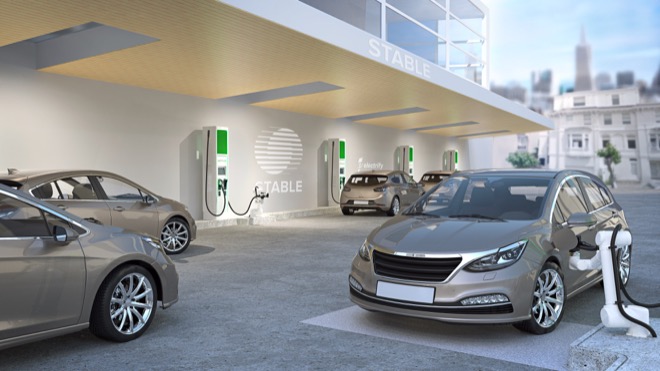
Charging network operator Electrify America and fleet charging company Stable Auto are launching a robotic charging pilot for self-driving vehicles in San Francisco. The pilot will aim to charge autonomous EVs without human intervention using robots attached to 150 kW DC fast chargers. Vehicles can park anywhere within a designated parking space and the robot… Continue reading Electrify America to deploy commercial robotic chargers