Press release / January 8, 2019 LeddarTech Joins Baidu’s Apollo Autonomous Driving Open Platform LeddarTech’s LiDAR technology will now be compatible with Apollo 3.5, the latest version of the platform, through the integration of an open source software development kit (SDK) which will facilitate the development for Tier-1 suppliers, OEMs, and other application developers.

Leddartech/Press release/LeddarTech Joins Baidu’s Apollo Autonomous Driving Open Platform

LeddarTech Joins Baidu’s Apollo Autonomous Driving Open Platform
LeddarTech joins Baidu’s Apollo autonomous driving open platform with its LiDAR products through an open source SDK.

QUEBEC CITY, January 8, 2019 — LeddarTech, an industry leader providing the most versatile and scalable auto and mobility LiDAR platform, announced the integration of LeddarTech’s LiDAR products into Apollo, Baidu’s autonomous driving open platform.

LeddarTech’s products will now be compatible with Apollo 3.5, the latest version of the platform, through the integration of an open source software development kit (SDK) which will facilitate the development for Tier-1 suppliers, OEMs, and other application developers who wish to use LeddarTech products within the Apollo open platform.

LeddarTech’s auto and mobility LiDAR platform equip key suppliers with the technology, tools, and resources they need to design their own differentiated LiDAR offering and to meet the specific requirements of various advanced driver-assistance systems (ADAS) and autonomous driving (AD) applications. At the core of the platform is the LeddarEngine, comprised of highly-optimized SoCs and signal processing software that have been designed to meet ISO 26262 ASIL-B standards and that will allow LeddarTech’s customers to deliver automotive-grade LiDAR sensors which comply with functional safety requirements.

“An open platform is a powerful model that fosters win-win, added-value partnerships throughout the automotive supply chain,” said Frantz Saintellemy, LeddarTech’s President and COO. “With our open source SDK for the Apollo platform, the data output format will allow easier comparison and system development,” added Saintellemy. “The wide, global reach of the Apollo partners provides tremendous new opportunities to accelerate the adoption of our LiDAR platform across the industry.”

Apollo serves as an open, reliable and secure software platform for its partners to develop their own autonomous driving systems through on-vehicle and hardware platforms. Apollo accelerates the development, testing, and deployment of autonomous vehicles.

Apollo welcomes LeddarTech as a new partner of its open development platform as all Apollo partners will now benefit from open, standardized access to LeddarTech’s LiDAR technology, greatly facilitating development and integration projects.

Both companies participate in CES 2019 in Las Vegas, Nevada, January 8-12. The LeddarTech Pavilion will be located at CP-16 and Baidu-Apollo will be situated at Westgate Pavilion #1814.

About LeddarTech

LeddarTech is an industry leader providing the most versatile, scalable auto and mobility LiDAR platform based on the unique LeddarEngine, which consists of a suite of automotive-grade, functional safety certified SoCs working in tandem with LeddarSP signal processing software. The company is responsible for several innovations in cutting-edge mobility remote-sensing applications, its patented technologies enhancing ADAS and autonomous driving capabilities for automobiles, trucks, buses, delivery vehicles, robotaxis, shuttles, and more. Additional information about LeddarTech is accessible at www.leddartech.com, and on LinkedIn, Twitter, Facebook and YouTube.

Return to News

This website places cookies on your device to give you the best possible user experience. By using our websites, you agree to our cookies being saved on your device (unless you have disabled cookies in your settings). For more information, please read our Terms of Use and our Privacy policy.

I Agree

Autonomous cars will never exist says Waymo boss – AutoExpress

Fully autonomous cars that can drive in any conditions and on any road without human input will never exist, according to the boss of a leading driverless vehicle firm. Waymo CEO John Krafcik told the Wall Street Journal’s D.Live conference “autonomy will always have constraints.” • Jaguar teams up with Waymo to build driverless I-Pace SUVs… Continue reading Autonomous cars will never exist says Waymo boss – AutoExpress

AEye Announces Industry Leading Family of Perception Sensors for ADAS Solutions

AE200 Series is designed to address the need of modular, high-performance sensors that are based on the iDAR™ platform and optimized for size, weight, power, and price.
“The AE200…product family — specifically for the ADAS market — delivers the perception data that is needed for safe and reliable L3 operation, at a price point that OEMs will find extremely attractive. We achieve this by using the concept of agile parallax, a derivative feature of our iDAR architecture. This agility allows us to retain the same world record flexibility, revisit rate and resolution of the AE110, by trading off range and achievable simultaneous ROIs.”

CES, Las Vegas, NV – January 8, 2019 – AEye, a world leader in artificial perception systems and the developer of iDAR™, today announced the AE200 Series of sensors, a game changing solid-state sensor family for Level 3 ADAS applications. AEye previously announced its latest Mobility/Robotaxi solution, the AE110, in December, 2018. Built on the world’s most extensive solid-state LiDAR patent portfolio, the AE200 Series features the industry’s only software-definable intelligent agile LiDAR, industry-leading ADAS performance, and is SWaP optimized for modular ADAS deployments capable of supporting all popular vehicle packaging locations.

The company simultaneously announced today that it has entered into strategic partnerships with Hella and LG Electronics. The AE200 Series will be one of the iDAR-based artificial perception systems that both Hella and LG Electronics will be using to deliver ADAS solutions to global OEMs at scale.

The AE200 Series includes AEye’s industry leading anti-spoofing and interference mitigation and is under ASIL-B functional safety certification, ensuring it meets the automotive industry’s stringent safety standards. Delivering ADAS L3 long range performance of up to 200M at 10% reflectivity at 0.1° resolution and the short range performance configuration of 50M range at 10% reflectivity, the AE200 Series will be modular in design and capable of up to 120°x 45° Field of View.

“The AE200 is about redefining performance expectations for modular ADAS perception sensors,” said Aravind Ratnam, Vice President of Product Management at AEye. “For level 3, current low cost LiDAR options don’t deliver value for their low price. This product family specifically for the ADAS market delivers the perception data that is needed for safe and reliable L3 operation, at a price point that OEMs will find extremely attractive. We achieve this by using the concept of agile parallax, a derivative feature of our iDAR architecture. This agility allows us to retain the same world record flexibility, revisit rate and resolution of the AE110, by trading off range and achievable simultaneous ROIs.”

Key features of the AE200 include:

Software-definable LiDAR
Designed to meet ISO 26262 functional safety requirements, eye safe in all modes
Four layers of interference mitigation and anti-spoofing technology
Software Development Kit
Software and fundamental perception capabilities to support specific ADAS solutions such as Cross Traffic Alerts, Emergency Braking, Front and Rear Collision Warning, and Blind Spot Monitoring, etc.
Automotive SWaP optimized with documented field and environmental testing
Modular for supporting all critical ADAS packaging locations including headlamp, windscreen, side mirror, front grill, A-pillar, and C-pillar
Optional High resolution RGB or IR camera fused and bore sighted with AEye’s agile LiDAR

The AE200 will be available to automotive OEMs and Tier 1s in the Summer, 2019. For more information about AEye, the AE110, and the company’s innovative approach to artificial perception, please visit CES Booth #2100 at the Westgate Convention Center in Las Vegas, January 8th – 11th, 2019. For a private car demo, please contact [email protected]

About AEye
AEye is an artificial perception pioneer and creator of iDAR™, a perception system that acts as the eyes and visual cortex of autonomous vehicles. Since its demonstration of its solid-state LiDAR scanner in 2013, AEye has pioneered breakthroughs in intelligent sensing. The company is based in the San Francisco Bay Area, and backed by world-renowned investors including Kleiner Perkins Caufield & Byers, Taiwania Capital, Intel Capital, & Airbus Ventures.

Media Contact:

AEye, Inc.
Jennifer Deitsch
[email protected]

925-400-4366

AEye Announces Industry Leading Family of Perception Sensors for ADAS Solutions — AEye Introduces Advanced Mobility Product for the Autonomous Vehicle MarketAEye’s iDAR Shatters Both Range and Scan Rate Performance Records for Automotive Grade LiDARAEye’s $40M Series B Includes Numerous Automotive Leaders Including Subaru, Hella, LG, and SKThe Future of Autonomous Vehicles: Part I – Think Like a Robot, Perceive Like a HumanThe Future of Autonomous Vehicles: Part II – Blind Technology without Compassion Is RuthlessAEye Announces Addition of Aravind Ratnam as Vice President of Product ManagementBlair LaCorte Named President of AEyeAEye Granted Foundational Patents For Core Solid-State MEMs-Based Agile LiDAR And Embedded AI TechnologyAEye’s iDAR Leverages Biomimicry to Enable First Solid State Lidar with 100Hz Scan RateAEye Introduces Next Generation of Artificial Perception: New Dynamic Vixels™

Understanding the collective wisdom of the car crowd

This article was originally published on LinkedIn. Mapping has been around for thousands of years. One of the very first things that early humans painted on the walls of their caves were maps – pictures representing how they saw the world. Maps are abstractions, and as humanity developed, we’ve gradually learned how to describe roads,… Continue reading Understanding the collective wisdom of the car crowd

Mercedes-Benz Cars at the CES 2019: Starting the New Year with the World Premiere of a Design Icon

08.

January 2019

Las Vegas

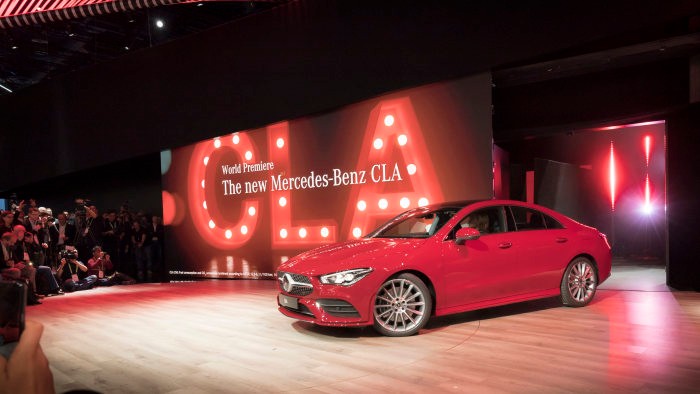
The brand with the three-pointed star is kicking off the new year at CES 2019 with the world premiere of the new Mercedes-Benz CLA Coupé featuring the further evolution of the MBUX (Mercedes-Benz User Experience) infotainment system. Further highlights are the US premieres of the battery-electric Mercedes-Benz EQC (power consumption combined: 22.2 kWh/100 km; CO2 emissions combined: 0 g/km, preliminary figures) and the pioneering Vision URBANETIC mobility concept. You can watch the Mercedes-Benz press conference via video-on-demand on Mercedes me media: https://media.mercedes-benz.com/ces2019.
The Mercedes-Benz CLA Coupé celebrates its world premiere. The successor to the premium coupé first unveiled in 2013 boasts an innovative interior with the next evolution of the MBUX, which now recognises control commands through movements. Also new is the ENERGIZING COACH familiar from the B-Class. This service, based on an intelligent algorithm, suggests one of the programmes from the ENERGIZING package according to the situation and individual needs. Its extensively facelifted exterior ensures the new CLA Coupé remains the design icon of the compact segment. Its distinctive forward-angled front end with its long, taut hood and power domes is particularly striking, while the wider track emphasises the sporty and dynamic look.
“We’re taking it to the next level by bringing the intelligent interior assistant to the compact class, too. Movement recognition makes it easier and more intuitive to operate,” says Ola Källenius, Member of the Board of Management of Daimler AG responsible for Group Research and Mercedes-Benz Cars Development. “The CLA offers a huge amount of automotive intelligence, and not just with this new feature.”
“With the first CLA, a four-door compact coupe, we opened up a completely new segment. And its success proves us right: 750,000 units of the CLA and CLA Shooting Brake alone have already been sold,” says Britta Seeger, Member of the Board of Management of Daimler AG responsible for Mercedes-Benz Cars Marketing & Sales. “The next iteration of the CLA is an intelligent evolutionary development that is even more emotional and sportier than its predecessor. Paired with the new operating system, it once again sets benchmarks for the entire class.”
Two electrified US premieres
On show for the first time on American soil is the Mercedes-Benz EQC. The first purely battery-electric vehicle from the EQ product and technology brand represents an ideal combination of comfort, quality and everyday usability. Both inside and out, the crossover SUV embodies the design language of progressive luxury. The EQC is likewise equipped with the groundbreaking MBUX – Mercedes-Benz User Experience – multimedia system, enhanced with a wide range of EQ-specific content. It also boasts a completely re-engineered powertrain system with a compact electric driveline (eATS) front and rear, giving the EQC the handling characteristics of an all-wheel-drive vehicle and providing it with an electric range of more than 450 km in the NEDC (preliminary figures)i.
“The EQC is the Mercedes-Benz among electric vehicles. Soon, we will have many more – we aim for over ten purely electric passenger cars by 2022,” stresses Ola Källenius. “This will cover the entire portfolio: from smart to large SUVs.
The future definitely is electric.”
Also celebrating its US premiere is the Vision URBANETIC – a revolutionary mobility concept that goes way beyond previous notions of autonomous vehicles. Vision URBANETIC removes the division between people moving and goods transportation. The concept lowers traffic volume, takes the pressure off city infrastructures and contributes to a new quality of urban life. The revolutionary vehicle is based on an autonomous, electrically powered driving platform that can carry different, interchangeable bodies for either people moving or goods transportation. As a ride-sharing vehicle, Vision URBANETIC can carry up to twelve passengers, while the cargo module can transport up to ten EPAL pallets.

“The empathy of the Vision URBANETIC was particularly important to us: The vehicle is attentive and interacts with people through various lighting elements,” says Ola Källenius. “With this kind of vehicle, we’re shooting for the moon. And that’s a crucial part of innovation.”
High customer loyalty – sales figures continue to rise for eighth year in a row
For the third time in a row, Mercedes-Benz is the best-selling premium brand in the automotive industry. “With more than 2.4 million vehicles delivered by Mercedes-Benz Cars in 2018, we once again surpassed our own sales record – for the eighth time in succession. In addition, despite a challenging year, we maintained our position at the top of the premium segment. The enthusiasm for our vehicles as well as the loyalty of our customers motivates us to give our best well into the new year,” said Britta Seeger, Member of the Board of Management of Daimler AG responsible for Mercedes-Benz Cars Marketing and Sales.
The Mercedes-Benz press conference is available as video-on-demand on https://media.mercedes-benz.com/ces2019, alongside two further multi-angle live streams from our show stand, which will be uploaded during the course of the day. At 2.00 pm local time (CET-9), Sajjad Khan, Member of the Divisional Board of Mercedes-Benz Cars, CASE and Vice President of Digital Vehicle & Mobility, will provide an insight into the latest CASE developments. At 3.30 pm local time
(CET-9), Wilfried Porth, Member of the Board of Management, Human Resources and Director of Labour Relations, Mercedes-Benz Vans, will talk about the future of mobility based on the example of the Vision URBANETIC. The media available on Mercedes me media also offers a wide range of additional information as well as extensive imagery and video footage from CES 2019.

i Figures on fuel consumption, power consumption and CO2 emissions are preliminary. They were calculated by Technical Services for the certification process in accordance with the WLTP and correlated with NEDC figures. EC type approval and a conformity certificate with official figures are not yet available. The official figures may differ from those stated here.

Press Contact

Andrea Eberhardt

Product Communications Mercedes-Benz Vans

andrea.eberhardt@daimler.com

Tel: +49 711 17-84020

Fax: +49 711 17-1779097330

Koert Groeneveld

Head of International Product & Technology Communications

koert.groeneveld@daimler.com

Tel: +49 711 17-92311

Fax: +49 711 17-94365

Press Contact Overview

Media

Download

Pictures (19)

Videos (3)

Documents (1)

Media Contact (2)

Filter

Show thumbnails
Show list
Slideshow

Zoom

Preview

Details

Do you really want to delete the data record?

Please wait a moment …

Please wait a moment …

Please wait a moment …

Please wait a moment …

19C0002_002

19C0002_003

19C0002_004

19C0002_007

19C0002_008

19C0002_009

19C0002_010

19C0002_013

19C0002_014

19C0002_015

19C0002_016

19C0002_019

19C0002_020

19C0002_021

19C0002_022

19C0002_025

19C0002_026

19C0002_027

19C0002_001

Loading

Walmart taps Udelv for latest driverless car tests to deliver groceries

Source: Walmart
An Udelv car that's being used in Walmart's test in Arizona.

Walmart is expanding its tests of driverless cars as a way to get online grocery orders to shoppers' homes more quickly.

The big-box retailer is now piloting a program to use Udelv autonomous-driving vans to deliver fresh groceries in Surprise, Arizona.

“We want to make sure we stay on the cutting edge of grocery delivery by exploring what's new and next,” Tom Ward, senior vice president of Walmart's digital operations in the U.S., said Tuesday in a blog post.

Walmart has already announced other pilot programs with self-driving car companies, including Ford and Alphabet's Waymo. The company plans to end this fiscal year with an online grocery delivery option in roughly 100 metropolitan areas, reaching more than 40 percent of U.S. households. For 2019, it plans to add that to another 800 stores.

There's good reason for retailers to be investing in online grocery delivery.

Online spending by U.S. consumers for groceries is expected to climb 15 percent this year, according to a survey by Brick Meets Click, an advisory group for grocers. That would push the share of grocery sales that take place on the internet to 6.3 percent of overall sales.

Companies that offer delivery and pick-up options for grocery orders should see even bigger growth, Brick Meets Click said. Those retailers' online sales could grow by 25 to 30 percent in 2019. By the end of the year, roughly 90 percent of U.S. households are forecast by Brick Meets Click to have access to at least one delivery or pick-up service for groceries. Other businesses experimenting in the space include Kroger, Whole Foods (via Amazon) and Albertsons.

Earlier this week, Walmart launched a campaign that aired during the Golden Globes and showed famous cars — like the Scooby Doo mystery machine — pulling up to Walmart stores and using its online grocery pickup service. That's also now available nationally.

Walmart's head of e-commerce in the U.S., Marc Lore, recently said the retailer was focused on taking food delivery to the next level, in addition to its driverless car tests. He envisions a day when food will be delivered to shoppers' refrigerators.

ZF expands Partnership with Microsoft to Develop Digital Services

Whether in the passenger car sector or for commercial vehicles, ZF is well on the road toward Vision Zero. Autonomous vehicles, innovative safety systems and intelligent mobility solutions contribute to a future of road traffic with zero accidents and zero emissions. This will be accompanied by digitalizing the entire value chain. The technological backbone for… Continue reading ZF expands Partnership with Microsoft to Develop Digital Services

Hyundai unveils automated charging and parking system concept

Hyundai and Kia have released a video featuring a proposed system that would relocate fully charged EVs from charging stations and allow waiting vehicles to charge. Here’s how the Automated Valet Parking System (AVPS) works: the driver tells the vehicle to charge using a smartphone app, and the vehicle automatically cruises to a vacant wireless… Continue reading Hyundai unveils automated charging and parking system concept

China: SenseTime backs WeRide; Starquest leads funding for Miaoshou Doctor

January 9, 2019 Autonomous driving startup WeRide has announced fresh investments from artificial intelligence (AI) unicorn SenseTime and a subsidiary of the Agricultural Bank of China, while Starquest Capital has led a 500 million-yuan ($72.77 million) Series C+ round of financing for Miaoshou Doctor. SenseTime invests in WeRide Level 4 autonomous driving startup WeRide (formerly known… Continue reading China: SenseTime backs WeRide; Starquest leads funding for Miaoshou Doctor

Velodyne Lidar Announces Collaboration with Nikon in Technology Development and Manufacturing

Velodyne Lidar Announces Collaboration with Nikon in Technology Development and ManufacturingDecember 21, 2018|In Press Releases|By Albie Jarvis
Velodyne Adds Nikon Corporation as a Strategic Investor

Velodyne Alpha Puck™ sensor is perfect for L4-L5 autonomy

Velodyne Lidar, Inc. (Velodyne), the inventor and leader of the lidar sensor industry for autonomous vehicles (AV), today announced Nikon Corporation (Nikon) as a new strategic investor with an investment of $25M. The parties further announced they have begun discussions for a multifaceted business alliance. Nikon is one of the world’s leading suppliers of products and solutions based on advanced opto-electronics and precision technologies.

As the culmination of millions of miles of on-road learning, the Alpha Puck™ is simply the most powerful lidar sensor in the world

Aiming to combine Nikon’s optical and precision technologies with Velodyne’s sensor technology, both companies have begun investigating a wide-ranging business relationship, including collaboration in technology development and manufacturing.

Velodyne believes the relationship will advance the timeline for manufacturing and mass production of lidar for the autonomous and advanced safety global market. The companies share a futuristic vision of advanced perception technology for a wide range of applications including robotics, mapping, security, shuttles, drones, and safety on roadways.

Headquartered in San Jose, Calif., Velodyne is known worldwide for its portfolio of breakthrough lidar sensor technologies

“Velodyne is creating a network of powerful alliances supporting the global autonomous vehicle industry,” said David Hall, Velodyne Lidar’s Founder and CEO. “One hundred years ago, optics and camera technologies like Nikon’s helped people to see better. Now, the basis of those technologies is helping computers see.”

Point Cloud from Velodyne’s Alpha Puck™ sensor

About Velodyne Lidar, Inc.

Velodyne provides the smartest, most powerful lidar solutions for autonomy and driver assistance. Founded in 1983 and headquartered in San Jose, Calif., Velodyne is known worldwide for its portfolio of breakthrough lidar sensor technologies. In 2005, Velodyne’s Founder and CEO, David Hall, invented real-time surround view lidar systems, revolutionizing perception and autonomy for automotive, new mobility, mapping, robotics, and security. Velodyne’s high-performance product line includes a broad range of sensing solutions, including the cost-effective Puck™, the versatile Ultra Puck™, the perfect for L4-L5 autonomy Alpha Puck™, and the directional view Velarray™. For more information, visit http://www.velodynelidar.com.

About Nikon Corporation

Nikon Corporation has been a pioneer in optical technology markets worldwide since its inception in 1917. Today, Nikon offers a wide range of products utilizing advanced technologies, from consumer products such as digital cameras, camera-related products and binoculars to industrial precision equipment including FPD and Semiconductor Lithography Systems, microscopes and measuring instruments. In the future, Nikon will take advantage of its core competencies for launching new products and also proposing solutions. In addition, Nikon focuses on the development of the healthcare business field.