STOCKHOLM (Reuters) – Sweden’s Northvolt has secured a partnership with German carmaker BMW (BMWG.DE) and is seeking more funds from the European Investment Bank (EIB) to help its plans to build Europe’s largest battery factory. The BMW logo is seen on the second press day of the Paris auto show, in Paris, France, October 3,… Continue reading UPDATE 2-Sweden’s Northvolt lands BMW deal in boost before fund raising
Tag: Tesla
The Secret Life of EV Batteries
Top Posts
The Secret Life of EV Batteries
Tesla Coverage: High Speed, Low Quality
Win a Tesla and Help Support Climate Action…
2018 Tesla Model 3 Long Range Passes The…
Did Tesla Just Confirm Q3 Production Milestone?
Model 3 Guide | Gear Selection — Basics…
Pony.ai racing to the top of Chinese self…
New Fuel Efficiency Standards: Can California Save The…
How Do Commodity Market Prices Impact Auto Enthusiasts?
Electric Car Planning: Not So Easy
Previously published on CleanTechnica.com
You are probably familiar with the lithium batteries in your smart phone, tablet, or laptop. You are probably aware that they do not last very long. The number of charge, and discharge cycles is only about 600, before the battery is seriously depleted. So, if you are charging everyday, 365 days in a year, a battery won’t even last for two years. I have read comments by electric vehicle, detractors, gleefully declaring that anyone buying an electric vehicle, (EV), will find that their EV battery is defunct within a couple of years, because, typically, a lithium battery only lasts for 600 cycles.
Of course, you and I know that an EV battery will last at least eight years, possibly 10 years, or more, depending on how it is treated. I have had my electric vehicle for three years, and somebody owned it for a couple of years before that, and the battery is still going strong. So, obviously, the electric vehicle detractor is talking a lot of nonsense about their 600 cycles, and yet this seems to conflict with our own experience, of smart-phone batteries, and the like, which we know do not last very long.
The Puzzle
I did not like that puzzle, because it made me realise that I did not really know how this was possible. Could it be something in the battery chemistry, or the battery architecture, that was different for EV batteries. I am sure that many university research departments are working on battery chemistry, to try to achieve greater efficiency, and longevity in lithium batteries, or even a different kind of battery altogether. Readers of CleanTechnica.com will have seen many articles about such developments, but they are always at the early stages, promising, but a few little problems yet to be solved, not yet in commercial production, etc, and so could not explain much about the longevity of any existing EV battery. I had also read, that when Tesla chose cells for the battery pack in the original Tesla roadster, they chose a cell, the “18650” cell, that was already very commonly in use, and so, very cheap to buy, readily available, and reliable, but was used for portable electronics, and was not designed to be used in a traction battery at all. So, if Tesla was using common, ordinary batteries, with a common ordinary life cycle of 600 charge/discharge events, how could it be made to last such a long time in a Tesla battery pack?
A Visit to the “Library”
“Curiouser and curiouser”, said Alice, but there is no little bottle labelled “drink me”, to make her battery last five times as long. There is only one way to solve such problems, and less like Alice, by hitting the bottle, and more like Hermione Granger, by a visit to the library. Well, not the library as such, but the modern-day version, with a delve into the “restricted section” of the biggest library on Earth, the Internet.
More is Less
So, what was I able to find out? Firstly, all cycles are not the same. One way of increasing the number of charging cycles is by charging between less than full, and more than empty. The lowest number of cycles, and the shortest battery life, will come from repeated cycles of charging 100%, and discharging to close to nil%. Lithium batteries should never be entirely discharged as this drastically shortens their life. There are a number of possibilities, such as charging from 100% down to 50%, from 85% down to 25%, or from 50% down to 25%. It would appear that charging between 85% and 25% gives a good balance between battery life, and workable capacity
Charging Parameters
Cycles before capacity reduced to 85%
100% – 25%
2010
100% – 40%
2800
100% – 50%
2800
85% – 25%
4500
75% – 25%
7100
75% – 45%
10000
75% – 65%
12000
The Whole Truth?
When your instruments say your EV battery is charged 100%, is it really? When your instruments say your EV battery is down to zero%, it definitely is not. The battery management system will keep an emergency reserve for you, and after that is used up, will protect that last precious 5% or so, to prevent damage to your battery. Your electric vehicle will behave as if the battery were completely flat, when it is not, and might tell you it is down to zero, when you really have about 10 miles in reserve. I have experienced part of this for myself, when I miscalculated somewhat, and ended up on the journey home, with one flashing bar left on my battery indicator, which then disappeared to leave no bars at all. I then drove about 3 miles after that, running on fairy dust, with the car behaving completely normally, and arrived on my drive, under full battery power. So, obviously my instrumentation was telling a little white lie, just to scare me.
Black Box
For the avoidance of any confusion, I need to say here that when I talk about a “Battery Management System”, I refer to a wider concept than that. There are many systems in an EV which are separately identifiable, but that all gets too technical for most readers. Let’s use the concept of a “black-box”. We do not need to know all the intricacies of what is in the box, but we can be aware of the inputs, and the outputs. Think of a PC box, or your tablet: you know how to use it, without knowing all the intricacies of what goes on inside the box. So, when I say “Battery Management System”, I am including all the complex systems between the battery and the motor, the battery and the charging ports, and the driver information outputs on the dash board, or your touch screen. What I am saying is that there is not just a battery, and a length of wire going to the motor, and a pedal like on a sewing machine to control the speed: there is a much more complex system than that, but I am not going into all the technical details.
Your Virtual Battery
What if the battery management system charged only up to, say, 80%, and kept 30% in reserve, but displayed this as 100% to zero, with a range of, say, 100 miles, (160kM), then, as the battery lost capacity, the system charged it up to, say, 90%, and kept 20% in reserve? You would not be aware that your battery had lost any capacity at all, because your instruments would still be displaying the virtual battery as 100% to zero, with the same range as before. That is a secret way that electric vehicle manufacturers could make it appear that your EV battery has lost no capacity, when in actual fact, it has.
Reserved
Virtual Battery From 0% – 100%, Range 100m
Reserved
10%
20%
30%
40%
50%
60%
70%
80%
90%
100%
Reserved
Virtual Battery From 0% – 100%, Range 100m
Reserved
10%
20%
30%
40%
50%
60%
70%
80%
90%
100%
Reserved
Virtual Battery From 0% – 100%, Range 100m
10%
20%
30%
40%
50%
60%
70%
80%
90%
100%
That would lull an EV owner into a false sense of security, because they would think their battery has not deteriorated at all, in how ever many years they have been using it, but once it reaches the stage in table 3, the virtual battery has no room left to expand, and range will begin to drop off for real. An ageing EV battery will also be more susceptible to damage from fast charging, so deterioration could become quite rapid. I am not saying that any particular manufacturer does this, because I haven’t found any information from them, but I have read about this idea in general as if it were a common practice.
Controlled Voltage Level
For the avoidance of any confusion the voltage level is pretty much synonymous with the percentage of charge I have just mentioned so when we talk about “100%” charged we are talking about a battery fully charged up, which will then have a voltage in each cell of around 4.2V. A flat battery will have a voltage in each cell of 3V or less. So, in some ways this following chart is just a different way of expressing the same thing, but is more precise. Percentage of charge is not to be confused with percentage of capacity. The capacity of a new 40kWh battery is to provide 40kW for a whole hour. If the capacity reduces to 75% it will only be able to provide 40kW for 45 minutes, or 30kW for an hour.
Where a lithium battery cell has a nominal voltage of 4.2 V, it can be charged up to slightly more than 4.2 V, or slightly less than 4.2 V. The difference between charging to only 3.9 V and 4.2 V can be as much as four times the number of cycles, and longevity of the battery. That gain in longevity has to be balanced against the loss of some of the battery’s full capacity. This is one secret that manufacturers employ in their battery management systems. Because this reduces the effective capacity of the battery, the battery has to be much bigger, physically, to provide the same level of capacity. This is one reason why EV batteries are so big and heavy, with relatively low efficiency. They could provide the same capacity, with a smaller battery, where all the cells are charged to the full voltage, but it would not last so long.
Voltage
Cycles
Capacity
4.25
200–350
105–110%
4.20
300–500
100%
4.15
400–700
90–95%
4.10
600–1,000
85–90%
4.05
850–1,500
80–85%
4.00
1,200–2,000
70–75%
3.90
2,400–4,000
60–65%
3.80
See note
35–40%
3.70
See note
30% and less
Controlled Rate of Discharge
We also need to look at discharging. Where a lithium cell has a nominal capacity of say 1500 mAh, that capacity could be provided by giving 1500 mA for an hour, 750 mA for two hours or 375 mA for four hours. If we call 1500 mA in one hour, 1C, then 750 mA would be 0.5 C, and 375 mA, 0.2 5C. Where the batteries are never discharged at a rate of more than 0.2 5C, they will last much longer than if they are drained at their full capacity. This is a secret of EV battery packs, where the control system ensures discharge rates are never excessive. This is another reason for EV battery packs being so big and heavy, not just for the sake of range, but for the sake of minimising the rate of discharge, and so, further extending the battery life.
A Tale of Two Batteries
So, it is as if you have two batteries in your car: one is the physical battery, and the other is a virtual battery, as presented to you by your instrumentation, and as created by the battery management system. Your physical battery, were it all to be made available to you, would be much bigger and more powerful than it appears. The virtual battery, created for you to use by the battery management system, that you see through your dashboard displays, is smaller, less powerful, but longer lasting. All these secret techniques that go on stealthily in the background and, probably unknown to you, are what constitutes the secret life of your electric vehicle battery.
Don’t Leave Your Battery in a Locked Car
That subtitle normally relates to dogs, and is a cryptic clue to one further secret, which although nothing to do with charging and discharging or even running the electric vehicle at all, is something to be aware of. Where a lithium battery is charged to 100% and then left stored, unused, but at a temperature, above 25°C, then degradation will occur without using the battery at all. So, if you are living somewhere hot, where your garage reaches high temperatures, or even high temperatures exist on your drive, it is not such a good idea to leave your electric vehicle fully charged up for long periods, unused. It might even be worth having a dedicated solar panel on the garage roof to power air conditioning in your garage during the heat of the day, to keep your battery cool, when not in use.
°C
Capacity after 1 year stored at 40% charge
Capacity after 1 year stored at 100% charge
0
98%
94%
25
96%
80%
40
85%
65%
60
75%
60%
(after 3 months)
Limitations on Fast Charging
Despite people’s impatience about waiting to charge up, there are limits to safe, charging-currents, if you do not want to damage your battery. A power level of only 3kW can produce enough heat to warm up an entire room. A power of 50kW is a huge amount of power to put into any electrical system. Impatient or not, regardless of what people “want”, there are limits to the amount of power you can safely put into an EV battery. Ideally, the fastest charge rate for a 50kWh battery is 50kW over a period of 1 hour, because that exactly matches the characteristics of the battery. However, charging from 30% to 80%, where 80 less 30 is 50%, representing only half the battery, the rate could be 50kW over a period of half an hour. To bring charging time down to 15 mins, would require 100kW, which is double the ideal. The combination of false capacity percentages, and lower charge voltages, plus over-sizing of the battery, and carefully designed battery chemistry, all helps to make faster charging possible, but there are limits.
People should not expect charging times to come down much below 20 mins, or ever be equivalent to filling a tank with fuel. Fifty litres of fuel represents 600kWh of energy. A 600kWh battery would weigh 6 tons. That makes a 50kWh battery weigh half a ton, so do you really want to be carrying around more than half a ton, on all short journeys every day, just to save a few charging stops on the occasional long run. People are just going to have to learn to be more patient, if humanity is to survive much longer.
Further Information
One thing I have not included in this article is any specific reference to any specific manufacturer or car. I have e-mailed Nissan, and Tesla about their battery management systems, but have received no reply at the time of publishing.
I did find the following statement about batteries on the Tesla site –
factors affecting cycle life are tied to how the cell is used. In particular:
Avoiding very high and very low states of charge. Voltages over 4.15V/cell (about 95 percent state of charge [SOC]) and voltages below 3.00V/cell (about 2 percent SOC) cause more stress on the insides of the cell (both physical and electrical). Avoiding very high charge rates. Charging faster than about C/2 (two hour charge) can reduce the cell’s life.
Avoiding charging at temperatures below 0° C. (Our design heats the pack before charging at cold temperatures.)
Avoiding very high discharge rates. (Our pack has been designed such that even at maximum discharge rate, the current required from each cell is not excessive.)
There is a huge difference in cycle life between a 4.2V/cell charge (defined by the manufacturers as “fully charged”) and a 4.15V/cell charge. 4.15 volts represents a charge of about 95 percent. For this reduction of initial capacity (5 percent), the batteries last a whole lot longer. Unfortunately, further reduction of charge has a much smaller benefit on cycle life. Understanding this trade-off, Tesla Motors has decided to limit the maximum charge of its cells to 4.15 volts, taking an initial 5 percent range hit to maximize lifetime of the pack. We also limit discharge of our battery pack to 3.0V/cell and will shut down the car when the batteries reach this level.
The information about batteries was obtained from BatteryUniversity.com, which is a very useful site for technical information on batteries of all kinds.
Andy Miles
As a child, I had the unrealistic expectation that I would learn about, and understand, absolutely everything, during the course of growing up. Now, at the other end of life, I am fully aware of how much I have not learnt, and do not understand, and yet, remain interested in everything. My education, starting with an arts degree, and going on to postgraduate studies, in everything from computer science, to hypnotism, reflected my broad interests. For 20 years, I worked in local government, and am now retired, living in North Leicestershire in the UK, with plenty of time for doing whatever I like. I have always had a keen interest in everything alternative, which includes renewable energy and energy efficiency and, of course, electric vehicles. So, naturally, I have taken ownership of an EV, now that they are affordable and practical forms of transport. Writing is also one of my great pleasures, so writing about EVs and environmental issues, is a natural evolution for me. You can find my work on EV Obsession, and CleanTechnica, and you can also follow me on twitter.
previous post
Tesla Coverage: High Speed, Low Quality
You may also like
Flexible EV Charging With Storage From ChargePoint &…
July 23, 2015
BMW i3 Police Car In Italy (Photo)
June 8, 2016
Nissan Supplying Over 100 Electric Vehicles To UEFA…
June 5, 2015
Tesla Model 3 Already Gobbling Premium Gas Car…
July 7, 2016
13 New Electric Vehicles For Sale In 2014
January 4, 2014
Tesla CEO Reduces 2016 Chinese Sales Target
January 29, 2016
Chevy Volt, Cadillac ELR, Opel Ampera Factory —…
February 7, 2014
Tesla Roadster 3.0 Goes ~340 Miles On 1…
February 15, 2015
City Of Porterville Transit (In California) Going 100%…
December 12, 2016
OXIS Energy UK & LiTHIUM BALANCE Create Lithium-Sulfur…
June 14, 2016
Lidar firm SOS Lab lands $6M
09 Oct 2018 Korean startup is the latest to target the future market for autonomous driving; auto parts giant and Hyundai among early backers. SOS Lab, a Korean startup company developing lidar equipment for future autonomous vehicles, has completed a series A round of venture funding worth around $6 million. The firm, founded in 2016 and based at… Continue reading Lidar firm SOS Lab lands $6M
Conflicted German Automakers Struggle With EV Transition
Electric Cars
Electric Car Benefits
Electric Car Sales
Solar Energy Rocks
RSS
Advertise
Privacy Policy
Autonomous Vehicles
Published on October 13th, 2018 |
by Guest Contributor
Conflicted German Automakers Struggle With EV Transition
Twitter
Google+
LinkedIn
Pinterest
Facebook
October 13th, 2018 by Guest Contributor
Originally published on EVANNEX.
By Charles Morris
It’s no secret that legacy automakers are making the transition to electric vehicles only reluctantly, in response to regulatory pressure from governments and to competitive pressure from Tesla. Contrary to what many seem to believe, Big Auto’s reluctance to embrace EVs is not merely the usual corporate fear of the future, nor is it the result of any oil industry-fueled conspiracy (as far as we know). It’s a simple matter of money — there are good reasons to believe that electrification will take a major bite out of industry profits, as BMW and Daimler execs recently acknowledged.
German automakers remain conflicted about how to transition factory production lines from gas-powered cars to EVs (Image: Werner Budding)
Now Volkswagen has warned that its stated plan to offer an electrified version of each of its models will cost more than it estimated. VW previously predicted that the coming shift to battery power would cost some €20 billion ($23 billion). CEO Herbert Diess, in an interview published in VW’s internal newsletter, indicated that this figure was too low, but didn’t offer a new estimate. “The burden for our company, such as the cost of bringing to market electric cars, will be higher than expected,” Diess says. “This is particularly so since some of our competitors have been making more progress.” (Hmm, who would that be?)
A recent article in the Financial Times discussed the challenges legacy carmakers are facing. Whereas industry disruptor Tesla started from a blank slate to design its vehicles and has “bet the company” on EVs, incumbent OEMs can’t go down that road — the risks are too high. Analysts have warned that a substantial number of Germany’s 800,000 auto industry jobs could disappear along with the internal combustion engine.
FT points out that VW, BMW, and Daimler have each earmarked billions of euros for electric technology, but are taking different approaches — some automakers hope to build EVs using the same architecture as legacy vehicles, whereas others intend to introduce new platforms. The choice of strategy “will re-sort the carmakers in profitability,” says Christian Senger, head of the VW’s e-mobility line. “Those who [take] the hardest road will be more successful than the others.”
Germany protects its car industry as EU goes for just 15% cut in CO2 car emissions by 2025 (Source:Transport & Environment / Image: Plugin Cars)
Volkswagen is leveraging its scale advantage — earlier this year, it awarded €20 billion worth of contracts for battery supplies as part of a plan to introduce 50 pure EVs by 2025. This represents an about-face from VW’s previous strategy — the e-Golf and e-Up, introduced in 2013, were basically existing models stuffed with batteries.
“To make it a fully fledged electric car, you need to start with a battery pack between the wheels and then you build up the car,” Herbert Diess, CEO of the VW Group, told the FT. “Then you have an effective battery system, the range, and you get a lot of freedom for the design of the car, to make more interior space with the same footprint.” (His words echo what Tesla designer Von Holzhausen said back in 2011.)
The first VW model designed this way, the ID Neo, is to come out late next year, the first of several models belonging to the ID electric sub-brand. Although recent reports suggest the program could be delayed.
VW’s ID concept car appears to be another unconventional design approach typically relegated to Big Auto’s electric car efforts (Image: Charged)
BMW seems to be taking the opposite tack, touting the advantages of “flexible architecture” that can accommodate fossil, hybrid or electric powertrains. BMW plans to offer all of its models with a choice of powertrain starting in 2021. “We can’t afford having two factories standing still,” says CEO Harald Krueger. “With a flexible approach, you can always manage the capacity of your plants. But if you have a specific EV architecture, what do you with the old one? What do you do with the people?”
Daimler is combining both approaches, designing purpose-built architecture for its EQ sub-brand while also setting up its production plants to accommodate all types of powertrains, including fuel cells. “We have hybrids, plug-in hybrids, electric cars and maybe robo-taxis tomorrow,” says Daimler Production Chief Markus Schaefer. “It’s hard to predict volumes for the best way in an uncertain world, so this is the most efficient approach to supply the market.”
Some analysts think the flexible approach is too complex in both design and production. “I don’t see how they can consolidate traditional platforms, from small hatchbacks to large SUVs, and at the same time try to include EVs in the equation,” says Pelham Smithers Analyst Julie Boote. “That’s incredibly complicated.”
In another revealing move, Audi decided no e-tron inventory for its US dealerships would be made available (Source: Charged / Image: Automobile Propre)
Others see merit in the flexible approach, pointing out that it’s hard to predict how quickly the shift to electric cars will take place. “Most carmakers proceeding with EVs are following an ‘If you build it, they will come’ approach,” says Bernstein Analyst Max Warburton. “If you have a dedicated EV platform and the demand doesn’t come, you’ve lost a lot of money.”
Sources: Financial Times, Bloomberg
Support CleanTechnica’s work by becoming a Member, Supporter, or Ambassador.
Or you can buy a cool t-shirt, cup, baby outfit, bag, or hoodie or make a one-time donation on PayPal.
About the Author
Guest Contributor is many, many people. We publish a number of guest posts from experts in a large variety of fields. This is our contributor account for those special people. 😀
Back to Top ↑
CleanTechnica Clothing & Cups
Advertisement
Advertise with CleanTechnica to get your company in front of our readers.
Top News On CleanTechnica
Advertisement
Follow @cleantechnica
Join CleanTechnica Today!
EV Charging Guidelines for Cities
Share our free report on EV charging guidelines for cities, “Electric Vehicle Charging Infrastructure: Guidelines For Cities.”
Advertisement
Cleantech Press Releases
The New Danish Climate Plan — Together For A Greener Future
Shift In Navajo Country As Coal Plant That Navajo Community Doesn’t Want Is Dropped
Capturing CO2 From Exhaust Pipes Is A Bad Idea That Won’t Die
The EV Safety Advantage
Read & share our free report on EV safety, “The EV Safety Advantage.”
The State of EV Charging
Our 93-Page EV Driver Report
30 Electric Car Benefits
Blockchain × Cleantech
Our Electric Vehicle Reviews
Tesla News
Correcting the Cleantech Record
38 Anti-Cleantech Myths
Wind & Solar Prices Beat Fossils
Cost of Solar Panels Collapses
© 2018 Sustainable Enterprises Media, Inc.
Electric Cars
Electric Car Benefits
Electric Car Sales
Solar Energy Rocks
RSS
Advertise
Privacy Policy
This site uses cookies: Find out more.Okay, thanks
Elon Musk files trademark for a Tesla-branded tequila, Teslaquila
SAN FRANCISCO: An April Fool’s Day prank may soon see the light of day as billionaire entrepreneur Elon Musk has confirmed that a Tesla-branded tequila, called “Teslaquila“, is “coming soon”. Teslaquila first featured in an April Fool’s joke in which Musk, the CEO of Tesla, said on Twitter that he had been found “passed out… Continue reading Elon Musk files trademark for a Tesla-branded tequila, Teslaquila
Order A Tesla By Monday To Get Full $7,500 Tax Credit
Electric Cars
Electric Car Benefits
Electric Car Sales
Solar Energy Rocks
RSS
Advertise
Privacy Policy
Cars
Published on October 12th, 2018 |
by Paul Fosse
Order A Tesla By Monday To Get Full $7,500 Tax Credit
Twitter
Google+
LinkedIn
Pinterest
Facebook
October 12th, 2018 by Paul Fosse
Tesla has put up a new note in its design studio. The note informs its customers that if they order any of Tesla’s three models (the Model 3, Model S, or Model X) by Monday, October 15, they will receive delivery by the end of the year and will thus be eligible for the full $7,500 tax credit.
In case you haven’t been following closely, Tesla delivered its 200,000th electric car in the US in July, which means the maximum federal tax credit for Tesla buyers will be reduced to $3,750 after the end of the year.
I see this note when accessing the design studio from my desktop browser (but I don’t see it from either Chrome or Safari on my iPhone for some reason):
Let us know in the comments if you see it on Android or other platforms.
Unless something changes with the federal tax credit, the tax credit for Tesla buyers will phase out next year and be gone in 2020 — unless legislation to extend and expand it is passed.
I wouldn’t bet on any extension passing right now, but with Democrats expected to take the House next year, this could be something that could be passed, as there are always deals made to get things in and with a divided government, the administration will need to compromise more to get spending bills passed. However, I don’t see Democrats making this a priority, but maybe I’m wrong.
So, if you’re on the fence about whether to order a Tesla, perhaps this will get you to make a decision to order by Monday!
Support CleanTechnica’s work by becoming a Member, Supporter, or Ambassador.
Or you can buy a cool t-shirt, cup, baby outfit, bag, or hoodie or make a one-time donation on PayPal.
About the Author
Paul Fosse I've been a software engineer for over 30 years, first working on EDI software and more recently developing data warehouse systems in the telecommunications and healthcare industry. Along the way, I've also had the chance to help start a software consulting firm and do portfolio management for several investment trusts. In 2010, I took an interest in electric cars because gas was getting expensive. In 2015, I started reading CleanTechnica and took an interest in solar, mainly because it was a threat to my oil and gas investments in my investment trusts. Tesla investor.
Back to Top ↑
CleanTechnica Clothing & Cups
Advertisement
Advertise with CleanTechnica to get your company in front of our readers.
Top News On CleanTechnica
Advertisement
Follow @cleantechnica
Join CleanTechnica Today!
EV Charging Guidelines for Cities
Share our free report on EV charging guidelines for cities, “Electric Vehicle Charging Infrastructure: Guidelines For Cities.”
Advertisement
Cleantech Press Releases
The New Danish Climate Plan — Together For A Greener Future
Shift In Navajo Country As Coal Plant That Navajo Community Doesn’t Want Is Dropped
Capturing CO2 From Exhaust Pipes Is A Bad Idea That Won’t Die
The EV Safety Advantage
Read & share our free report on EV safety, “The EV Safety Advantage.”
The State of EV Charging
Our 93-Page EV Driver Report
30 Electric Car Benefits
Blockchain × Cleantech
Our Electric Vehicle Reviews
Tesla News
Correcting the Cleantech Record
38 Anti-Cleantech Myths
Wind & Solar Prices Beat Fossils
Cost of Solar Panels Collapses
© 2018 Sustainable Enterprises Media, Inc.
Electric Cars
Electric Car Benefits
Electric Car Sales
Solar Energy Rocks
RSS
Advertise
Privacy Policy
This site uses cookies: Find out more.Okay, thanks
Tesla produced 7,400 Model 3 sedans in the first two weeks of the quarter, report says
David Paul Morris | Bloomberg | Getty Images
Tesla vehicles are transported on a truck after leaving the company's manufacturing facility in Fremont, California, on Wednesday, June 20, 2018.
Tesla has produced 7,400 Model 3 mid-sized sedans in the first two weeks of the quarter, according to a report in Electrek, citing unnamed people.
That would mean Tesla has so far produced 3,700 Model 3's per week, short of the goal of 5,000 cars per week Tesla has been aiming for and occasionally hit. The report attributes this to an anticipated production slowdown early in the quarter.
Overall, the automaker is has made 11,500 cars total in the first weeks of the quarter, Electrek said.
Tesla has struggled with production on the Model 3 in the past. It had originally aimed to make 5,000 cars in a week at the end of the 2017, but did not reach that goal until the end of the second quarter this year. However the company did deliver more vehicles in the third quarter than analysts expected. At the time, the automaker said production had stabilized.
Tesla declined to comment.
Read the full story at Electrek
Elon Musk’s Tesla files for a trademark of ‘Teslaquila’
Original Article
Charging Your Chevy Bolt EV In The Most Insane Way Possible
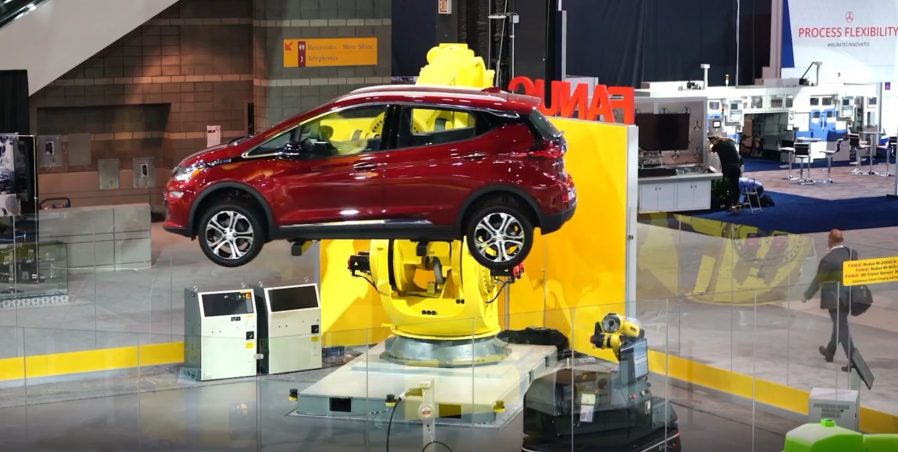
3 H BY WADE MALONE And here I’ve been parking and plugging in my own electric car like a sucker! We have seen a number of organizations combine a robotic arm with a charging station. Tesla’s snake-like concept garnered the most attention a few years ago. Although the impracticality of these set ups means we haven’t… Continue reading Charging Your Chevy Bolt EV In The Most Insane Way Possible
Tesla says orders placed by October 15 eligible for full tax credit
(Reuters) – Electric carmaker Tesla Inc said bit.ly/2NCbs1r all orders for its vehicles placed by Oct. 15 are eligible for full federal tax credit of $7,500 and such customers will get their cars delivered by the end of the year. FILE PHOTO: Rows of the new Tesla Model 3 electric vehicles are seen in Richmond,… Continue reading Tesla says orders placed by October 15 eligible for full tax credit