Lyft has filed a draft registration statement with the U.S. Securities and Exchange Commission for its long-awaited initial public offering, Lyft wrote in a press release today. However, the exact timing of the offering is unclear. In a confidential filing with the SEC, Lyft did not state the number of shares it expects to offer,… Continue reading Lyft files IPO documents with SEC
Tag: Uber
And Uber is going with . . . Bird (looks like)
Five months ago, the Bay Area-based electric scooter rental company Lime joined forces with the ride-hailing giant Uber, which both invested in the company as part of a $335 million round and said it was going to promote Lime in its mobile app. It’s looking now like that may have been a mistake for Lime. Though… Continue reading And Uber is going with . . . Bird (looks like)
Google’s robotic spinoff launches ride-hailing service
Google’s robotic spinoff launches ride-hailing serviceSan Francisco – Google’s self-driving car spinoff is finally ready to try to profit from its nearly decade-old technology.
Waymo is introducing a small-scale ride-hailing service in the Phoenix area that will include a human behind the wheel in case the robotic vehicles malfunction.
The service debuting Wednesday marks a significant milestone for Waymo, a company that began as a secretive project within Google in 2009. Since then, its cars have robotically logged more 10 million miles on public roads in 25 cities in California, Arizona, Washington, Michigan and Georgia while getting into only a few accidents – mostly fender benders.
The company is initially operating the new service cautiously, underscoring the challenges still facing its autonomous vehicles as they navigate around vehicles with human drivers that don’t always follow the same rules as robots.
The service, dubbed Waymo One, at first will only be available to a couple hundred riders, all of whom had already been participating in a free pilot program that began in April 2017. It will be confined to a roughly 100-square-mile area in and around Phoenix, including the neighboring cities of Chandler, Tempe, Mesa, and Gilbert.
Although Waymo has been driving passengers without any humans behind the wheel in its free pilot program, it decided to be less daring with the new commercial service.
“Self-driving technology is new to many, so we’re proceeding carefully with the comfort and convenience of our riders in mind,” Waymo CEO John Krafcik wrote in Wednesday blog post heralding the arrival of the new service.
The ride-hailing service is launching in the same area where a car using robotic technology from ride-hailing service Uber hit and killed a pedestrian crossing a darkened street in Tempe, Arizona seven months ago. That fatal collision attracted worldwide attention that cast a pall over the entire self-driving car industry as more people began to publicly question the safety of the vehicles.
“I suspect the Uber fatality has caused Waymo to slow down its pace a bit” and use human safety drivers in its ride-hailing service,” said Navigant Research analyst Sam Abuelsamid. “If people keep dying, there will be a bigger backlash against these vehicles.”
The Uber robotic car had a human safety driver behind the wheel, but that wasn’t enough to prevent its lethal accident in March.
Waymo’s self-driving vehicles are still susceptible to glitches, as an Associated Press reporter experienced during a mid-October ride in an autonomous minivan alongside Krafcik near company’s Mountain View, California, headquarters.
The minivan performed smoothly, even stopping for a jaywalker, before abruptly pulling to the right side of the road. Ahead was a left-turning FedEx delivery truck. In a digital message to the two human backup drivers, the van said it “detected an issue” and it would connect to a rider support agent. Rider support didn’t respond, so they switched to manual mode and returned to Waymo headquarters.
At that time, Krafcik conceded to the AP that Waymo’s self-driving vehicles were still encountering occasional problems negotiating left-hand turns at complicated intersections.
“I think the things that humans have challenges with, we’re challenged with as well,” Krafcik said. “So sometimes unprotected lefts are super challenging for a human, sometimes they’re super challenging for us.”
Waymo eventually plans to open its new ride-hailing app to all comers in the Phoenix area, although it won’t say when. It also wants to expand its service to other cities, but isn’t saying where. When that happens, it could pose a threat to Uber and the second most popular U.S. ride-hailing service, Lyft, especially since it should be able charge lower prices without the need to share revenue with a human driver in control at all times.
General Motors also is gearing up to begin offering a ride-hailing service through its Cruise subsidiary under the management of a new CEO, Dan Ammann, who has been the Detroit automaker’s No. 2 executive. Cruise plans to start its ride-hailing service at some point next year in at least one U.S. city. Another self-driving car company, Drive.ai, has been giving short-distance rides to all comers within Frisco, Texas and Arlington, Texas since the summer.
–––
AP Auto Writer Tom Krisher in Detroit contributed to this story.
Read or Share this story: https://www.detroitnews.com/story/business/autos/mobility/2018/12/05/google-robotic-spinoff-launches/38676567/
Waymo starts commercial ride-share service
Geoff Robins | AFP | Getty Images
John Krafcik, CEO of Waymo speaks at a press conference at the 2017 North American International Auto Show in Detroit, Michigan, January 8, 2017.
After months of testing and millions of miles developing self-driving vehicle technology, Waymo has officially launched the country's first commercial autonomous ride-share service.
The company's Waymo One program will give customers rides in self-driving vehicles 24 hours a day. Initially, the service will be limited to cities surrounding Phoenix, including Tempe, Mesa and Chandler.
While there may be many potential customers who want to ride in an autonomous vehicle, the Waymo One service will initially be offered to a limited number of people. Those customers will include hundreds of people in the Phoenix area who were test users of the Waymo self-driving vehicle fleet that has been in development since April 2017.
“Self-driving technology is new to many, so we're proceeding carefully with the comfort and convenience of our riders in mind,” said Waymo CEO John Krafcik. One example of Waymo taking a cautious approach rolling out its ride-share service is the company's use of safety drivers to supervise the rides, at least initially. In addition, the company's app and consoles in the Waymo One vehicles will allow riders to instantly connect with support agents who can assist riders with questions.
Alphabet's Waymo One marks the start of the race by automakers, tech companies and other firms to launch autonomous ride-share services. General Motors subsidiary Cruise plans to launch a similar service using self-driving vehicles next year.
What's driving the competition? The pursuit of greater profits. Studies of have shown the biggest cost for ride-share operations is the expense of paying a driver. General Motors estimates it costs ride -share companies more than $3 per mile in San Francisco. However, GM believes that cost could drop to roughly $1 per mile by 2025 with driverless vehicles in ride-share fleets.
Waymo has said it expects the cost to consumers for using Waymo One to be competitive with Uber, Lyft and other ride-hailing services.
The future of the auto industry lies in car sharing, Chinese executives say
Dave Zhong/Getty Images for CNBC International
Freeman H. Shen, Founder, Chairman & CEO of WM Motor, speaks during Fireside Chat on Day 2 of CNBC East Tech West at LN Garden Hotel Nansha Guangzhou on November 28, 2018 in Nansha, Guangzhou, China.
Several Chinese auto and transportation industry leaders are preparing for a future in which people share cars, rather than own them individually.
“(The new generation), they're not interested in the ownership. They're probably more interested in accessibility,” Freeman Shen, founder and CEO of Chinese electric car company WM Motor, said last week at CNBC's East Tech West conference in the Nansha district of Guangzhou, China.
Technological advances in the last several years have aided the rise of multibillion-dollar ride-hailing giants such as Uber and Didi. They, in turn, have challenged the traditional taxi driver system and cultivated a habit of on-demand car services for tens of millions of users globally despite ongoing safety concerns. Traditional automakers, many already trying to navigate rising interest in the electric vehicle market, are paying close attention to the ride sharing trend. Notably, General Motors is testing the waters with its own rental program.
In China, Feng Xing Ya, general manager of Guangzhou-based automaker GAC, also said the future of the auto industry lies in car sharing.
“(It's) a challenge for the auto industry because people may buy fewer cars,” Feng said in Mandarin, according to a CNBC translation, during a Nov. 27 conference session.
Without giving much detail on a plan, Feng said he favored a strategy of entering — rather than avoiding — the car sharing economy, which he said can still generate a lot of income for a company.
However, such a rapid change in consumer tastes could give start-ups an advantage.
Shen, formerly a director at Fiat Chrysler and Chinese automaker Geely, said traditional automakers are too focused on selling cars rather than improving user experiences. He said his company's focus on software and newness to the market means he has everything to gain and little to lose from a shift to ride sharing.
Shen founded WM Motor — which stands for “world champion” in German — in 2015 and the company has received more than $1 billion in funding, according to Crunchbase.
The rise of car sharing may also lead to new kinds of living environments in China as Beijing tries to encourage technological and urban developments through “smart cities.”
“If we can allocate the seats instead of vehicles … then we can use the transportation system more efficiently,” Henry Liu, vice president, chief scientist of smart transportation at Didi, said during a conference session.
“If you think about the future city, I think the future city will have much less in terms of parking spaces, road spaces, because we don't really need that much of spaces for vehicles,” Liu said. “At that moment, I think we have an autonomous vehicle fleet. And they can serve the transportation demand.”
Robot couriers scoop up early-stage cash
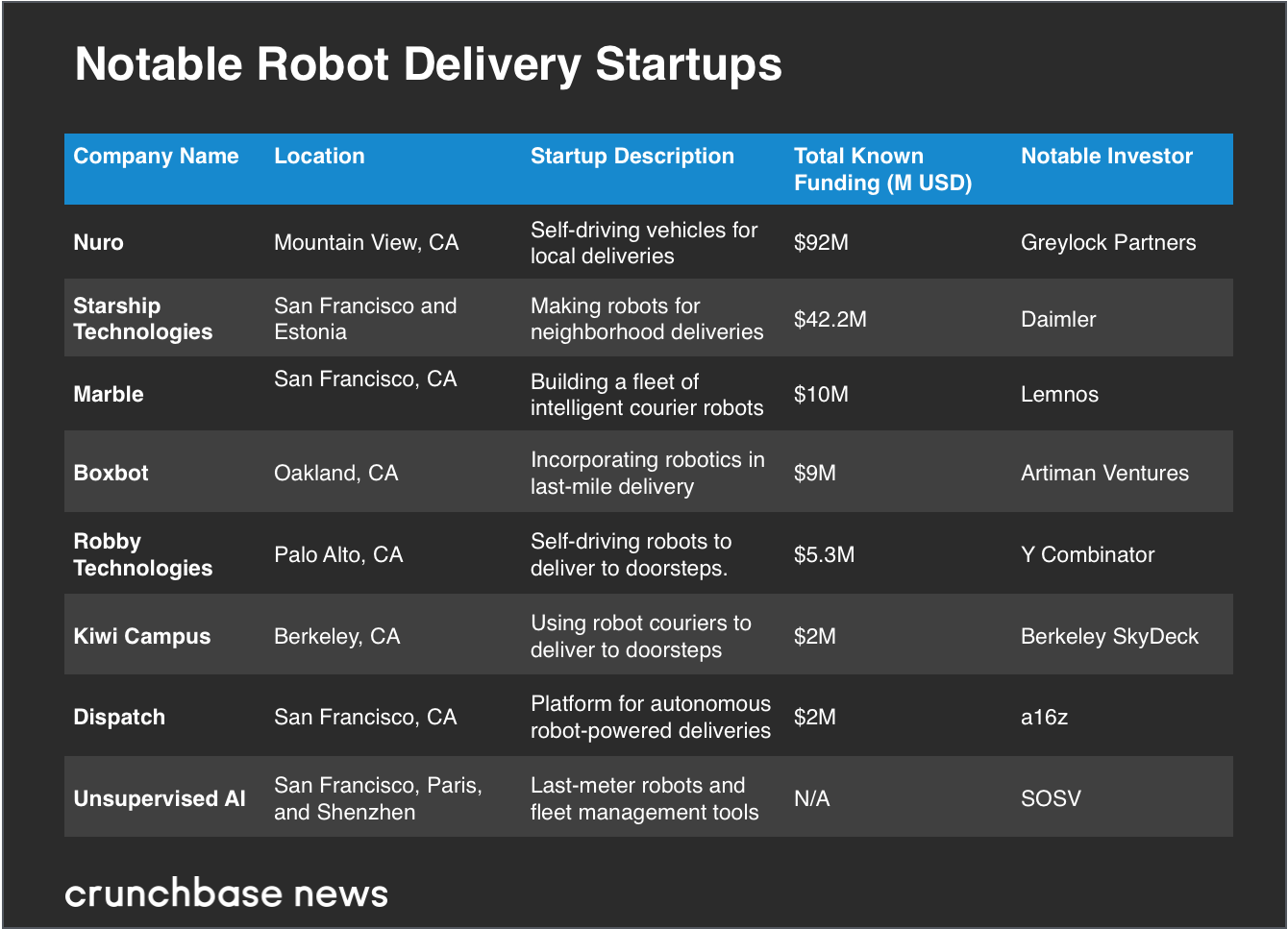
Joanna Glasner Contributor More posts by this contributor Getting personal: Funding rises for software-driven tastemakers The alumni of these universities raised the most VC in the past year Much of the last couple of decades of innovation has centered around finding ways to get what we want without leaving the sofa. So far, online ordering… Continue reading Robot couriers scoop up early-stage cash
Lyft Acquires Bike-Share Company and Inks Deal With N.Y.C. – Fortune
Having sealed a deal to expand New York City’s Citi Bike, Lyft announced Thursday that it is now the largest bike-share service in the United States. Although the ride-hailing company agreed in July to buy Motivate, an operator that reportedly dominates 80% of bike rentals in America, the deal didn’t become official until Thursday morning… Continue reading Lyft Acquires Bike-Share Company and Inks Deal With N.Y.C. – Fortune
Europe’s ride-hailing companies aren’t scared of Uber

Uber is speeding toward a historic IPO next year that could value it as high as $120 billion, but that doesn’t scare its rivals that operate across Europe. Speaking on stage at TechCrunch Disrupt Berlin, Markus Villig — the CEO of $1 billion-valued Taxify — and Via CEO Daniel Ramot, whose company has expanded from Israel into… Continue reading Europe’s ride-hailing companies aren’t scared of Uber
Top Automotive Industry News for Week of October 29 – November 4, 2018
Here is the most important news associated with the automotive industry
identified by the AEA for the week October 29, 2018 -November 4, 2018.
We hope it helps you stay up to speed on the key developments in our
industry:
-Automotive Manufacturing News-
Every Mid-Size Luxury Crossover and SUV Ranked from Worst to Best
(Car and Driver)
Faraday Future's Rough Road: Funds Sought As Cofounders Depart, Workers
Furloughed
(Forbes)
Ford could provide a 40% return in the year ahead as restructuring
takes hold, Goldman says
(CNBC)
GM memo: We must cut costs, can't wait to see what happens in industry
(Detroit Free Press)
GM Throws Weight Behind Nationwide Electric-Car Quota
(Cars.com)
GM to offer buyout to some workers in cost-cutting move: DJ
(CNBC)
Jaguar Land Rover undergoes $3.2 billion turnaround plan as sales slump
(autoblog)
Tesla electric vehicles will park themselves in 2019, Elon Musk says
(USA Today)
Tesla’s third-largest shareholder says it’s willing to pump more money
into the company
(CNBC)
The brutal and extreme tests Ram, Ford, Chevy run on trucks
(Detroit Free Press)
US regulators subpoenaed Tesla Model 3 production forecasts, data
(USA Today)
Volvo and Baidu join forces to mass produce self-driving electric cars
in China
(CNBC)
-Automotive Evolution News-
Cadillac cancels its car subscription program after just two years
(autoblog)
Ford, Volkswagen explore driverless venture to challenge Tesla, Waymo
(MarketWatch)
GM is making e-bikes as it expands beyond cars
(autoblog)
Hyundai, Kia Motors to develop new solar charging tech for vehicles
(Reuters)
Uber details why its driverless SUV killed a pedestrian and how it's
working to fix safety problems
(LA Times)
Uber says it's ready to start testing self-driving cars again
(Mashable)
VW and Intel's Mobileye Will Launch Autonomous Ride-Hailing Service In
Israel Next Year
(Forbes)
Waymo Gets California's Okay For Human-Free Driving Tests As Robo-Car
Skepticism Rises
(Forbes)
-Automotive Retail News-
5 hottest-selling U.S. vehicles in October: Tesla, Toyota, Subaru make
the list
(USA Today)
FCA, Honda and VW Lead October Auto Sales
(The Detroit Bureau)
GM Financial: More Loans, Fewer Leases in Q3
(Auto Dealer Monthly)
Luxury car owners trade up for American pickups as Ford, GM and Dodge
trucks dominate market
(CNBC)
New Vehicle Prices Continue to Rise in Fourth Quarter
(The Detroit Bureau)
Rising interest rates and prices hurt October auto sales, with SUVs
still faring better than cars
(USA Today)
Rising interest rates pinch U.S. auto sales, consumer confidence
(Reuters)
Vehicle sales reached 11-month high in October
(MarketWatch)
-Automotive Wholesale News-
Car Depreciation Reaches 10-Month High
(Vehicle Remarketing)
Lane watch: Wintry chill hits wholesale prices
(Auto Remarketing)
-Automotive Ownership News-
A Comfortable Place to Spend 38,000 Hours Behind the Wheel
(The New York Times)
-Automotive Enthusiast News-
140-car collection headed to Mecum’s Las Vegas auction
(ClassicCars)
Here are the most Googled car brands of 2018
(autoblog)
-Automotive Servicing News-
AAA offers free Lyft rides to and from repair shops
(autoblog)
New car safety technology saves lives — but can double the cost of
repairs
(NBC)
Stalling prompts recall of 2019 Jeep Cherokees with 2.4-liter engines
(Detroit Free Press)
Subaru, Toyota recall 165,000 U.S. cars with defect that could lead to
engine stalling
(USA Today)
-General Business & Executive News-
Broadcom makes $1 billion patent claim against Volkswagen: Der Spiegel
(Reuters)
New Autotrader Experience Helps Car Shoppers Accelerate Their Deal, Buy
Faster From The Palm of Their Hands
(PR Newswire)
U.S. Auto Industry's October Surprise
(Forbes)
With $50M investment, AutoNation obtains 7% stake in Vroom
(Auto Remarketing)
-AEA Reminder-
Did we miss something? Let us know via our
Contact Us Page >>
. If you have specific important news going public soon that you would like
to share with your fellow AEA Members, submit your
PR Distribution Request >>
Have a great week,
Member Services
memberservices@automotiveexecutives.com
Automotive Executives Association
www.automotiveexecutives.com
Go-Jek releases beta ride-sharing app to kick off Singapore launch
Indonesia’s Go-Jek has unleashed a beta version of its ride-sharing app in Singapore, marking the start of its anticipated entry into the market where it will be looking to challenge incumbent Grab. Available for download on Google Android and Apple iOS devices, the beta app was party of the company’s “staggered approach” to ensure its… Continue reading Go-Jek releases beta ride-sharing app to kick off Singapore launch