Autonomous vehicle technology company Velodyne Lidar has hired bankers for an IPO, according to sources familiar with the process. Velodyne Lidar, which makes a laser technology that helps self-driving cars detect the objects around them, is working with Bank of America Merrill Lynch, Citigroup, Royal Bank of Canada, and William Blair for a potential public… Continue reading Autonomous vehicle tech company Velodyne Lidar has hired bankers for an IPO in a high-stakes moment for the emerging industry
Tag: Mobility
Velodyne Lidar hires bankers for an IPO – Business Insider
A Velodyne LiDAR sensor is seen mounted on a self-driving vehicle during a self-racing cars event at Thunderhill Raceway in Willows, California, U.S., April 1, 2017. REUTERS/Stephen Lam (Reuters) – Autonomous vehicle technology company Velodyne Lidar has hired bankers for an initial public offering, Business Insider reported on Saturday, citing sources familiar with the process.… Continue reading Velodyne Lidar hires bankers for an IPO – Business Insider
India asks scooter, bike makers to draw up plan for EVs
NEW DELHI, June 22 (Reuters) – India's federal think-tank has asked scooter and motorbike manufacturers to draw up a plan to switch to electric vehicles, days after they publicly opposed the government's proposals saying they would disrupt the sector, two sources told Reuters.
Niti Aayog officials met with executives from companies including Bajaj Auto, Hero MotoCorp and TVS late on Friday, giving them two weeks to come up with the plan, according to one of the executives.
The think-tank, which is chaired by Prime Minister Narendra Modi and plays a key role in policymaking, had recommended that only electric models of scooters and motorbikes with engine capacity of more than 150cc must be sold from 2025, sources have told Reuters.
Automakers opposed the proposal and warned that a sudden transition, at a time when auto sales have slumped to a two-decade low, would cause market disruption and job losses.
India is one of the world’s largest two wheeler markets with sales of more..
Via Far Outpaces Uber, Lyft in NYC Utilization
Published June 21, 2019 6:01 pm, Via NYC
Via Far Outpaces Uber, Lyft in NYC Utilization
A new study by the city’s Taxi & Limousine Commissions reveals Via has a substantially higher utilization rate than its competition, cutting down on ‘cruising’
Newly proposed ride-hailing regulations in New York City reveal that Via is outpacing the competition yet again, this time showing that Via has a dramatically higher utilization rate than its competitors.
That’s according to a new study by the city’s Taxi & Limousine Commission on how to improve efficiency and manage for-hire vehicle growth in NYC. The city announced it will soon require for-hire vehicles in Manhattan be empty no more than 36 percent of the time by February 2020, and 31 percent by August 2020. But according to the TLC, Via is already at only 13 percent, while every other company is at least 42 percent.
According to the report, Via “has a substantially higher utilization in the Manhattan core (87%) than do Uber, Lyft, or Juno (54-58% in the Manhattan core). Of the other three high-volume FHV companies, Uber has the highest utilization and Juno the lowest, but the difference is small.”
Taking home the top spot for utilization is nothing new for Via, either. In 2018, the TLC reported that Via had the highest utilization rate of any for-hire vehicle service in New York City. Since launching in 2013, 95 percent of the company’s rides in NYC have been booked as shared. To date, Via’s shared rides eliminated 30 million driver miles on New York streets.
That’s compared to self-reported data from Uber and Lyft, which saw only 20 percent and 35 percent booked as shared, respectively.
The city’s latest report on utilization, however, comes just months after it mandated widespread driver wage increases, where it became clear that Via already paid its drivers far above the new minimum wage restrictions. And not by coincidence, Via’s higher driver pay and vehicle utilization are linked.
The TLC’s new report outlines how Uber, Lyft and Juno’s low utilization rates “cause drivers to spend over 40% of total work time empty and cruising for passengers. Combined with decreasing per-trip pay, this underutilization led to significant declines in driver income.”
Much like NYC’s updated minimum wage requirements, Via is already far exceeding the city’s new proposed “cruising” requirement. New York officials are now demanding that Uber, Lyft and Juno play catch-up.
Between Via’s exceptional utilization rate and high driver wages, the company continues to prove that it’s possible to run a highly efficient transportation service that both treats drivers fairly and reduces traffic congestion.
Read more
Airbus-owned Voom will compete with Uber Copter in the US in 2019
The U.S. air taxi market is heating up: Aeronautics industry giant Airbus will be among the companies operating on-demand air travel service in 2019 in American skies, FastCompany reports. Airbus’ Voom on-demand helicopter shuttle operation will set up shop in the U.S. starting this fall, after previously providing service exclusively in Latin America. Uber announced… Continue reading Airbus-owned Voom will compete with Uber Copter in the US in 2019
AEye Team Profile: Vivek Thotla
On June 26th, AEye Staff Engineer, Vivek Thotla, will be speaking on a panel called “Should We Take CV To The Edge?” at IoT Forum on Computer Vision @ Sensors Expo.
Vivek is a staff engineer at AEye, where he leads product verification and validation, and is responsible for LiDAR simulation and data strategy in producing automotive grade products. Previously, he was a Component Owner / Functional Delivery Owner for point cloud algorithms at Continental, where he was responsible for planning, requirements, design and development of embedded platform-based algorithms for a Hi-Res 3D Flash LiDAR, in addition to enforcing ADAS process stages to meet ASPICE levels and functional safety. He has also held engineering roles at Tribis, AmpliSine Labs, Missouri S&T and Enigma Portal. Vivek holds an MBA in Information Technology Project Management and a PhD and Masters in Electrical, Electronics and Communications Engineering.
We sat down with Vivek to learn more about the advantages of integrating computer vision at the sensor, building automotive grade LiDAR products, and why he decided to move to the Bay Area.
Q: How much of an autonomous vehicle’s computer vision should be done at the sensor, as opposed to a central processor?
The amount of data produced today by a perception system is enormous. And incorporating all the data from the different kinds of sensors used (like radar, camera, and LiDAR) makes it very difficult and expensive to process and store. In a typical perception system, roughly 80% of the data produced by the sensors is thrown out.
However, intelligent sensors – like what we develop at AEye – are software definable. Meaning, you can adjust its settings to get high resolution data from an object and get sparse data in the background, cutting down the overall amount of data processed by more than 80%. This makes computer vision algorithms at the central processor faster and efficient because once you preprocess data, latency becomes less of an issue. Currently, AV companies are spending a tremendous amount of money storing useless data. Preprocessing saves both time and money.
Q: What is the largest challenge in producing automotive grade LiDAR products?
Industry wide, the greatest challenge is maintaining the quality, reliability, and consistency needed on all components and software that go into a LiDAR sensor of over 100,000 samples or more and over the sensor’s lifetime. Another major challenge for bringing LiDAR products to the automotive market is designing the sensor to fit in different regions of the car. There are a lot of constraints based on where the sensor is placed on the vehicle and certain issues that arise from each placement. For example, a sensor placed behind a windshield might need a completely different design than a sensor that’s placed in the front bumper.
There are many interesting LiDAR architectures out there that work really well at smaller samples and in the lab. But the moment the product needs to scale and deal with all the quality and environmental requirements of being an automotive grade product, they fail. AEye is mitigating these challenges by partnering directly with Tier 1’s who know the process of making large-scale, automotive grade products. In my own experience, I’ve found that once a Tier 1 partners with you, they are extremely supportive because they believe in you, and that proves you are capable of achieving it.
In addition to our partners who help us push the sensor to automotive grade, we have a great functional safety team here at AEye. I came to AEye from a Tier 1, so I know what goes into developing an automotive grade sensor, and the AEye team is made up of people from all over the automotive industry that have great, diverse insight into how to bring a product to market.
Q: You moved to the Bay Area from Santa Barbara. What was it about Silicon Valley that drew you here?
It has always been my dream to come to Silicon Valley – you hear about it so much as the epicenter of technology and innovation. And it’s true: Silicon Valley is at the heart of the autonomous driving industry. All the innovative and novel work happening today in the LiDAR industry is happening here and I did not want to miss my chance to help develop the tools for true autonomy.
Connect with AEye at Sensors Expo! Learn more here.
AEye Team Profile: Vivek Thotla — VentureBeat Says iDAR Is “Built for Speed”AEye Team Profile: Dr. Allan SteinhardtAEye Adds VP of AI and Software to Executive TeamAEye Advisory Board Profile: Scott PfotenhauerThe Future of Autonomous Vehicles: Part II – Blind Technology without Compassion Is RuthlessAEye Advisory Board Profile: Adrian KaehlerAEye Team Profile: Indu VijayanAEye Expands Business Development and Customer Success Team to Support Growing Network of Global Partners and CustomersAEye Sets New Benchmark for LiDAR Range
Ford to Deliver Exciting Ford GT Supercar News at Goodwood Festival of Speed
About Ford Motor Company Ford Motor Company is a global company based in Dearborn, Michigan. The company designs, manufactures, markets and services a full line of Ford cars, trucks, SUVs, electrified vehicles and Lincoln luxury vehicles, provides financial services through Ford Motor Credit Company and is pursuing leadership positions in electrification, autonomous vehicles and mobility solutions.… Continue reading Ford to Deliver Exciting Ford GT Supercar News at Goodwood Festival of Speed
Indian two-wheeler rental startup Vogo in talks to raise up to $50m
Vogo Automotive Pvt. Ltd, which offers bikes on rent, is in talks to raise $40-50 million as equity to fuel its growth plans, said two people familiar with the matter, requesting anonymity. The Bengaluru-based startup, which operates under the brand Vogo, has mandated Mumbai-based investment bank Avendus Capital for the latest fundraise, said the first… Continue reading Indian two-wheeler rental startup Vogo in talks to raise up to $50m
Jeffrey Jones

Jeff Jones is the Vice President of Ford’s North American City Solutions. He leads Ford’s global efforts to partner with municipalities to identify key urban mobility needs that will inform development of new mobility services while also working to create, pilot and implement new mobility solutions in cities worldwide. Previously, Jones was an Executive Director… Continue reading Jeffrey Jones
A Qashqai Is Nissan Sunderland’s 10 Millionth Vehicle
autoevolution
cars
moto
news
car reviews
spyshots
driven cars
space junk
green
newspaper
Compare Cars
BAC Calculator
Editorial
Coverstory
Motorsport
Testdrives archive
Auto Shows
Tuning
Car Finder
Photo of the Day
Glossary of automotive terms
Masthead
RSS Feeds
More on this:1 Waymo Goes International with Renault-Nissan Deal for Self-Driving Cars2 Nissan Electric Ice Cream Truck Looks Chilling3 Nissan 370Z Has Rookie Nurburgring Crash, Front and Back Ruined4 Tunned Nissan GT-R Looks Like a Racecar, Packs Extreme Aero5 Tuned Nissan GT-R Drag Races Modded Mercedes-AMG CLS63, Brutal Battle Ensues
Space Junk
NASA Shows Us the Anus of Mars
A Qashqai Is Nissan Sunderland’s 10 Millionth Vehicle
20 Jun 2019, 20:18 UTC ·
by Mircea Panait
Home > News > Industry
Founded in 1984, Nissan Motor Manufacturing UK is headquartered in Sunderland. Built on the site of a former RAF airfield, the factory where the Qashqai is manufactured is complemented by the Japanese automaker's distribution center and lots of on-site suppliers.
21 photos
Production at Sunderland started in 1986 with the Bluebird, then the Primera and Micra followed in 1990 and 1992. As of May 2019, the Micra and Primera are listed on second and third in terms of total production at the British plant. The Qashqai reigns supreme even though it’s been introduced in 2006, tallying more than 3,416,500 examples of the breed.
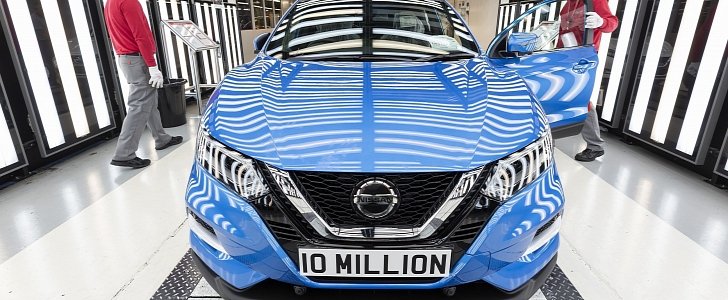
33 years on, Nissan Motor Manufacturing UK reaches the ten million mark with a Vivid Blue-painted Qashqai Tekna. The vehicle is optioned with ProPilot semi-autonomous driving technologies. “Building ten million vehicles is a tremendous achievement for everyone associated with the plant,” said Steve Marsh, vice president of manufacturing at Sunderland.
“Together we are determined to continue to drive up the high quality standards our customers have come to expect over the last three decades,” concluded the official, but we don’t agree with everything. For starters, continuously variable transmissions built by JATCO are as unreliable as CVTs get. There’s also the matter of Renault, which took its toll on build quality ever since the alliance was formed.
The Infiniti Q30 is also manufactured in Sunderland, a Mercedes-Benz GLA-Class with a different body shell, interior, and badging. Does it come as a surprise this crossover isn’t selling well? The luxed-up brand is leaving the western part of Europe in 2020 because of poor sales, totaling 5,800 vehicles in 2018.
Turning our attention back to production, Sunderland is also the place where the Leaf is manufactured for the United Kingdom and Europe. The all-electric hatchback is joined by the Juke, which will enter the second generation for the 2020 model year.
Parked bumper to bumper, Nissan claims the 10 million vehicles manufactured in Sunderland would stretch around the globe. Considering that Earth has a circumference of 40,075 kilometers (24,901 miles), the automaker’s statement appears to be correct.
click to load Disqus comments for this storyThis enables Disqus, Inc. to process some of your data.
Manipulated Into Liking Cars
Upgrading Your Car: Top 5 Android Auto / Apple CarPlay Multimedia Systems
When Ford Told Ferrari to Shove It Using a Race Car
Car, Go Make Me Some Money!
5 Top Rated Electric Scooters to Cure Your Lime and Bird Addiction
Interview with Lamborghini EMEA CEO, Andrea Baldi: Hybridization, Female Buyers
Smoke and Mirrors: Volvo's New Top Speed Limit
5 Must Have Truck Bed Accessories Your Pickup Badly Needs
Alfred Neubauer: the First “Don” of Motor Racing
Could Volkswagen Group's Electric Plans Include Ducati?
The Dos and Don’ts of Washing a Motorcycle, Part One
Aprils Fools' Pranks We’d Love or Hate to See Come True
The Engine Start-Stop Systems Conspiracy
5 Essential Car Accessories for the Summer Vacation
Headwave TAG Helmet Music and Navigation System Reviewed
The Perversion of the Fast and the Furious
The Dos and Don’ts of Washing a Motorcycle, Part Two (Final)
Can Cars Be Hacked? Inside Secure CSO Asaf Ashkenazi Says Yes. By Anyone
On Electric Harleys and New Generations
Engine Break-In: What You Need to Know
The Biggest Anticipations in Motorcycling for 2016, Part 1
NISSAN models:NISSAN GT-R Nismo CoupeNISSAN Tiida/Versa Sedan CompactNISSAN Rogue Sport Small SUVNISSAN Murano CrossoverNISSAN Maxima MediumAll NISSAN models
googletag.cmd.push(function(){ window.slot4 = googletag.defineSlot(“/1004334/AE_news_300x600_noref”, [300, 600], “AE_news_300x600_noref__slot_4”).addService(googletag.pubads()); googletag.display(“AE_news_300x600_noref__slot_4”); });if(typeof window.REQUEST_NONPERS !== “undefined”) { console.log(“manref”); googletag.pubads().refresh([window.slot4]); } '+'ipt>';
if(i==3) txt+='googletag.cmd.push(function(){ window.slot5 = googletag.defineSlot(“/1004334/AE_news_300x250_noref”, [300, 250], “AE_news_300x250_noref__slot_5”).addService(googletag.pubads()); googletag.display(“AE_news_300x250_noref__slot_5”); });if(typeof window.REQUEST_NONPERS !== “undefined”) { console.log(“manref”); googletag.pubads().refresh([window.slot5]); } '+'ipt>';
}
txt+=””+
“”+
“”+data[i][0]+””+
“”+
“”+
“”+data[i][2]+”
“+
“”+
“”+
“”;
}
txt+=””;
$('#morescroll').html(txt);
nxloaderactive=false;
});
}
function aenext_lzy() {
$(window).on(“scroll”, function() {
if(nxstories!=false) return;
var footOffset = $(“#footer”).offset().top;
if($(window).scrollTop() > footOffset – $(window).height() – 600) aenext_load();
});
}
function aenews_fixoverlaps_actual() {
window.aeoverlapst=-1;
var $rsoc=$(“.rightsocial”).first();
if($rsoc.length!=0) {
var rsocofs=$rsoc.offset().top;
var $newsgal=$(“.newsgal”).first();
if($newsgal.length==0) return;
var ngofs=$newsgal.offset().top+$newsgal.height();
if(rsocofs commentsOffset – $(window).height() – 400) anyclip_load();
}
}
}
function anyclip_load() {
var d = document, s = d.createElement('script');
s.src = 'https://player.anyclip.com/anyclip-widget/lre-widget/prod/v1/src/lre.js';
s.setAttribute('id', 'lre-player-widget');
s.setAttribute('pubname', 'autoevolutioncom');
s.setAttribute('widgetname', '0011r00002IZQzB_730');
(d.head || d.body).appendChild(s);
window.acLoaded = true;
}