Meituan Dianping, China’s largest on-demand food delivery company, announced today at CES that it has signed three new major partners for the development of its autonomous delivery open platform. They are Nvidia, Italian automotive design company Icona, and French automotive supplier Valeo. This is the first time Meituan Dianping, which went public four months ago… Continue reading Meituan partners with Nvidia, Valeo and Icona for its autonomous delivery platform
Tag: Mobility
VW & GM Exec Statements on Electric Vehicles & Tesla Leave Me Dizzy, Confused, Laughing
Electric Cars
Electric Car Benefits
Electric Car Sales
Solar Energy Rocks
RSS
Advertise
Privacy Policy
Autonomous Vehicles
Published on January 9th, 2019 |
by Matt Pressman
VW & GM Exec Statements on Electric Vehicles & Tesla Leave Me Dizzy, Confused, Laughing
Twitter
Google+
LinkedIn
Pinterest
Facebook
January 9th, 2019 by Matt Pressman
Originally published on EVANNEX.
Big Auto’s executives have a long history of taking shots at Tesla. Now, two industry giants, VW and GM, have decided to dismiss the Silicon Valley automaker altogether and claim they’ll (instead) lead the EV revolution. Yet, their braggadocio, somehow, doesn’t seem to add up.
Two of the industry’s biggest heavyweights, VW and GM, have dialed up their bold claims surrounding electric car efforts. VW has lineup of fully electric vehicles coming in next few years.
Larry Vellequette reported in November (via Automotive News Europe) that Volkswagen’s rhetoric about electric vehicles is “the direct result of a strategy shift that came after getting caught cheating on diesel-emissions testing.” Deflecting attention from the dieselgate scandal and recent cartel allegations, VW’s corporate communications vacillate wildly from reluctant to boastful when it comes to the company’s EV plans.
In a puzzling interview with VW’s Herbert Diess shared in that article, the company’s CEO downplayed the viability of the electric car, explaining, “if you are still driving far distances, 20,000 or 30,000 miles [per year], it’s probably not the right car.” And with EVs, Deiss adds, “you’re driving on coal instead of oil, and it doesn’t make sense.” [Editor’s note: What????] That said, he concedes, “Renewable energy is a must… [so] we will be very big in electric cars worldwide because we are very strong in China.”
A look back at VW’s dieselgate scandal, which likely sparked the company’s recent PR offensive touting its “support” for EVs (YouTube: The Verge)
Deiss admits, “[Electric car] sales are picking up. It’s not all over the place, but West Coast, if you go to a parking lot, you see already a decent mix of electric cars there. Most of them are probably Teslas, but what’s happening now is that the cars become so much better.” He continues, “I think we have the best setup strategy for the electric vehicles to come. … We will be aggressive on the pricing. We will be much lower than Tesla.”
Meanwhile, GM’s former bigwig, Bob Lutz, is consistently appearing on financial news shows in order to trash-talk Tesla. Recently, he claimed, “Tesla is headed to the graveyard.” Do GM’s top brass feel the same way? Jamie Lareau (via Detroit Free Press) spoke with Mike Abelson, GM’s vice president of global strategy, for his take on EVs. He reports, “GM’s gasoline-powered cars and trucks will be the main revenue stream for the company for at least the next two decades,” according to Abelson. [Editor’s note: What?????]
GM has no plans for electric pickup trucks.
Yet, contradicting himself, Abelson adds, “We do believe we’ll lead the industry in EVs sometime in the next decade or so.” [Editor’s note: What???????]
If that’s the case, will GM, perhaps, battle Tesla in market segments like pickup trucks. No. Abelson says, “There will not be any AV/EV pickups.” [Editor’s note: OMG]
Nevertheless, it’s reported that “GM is exploring all fronts in future mobility, including talking to companies working on flying cars.”
About the Author
Matt Pressman is all about Tesla. He’s a TSLA investor, pre-ordered the Model 3, and loves driving the family's Model S and Model X company cars. As co-founder of EVANNEX, a family business specializing in aftermarket Tesla accessories, he’s served as a contributor/editor of Electric Vehicle University (EVU) and the Owning Model S and Getting Ready for Model 3 books. He writes daily about Tesla and you can follow his work on the EVANNEX blog.
Back to Top ↑
Advertisement
Advertise with CleanTechnica to get your company in front of our readers.
CleanTechnica Clothing & Cups
Top News On CleanTechnica
Join CleanTechnica Today!
Advertisement
Advertisement
Follow CleanTechnica Follow @cleantechnica
Our New Electric Car Driver Report
Read & share our new report on “electric car drivers, what they desire, and what the demand.”
The EV Safety Advantage
Read & share our free report on EV safety, “The EV Safety Advantage.”
EV Charging Guidelines for Cities
Share our free report on EV charging guidelines for cities, “Electric Vehicle Charging Infrastructure: Guidelines For Cities.”
30 Electric Car Benefits
Our Electric Vehicle Reviews
Tesla News
Cleantech Press Releases
New Research Shows That Only Two Large Petroleum Companies Have Meaningful Emission Reduction Targets
Koben Announces EVOLVE EVSF —Grid-Friendly Modular EV Store & Forward System
The New Danish Climate Plan — Together For A Greener Future
38 Anti-Cleantech Myths
Wind & Solar Prices Beat Fossils
Cost of Solar Panels Collapses
© 2018 Sustainable Enterprises Media, Inc.
Electric Cars
Electric Car Benefits
Electric Car Sales
Solar Energy Rocks
RSS
Advertise
Privacy Policy
This site uses cookies: Find out more.Okay, thanks
Unmanned systems: Silent Falcon UAS assisting Pojoaque Pueblo in New Mexico, Resolute Eagle UAS adopts MPU5 technology, Ford and Michigan State expand research partnership

In this week’s/today’s roundup from the Association for Unmanned Vehicle Systems International (AUVSI) which highlights some of the latest news and headlines in unmanned vehicles and robotics, the Wildflower International technology firm pairs with Silent Falcon UAS in Wildflower’s bid to build a new data service, PAE ISR upgrades the Resolute Eagle UAS with new communication… Continue reading Unmanned systems: Silent Falcon UAS assisting Pojoaque Pueblo in New Mexico, Resolute Eagle UAS adopts MPU5 technology, Ford and Michigan State expand research partnership
Mercedes-Benz, NVIDIA Announce Collaboration to Create New AI Computer Architecture for Mercedes Vehicles
Mercedes-Benz announced today it has selected NVIDIA to help realize its vision for next-generation vehicles. Speaking to a packed crowd at the Mercedes-Benz booth on the first day of CES 2019, Mercedes-Benz Executive Vice President Sajjad Khan and NVIDIA Founder and CEO Jensen Huang outlined their plans for next-gen AI cars and the new breed… Continue reading Mercedes-Benz, NVIDIA Announce Collaboration to Create New AI Computer Architecture for Mercedes Vehicles
Report: Self-driving car startup Aurora is raising capital at a $2B valuation
Early last year, LinkedIn co-founder and prolific venture capital investor Reid Hoffman called Chris Urmson “the Henry Ford of autonomous vehicles (AV).” The vote of confidence and big check from Hoffman, coupled with a team of deeply knowledgable AV entrepreneurs, has catapulted his company, Aurora Innovation, squarely into “unicorn” territory. Aurora, the developer of a full-stack… Continue reading Report: Self-driving car startup Aurora is raising capital at a $2B valuation
Press release / January 8, 2019 LeddarTech Joins Baidu’s Apollo Autonomous Driving Open Platform LeddarTech’s LiDAR technology will now be compatible with Apollo 3.5, the latest version of the platform, through the integration of an open source software development kit (SDK) which will facilitate the development for Tier-1 suppliers, OEMs, and other application developers.
Leddartech/Press release/LeddarTech Joins Baidu’s Apollo Autonomous Driving Open Platform
LeddarTech Joins Baidu’s Apollo Autonomous Driving Open Platform
LeddarTech joins Baidu’s Apollo autonomous driving open platform with its LiDAR products through an open source SDK.
QUEBEC CITY, January 8, 2019 — LeddarTech, an industry leader providing the most versatile and scalable auto and mobility LiDAR platform, announced the integration of LeddarTech’s LiDAR products into Apollo, Baidu’s autonomous driving open platform.
LeddarTech’s products will now be compatible with Apollo 3.5, the latest version of the platform, through the integration of an open source software development kit (SDK) which will facilitate the development for Tier-1 suppliers, OEMs, and other application developers who wish to use LeddarTech products within the Apollo open platform.
LeddarTech’s auto and mobility LiDAR platform equip key suppliers with the technology, tools, and resources they need to design their own differentiated LiDAR offering and to meet the specific requirements of various advanced driver-assistance systems (ADAS) and autonomous driving (AD) applications. At the core of the platform is the LeddarEngine, comprised of highly-optimized SoCs and signal processing software that have been designed to meet ISO 26262 ASIL-B standards and that will allow LeddarTech’s customers to deliver automotive-grade LiDAR sensors which comply with functional safety requirements.
“An open platform is a powerful model that fosters win-win, added-value partnerships throughout the automotive supply chain,” said Frantz Saintellemy, LeddarTech’s President and COO. “With our open source SDK for the Apollo platform, the data output format will allow easier comparison and system development,” added Saintellemy. “The wide, global reach of the Apollo partners provides tremendous new opportunities to accelerate the adoption of our LiDAR platform across the industry.”
Apollo serves as an open, reliable and secure software platform for its partners to develop their own autonomous driving systems through on-vehicle and hardware platforms. Apollo accelerates the development, testing, and deployment of autonomous vehicles.
Apollo welcomes LeddarTech as a new partner of its open development platform as all Apollo partners will now benefit from open, standardized access to LeddarTech’s LiDAR technology, greatly facilitating development and integration projects.
Both companies participate in CES 2019 in Las Vegas, Nevada, January 8-12. The LeddarTech Pavilion will be located at CP-16 and Baidu-Apollo will be situated at Westgate Pavilion #1814.
About LeddarTech
LeddarTech is an industry leader providing the most versatile, scalable auto and mobility LiDAR platform based on the unique LeddarEngine, which consists of a suite of automotive-grade, functional safety certified SoCs working in tandem with LeddarSP signal processing software. The company is responsible for several innovations in cutting-edge mobility remote-sensing applications, its patented technologies enhancing ADAS and autonomous driving capabilities for automobiles, trucks, buses, delivery vehicles, robotaxis, shuttles, and more. Additional information about LeddarTech is accessible at www.leddartech.com, and on LinkedIn, Twitter, Facebook and YouTube.
Return to News
This website places cookies on your device to give you the best possible user experience. By using our websites, you agree to our cookies being saved on your device (unless you have disabled cookies in your settings). For more information, please read our Terms of Use and our Privacy policy.
I Agree
Autonomous cars will never exist says Waymo boss – AutoExpress
Fully autonomous cars that can drive in any conditions and on any road without human input will never exist, according to the boss of a leading driverless vehicle firm. Waymo CEO John Krafcik told the Wall Street Journal’s D.Live conference “autonomy will always have constraints.” • Jaguar teams up with Waymo to build driverless I-Pace SUVs… Continue reading Autonomous cars will never exist says Waymo boss – AutoExpress
AEye Announces Industry Leading Family of Perception Sensors for ADAS Solutions
AE200 Series is designed to address the need of modular, high-performance sensors that are based on the iDAR™ platform and optimized for size, weight, power, and price.
“The AE200…product family — specifically for the ADAS market — delivers the perception data that is needed for safe and reliable L3 operation, at a price point that OEMs will find extremely attractive. We achieve this by using the concept of agile parallax, a derivative feature of our iDAR architecture. This agility allows us to retain the same world record flexibility, revisit rate and resolution of the AE110, by trading off range and achievable simultaneous ROIs.”
CES, Las Vegas, NV – January 8, 2019 – AEye, a world leader in artificial perception systems and the developer of iDAR™, today announced the AE200 Series of sensors, a game changing solid-state sensor family for Level 3 ADAS applications. AEye previously announced its latest Mobility/Robotaxi solution, the AE110, in December, 2018. Built on the world’s most extensive solid-state LiDAR patent portfolio, the AE200 Series features the industry’s only software-definable intelligent agile LiDAR, industry-leading ADAS performance, and is SWaP optimized for modular ADAS deployments capable of supporting all popular vehicle packaging locations.
The company simultaneously announced today that it has entered into strategic partnerships with Hella and LG Electronics. The AE200 Series will be one of the iDAR-based artificial perception systems that both Hella and LG Electronics will be using to deliver ADAS solutions to global OEMs at scale.
The AE200 Series includes AEye’s industry leading anti-spoofing and interference mitigation and is under ASIL-B functional safety certification, ensuring it meets the automotive industry’s stringent safety standards. Delivering ADAS L3 long range performance of up to 200M at 10% reflectivity at 0.1° resolution and the short range performance configuration of 50M range at 10% reflectivity, the AE200 Series will be modular in design and capable of up to 120°x 45° Field of View.
“The AE200 is about redefining performance expectations for modular ADAS perception sensors,” said Aravind Ratnam, Vice President of Product Management at AEye. “For level 3, current low cost LiDAR options don’t deliver value for their low price. This product family specifically for the ADAS market delivers the perception data that is needed for safe and reliable L3 operation, at a price point that OEMs will find extremely attractive. We achieve this by using the concept of agile parallax, a derivative feature of our iDAR architecture. This agility allows us to retain the same world record flexibility, revisit rate and resolution of the AE110, by trading off range and achievable simultaneous ROIs.”
Key features of the AE200 include:
Software-definable LiDAR
Designed to meet ISO 26262 functional safety requirements, eye safe in all modes
Four layers of interference mitigation and anti-spoofing technology
Software Development Kit
Software and fundamental perception capabilities to support specific ADAS solutions such as Cross Traffic Alerts, Emergency Braking, Front and Rear Collision Warning, and Blind Spot Monitoring, etc.
Automotive SWaP optimized with documented field and environmental testing
Modular for supporting all critical ADAS packaging locations including headlamp, windscreen, side mirror, front grill, A-pillar, and C-pillar
Optional High resolution RGB or IR camera fused and bore sighted with AEye’s agile LiDAR
The AE200 will be available to automotive OEMs and Tier 1s in the Summer, 2019. For more information about AEye, the AE110, and the company’s innovative approach to artificial perception, please visit CES Booth #2100 at the Westgate Convention Center in Las Vegas, January 8th – 11th, 2019. For a private car demo, please contact [email protected]
About AEye
AEye is an artificial perception pioneer and creator of iDAR™, a perception system that acts as the eyes and visual cortex of autonomous vehicles. Since its demonstration of its solid-state LiDAR scanner in 2013, AEye has pioneered breakthroughs in intelligent sensing. The company is based in the San Francisco Bay Area, and backed by world-renowned investors including Kleiner Perkins Caufield & Byers, Taiwania Capital, Intel Capital, & Airbus Ventures.
Media Contact:
AEye, Inc.
Jennifer Deitsch
[email protected]
925-400-4366
AEye Announces Industry Leading Family of Perception Sensors for ADAS Solutions — AEye Introduces Advanced Mobility Product for the Autonomous Vehicle MarketAEye’s iDAR Shatters Both Range and Scan Rate Performance Records for Automotive Grade LiDARAEye’s $40M Series B Includes Numerous Automotive Leaders Including Subaru, Hella, LG, and SKThe Future of Autonomous Vehicles: Part I – Think Like a Robot, Perceive Like a HumanThe Future of Autonomous Vehicles: Part II – Blind Technology without Compassion Is RuthlessAEye Announces Addition of Aravind Ratnam as Vice President of Product ManagementBlair LaCorte Named President of AEyeAEye Granted Foundational Patents For Core Solid-State MEMs-Based Agile LiDAR And Embedded AI TechnologyAEye’s iDAR Leverages Biomimicry to Enable First Solid State Lidar with 100Hz Scan RateAEye Introduces Next Generation of Artificial Perception: New Dynamic Vixels™
Understanding the collective wisdom of the car crowd

This article was originally published on LinkedIn. Mapping has been around for thousands of years. One of the very first things that early humans painted on the walls of their caves were maps – pictures representing how they saw the world. Maps are abstractions, and as humanity developed, we’ve gradually learned how to describe roads,… Continue reading Understanding the collective wisdom of the car crowd
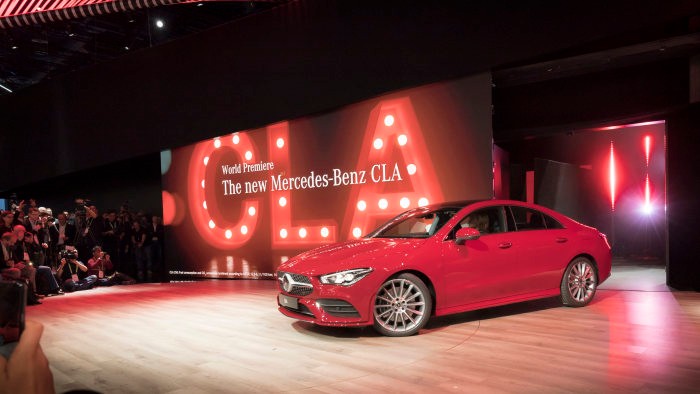
Mercedes-Benz Cars at the CES 2019: Starting the New Year with the World Premiere of a Design Icon
08.
January 2019
Las Vegas
The brand with the three-pointed star is kicking off the new year at CES 2019 with the world premiere of the new Mercedes-Benz CLA Coupé featuring the further evolution of the MBUX (Mercedes-Benz User Experience) infotainment system. Further highlights are the US premieres of the battery-electric Mercedes-Benz EQC (power consumption combined: 22.2 kWh/100 km; CO2 emissions combined: 0 g/km, preliminary figures) and the pioneering Vision URBANETIC mobility concept. You can watch the Mercedes-Benz press conference via video-on-demand on Mercedes me media: https://media.mercedes-benz.com/ces2019.
The Mercedes-Benz CLA Coupé celebrates its world premiere. The successor to the premium coupé first unveiled in 2013 boasts an innovative interior with the next evolution of the MBUX, which now recognises control commands through movements. Also new is the ENERGIZING COACH familiar from the B-Class. This service, based on an intelligent algorithm, suggests one of the programmes from the ENERGIZING package according to the situation and individual needs. Its extensively facelifted exterior ensures the new CLA Coupé remains the design icon of the compact segment. Its distinctive forward-angled front end with its long, taut hood and power domes is particularly striking, while the wider track emphasises the sporty and dynamic look.
“We’re taking it to the next level by bringing the intelligent interior assistant to the compact class, too. Movement recognition makes it easier and more intuitive to operate,” says Ola Källenius, Member of the Board of Management of Daimler AG responsible for Group Research and Mercedes-Benz Cars Development. “The CLA offers a huge amount of automotive intelligence, and not just with this new feature.”
“With the first CLA, a four-door compact coupe, we opened up a completely new segment. And its success proves us right: 750,000 units of the CLA and CLA Shooting Brake alone have already been sold,” says Britta Seeger, Member of the Board of Management of Daimler AG responsible for Mercedes-Benz Cars Marketing & Sales. “The next iteration of the CLA is an intelligent evolutionary development that is even more emotional and sportier than its predecessor. Paired with the new operating system, it once again sets benchmarks for the entire class.”
Two electrified US premieres
On show for the first time on American soil is the Mercedes-Benz EQC. The first purely battery-electric vehicle from the EQ product and technology brand represents an ideal combination of comfort, quality and everyday usability. Both inside and out, the crossover SUV embodies the design language of progressive luxury. The EQC is likewise equipped with the groundbreaking MBUX – Mercedes-Benz User Experience – multimedia system, enhanced with a wide range of EQ-specific content. It also boasts a completely re-engineered powertrain system with a compact electric driveline (eATS) front and rear, giving the EQC the handling characteristics of an all-wheel-drive vehicle and providing it with an electric range of more than 450 km in the NEDC (preliminary figures)i.
“The EQC is the Mercedes-Benz among electric vehicles. Soon, we will have many more – we aim for over ten purely electric passenger cars by 2022,” stresses Ola Källenius. “This will cover the entire portfolio: from smart to large SUVs.
The future definitely is electric.”
Also celebrating its US premiere is the Vision URBANETIC – a revolutionary mobility concept that goes way beyond previous notions of autonomous vehicles. Vision URBANETIC removes the division between people moving and goods transportation. The concept lowers traffic volume, takes the pressure off city infrastructures and contributes to a new quality of urban life. The revolutionary vehicle is based on an autonomous, electrically powered driving platform that can carry different, interchangeable bodies for either people moving or goods transportation. As a ride-sharing vehicle, Vision URBANETIC can carry up to twelve passengers, while the cargo module can transport up to ten EPAL pallets.
“The empathy of the Vision URBANETIC was particularly important to us: The vehicle is attentive and interacts with people through various lighting elements,” says Ola Källenius. “With this kind of vehicle, we’re shooting for the moon. And that’s a crucial part of innovation.”
High customer loyalty – sales figures continue to rise for eighth year in a row
For the third time in a row, Mercedes-Benz is the best-selling premium brand in the automotive industry. “With more than 2.4 million vehicles delivered by Mercedes-Benz Cars in 2018, we once again surpassed our own sales record – for the eighth time in succession. In addition, despite a challenging year, we maintained our position at the top of the premium segment. The enthusiasm for our vehicles as well as the loyalty of our customers motivates us to give our best well into the new year,” said Britta Seeger, Member of the Board of Management of Daimler AG responsible for Mercedes-Benz Cars Marketing and Sales.
The Mercedes-Benz press conference is available as video-on-demand on https://media.mercedes-benz.com/ces2019, alongside two further multi-angle live streams from our show stand, which will be uploaded during the course of the day. At 2.00 pm local time (CET-9), Sajjad Khan, Member of the Divisional Board of Mercedes-Benz Cars, CASE and Vice President of Digital Vehicle & Mobility, will provide an insight into the latest CASE developments. At 3.30 pm local time
(CET-9), Wilfried Porth, Member of the Board of Management, Human Resources and Director of Labour Relations, Mercedes-Benz Vans, will talk about the future of mobility based on the example of the Vision URBANETIC. The media available on Mercedes me media also offers a wide range of additional information as well as extensive imagery and video footage from CES 2019.
i Figures on fuel consumption, power consumption and CO2 emissions are preliminary. They were calculated by Technical Services for the certification process in accordance with the WLTP and correlated with NEDC figures. EC type approval and a conformity certificate with official figures are not yet available. The official figures may differ from those stated here.
Press Contact
Andrea Eberhardt
Product Communications Mercedes-Benz Vans
andrea.eberhardt@daimler.com
Tel: +49 711 17-84020
Fax: +49 711 17-1779097330
Koert Groeneveld
Head of International Product & Technology Communications
koert.groeneveld@daimler.com
Tel: +49 711 17-92311
Fax: +49 711 17-94365
Press Contact Overview
Media
Download
Pictures (19)
Videos (3)
Documents (1)
Media Contact (2)
Filter
Show thumbnails
Show list
Slideshow
Zoom
Preview
Details
Do you really want to delete the data record?
Please wait a moment …
Please wait a moment …
Please wait a moment …
Please wait a moment …
19C0002_002
19C0002_003
19C0002_004
19C0002_007
19C0002_008
19C0002_009
19C0002_010
19C0002_013
19C0002_014
19C0002_015
19C0002_016
19C0002_019
19C0002_020
19C0002_021
19C0002_022
19C0002_025
19C0002_026
19C0002_027
19C0002_001
Loading