Elon Musk just sent his second email this month to employees explaining Tesla’s store closure plan

Patrick T. Fallon | Bloomberg | Getty Images
Elon Musk, co-founder and chief executive officer of Tesla Inc., speaks during an unveiling event for the Tesla Model Y crossover electric vehicle in Hawthorne, California, U.S., on Friday, March 15, 2019.

Tesla CEO Elon Musk sent his second email to employees in a month to clear up confusion around its store closures, according to a copy of the memo viewed by CNBC.

The email says Tesla stores with high foot traffic and sales will remain open. It also says Tesla will open more stores if it thinks it can increase sales. Musk's memo also said customers will still have to buy cars from their phone or a computer, even if they do so in a store.

Tesla originally caused a stir with its February announcement that it would shift to online only sales. At the time, Musk confirmed this move would involve reducing the headcount in Tesla's sales and retail force. On March 10, Musk addressed employees directly in an internal email to all employees, saying its plans had changed and Tesla would “retain more stores than previously announced.” The company also published a blog post to explain its shifted mindset to the public, saying that upon review, it had decided to close fewer stores.

As a tradeoff, the company said, “Tesla will need to raise vehicle prices by about 3% on average worldwide. In other words, we will only close about half as many stores, but the cost savings are therefore only about half.”

In the latest email to employees sent Wednesday, Musk said he hoped to clarify some confusion around the new plans around retail locations.

“Stores with a high visitation rate and that lead to significant sales will absolutely not be closed down,” Musk said in the email. “It would not make any sense to do so, except in rare cases where the rent is absurdly high. Moreover, Tesla will continue to open stores throughout the world that meet the above criteria.”

He also cleared up some misconceptions around Tesla's decision to sell online only.

“What is meant by 'all sales will be online' is just that the act of purchasing a Tesla will always be done via the potential new owner's phone or computer,” Musk wrote.

Tesla was not immediately available to comment.

Read the full memo below:

From: Elon Musk
To: Everyone
March 27, 2019
Subject: Tesla Stores & Sales
There [is] still some uncertainty around Tesla stores and the sales team. Hopefully, this note clears things up. Please let me know if there is anything I've forgotten to address.
– Stores with a high visitation rate and that lead to significant sales will absolutely not be closed down. It would not make any sense to do so, except in rare cases where the rent is absurdly high. Moreover, Tesla will continue to open stores throughout the world that meet the above criteria.
– Stores that are in a location with low visitation rates (ie empty most of their opening hours) and lead to low sales will gradually be closed down. This is analogous to seeds on barren ground. There is no reasonable way to justify keeping such stores open.
– Stores that are somewhere in the middle will be evaluated over time to see [if] there is some way to allow them to cover their costs. If there is, they will remain open, otherwise not. However, these stores will be given a fair opportunity to prove their case.
The above principles also apply to the sales team. No one who is a major contributor to demand generation will be let go. That would make no sense. However, sometimes, in a company with 45,000 people, things happen that make no sense. I will do my best to remedy issues when brought to my attention directly or through emdesk@tesla.com.
What is meant by “all sales will be online” is just that the act of purchasing a Tesla will always be done via the potential new owner's phone or computer. This is true whether they are at home or in a store. Unlike buying from other carmakers, ordering a Tesla doesn't require any *physical paperwork*.
This is very different from normal expectations for buying from other carmakers and is simply meant to emphasize that ordering a Tesla is super easy and can be done in 2 minutes from your phone or laptop at Tesla.com. Ordering a Tesla is not much harder than ordering an Uber, but hardly anyone knows this!
However, many potential Tesla owners will still want to talk to a Tesla representative in person or want a test drive from a Tesla representative. Stores also have a small number of Tesla vehicles available to drive away immediately for customers that want a car right then and there.
This is why stores and Tesla product specialists and owner advisors will always be of critical importance to our long-term success.
Thanks,
Elon

Subscribe to CNBC on YouTube.

This court appearance might be a problem for Musk, says Jim Cramer
6 Hours Ago | 02:46

THE BEST GBS CARS & COFFEE HAPPENED AT THE WEEKEND….

The GBS Cars & Coffee events that we hold at the GBS Factory were created in 2016 and have since been a massive success & we have decided to continue to hold the events again and again throughout the year. On Saturday saw the first event of 2019 and we would like to say a… Continue reading THE BEST GBS CARS & COFFEE HAPPENED AT THE WEEKEND….

Press: Service Packs for fast and efficient chassis and steering repairs

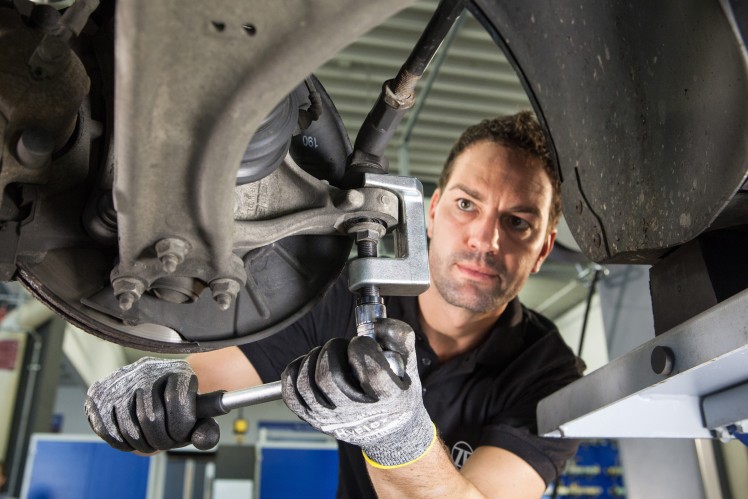
Expansion of the range of Lemförder Service Packs Cost-effective and efficient repair thanks to comprehensive assembly accessories ZF Aftermarket’s brand Lemförder offers garages with its Service Packs significantly less complicated steering and chassis repairs. The vehicle-specific mounting kits can be ordered in addition to the respective main component and then include all parts required for… Continue reading Press: Service Packs for fast and efficient chassis and steering repairs

Press: ZF acquires mobility provider 2getthere

“2getthere has more than three decades of experience in the market for autonomous passenger transport vehicles as well as unique engineering and software competences. This acquisition supports our strategy to become a leading autonomous transportation systems supplier in the booming new mobility market”, said Wolf-Henning Scheider, Chairman of the Board of Management at ZF Friedrichshafen… Continue reading Press: ZF acquires mobility provider 2getthere

Press: Successful E-Mobility from ZF: Speed on the Track, Range in Everyday Traffic

“We not only provide electric drives for cars, buses and commercial vehicles. Our specially developed technology also delivers in extreme motor racing where every watt-second from the battery, top efficiency and every hundredth of a second count,” says Jörg Grotendorst, Head of ZF’s E-Mobility Division. The latest example of the systems supplier’s vision in this… Continue reading Press: Successful E-Mobility from ZF: Speed on the Track, Range in Everyday Traffic

Uber buys Middle-East rival Careem

Uber has acquired Careem, the biggest ridehailing company in the Middle East. Uber acquired Careem for $3.1 billion and will make it a wholly-owned subsidiary of Uber, operating as an independent company under the Careem brand and still led by the Careem founders.  The transaction itself is expected to close in the first quarter of… Continue reading Uber buys Middle-East rival Careem

Uber Buys Middle East Rival Careem for $3.1B

The Careem brand and app will remain the same, and the Careem co-founders will stay on with the company. Photo via Uber. Uber announced Monday that it will spend $3.1 billion to buy Middle East ride-hailing group Careem, Reuters reports. The San Francisco-based ride-hailing firm will pay $1.4 billion cash and $1.7 billion in convertible… Continue reading Uber Buys Middle East Rival Careem for $3.1B

Cars in Europe could soon be fitted with technology to stop drivers speeding

Silas Stein | picture alliance | Getty Images
Illuminated panels indicate a speed limit of 120 kilometers per hour above the A3 motorway near Frankfurt Airport, Germany.

A range of mandatory safety features for new vehicles, including technology that could limit speed, are set to be introduced in the European Union (EU).

In an announcement Tuesday, the European Commission — the EU's executive arm — said that EU institutions had come to a provisional political agreement on the new measures. That agreement is now subject to formal approval from the European Parliament and Council, with the new technologies set to be introduced in 2022.

The proposed safety features include the introduction of intelligent speed-assistance technology, or ISA. According to the European Transport Safety Council (ETSC), ISA uses technology such as GPS, digital mapping and cameras to give vehicles location and speed limit information.
ISA systems can “limit engine power” to stop drivers from going above the speed limit. The ETSC says it recommends ISA technologies that can be temporarily overridden. This would mean that drivers could, in scenarios such as overtakes on lower-speed sections of road, override the system by putting their foot down on the accelerator.

The mandatory ISA system proposed by the Commission would not automatically slow a car down, but warn a driver that they were travelling above a road's speed limit.

Several major car manufacturers already offer various iterations of ISA systems in their vehicles.

Other proposed safety features include advanced emergency braking, cameras that assist with reversing, and lane-keeping assistance. Vehicles will also provide warnings if they detect a driver is drowsy or distracted and will use data recorders to document accidents.

“Every year, 25,000 people lose their lives on our roads,” EU Commissioner Elzbieta Bienkowska said in a statement.
“The vast majority of these accidents are caused by human error,” she added. “We can and must act to change this. With the new advanced safety features that will become mandatory, we can have the same kind of impact as when the safety belts were first introduced.”
A number of major car firms are looking to introduce increasingly sophisticated and connected safety features to their vehicles.
Just last week, Volvo Cars announced it would install in-car cameras and sensors to monitor drivers for signs of intoxication and distraction.

The firm said the technology would be used to monitor drivers and, when needed, enable the car “to intervene if a clearly intoxicated or distracted driver does not respond to warning signals and is risking an accident involving serious injury or death.”

Actions the car could take include limiting speed to slowing down and then parking the car in a safe place. Installation of the technology will start in the early 2020s.

At the beginning of March, the company announced it would introduce a 180 kilometers per hour (112 miles per hour) speed limit on all its cars from 2020.

Follow CNBC International on Twitter and Facebook.

Clarification: This story has been updated to reflect how the ISA system proposed by the European Commission would work.

Europe agrees raft of safety features to be baked into new vehicles

All new vehicles sold in the European Union must have a wide range of safety features baked in as standard in the coming years, after EU institutions reached provisional agreement on a safety regulation that’s aimed at protecting passengers, pedestrians and cyclists. Once formally adopted most of the new safety features will become mandatory from… Continue reading Europe agrees raft of safety features to be baked into new vehicles