Ford cuts shifts at factories in Kentucky and Michigan, but keeps jobs

Luke Sharrett | Bloomberg | Getty Images
An employee works on a Ford Expedition sports utility vehicle on the assembly line at the Ford Kentucky Truck Plant in Louisville, Kentucky.

Ford is cutting a shift at two of its plants, but the automaker is avoiding layoffs by moving workers to other facilities, the company said Wednesday.

The automaker is shifting about 500 workers from its Louisville Assembly plant to its Kentucky Truck Plant — both in Kentucky — to increase production of the Ford Expedition and Lincoln Navigator, which are both experiencing strong sales.

It will also move 500 jobs from its Flat Rock Assembly Plant to its Livonia Transmission plant, which makes transmissions for several vehicles, including its F-150 full-size pickup and the Ranger, a midsize pickup Ford is reintroducing after 8 years. Both plants are in Michigan.

Ford makes the Ford Escape and the Lincoln MKC, both compact crossover vehicles, at the Louisvile Assembly plant, and the Mustang sports car at Flat Rock.

Higher demand for pricey pickups and SUVs have helped automakers, particularly American ones, weather falling sales this year. Ford is especially strong in larger pickups and SUVs. Ford Expedition sales in October increased 36 percent from one year ago, while Lincoln Navigator rose more than 80 percent over the same month in 2017. At the same time, sales of the Escape fell 7 percent, the MKC 8.5 percent, and the Mustang 6 percent.

“Our collectively bargained contract provides for the placement of all members displaced by the shift reduction and, after working with Ford, we are confident that all impacted employees will have the opportunity to work at nearby facilities,” said United Auto Workers Union Vice President Rory Gamble.

General Motors came under fire this week after announcing it was winding down production at five plants in the U.S. and Canada and cutting 14,000 jobs. President Donald Trump was irate with GM, tweeting on Tuesday that he was “very disappointed” with the company and CEO Mary Barra for idling plants in Ohio, Michigan and Maryland.

“Nothing being closed in Mexico & China. The U.S. saved General Motors, and this is the THANKS we get,” Trump tweeted. He also threatened to cut all of the company's federal subsidies, following up on Wednesday with the announcement that the administration was studying all tariffs on cars imported to the U.S. because of the “G.M. event.”

WATCH: Ford is using bionic suits to help employees work safer

Ford is using bionic suits to help employees work safer
6:24 PM ET Fri, 20 April 2018 | 02:20

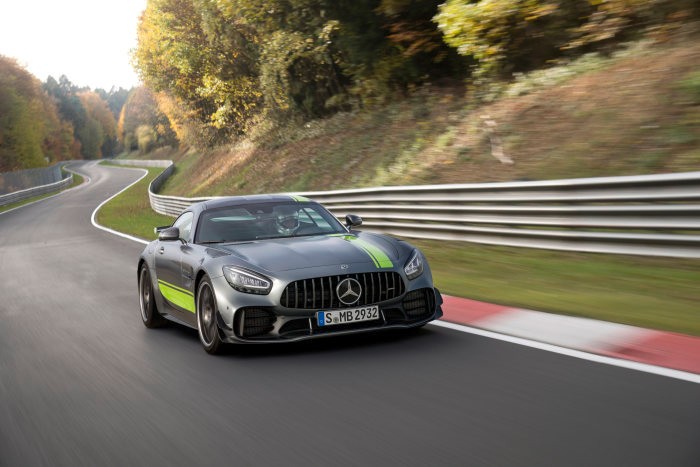
The new Mercedes-AMG GT and AMG GT R PRO: Further honed and even more agile

28.

November 2018

Affalterbach

combined fuel consumption 12.5-11.4 l/100 km, combined CO2 emissions 284-261 g/km*Affalterbach. At its début four years ago, the AMG GT (combined fuel consumption 12.5-11.4 l/100 km, combined CO2 emissions 284-261 g/km) confidently sought out competition on the world-wide sports car scene – and conquered a large part of the market. The top athlete from Affalterbach now comes to the starting line honed further, and with the new limited edition AMG GT R PRO. In addition to exterior updates, the two-door AMG GT Coupés and Roadsters will be fitted with the AMG DYNAMICS integrated driving dynamics control system for added agility, the new AMG Performance steering wheel, the centre console with innovative display buttons from the AMG GT 4-Door Coupé (combined fuel consumption: 11.3-9.4 l/100 km; combined CO2 emissions: 257-215 g/km) and a fully digital instrument display with exclusive AMG “Superport” display style on the instrument cluster. The AMG GT R PRO was modified in numerous details to deliver even more racetrack performance: The optimised specific power, the new suspension, the aerodynamic fine-tuning resulting in even more downforce overall, lightweight-design bucket seats and lightweight-design wheels contribute to the enhanced driving dynamics and faster lap times on the racetrack.
“The AMG GT embodies the core of our brand, “Driving Performance”, in a unique way. At its début four years ago, it not only turned the heads of customers and sports car enthusiasts, but also created new dimensions in the competitive environment. In order to continue this success story, we have now equipped it with numerous innovations from the AMG GT 4-Door Coupé and added a new limited-edition top-of-the-range model: No other production model of Mercedes-AMG presently is as close to motor racing as the new AMG GT R PRO. A lot of experience from our current GT3 and GT4 motorsport activities entered into its development.
The agile responses to all driver commands and the overall performance now deliver even more of that incomparable feeling that our racing drivers experience on the track”, says Tobias Moers, Chairman of the Management Board of Mercedes-AMG GmbH.
Fully digital instrument display as standard.
As in the AMG GT 4-Door Coupé, the new telematics architecture in the two-door AMG GT models makes the innovative, standard fully digital instrument display with 12.3-inch instrument cluster and a 10.25-inch multimedia display on the centre console possible. The instrument cluster offers an entirely new screen design with the three AMG-specific display styles “Classic”, “Sporty” or “ Supersport”. In the “Supersport” mode, there is also extensive additional information specific to AMG, such as a prompt borrowed from motorsport to shift up in manual transmission mode. The newly designed visualisations in the multimedia display enable further vehicle functions to be experienced even better, e.g. with an animated presentation of the driving assistance, vehicle and communication systems.
Via the left-hand touch control button on the steering wheel, preferred information can also be displayed on the left or right-hand side of the instrument panel – for example the classic speedometer and rev counter, navigation information or assistance systems through to detailed engine data. Sporty drivers especially can fade in a g-force display or the current output and torque values.
Innovative display buttons in the centre console
The eye-catching feature in the interior is the centre console with its stylised V8 design, not only putting the spotlight on the brand's performance claim but also perfectly fulfilling functional requirements. The 2-door AMG GT is now also getting the innovative, coloured display buttons. They integrate the display and steering of transmission logistics, chassis, ESP®, exhaust system, rear spoilers and start stop function. Using TFT technology the display buttons use intuitively comprehensible symbols to show the function and are easy to operate with just a small tap of the finger. The display buttons are supplemented by the two rocker switches for the drive programmes and volume control.
It’s all down to the grip: the new generation of AMG steering wheels
During model maintenance the 2-door AMG GT is getting the new AMG performance steering wheel which celebrated its début in the AMG GT 4-door coupé and is also available in the C 63. It is characterised by its sporty design, a flattened bottom section with a heavily contoured rim and intuitive operation. The steering wheel cover in black nappa leather is perforated at the sides to ensure optimum grip.
On the AMG GT S and AMG GT C the steering wheel comes as standard with a rim in black nappa leather/DINAMICA microfibre. In the AMG GT R the rim is completely covered with DINAMICA microfibre. The AMG steering wheel also comes in black nappa leather with trim in black piano gloss, as well as DINAMICA microfibre with elements in high-gloss carbon fibre. In any case the galvanised gearshift paddles on the steering wheel allow an even sportier driving style with manual gear shift.
The integrated Touch Control buttons can be used to control the functions of the digital dash and the multimedia display by means of horizontal and vertical swiping of the finger. The active distance assistant DISTRONIC and the TEMPOMAT cruise control can be adjusted on the control panels on the left. The control panels on the right are used to activate the voice control and telephone, to regulate the volume as well as other functions of the multimedia system.
All 2-door AMG GT models have the standard new AMG steering wheel buttons. These consist of a round controller with an integrated display beneath the right-hand steering-wheel spoke, plus two vertically positioned colour display buttons with switches beneath the left-hand steering-wheel spoke.
The AMG drive programmes can be triggered via the controller. The selected setting is shown on the colour LCD display directly integrated in the controller.
The two freely configurable display buttons and the additional switches on the left-hand side enable further AMG functions to be controlled directly on the steering wheel. This means that the driver can concentrate fully on dynamic driving without having to take their hands off the wheel. Each required function can be depicted on the display icon and its switch is tapped by the driver to set the respective function.
So the two individually preferred AMG functions can be defined exactly and the settings changed with just one tap of the finger.
Data logger for use on the race track: AMG TRACK PACE
The AMG TRACK PACE virtual race engineer, which records data when driving on closed-off race tracks, provides a significantly extended and even more precise scope of functions. AMG TRACK PACE is a standard part of the COMAND online infotainment system.
Once the function has been activated, while driving on a race track, more than 80 vehicle-specific sets of data (e.g. speed, acceleration) are recorded ten times per second. On top of this, lap and sector times are displayed, as well as the respective difference to a reference time. Because specific display elements are shown in green or red, the driver is able to see at a glance without reading numbers whether they are currently faster or slower than the best time.
After putting in some fast laps, the driver can use the data to analyse and, if necessary, improve their driving skills. In addition, acceleration and deceleration values (e.g. 0-100 km/h, ¼ mile, 100-0 km/h) can be measured and saved. Thanks to a newly developed algorithm which determines the vehicle position as precisely as possible, AMG TRACK PACE even detects when the circuit has been left or it has been shortened. This is done using GPS data as well as the sensors available in the vehicle (acceleration, gyroscope, steering angle, wheel speeds).
The data is displayed on the multimedia display and the digital dash. Well-known race tracks like, for example, the Nürburgring or Spa Francorchamps, are already stored. Furthermore, it is also possible to record your own circuits.
Exterior: AMG GT family connection further enhanced
The new light controls of the LED high performance headlights now show parallels to the AMG GT 4-door coupé and therefore further enhance the AMG GT family connection. A tri-functional, arched light guide takes on the functions of daytime running light, navigation light and turn signals.
The multi-chamber reflector system with three single reflectors each for dipped beam and main beam not only ensures optimal illumination of the roadway, but also gives the AMG GT a sporty, dynamic look which gains even more optical depth as the result of the black background. The light of the LED tail lights also appears even deeper set and sportier through the dark background.
From the back the new look of the rear apron is striking, its sporty black diffuser insert was redesigned for the AMG GT, AMG GT S and AMG GT C. At the same time the tail pipe cover was visually redesigned and matched to the shape of the AMG GT 4-door coupé. The AMG GT now has two round twin tail pipe covers, the AMG GT S and AMG GT C has trapeze shaped twin tail pipe covers. The rear design of the AMG GT R keeps its distinctive shape with the large, centrally positioned tail pipe cover with centre bar. It is flanked by two more black tail pipes on the left and right of the diffuser.
The AMG GT and AMG GT S are getting a new black grained sill cover on the bottom section. This makes for an additional dynamic optical look. Used in combination with the optional exterior package, additional decorative element attachments emphasise the features.
Also, if desired, the AMG GT and AMG GT S can come with a new light y-spoke alloy wheel in soft black with a finely polished surface. In addition, an option for the AMG GT, AMG GT S and AMG GT C is new 10-double-spoked forged wheels in titanium grey with finely polished surfaces or in soft black with finely polished rim flange.
A new option is the parking package with the PARKTRONIC park assistant, reverse and front camera, which increases everyday suitability when manoeuvring. And one more sign of a family connection is also the 2-door AMG GT, now available in brilliant blue magno, which will be introduced with the AMG GT 4-door coupé. Other extras are two-tone leather upholstery in exclusive nappa style in silver pearl/black.
Even more agile through AMG DYNAMICS
As a new feature in the AMG DYNAMIC SELECT “Slippery”, “Comfort”, “Sport”, “Sport Plus”, “RACE” and “Individual” drive programmes, the 2-door AMG GT now also comes with AMG DYNAMICS. This integrated driving dynamics regulation expands the functions of ESP® (electronic stability programme) to exact dosing of power distribution at the rear axis and the characteristics of steering.
In this way the AMG GT becomes even more agile at its highest stability. In the first place AMG DYNAMICS optimises the transverse dynamics by a higher lateral acceleration, better traction and load change reactions.
Particularly remarkable: AMG DYNAMICS calculates how the vehicle will react. To do this, the system uses the available sensors that detect the speed, the steering angle or the yaw rate, for instance. Based on the pilot-control principle it is possible to anticipate the vehicle behaviour on the basis of the driver's actions and the data from the sensors. The control system reacts in this way even before the driver – and with no noticeable or intervention of the system. The driver gets a very authentic driving feel with high cornering dynamics and optimum traction as well as high stability and predictable handling. Even experienced drivers receive optimum assistance without feeling patronised by the system.
The different AMG DYNAMICS modes are named “Basic”, “Advanced”, “Pro” and “Master”. The drive program selection indicated on the multimedia display now shows the new AMG DYNAMICS symbol with the relevant additional term instead of the previous ESP® symbol.
“Basic” is assigned to the “Slippery” and “Comfort” drive programs. Here the AMG GT demonstrates exceptionally stable handling characteristics with high yaw damping. “Advanced” is activated in the “Sport” programme. The AMG GT is then neutrally balanced. The lower yaw damping, lower steering angle requirement and enhanced agility support dynamic manoeuvres such as driving on winding country roads. “Pro” (abbreviation for “professional”) is part of the “Sport+” programme. In “Pro” the driver receives even more assistance for dynamic driving manoeuvres while agility and precision are further enhanced when taking corners. “Master” (only available for GT C, GT S and GT R) is connected to the RACE drive programme. “Master” mode is aimed at drivers who want to experience dynamism and the driving enjoyment on closed-off circuits. “Master” offers an extremely neutral vehicle balance, low steer angle requirement and more agile steering. In this way, “Master” ensures maximum agility and fully exploits the dynamic potential. Closer to motor racing than ever before: the new AMG GT R PRO
The new limited-edition top-of-the-range model AMG GT R PRO is characterised by yet further improved driving dynamics, in particular on the racetrack. The experience from the AMG GT3 and AMG GT4 racing cars entered into the development. The measures from motorsport can be clustered in four areas: suspension, lightweight construction, aerodynamics and looks.
Suspension: the optimal set-up
The new AMG coil-over suspension offers even more choices for tailoring the set-up to the particular circuit. As in professional motorsport, the driver is not only able to set the spring preload length mechanically, but can now also adjust the compression and rebound of the dampers. This is done quickly and precisely without tools via a click system with an integral adjustment dial on the damper. The compression rate is adjusted separately for high-speed and low-speed movements. This means that the settings can be dialled-in for slow and fast compression movements as is common practice in motorsport. This allows influencing the body dive and roll as the well as the traction of the AMG GT R PRO even more selectively.
The front axle is fitted with an adjustable torsion bar made of lightweight carbon fibre. Its counterpart at the rear is made of steel, is likewise adjustable and also saves weight due to its hollow tube design.
The AMG GT R is already fitted with Uniball spherical bearings at the lower wishbones of the rear axle. The AMG GT R PRO now gets these bearings also for the upper wishbones. They are significantly more wear-resistant than conventional wishbone bearings and due to their design have no play, which means toe-in and camber do not change even under high loads. As a result, the AMG GT R PRO can be driven with even more precision.
The carbon-fibre shear panel in the underbody of the rear end also contributes to the high handling precision. This lightweight and rigid element stiffens the rear-end structure and as a result adds even more stability to the body shell.
The electronically controlled dynamic engine and transmission mounts were also retuned to further increase the agility and deliver high-precision response and clear feedback.
The standard delivery scope of the AMG GT R PRO also includes the Track Package (not for USA, Canada and China). It comprises a roll-over protection system, enclosed 4-point safety harnesses for driver and front passenger, and a 2-kg fire extinguisher (both scopes exclusively for use on the racetrack). The bolted steel roll cage of the roll-over protection system consists of a main roll bar, a brace for mounting the harnesses, two rear braces as well as a diagonal X-brace in the rear end. The system further increases the already excellent vehicle rigidity and thus also has a positive influence on the vehicle's driving dynamics. In the USA, Canada and China, the AMG GT R PRO is fitted with matte carbon-fibre trim elements and the boot brace in place of the Track Package.
Lightweight construction: carbon-fibre components and new forged wheels
In addition to a host of carbon-fibre components, weight is saved by the standard-fit ceramic high-performance compound braking system exclusively with black painted brake callipers as well as by the AMG bucket seats made of clear-coated carbon fibre (not for USA, Canada and China). In the USA, Canada and China, the AMG GT R PRO is equipped with AMG Performance seats as standard. The lightweight AMG Performance 5-double-spoke forged wheels are exclusively painted titanium grey and feature a rim flange with high-sheen finish.
Aerodynamics: redesigned front apron with additional flics
The aerodynamic fine-tuning increases the overall performance of the AMG GT R PRO as well. The redesigned front apron was fitted with two flics at the sides made of clear-coated carbon fibre. The lower flics transition virtually seamlessly into the front splitter, which was extended further forward and is held by small metal braces – they stabilise the front splitter at higher speeds. In addition, they are another visual homage to the role models from motorsport.
The louvres (air slots) in the front wings effectively vent the wheel arches and consequently contribute to reducing front-axle lift. At the rear, a clear-coated carbon-fibre aero element at the wheel arch on either side rises up vertically almost to the level of the tail lamps. The interplay of all these measures significantly reduces front-axle lift without negatively impacting the aerodynamic conditions at the rear axle.
The active aerodynamics profile in the underbody, the AIRPANEL active air regulation system in the front apron and the large aerofoil on the hatch, all known from the AMG GT R, are part of the standard specification. In addition, the rear aerofoil is fitted with a spoiler lip (gurney), which increases downforce at the rear axle, and now sits on milled aluminium brackets that underscore the proximity to motor racing.
Motor racing looks: Carbon Package, new carbon-fibre roof, car wrap
The AMG GT R PRO does not only drive like a racing car, it also looks the part. The standard-fit Carbon Package I with front splitter, fins in the wings, trim strips in the side sills and a diffuser with high-quality clear-coated carbon-fibre finish emphasise the proximity to motorsport, as does the redesigned carbon-fibre roof with lowered centre.
The special status is also underscored by the car wrap with racing stripes running over the bonnet, roof and hatch as well as along the sides of the vehicle. This car wrap is light green exclusively in combination with the selenite grey paint finish. For all other colour variants, the stripes come in dark-grey matt. Optionally, the car wrap can also be omitted completely.
Even before the world premiere, the new AMG GT R PRO has impressively demonstrated its performance potential on the racetrack: In early November, AMG brand ambassador and AMG GT3 racing driver Maro Engel completed a circuit of the Nürburgring North Loop in exactly 7.04.632 minutes driving a still disguised AMG GT R PRO. This considerably bettered the previous time for the AMG GT R – and at an autumnal ambient temperature of 12 degrees, it demonstrated the great potential of the current AMG flagship model.
The lap was measured precisely by the independent experts of “wige SOLUTIONS”. An independent notary confirmed the lap time, and that the vehicle's condition was in accordance with regulations.
The Nürburgring ride can be seen on a video here: https://youtu.be/1LlXeAR3ntw

Technical data at a glance
Mercedes-AMG GT (figures for Roadster in brackets)
Mercedes-AMG GT S (figures for Roadster in brackets)
Mercedes-AMG GT C (values for Roadster in parentheses)
Mercedes-AMG GT R Mer..

The Workhorse Electric Vehicles Are Revolutionizing An Industry

Although consumers are only recently embracing electric vehicles, Workhorse has been perfecting this technology for over a decade. Workhorse started out converting gasoline-powered vehicles into electric cars. Soon they applied this technology to the commercial sector and discovered an opportunity to transform an industry. I recently had an opportunity to Jeff Bennett, Aerospace Project Manager… Continue reading The Workhorse Electric Vehicles Are Revolutionizing An Industry

Ford to shuffle hourly workers to meet SUV demand

Ford to shuffle hourly workers to meet SUV demandEven as General Motors Co. is planning to idle four U.S. plants affecting 3,300 hourly jobs, rival Ford Motor Co. is moving to trim car production without idling a plant.
The automaker plans to move 500 hourly employees from its Flat Rock Assembly Plant where it builds cars to its Livonia plant to build transmissions for in-demand trucks and SUVs. Ford said Wednesday its Flat Rock plant, where it builds the Ford Mustang and Lincoln Continental sedan, will go down to a one-shift schedule in the spring. That will displace 650 full-time hourly employees.
Five hundred of those people will be moved to Ford's Livonia Transmission. The remaining 150 will be offered jobs at other Ford plants, spokeswoman Kelli Felker said Wednesday. The automaker also will shift 500 people to its Kentucky Truck Plant to build full-size SUVs and trucks.
“We have been informed by Ford that due to sales, there will be scheduled work reductions at the Flat Rock, MI and Louisville, KY plants,” UAW Vice President Rory Gamble, head of the union's Ford department, said in a statement. “Our collectively bargained contract provides for the placement of all members displaced by the shift reduction and, after working with Ford, we are confident that all impacted employees will have the opportunity to work at nearby facilities. The UAW will be working with our members to ensure they have continuous work and help minimize, as much as possible, any hardship on members and their families.”
The news comes two days after crosstown-rival GM announced its on-going restructuring would idle three plants that make sedans, a transmission plant in Warren and one of two assembly plants in Oshawa, Ont. The Detroit automaker also plans to eliminate 8,000 salaried workers to reduce costs.
Ford is deep in a restructuring expected to cost the automaker $11 billion, including cuts to the global salaried workforce. According to an internal memo from UAW Local 3000 Chairman Larry Stewart, the UAW expects about 50 positions to open up at Ford's Dearborn Truck Plant, where the automaker builds the F-150.
“Basically everybody who has a job will keep a job,” Felker said.
Congresswoman Debbie Dingell, D-Michigan, in a statement said she was “deeply disturbed” that Ford is eliminating a shift in Flat Rock, but praised the automaker's move to retain jobs.
“Ford’s announcement today continues to be a warning about the strength of the auto industry in this country,” said Dingell. “We all must pay attention to what this means for workers, the industry, and the whole economy.”
The Livonia plant currently builds transmissions for Ford F-150s, Rangers, Navigators and other trucks and SUVs. The automaker is also shifting 500 jobs to its Kentucky Truck Plant from Louisville Assembly Plant in effort to increase Expedition and Lincoln Navigator production by 20 percent.
The Louisville plant, which builds Escape and the Lincoln MKC, will move to a two-shift schedule in the spring.
ithibodeau@detroitnews.com
Twitter: @Ian_Thibodeau
Read or Share this story: https://www.detroitnews.com/story/business/autos/ford/2018/11/28/ford-shuffle-hourly-workers-meet-suv-demand/2138319002/

ChargePoint Secures $240 Million In Series H Funding

ChargePoint raised $240 million to keep growing. ChargePoint announced another successful round of funding. The latest Series H enabled it to raise $240 million, which is the largest round so far. Since inception, ChargePoint has raised more than $500 million. ChargePoint was able to attract investors from various businesses as electric mobility expands quicker than ever.… Continue reading ChargePoint Secures $240 Million In Series H Funding

Why we invested in WeTrip – the adventure travel platform

We recently announced our investment in WeTrip (here), building on our previous investments in the adventure travel space. Sam Clifton, Associate at InMotion Ventures, explores why we invested in WeTrip. The anguish was fresh in my memory. Plans for a holiday with a group of friends had just fallen through, on account of too many… Continue reading Why we invested in WeTrip – the adventure travel platform

Ford reshuffles U.S. plants to beef up SUV, truck production

DETROIT, Nov 28 (Reuters) – Ford Motor Co said on Wednesday it will reshuffle workers at several of its plants to meet rising demand for pickup trucks and large SUVs, a process that will require finding new positions for 150 workers displaced by the changes but not result in job cuts. The changes also will… Continue reading Ford reshuffles U.S. plants to beef up SUV, truck production

Byton reveals self-driving living-room on wheels, the K-Byte, in LA

Byton K-Byte concept
Byton aims to reinvent the car by turning it into the next generation iPhone. Other automakers have talked about turning their center screen displays into iPhone-like interfaces, but not the whole car.

That seems to be the goal of Byton, which says it is creating the “next generation smart device,” “spaceship Byton,” “your self-cruising living space.”

In a two-hour press conference streamed from Shanghai in English and Chinese to coincide with its press-conference slot at the LA Auto Show, the startup electric-carmaker laid out plans to bring its first SUV to market late next year, and showed a concept version of its next model, the K-Byte luxury sedan.

READ THIS: Byton begins road testing its electric car in China

Both cars are fully electric, based on the same “skateboard” chassis, with batteries under the floor.

Byton was scant with actual specs, but said the base version of the M-Byte SUV will have about 280 miles of range, while a more expensive trim level with a bigger battery will get about 325 miles. Batteries will be supplied by Chinese manufacturer CATL.

The K-Byte will be a full-size sedan, 195 inches long, on a 118-inch wheelbase (about 2 inches longer than the SUV), making it about the size of a Toyota Avalon. It has small flying buttresses covering the rear window pillars, which Byton says improve aerodynamics to stretch the car's range.

Byton K-Byte concept

Byton executives made a bigger deal about the cars’ 49-inch “coast-to-coast,” “shared-experience display,” which it displayed in the M-Byte, and which we had a chance to sample at the Consumer Electronics Show in Las Vegas last January. The single, curved screen stretches the width of what would normally be the dashboard. If the car is to be the next-generation iPhone, this screen is the heart of the car.

The interface isn’t that different from the one we sampled, with three sections to the screen, one on the left for driving displays, a center section for navigation and audio, and an entertainment screen for the passenger on the right.

It will offer augmented reality for the driver, virtual reality, a simulator, and video conferencing. Reading and sending emails should be comparatively simple. A wide-angle, digital rear-view camera screen appears at the bottom left behind the steering wheel.

Byton K-Byte concept

Byton says the screen will comply with all international automotive standards, which means that while driving, the screen either can’t display video or the driver can’t see the section of it that does. The company also says it will be silicon-coated for crash safety.

The screen can be reconfigured, with the navigation system, for example, taking up the right two-thirds of the display, complete with, Byton says, “all” points of interest, which will be integrated with navigation and search, much like Google Maps—only larger.

Driving controls are on a separate tablet in the center of the steering wheel, which gets covered by the airbag in an accident to protect the driver. Byton says there are no other controls.

CHECK OUT: Chinese electric-car startup Byton reveals its second concept: a Level 4 self-driving sedan

The idea, however, is for drivers not to have to use the system to drive. Byton says the M-byte will come with full Level 4 self-driving capability starting in 2020, which will allow the car to drive itself on limited access highways.

Byton K-Byte concept

The K-byte uses a set of lidar sensors integrated on the front and rear of the panoramic glass roof, and retractable lidar sensors that the company calls LiGuards on the front fenders. They deploy when the self-driving system is activated.

Both the self-driving system and the “shared-experience display” can be controlled using gesture commands or voice commands provided by Byton partner Baidu.

Byton K-Byte concept

The company says it has finished its global factory in Nanjing, China, and has produced the first handful of its planned 100 M-Byte prototypes.

Byton says this “self-cruising living space,” will be the new standard of automotive luxury when the M-Byte goes on sale next year. The question we can’t help but ask is, how will this new iPhone on wheels drive?

GM May Finally Be Serious About Electric Vehicles

Electric Cars
Electric Car Benefits
Electric Car Sales
Solar Energy Rocks
RSS
Advertise
Privacy Policy

Cars

Published on November 27th, 2018 |

by Frugal Moogal

GM May Finally Be Serious About Electric Vehicles

Twitter
Google+
LinkedIn
Pinterest
Facebook

November 27th, 2018 by Frugal Moogal

When I saw the news yesterday that GM is closing five plants and laying off nearly 15,000 employees, I was surprised. Not because it was happening, but because this could be an extremely forward looking move by the company.

Before I go on, I feel it’s important to present this article from a business perspective. In other words, what does this mean for GM as a company. The personal story of the people who are losing their jobs aren’t really a consideration in that case, even though obviously they should be.

Having said that, GM like all companies, is in a fight to stay ahead in its industry. Companies don’t make decisions to lay off those people without thinking them through. Even beyond any potential feelings of empathy for the workers, layoffs usually spur poor publicity, and in the case of GM will also create a battle with the auto workers union, neither of which is something the company wants. Yet, the decision to cut positions ultimately is connected to a business strategy that management feels makes the most sense at that given point in time. Sometimes it works, and sometimes it doesn’t.

It still negatively impacts those who lost their jobs. But that isn’t the focus of the rest of this article.

With all of that having been said, let’s dig in here for the reasons that GM may have made this move and why now was the right time.

GM Sales: Dropping?
The majority of the articles written about GM’s announcement talk about how GM sales have been dropping, and that’s the reason for the closures. And it’s true, sales dropped 11.1% in Q3 2018 compared to Q3 2017.

But there are a few problems with that. The first is that Q3 2017 was affected by higher than normal sales due to the effects of Hurricane Harvey.

Additionally, the results that GM posted for Q3 2018 were … well, I’m just going to let this article from Automotive News describe it:

“Stronger-than-expected results in China and North America propelled General Motors to a 25 percent increase in pretax profit in the third quarter and net income of $2.5 billion.”

So, sales dropped, but those drops were expected due to unique circumstances, were less of a drop than was anticipated, and GM still managed to improve its profitability. That’s not exactly the sort of results that cause businesses to lay off thousands and discontinue large segments of their market.

It does, however, work as a good scapegoat to changing your business strategy to try to meet a new market.

The SUV is King?
The media seems to have adopted recently that SUVs and crossovers are all that anyone wants now, and I hate it. I could have devoted an entire article to just this, but there are again factors at work here that I feel are driving the shift, so I’m going to try to encapsulate them here.

First, automobiles are lasting longer than ever before. When gas prices rose significantly, the majority of automobiles that were sold were smaller vehicles, many of which are still on the road today and nearly as good as the newer models. As a simple, single data point, the car that I traded in for my Model 3 was a 2008 Nissan Sentra. The 2015 Nissan Sentra looks physically the exact same as my car did.

Right along with this, a dealership makes the majority of its money on used car sales and service, incentivizing dealerships to sell consumers on these cheaper, new-looking sedans instead of directing them into the most recent 100% new model.

On the flip side, if you want a crossover or SUV, there are far fewer old, used options. Remember that when gas prices rose quickly about 10 years ago, people were dumping their SUVs because they could no longer afford to fuel them. Sedans made up the majority of new sales, and the used market had a glut of SUVs that dealers couldn’t give away.

Those used SUVs have aged out of the market — how often do you see Hummers driving around now, for instance — meaning if a driver wants to move into that vehicle segment, chances are she or he is going to be opting for a new vehicle or paying a lot for a used one.

At the same time, 2010 fuel standards are based on the vehicle’s footprint, or size. Thus, a larger vehicle needs to achieve less stringent fuel efficiency than a small vehicle. This example from Wikipedia’s article on Corporate Average Fuel Economy (CAFE) explains it perfectly:

“For example, the fuel economy target for the 2012 Honda Fit with a footprint of 40 sq ft (3.7 m2) is 36 miles per US gallon (6.5 l/100 km), equivalent to a published fuel economy of 27 miles per US gallon (8.7 l/100 km), and a Ford F-150 with its footprint of 65–75 sq ft (6.0–7.0 m2) has a fuel economy target of 22 miles per US gallon (11 l/100 km), i.e., 17 miles per US gallon (14 l/100 km) published.”

This gives automakers a few incentives to sell larger vehicles — not just can they charge more for them, but the technology to get them to be CAFE compliant is cheaper.

These two factors I think often go overlooked in the SUV “boom,” and it may be less of a boom than a temporary realignment. The narrative of an SUV surge and changing car buyers tastes is a good excuse by car companies, however, to hold off costly development into new cars.

Electric Vehicles Are A Material Risk to Legacy Automakers
This can’t be understated, yet it seems that the majority of investors haven’t grasped this. Electric vehicles are a material risk to legacy automakers.

The gasoline car market is extremely well developed and competitive. Margins are difficult to come by. GM achieved a $2.5 billion profit based on a margin of about 10% on its vehicles. While $2.5 billion seems like a huge number, GM pays shareholders a significant dividend, hovering near 25% of its expected profits in a year. (Ford’s is around 45%!)

Here’s a weird yet true fact — GM “burned” more cash in Q1 2018 than Tesla did. GM reported an adjusted automotive free cash flow of negative $3.464 billion. Tesla, which pundits were lined up to declare as a cash burning machine after Q1 2018, reported free cash flow of negative $785 million.

I’m highlighting this for a reason. Legacy automakers are having a difficult time creating a compelling electric vehicle that they make money on, and they have to spend significantly more money than Tesla does just to retain their position in the gas car business, a business which is expected to decline as electric vehicle sales increase.

Instead, GM (and every legacy automaker) has been forced into a difficult corner. Developing proper EV tech is not as easy as dropping a battery and electric motor into a car and calling it a day, as Tesla has clearly shown us. In 2010, it was estimated that bringing a new car model to market costs an automaker around $1 billion to $6 billion. I can only assume a whole new architecture would be even more.

Invest too much too soon, accidentally kill your gas car business, and you’ll burn so much money that the company will go bankrupt within a year or two.

Invest too little, and if the market shifts to electric cars that you haven’t yet developed, your margins crash and you burn all your money trying to quickly catch up and create a compelling, high-volume EV.

Is the Model 3 to Blame?
This may sound crazy on the surface, but I don’t think we would have been here without the Model 3 doing what it has done. To keep their smaller cars CAFE compliant, GM has to spend more money to develop better technology, which leads to smaller margins on those cars. A smaller margin on these vehicles means even a minor drop in sales could lead to significant losses.

What could have led to a drop in smaller sedan demand? According to AAA earlier this year, one in five drivers wants an electric car as their next vehicle.

I don’t think it’s a coincidence that both Ford and GM have discontinued huge segments of their sedans in the past seven months. Both companies see mounting development costs for a product that could be rapidly replaced. Ford seems to have no real plan, but GM seems to be trying to meet the challenge head on.

And, it’s going to get worse for legacy automakers soon. By 2020, Tesla will have the $35,000 Model 3 and could be spooling up production for the Model Y and truck. If a large number of buyers hear about these new electric models and decide to hold off purchasing a new gas car to see what is brought to market, that drop alone could be enough to put a legacy automaker that hasn’t created compelling electric options of their own into a tailspin.

Back to Yesterday’s News
This is what makes yesterday’s news so interesting. Most reporters stated that GM is responding to falling sales by focusing on its larger and more popular models.

Looking at the numbers, that isn’t what seemed to happen. GM is discontinuing the Chevy Cruze (31,971 Q3 sales), Impala (16,290), and Volt (5,429), the Buick LaCrosse (2,290), and the Cadillac XTS (4,101) and CT6 (2,281). Of these, both the Volt and XTS actually had increasing sales in Q3.

The Cruze, even with a 27% decrease in sales, was still Chevy’s fifth best selling model, and it accounted for over 6% of all Chevys sold.

We could contribute the decrease in Cruze sales to a lot of things, but if an automaker were to believe that the decrease in sales came partially from buyers holding off until they found a compelling electric car, this might be the time to ditch those models before they bleed too much money. This might be the time to quickly rush the new electric vehicles to market. When automakers suddenly find a luxury-priced sedan is all of a sudden competing on the best selling car list, it may be a wake-up call of sorts.

There isn’t a compelling, reasonably affordable SUV or truck option. Yet. But with the Tesla M..